
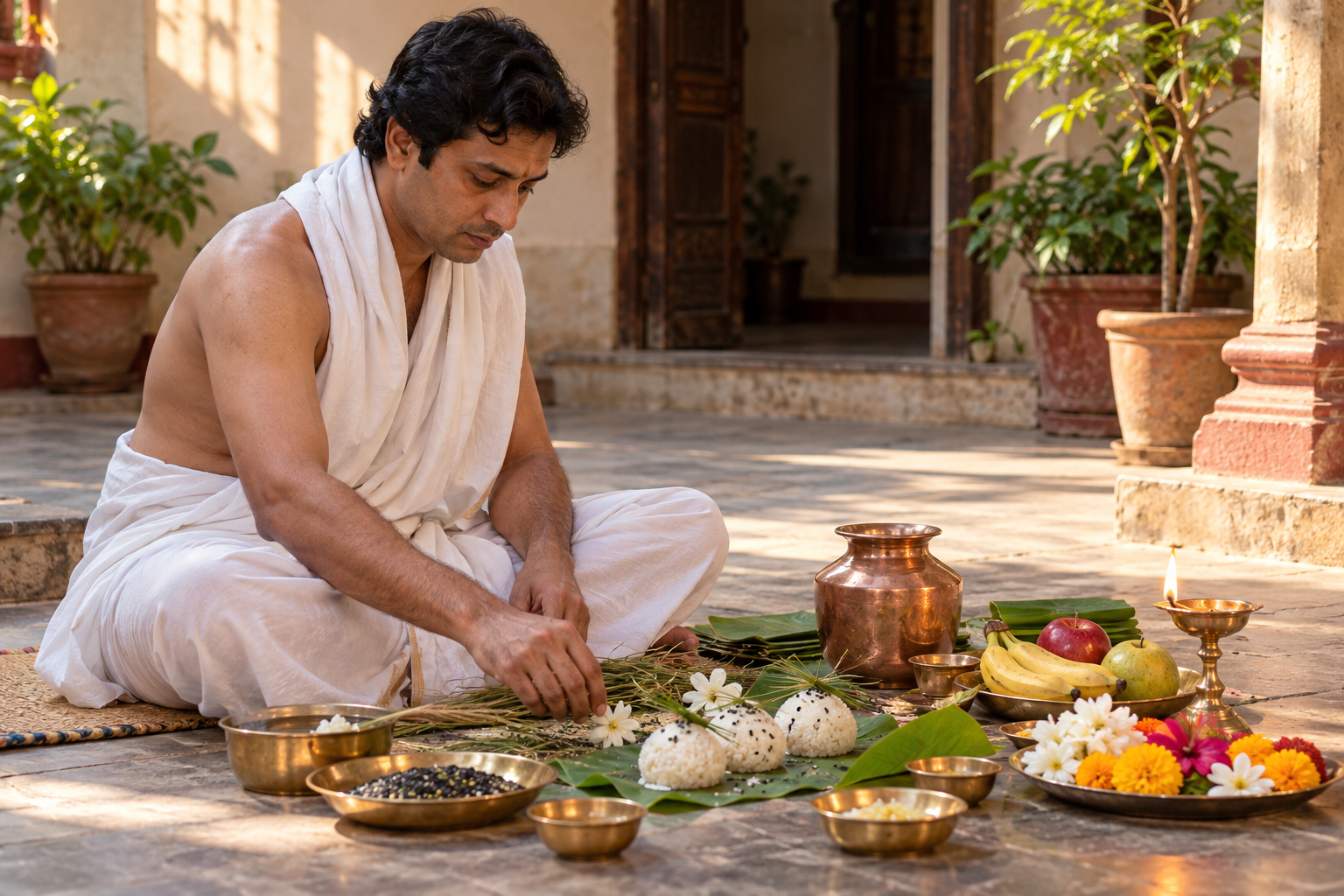
You may know that your family observes Shraddha yet still be unsure how to continue it. Perhaps the elder who remembered every detail is no longer available, relatives give conflicting instructions, or you now live far from the priest and place associated with your family tradition.
Your immediate task is to separate the enduring duty from the details that vary. Preserve the intention of grateful remembrance, then verify the date, ritual form, officiant, participants, and materials before you attempt the observance.
What Parvana Shraddha asks you to preserve
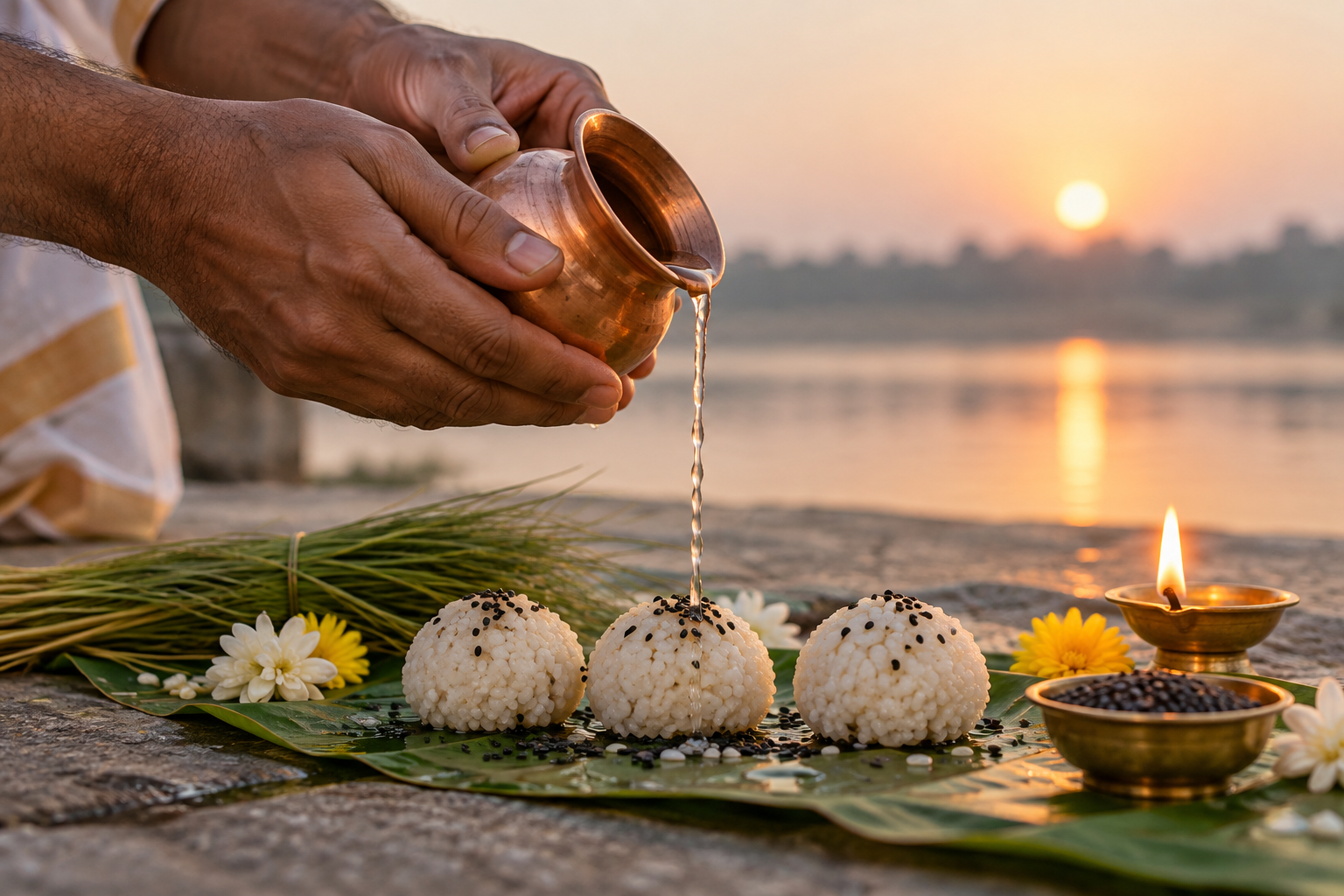
Parvana Shraddha is an annual rite through which departed ancestors are remembered and honoured. It rests on a recognisably Dharmic understanding of human life: you do not stand alone, but belong to a continuity that reaches back through your forebears and forward through those who come after you. Remembering the departed is therefore treated as a sacred responsibility within that chain, not merely as a private response to grief.
This changes the way you should approach the rite. Its centre is neither display nor expense. It is shraddha: sincere, attentive remembrance expressed through the form your tradition has received. A modest observance conducted with care is more faithful to that purpose than an elaborate event assembled from incompatible instructions.
The word annual also needs care. It does not mean that every Hindu household follows one universal script. The applicable date, the person undertaking the principal ritual role, the sequence of offerings, the mantras, the food disciplines, and the involvement of a priest may differ by region, sampradaya, family custom, and circumstance. Treat those differences as reasons to verify your practice, not as evidence that the rite has no coherent meaning.
If the death was recent, do not automatically assume that an annual Parvana observance is the next rite to perform. Rites connected with the period immediately after death and later annual observances are not interchangeable. Tell a qualified purohita when the death occurred and which rites have already been completed before fixing the procedure.
Recover your family practice before following a generic checklist
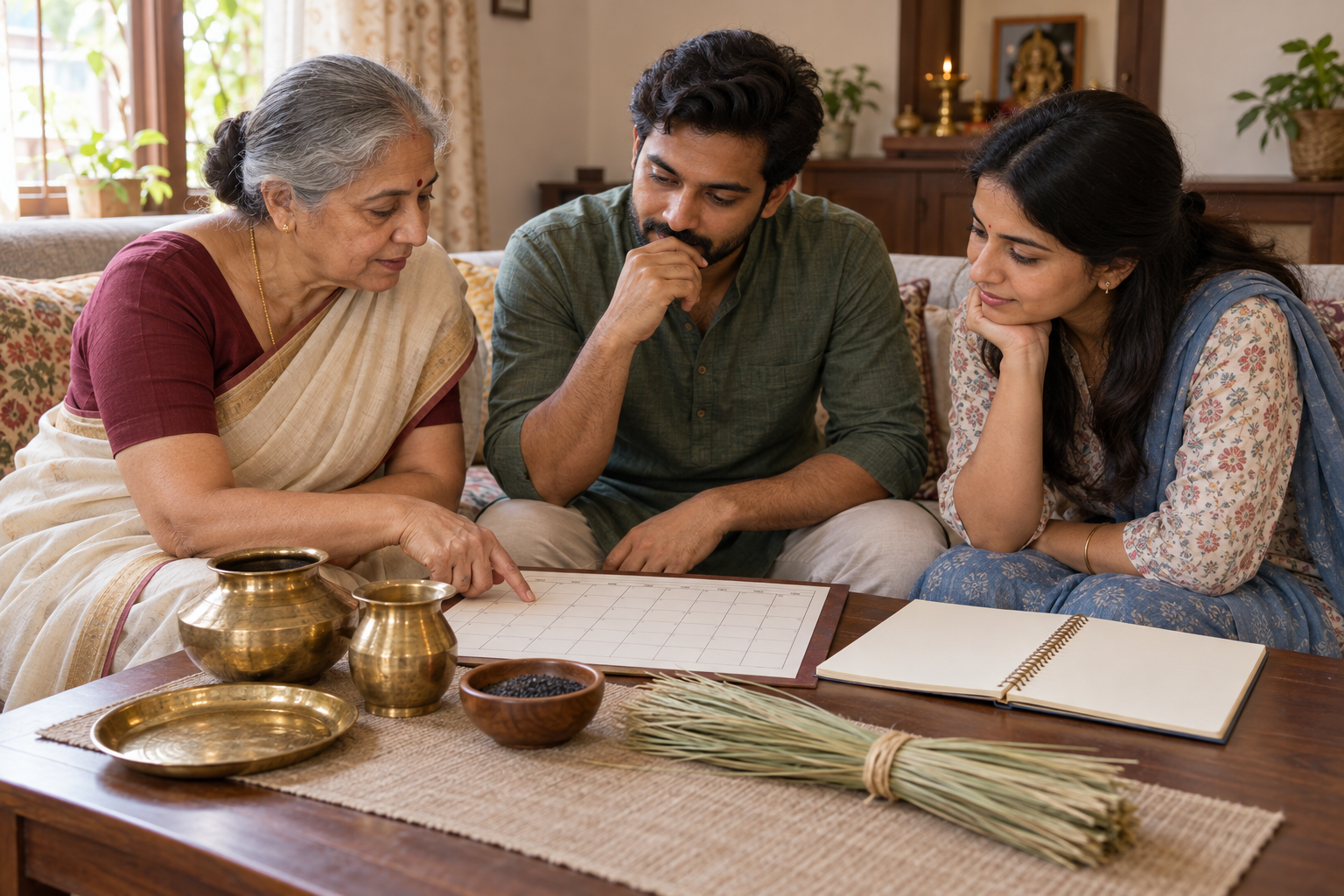
The most useful preparation begins with people, not purchases. Before collecting ritual materials, find out what your own family actually observes. A generic online procedure may belong to another region or ritual tradition, even when it uses the same name.
Start by making a small family record. Write down what you know, and mark uncertainty honestly rather than filling gaps with guesses:
- The full names of the ancestors being remembered and their relationships to the family.
- The family’s place of origin, sampradaya, and customary language of worship, if known.
- The traditional date or tithi on which the observance was previously performed.
- The family gotra and any other lineage details used in the sankalpa, but only when they are reliably known.
- The name of the priest, temple, matha, or knowledgeable relative who assisted in earlier years.
- Any remembered practices concerning offerings, food, invited participants, or the ritual role of family members.
Ask the oldest knowledgeable relatives separately before trying to reconcile their memories. One person may remember the calendar date, another the name of the purohita, and another the cooking restrictions. Record the overlapping details first. Where memories conflict, take the disagreement to a qualified practitioner from the same tradition rather than deciding by majority vote.
When you contact a purohita, avoid the broad question, “What do we need for Shraddha?” Give the context and ask for decisions you can act on:
- Which observance applies in our present circumstances?
- How should the date and time be determined for our location?
- Who should undertake the principal ritual role under our family custom?
- Which ancestors and lineage details belong in the sankalpa?
- Which parts require priestly guidance, and which may the family perform?
- What exact materials and food preparations are required?
- What purity, fasting, cooking, serving, and disposal rules should participants follow?
- If we cannot reproduce the customary setting, what simplified form is legitimate within this tradition?
Request the final instructions in writing. Ask for unfamiliar names and sankalpa details in a script or transliteration that the person reciting them can read. This prevents last-minute substitutions and makes the record useful to the next generation.
Prepare the rite as a sequence, not as an event
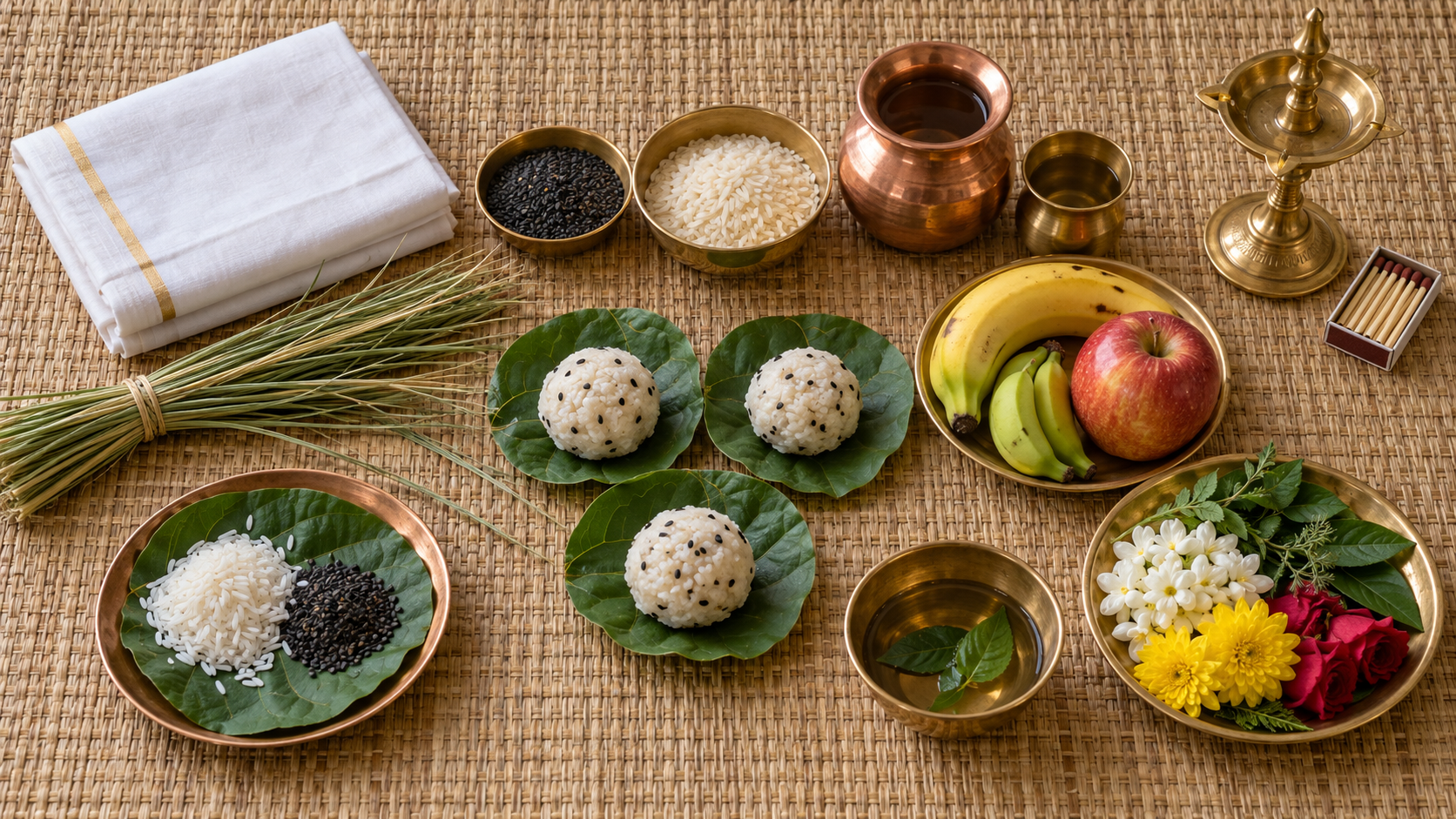
Most avoidable problems occur before the observance begins: the date was assumed, names were incomplete, ingredients were purchased from a mismatched list, or nobody knew who was responsible for each task. Use a sequence that resolves those uncertainties in order.
- Confirm that Parvana Shraddha is the applicable rite and establish its date and time according to the family calendar and location. Many Hindu observances follow a tithi rather than the same Gregorian date every year, so do not copy last year’s civil date without checking.
- Confirm the officiant, the principal participant, and everyone who needs to be present. Ask explicitly rather than relying on assumptions about age, gender, or seniority, because customary rules differ.
- Obtain one complete materials list from the person guiding the rite. Do not combine several online lists unless that person approves the changes.
- Confirm the cooking and serving requirements before planning the meal. Keep ritual food separate from ordinary entertaining, and make sure anyone helping in the kitchen understands the applicable rules.
- Prepare the names, relationships, and lineage information in a legible order. Read them aloud beforehand so that missing or uncertain details can be resolved while there is still time.
- Set aside a clean, quiet place and arrange the objects in the order requested by the officiant. Decide in advance how prescribed remnants and materials will be handled after the rite.
- Give practical jobs to named people: receiving the priest, managing water and materials, assisting with food, and keeping interruptions away from the ritual space.
On the day, protect the observance from turning into a social production. Silence phones, postpone unrelated conversations, and let one person coordinate practical needs so the principal participant can remain attentive. Photography should never interrupt the rite; if the family wishes to record anything, obtain the officiant’s agreement beforehand.
If a mantra, name, or action is missed, ask for correction calmly. Accuracy deserves care, but anxious improvisation usually creates a second problem. Follow the officiant’s remedy and continue.
Children and younger relatives need a short explanation before the ritual starts. Tell them whose names will be remembered, how those people belong to the family, and why the family has gathered. A rite cannot carry memory forward if the next generation sees only unexplained restrictions and unfamiliar words.
When distance or circumstance prevents the customary form
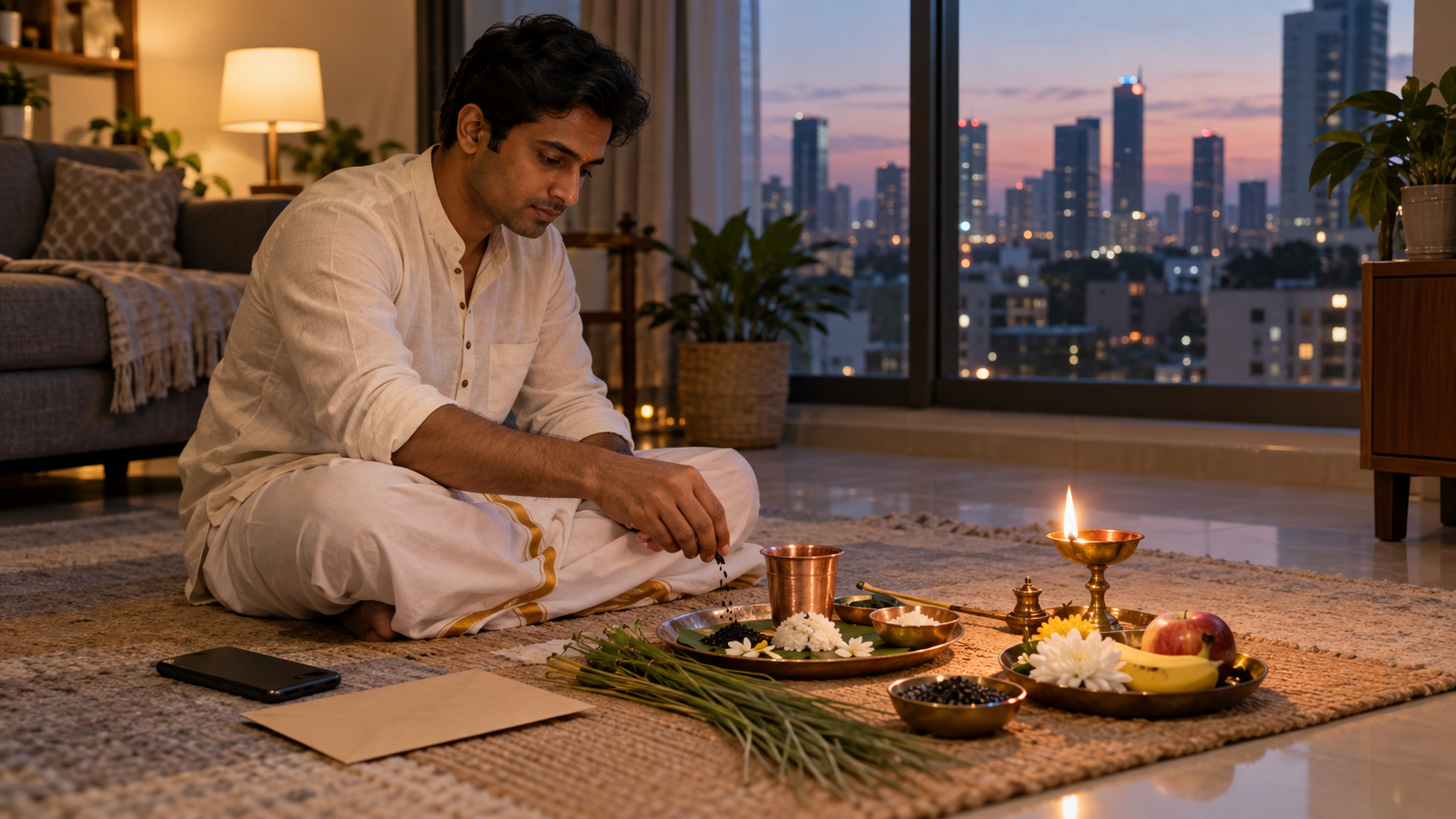
Living abroad, travelling, lacking a local purohita, or facing a family emergency may make the customary arrangement impossible. Do not solve that problem by treating the first video or checklist you find as a universal substitute. A shortened observance can still have integrity, but its scope should be clear.
Contact a temple or practitioner connected to your sampradaya and explain exactly what is unavailable. Ask whether the temple can perform the rite with your sankalpa details, guide you remotely, recommend someone nearer to you, or prescribe a permitted home observance. The appropriate option depends on the tradition and on the rites already completed.
If full performance truly cannot be arranged, do only the simple acts of remembrance and prayer that your tradition recognises. Do not claim that an improvised memorial gesture is liturgically identical to Parvana Shraddha. Preserve the ancestors’ names, note what prevented the customary observance, and ask a qualified practitioner whether anything should be completed later.
The same principle applies when family members disagree. Do not turn an ancestor rite into a contest over status or ritual authority. Identify the inherited custom, seek a competent ruling within that tradition, and give relatives a meaningful way to participate even when one person has the principal ceremonial role.
Key takeaways for a sincere observance
- Begin with the purpose: annual gratitude and duty toward the departed ancestors.
- Verify the applicable rite, tithi, participants, sankalpa details, and procedure with someone qualified in your family tradition.
- Use one coherent set of instructions instead of combining practices from unrelated lineages.
- Measure preparation by attentiveness and accuracy, not by expense or public display.
- Record the confirmed procedure so younger relatives inherit knowledge rather than another round of uncertainty.
Your best first step is simple: write down the ancestors’ names, the family’s place of origin, and the last known form of the observance. Then take that record to a trusted purohita before fixing the date or buying materials. That small act of continuity is already part of preserving the duty Parvana Shraddha represents.
References

Leave a Reply
You must be logged in to post a comment.