
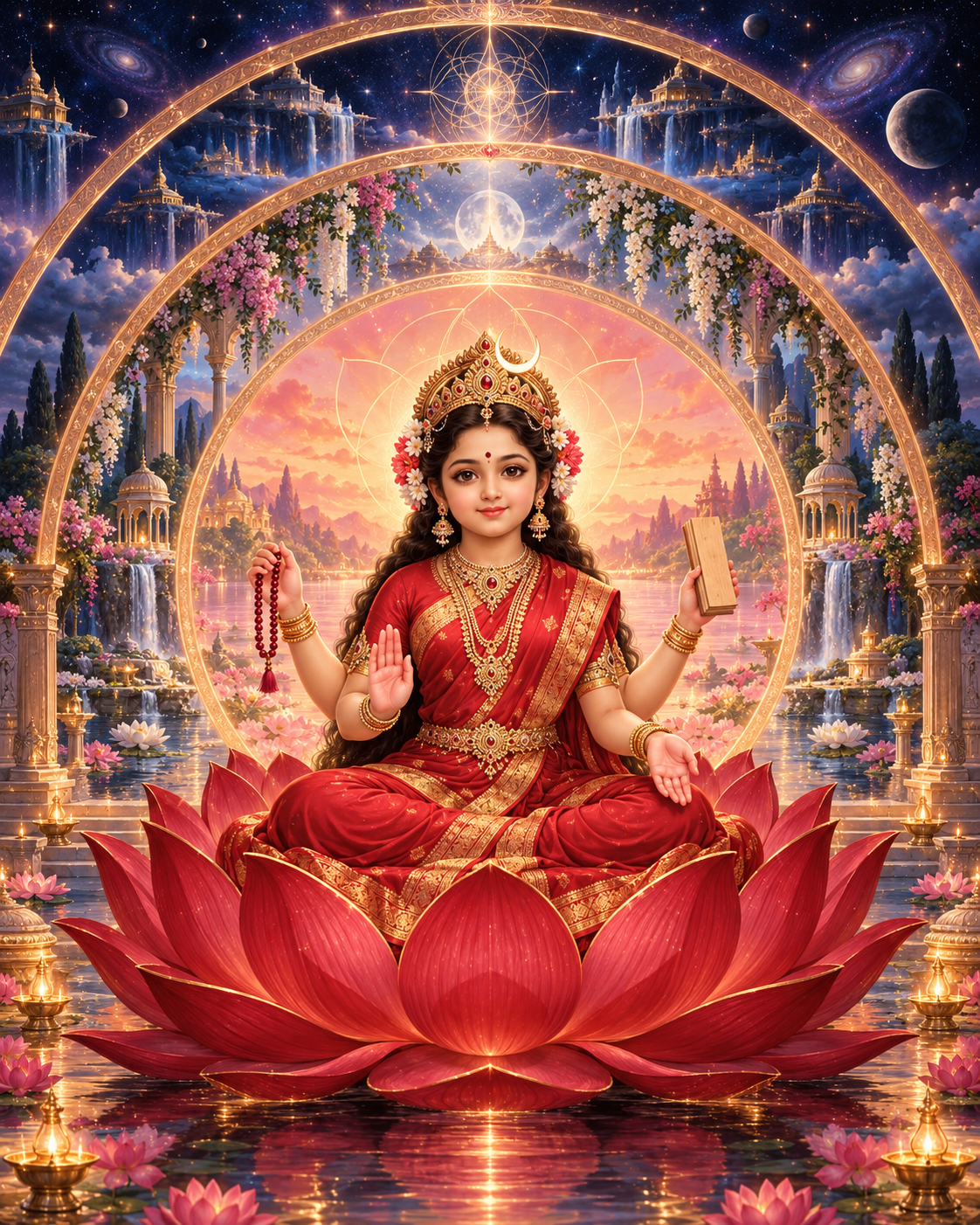
If you came across Bala Tripura Sundari and were told only that she is the Goddess in a youthful form, you were given a translation, not yet an interpretation. The real question is why supreme power should appear as a child, what the three in her name includes, and why beauty matters to consciousness.
The clearest way to understand her symbolism is to keep all three parts of the name together. Bala describes the freshness of the divine presence. Tripura gives that presence an all-encompassing field. Sundari tells you how pure consciousness is perceived: not as lifeless abstraction, but as radiant beauty.
Read the three parts of her name together
In the Shakta tradition, Bala Tripura Sundari is revered as the young and radiant form of the Supreme Goddess. Her youth therefore does not make her a minor or incomplete deity. The child form belongs to the Supreme herself.
- Bala means young or a child. It directs attention to consciousness as fresh, unburdened and ever new.
- Tripura can indicate three cities, three worlds or the three states of waking, dreaming and deep sleep. It expands the symbolism beyond one place or one condition of mind.
- Sundari means beauty. Here beauty is inseparable from the radiance of divine consciousness.
Each word corrects a possible misreading of the others. Bala without Tripura can be reduced to mere childhood. Tripura without Bala can become an abstract scheme. Sundari without the other two can be mistaken for physical attractiveness alone. Read together, the name presents consciousness as eternally fresh, present throughout the whole field of experience, and beautiful in its own nature.
The child form signifies freshness, not incomplete power
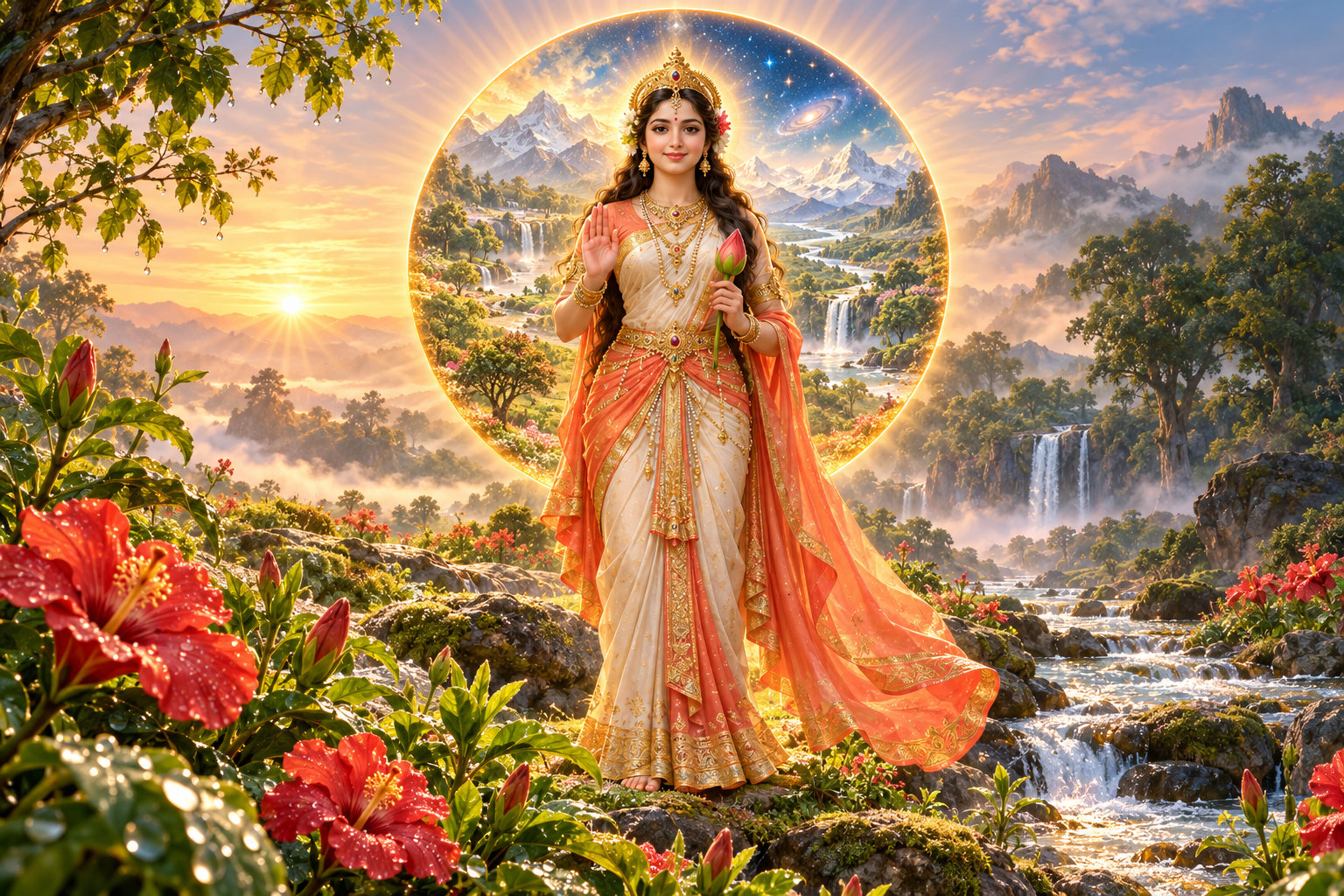
Human childhood normally implies dependence, limited knowledge and growth still to come. Applying all of those limitations to Bala would miss the theological point. She is not a developing being who will eventually become the Supreme Goddess. She is the Supreme Goddess appearing through the symbol of divine youth.
This reverses an ordinary assumption: that wisdom must look old, severe or weighed down by experience. Bala presents another possibility. The ground of awareness can be beginningless and still appear new. Its purity is not ignorance. Its freshness is not inexperience. Its child form is not a lower rank.
You can test an interpretation with two simple questions. Does it treat Bala as less powerful because she appears young? Does it confuse purity with fragility or gullibility? If either answer is yes, the interpretation has imported ordinary ideas about age into a symbol meant to transcend them.
Pure consciousness also should not be turned into a moral comparison between actual children and adults. The symbol is not claiming that one age group is spiritually superior. It asks you to notice how accumulated labels, memories and expectations cover the freshness with which experience first appears.
Tripura turns your ordinary experience into a map

Tripura carries several related meanings: the three cities, the three worlds and the three states of consciousness. These meanings should not be collapsed into a single rigid formula. They are different ways of expressing a threefold field embraced by the Goddess.
For personal contemplation, waking, dreaming and deep sleep provide the most immediate entry. You pass through them without needing to accept an elaborate theory first.
| State | What is present | What to notice |
|---|---|---|
| Waking | Objects, duties, relationships and your public identity | How readily you mistake your current roles for the whole of who you are |
| Dreaming | An experienced world not organized by the waking environment | How completely a state can absorb you while it is occurring |
| Deep sleep | The familiar contents of waking and dream are unavailable to ordinary report | How quickly the mind turns an absence of reportable content into a final metaphysical claim |
This map does not, by itself, prove a particular doctrine about what remains in deep sleep. It gives you a disciplined question: if every state changes, should consciousness be reduced to the contents of any one state? Different philosophical traditions can develop that question differently. The symbolism remains useful because it prevents waking thought from declaring itself the entirety of existence.
When Tripura is read as three worlds or three cities, the scale shifts from your daily cycle to a larger sacred order. The practical principle stays consistent: the divine is not confined to one compartment. Avoid forcing the different meanings into a one-to-one chart unless the tradition you are studying explicitly provides one.
Sundari relocates beauty from appearance to awareness

Sundari is easily flattened into a statement about an attractive form. Sacred form and artistic beauty certainly matter, but the symbolism goes further. Bala Tripura Sundari embodies the beauty of pure consciousness. Beauty therefore describes the divine reality revealed through the form, not merely the form’s visible features.
In this contemplative reading, beauty means that ultimate consciousness is not presented as barren, mechanical or alien. It is radiant and intrinsically whole. The youthful appearance makes that radiance immediate; Tripura prevents it from being limited to one body, realm or mental state.
When you encounter an image or description of Bala, ask three questions. Does the interpretation stop at physical appearance? Does it connect radiance with consciousness? Does it preserve her status as the Supreme even while attending to her child form? These questions help distinguish theological symbolism from a merely decorative reading.
A careful way to contemplate the symbolism
You do not need to invent ritual instructions in order to engage the meaning of the name. The following is a reading exercise, not a mantra practice or initiation:
- Choose a natural transition, such as shortly after waking or before sleep, when the movement between states is easy to recognize.
- Recall the name in its three parts: Bala, Tripura, Sundari. Do not rush past the distinctions.
- With Bala, notice the labels already accumulating around the present moment. Ask what is here before you turn it into a role, plan or remembered story. Do not strain to manufacture a blank mind.
- With Tripura, identify the state you are presently in and remember that waking is one member of a larger threefold cycle. Let that recognition loosen the assumption that the current state is the whole.
- With Sundari, look for the wholeness of awareness rather than an extraordinary sensation. End without demanding a vision, mood or result.
This approach keeps the contemplation anchored to the symbolism actually carried by the name. If you later undertake formal worship, mantra or a lineage-specific discipline, learn its methods from a trustworthy teacher within that tradition rather than reconstructing them from symbolism alone.
Key takeaways
- Bala signifies divine youth and freshness, not reduced power or spiritual immaturity.
- Tripura can refer to three cities, three worlds, or waking, dreaming and deep sleep; keep these layers distinct unless a tradition explicitly connects them.
- The three states provide a practical map for examining experience, but they should not be used to smuggle in an unsupported conclusion about deep sleep.
- Sundari points beyond physical attractiveness to the radiance and beauty of pure consciousness.
- The full meaning appears when youth, threefold totality and beauty are read together.
The next time you meet Bala Tripura Sundari in a name, image or prayer, begin with these three words before collecting more correspondences. If your reading preserves her supreme status, includes the full range of experience and locates beauty in consciousness rather than appearance alone, you have a sound foundation from which to go deeper.
References

Leave a Reply
You must be logged in to post a comment.