
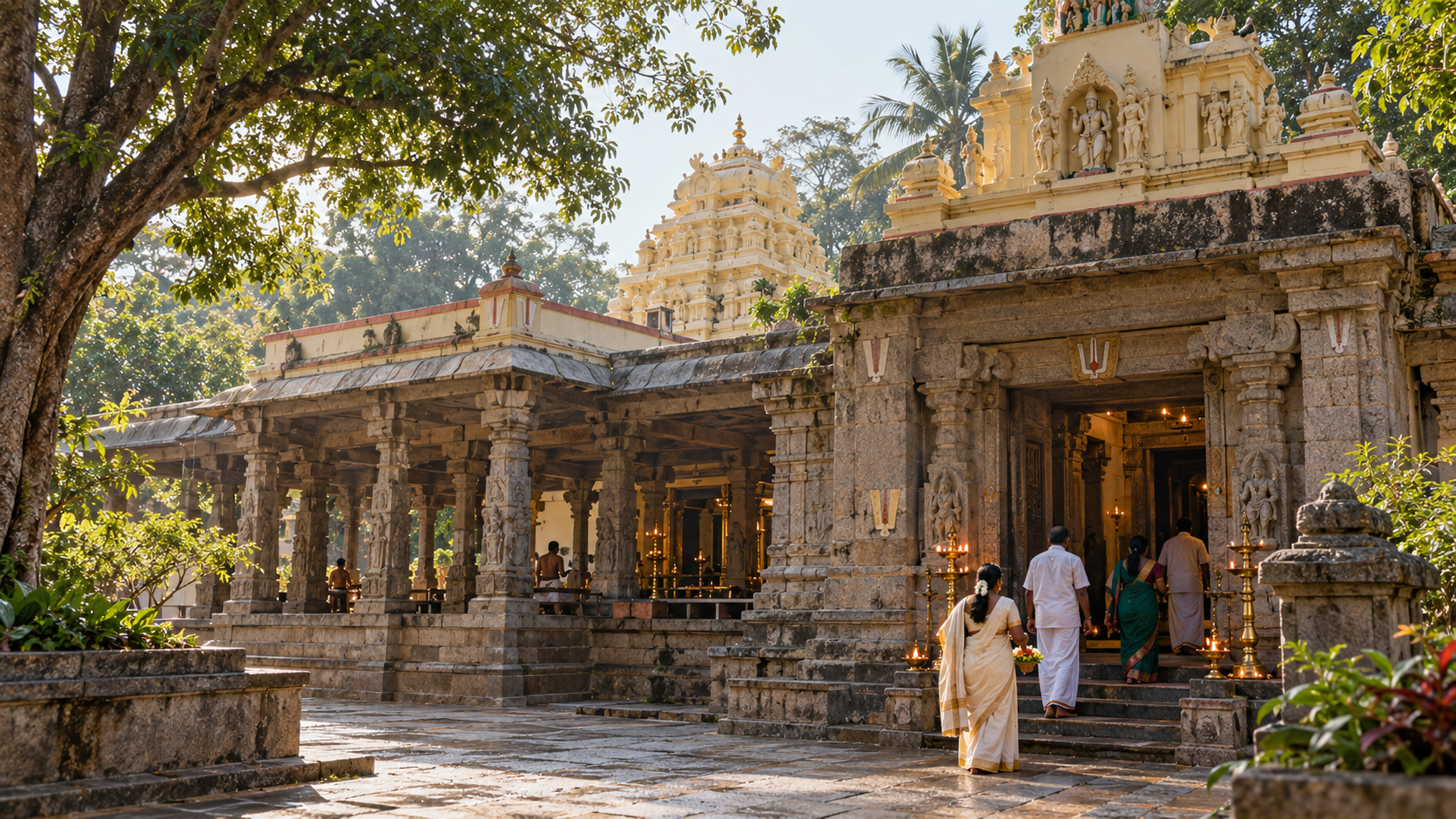
If you are heading towards Bannerghatta and wondering whether Champakadhama Temple deserves a place beside the area’s better-known attractions, the answer is yes – provided you do not treat it as a hurried detour. The temple rewards a visitor who knows where to look.
Here, Bengaluru’s history does not appear as one perfectly preserved architectural style. It survives as a worshipping temple assembled across centuries: an old sacred core, Vijayanagara halls, Mysore Wodeyar additions, changing names in inscriptions, and festival practices that still give the complex its purpose. You can read those layers during an ordinary darshana without turning the visit into an academic exercise.
Key takeaways for your visit
- Champakadhama is best understood as a layered temple, not as a monument belonging wholly to one dynasty.
- The complex is associated with approximately 18 inscriptions, with the earliest dated to 1257 CE.
- The oldest surviving fabric is concentrated in the garbhagriha and antarala; the halls and outer structures belong to later phases.
- The east-facing Champakadhamaswamy shrine and south-facing Mahalakshmi shrine should be experienced as two essential parts of the same sacred landscape.
- Start early, confirm the day’s temple schedule locally, and follow the architecture from the outer additions towards the ancient core.
The temple’s names preserve a history that stone alone cannot show
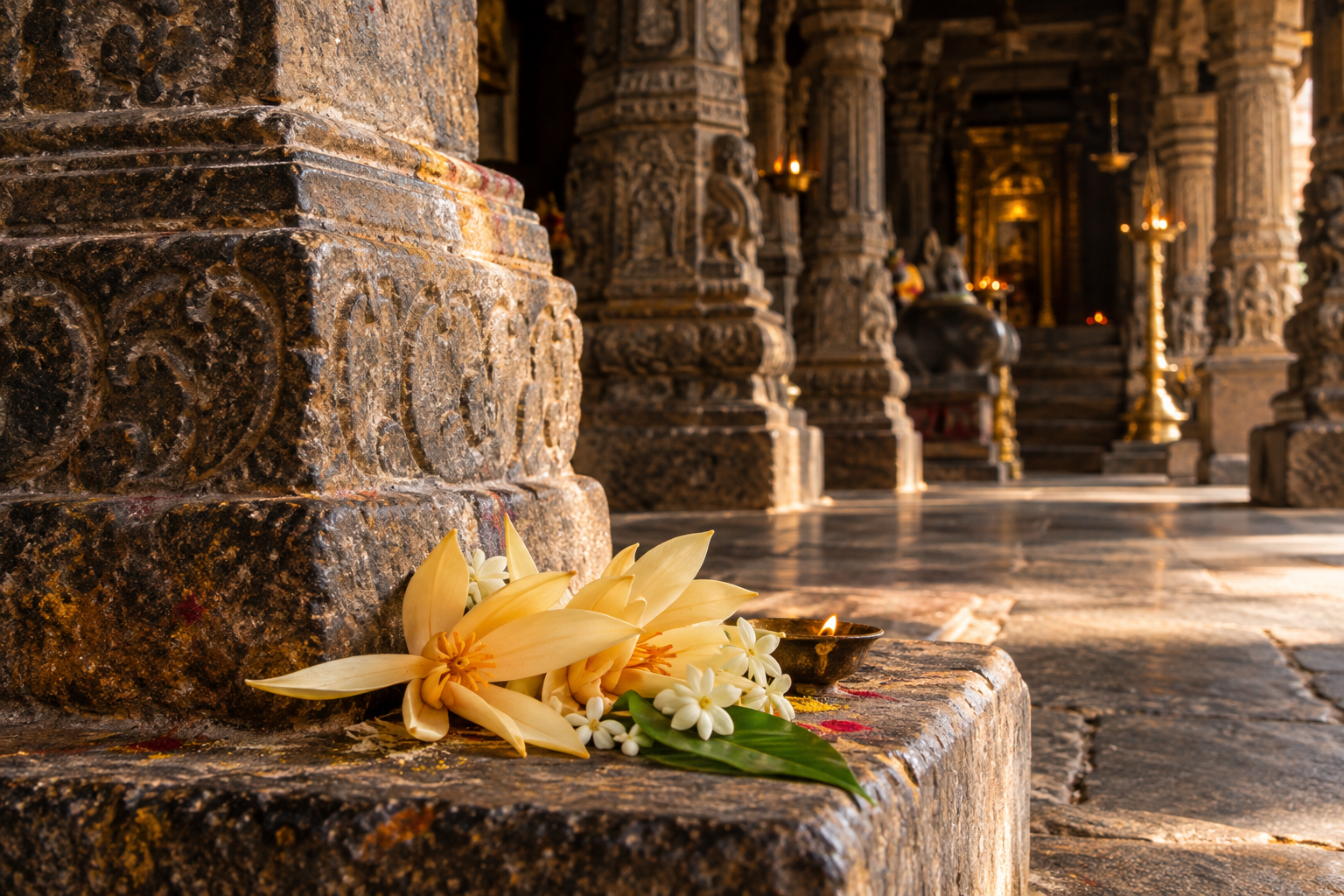
Begin with a useful correction: Champakadhama cannot be understood by looking for a single dynastic label. Bannerghatta itself appears in inscriptions under several names, including Varadaraja Pattana, Vanniyoor Ghatta and Bamnooraghatta. A scholarly interpretation has also connected the modern place-name with minerals or metallurgy. These names are not decorative curiosities. They show that the settlement, the deity and the language used to describe the kshetra changed together.
The deity was known in older records as Damodara of Bamnooraghatta and Damodarapperumal. The name Champakadhama is attested in an inscription from 1818 CE. It is associated with the Champaka, or Sampige, trees traditionally used in the worship of the deity; the nearby name Sampigehalli preserves the same botanical memory. The date gives you a secure point in the written record, but it should not be mistaken for the beginning of the temple or its worship.
The epigraphic record reaches much further back. The temple is associated with approximately 18 inscriptions, the earliest dated to 1257 CE. Four donation inscriptions belong to the Hoysala period and another four to the Sangama period of the Vijayanagara Empire. What these records establish most clearly is continuing patronage. They do not mean that every visible portion of the present complex was built at the same time.
The Mysore Archaeological Report attributes the establishment of the temple to Poorvadiraya, who is described as having served first as a feudatory of the Cholas and later of the Hoysalas. The core is consequently understood as a 13th-century foundation, although conspicuous Hoysala features are not readily visible in the temple as it now stands. If you are describing Champakadhama to someone else, call it a temple with a 13th-century core and major later additions. Calling the entire complex simply Hoysala conceals the very history that makes it valuable.
Read the three building phases as you walk towards the sanctum
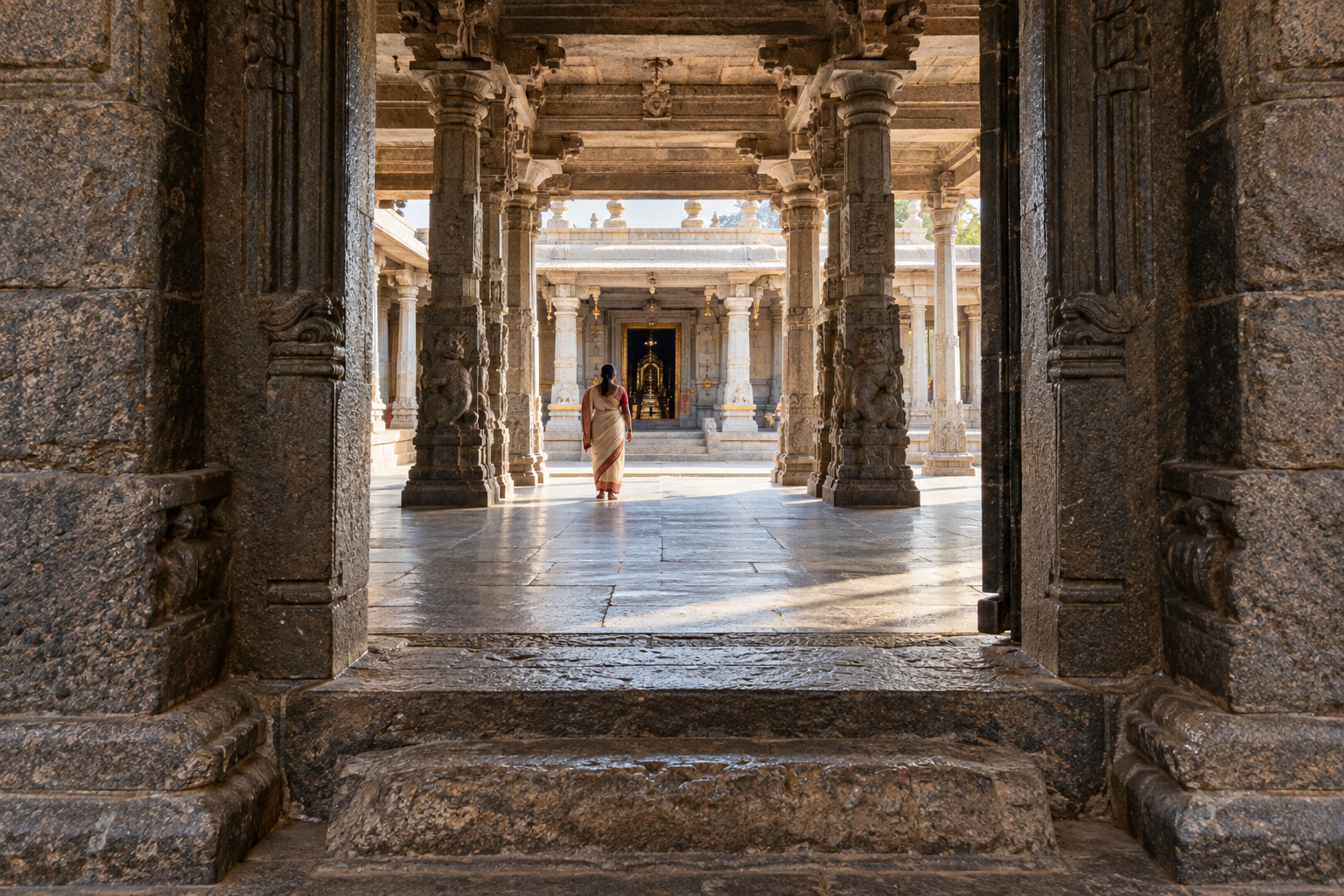
The main temple faces east and unfolds through a clear sequence: entrance hall, navaranga, ardhamantapa, antarala and garbhagriha. Walk this route slowly. You are not merely moving from a doorway to the deity; you are passing through successive periods of Bengaluru’s political and sacred history.
| Building phase | Principal surviving parts | What you should notice |
|---|---|---|
| Ancient core, associated with the 13th-century foundation | Garbhagriha and antarala | The compact inner structure and the point at which the older base appears to end |
| Vijayanagara period | Ardhamantapa and navaranga | Carved pillars, floral work, elephant reliefs and pushpabodige brackets |
| Mysore Wodeyar period | Later outer sections and the shikharas of the principal and Mahalakshmi shrines | The expanded public-facing form surrounding the earlier sacred core |
The most useful architectural clue appears near the antarala. The adhisthana, or structural base, extends beyond it and includes small pillars at the sides. This change helps mark the limit of the earlier construction. Look down at the base before looking up at the tower: the quieter junction near your feet can tell you more about the temple’s development than its most prominent silhouette.
In the Vijayanagara portions, direct your attention to the points where pillars meet the structure above. The distinctive pushpabodige brackets, together with floral motifs and elephant reliefs, help identify the character of the halls. These are not ornaments added to make an old sanctum look grand. The halls reveal how a growing institution created more space for assembly, movement and worship.
The outer portions and both prominent shikharas belong to the Mysore rulers’ phase. This is why dating a temple from its tower alone can mislead you. At Champakadhama, the structure seen first is not necessarily the structure built first. The temple’s age becomes legible only when you compare the exterior, halls, base and innermost chambers.
Give both Champakadhamaswamy and Mahalakshmi your attention
Begin with the iconography of Champakadhamaswamy
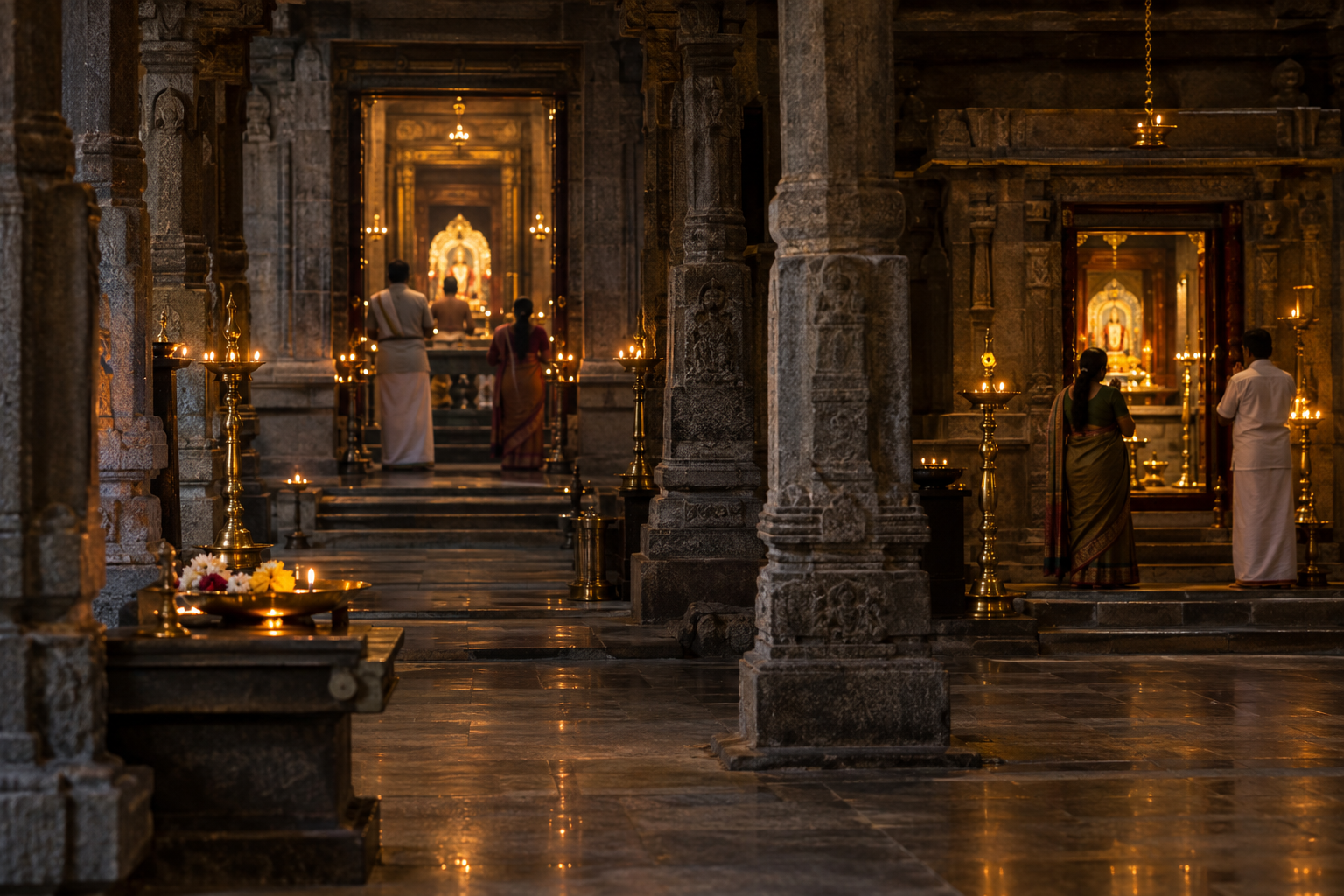
Within the main sanctum, Champakadhamaswamy stands as Vishnu upon a lotus pedestal, accompanied by Sri Devi and Bhu Devi. His four hands display the abhaya gesture and bear the conch, discus and mace. Do not let the relative restraint of the image make you pass over it quickly. The elongated proportions, limited ornamentation and overall treatment suggest that the principal images may date to the 14th or 15th century.
The inscriptions identify the deity as Varadaraja and connect his sacred identity across yugas: Varada in Kali Yuga and Damodara in Dvapara Yuga. The place-name Varadarajapattana therefore matters. It ties the identity of the settlement to the identity of the deity rather than treating the temple as an isolated building placed inside a later suburb.
Before leaving the navaranga, locate the image of Vishvaksena and the metal representation of Garuda. These secondary presences help you read the shrine as an ordered Vaishnava ritual space. A useful sequence is to attend first to the main murti and the accompanying devis, then to these figures, and only afterwards to study the pillars and decorative details. Heritage attention should deepen darshana, not displace it.
Do not treat the Mahalakshmi shrine as an appendix
After descending the steps and turning to the right near the Garuda-kambha, you reach the Mahalakshmi shrine. Its south-facing orientation immediately distinguishes it from the east-facing principal temple. On the exterior, look for the jalendra stone screens, carefully worked masonry and vesara-style shikhara. These features give the shrine its own architectural identity while keeping it visually related to the larger complex.
Mahalakshmi holds lotuses in her upper hands, while her lower hands express abhaya and varada – assurance and grace. The ardhamantapa contains pillars with floral carving, and a small Ganesha image occupies a niche on the inner wall. Beyond it is a spacious pillared hall whose workmanship echoes elements of the Champakadhamaswamy temple. Give this sequence the same deliberate attention you gave the main shrine: exterior screens, tower, pillared space, niche and sanctum.
The surrounding features show how sacred use extends beyond the two sanctums. Local memory recalls a kalyana mantapa that formerly stood near the Mahalakshmi shrine. Across the road is a simpler uyyaale mantapa constructed to hold a swing; Sri Varu is placed there during festival observances. Keep the distinction clear when you visit: the remembered marriage hall belongs to community memory, while the swing pavilion remains a visible part of the festival landscape.
This is the point at which Champakadhama becomes more than a sequence of architectural periods. Its stones have been altered, extended and assigned new functions because the kshetra remained active. The later work does not dilute the older heritage. It shows how a Hindu temple carries inherited sanctity forward while making room for continuing worship.
Plan a visit that respects both darshana and heritage
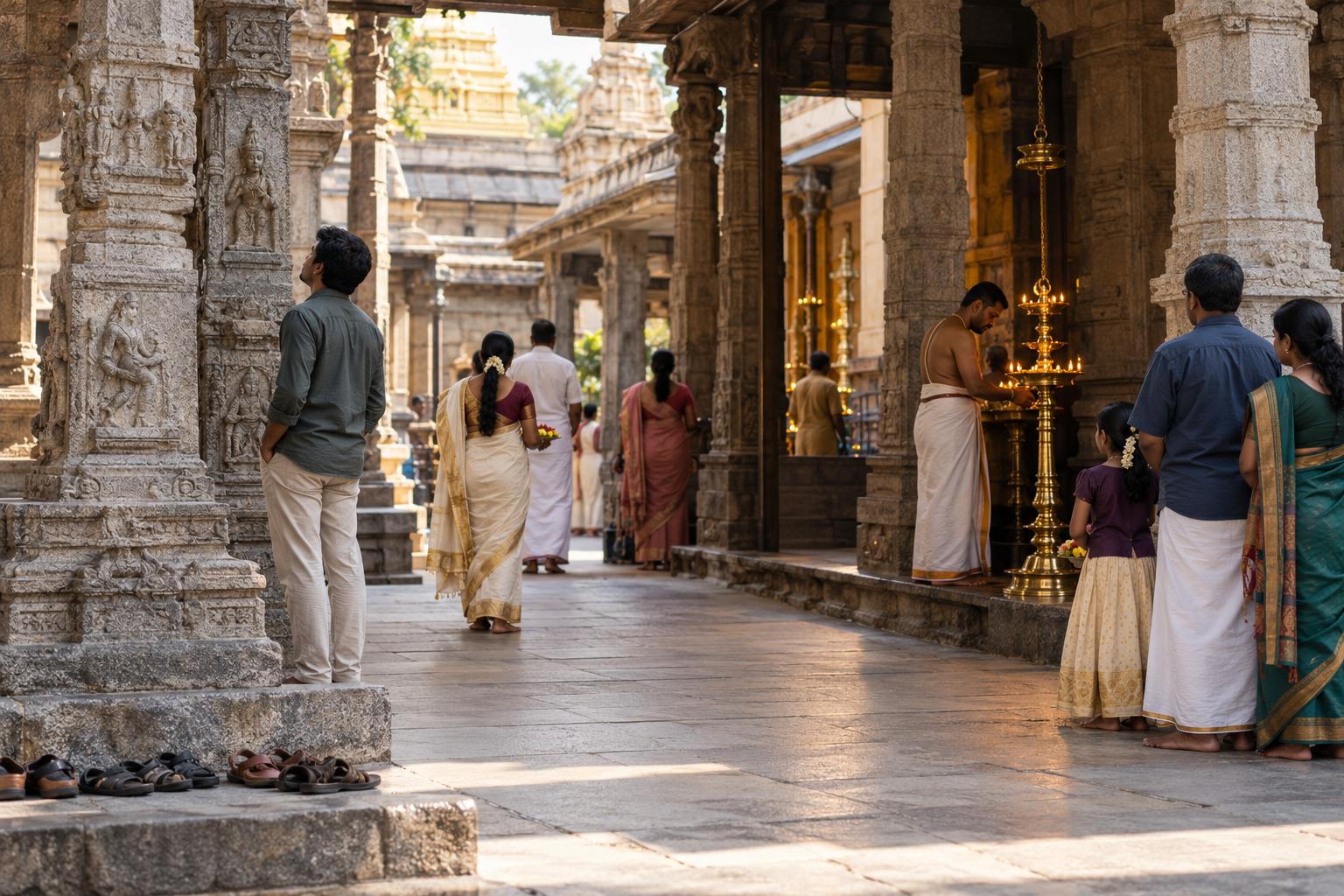
Champakadhama stands at Bannerghatta in Anekal taluk, within Bengaluru Urban district. Traffic can consume the attention you meant to bring to the temple, so make it the first destination of your day rather than an afterthought following a crowded outing.
- Leave early enough to reach Bannerghatta before the roads become the main event. If you are coming from central Bengaluru, one practical route uses the Metro towards Yelachenahalli, followed by an autorickshaw or local transport. Confirm the current connection before departure.
- Check opening, puja, festival and annadanam timings locally on the day of your visit. Do not treat a time associated with one occasion as a permanent schedule.
- Approach the main east-facing temple from the exterior. Notice the later shikhara first, then follow the entrance hall, navaranga, ardhamantapa, antarala and garbhagriha in order.
- At the transition to the inner core, examine the adhisthana and small flanking pillars without touching the old surfaces. This is the most useful place to notice where the earlier structure gives way to the expanded temple.
- Complete darshana before concentrating on close architectural observation. Ask before photographing murtis, worship or inscriptions, and avoid obstructing devotees while studying the halls.
- Visit the Mahalakshmi shrine and, if accessible, observe the swing pavilion across the road. Leaving after only the principal sanctum means missing an important part of the temple’s living geography.
You can test whether you have really seen Champakadhama with five questions. Can you identify the ancient core? Can you point to a Vijayanagara feature? Can you distinguish a Wodeyar addition? Can you explain why the deity has more than one historical name? Can you name a structure that still supports festival practice? If you can answer all five, you have read the temple as both a sacred place and a historical record.
On your next journey to Bannerghatta, place Champakadhama first on the route. Walk from the later exterior towards the older sanctum, receive darshana at both shrines, and make a short note afterwards of one inscriptional name, one architectural transition and one living ritual feature. That small discipline turns a pleasant temple visit into durable knowledge of Bengaluru’s Dharmic inheritance.
References

Leave a Reply
You must be logged in to post a comment.