
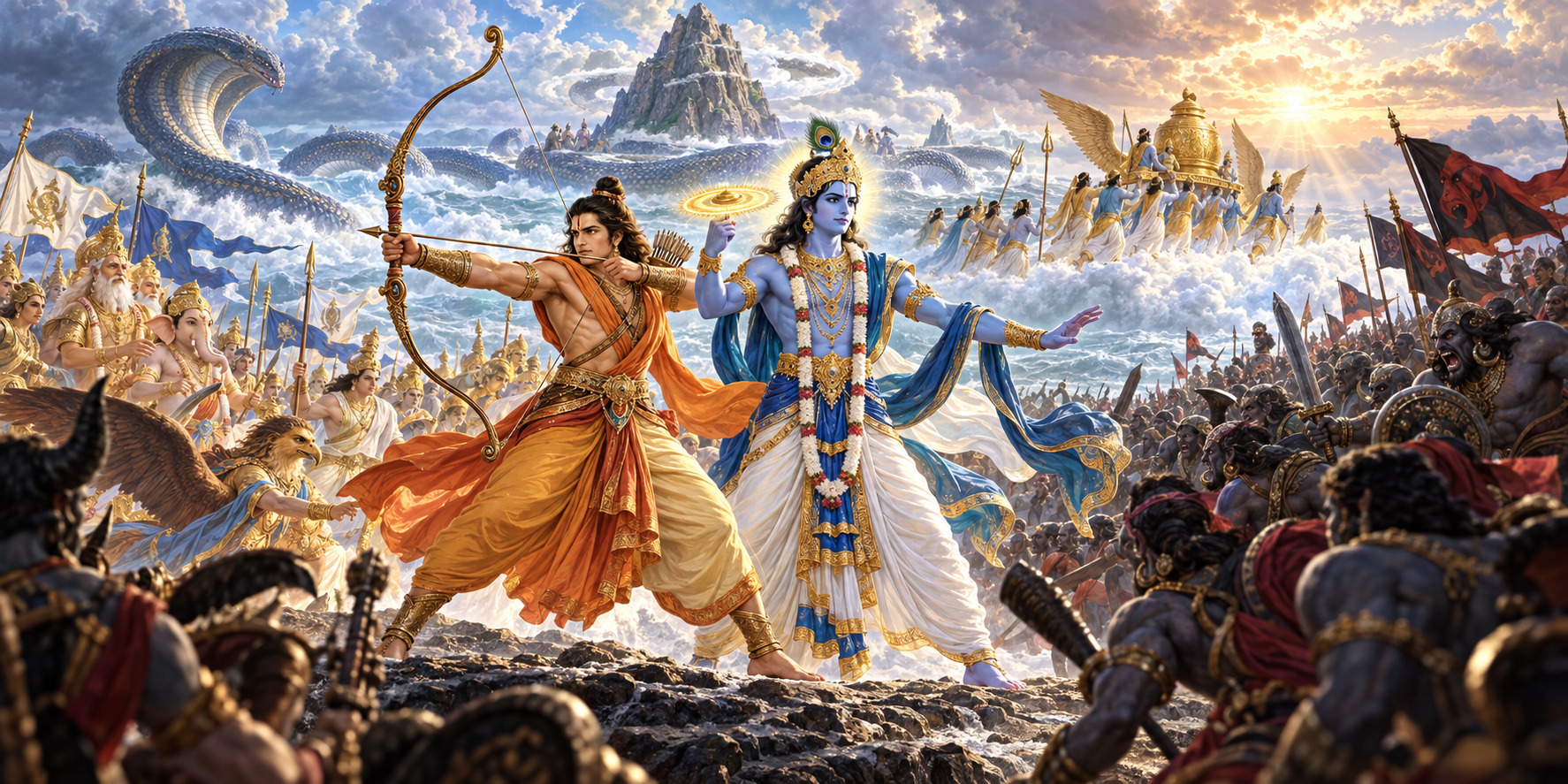
If your memory of Samudra Manthan ends with Mohini distributing amrit, you have stopped one scene too soon. The neglected battle that follows answers a difficult question: obtaining a sacred good is one thing, but who will protect its purpose once desire turns into force?
That is why Nara and Narayana matter. Their arrival is not an ornamental addition to an already complete story. It reveals how Hindu thought joins discernment, disciplined human action, divine support and the defence of dharma.
The missing final act changes the whole episode
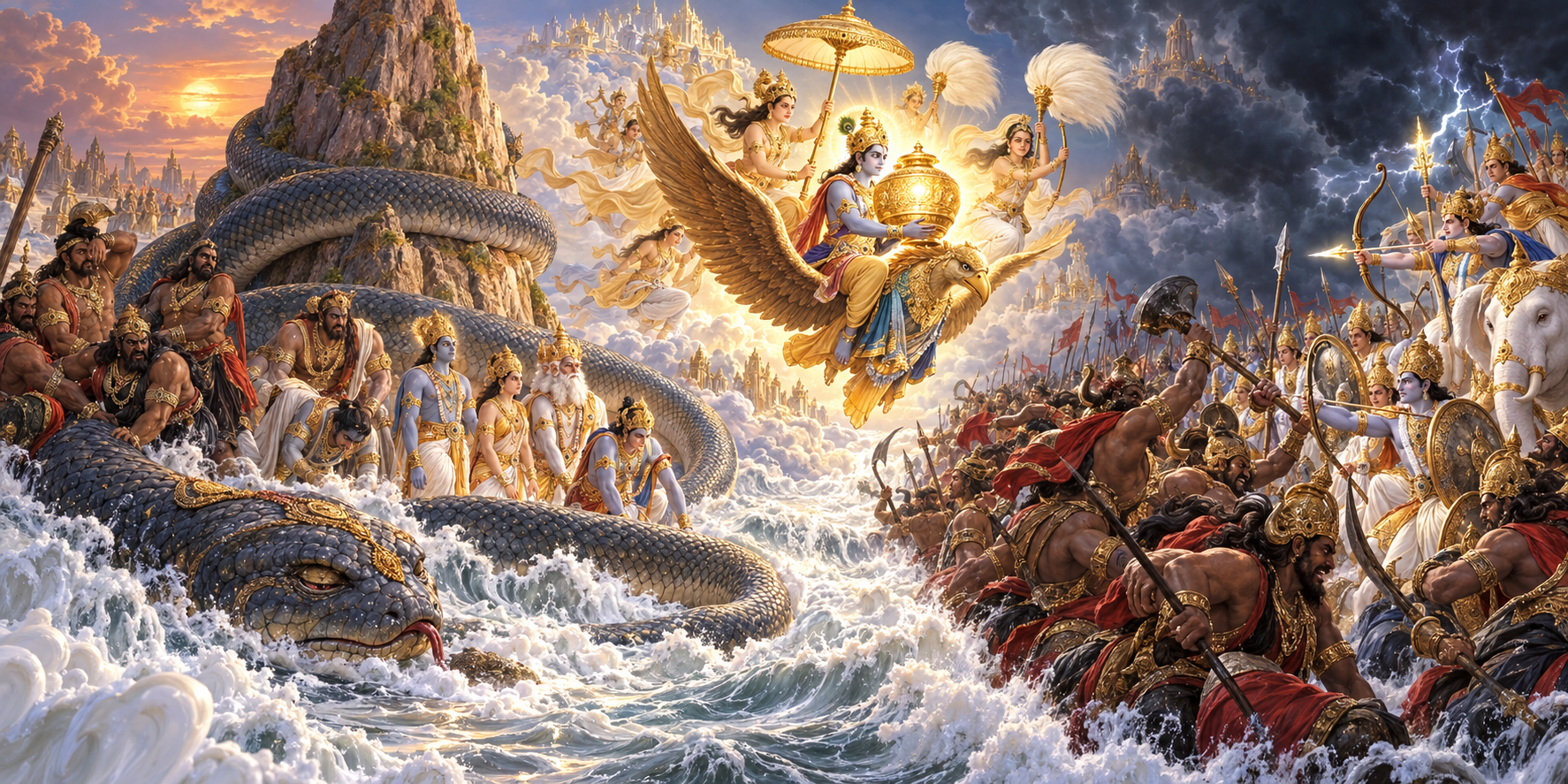
Samudra Manthan begins with cooperation between rivals. Devas and danavas undertake the same immense labour because both want amrit, the nectar of immortality. Their partnership is real, but it is limited. They share an immediate task without establishing lasting trust or an accepted rule for the result.
That distinction becomes decisive as soon as the nectar appears. A resource that could be pursued jointly cannot necessarily be possessed jointly, especially when possessing it would transform the balance of power. After the churning, the emergence of amrit produces a struggle over its distribution; Vishnu assumes the form of Mohini, the devas receive the nectar, and a battle with the danavas follows in which Nara and Narayana fight.
- Cooperation: devas and danavas perform the churning together.
- Emergence: amrit appears and changes the stakes of the undertaking.
- Distribution: Vishnu, as Mohini, prevents the nectar from passing to the danavas.
- Reaction: the unresolved claim becomes open conflict.
- Protection: Nara and Narayana enter the post-Manthan battle.
This sequence prevents a sentimental reading of cooperation. Working beside someone does not prove that you share an understanding of justice, responsibility or the proper use of the result. When the desired object finally arrives, hidden differences become visible.
For you as a reader, the practical lesson is to watch the transition points. Do not ask only who helped produce the result. Ask what the result can do, who intends to control it, and what order will follow from that control. In the Manthan narrative, the crisis lies not merely in finding amrit but in determining what immortality would serve.
Why Nara and Narayana enter as a pair
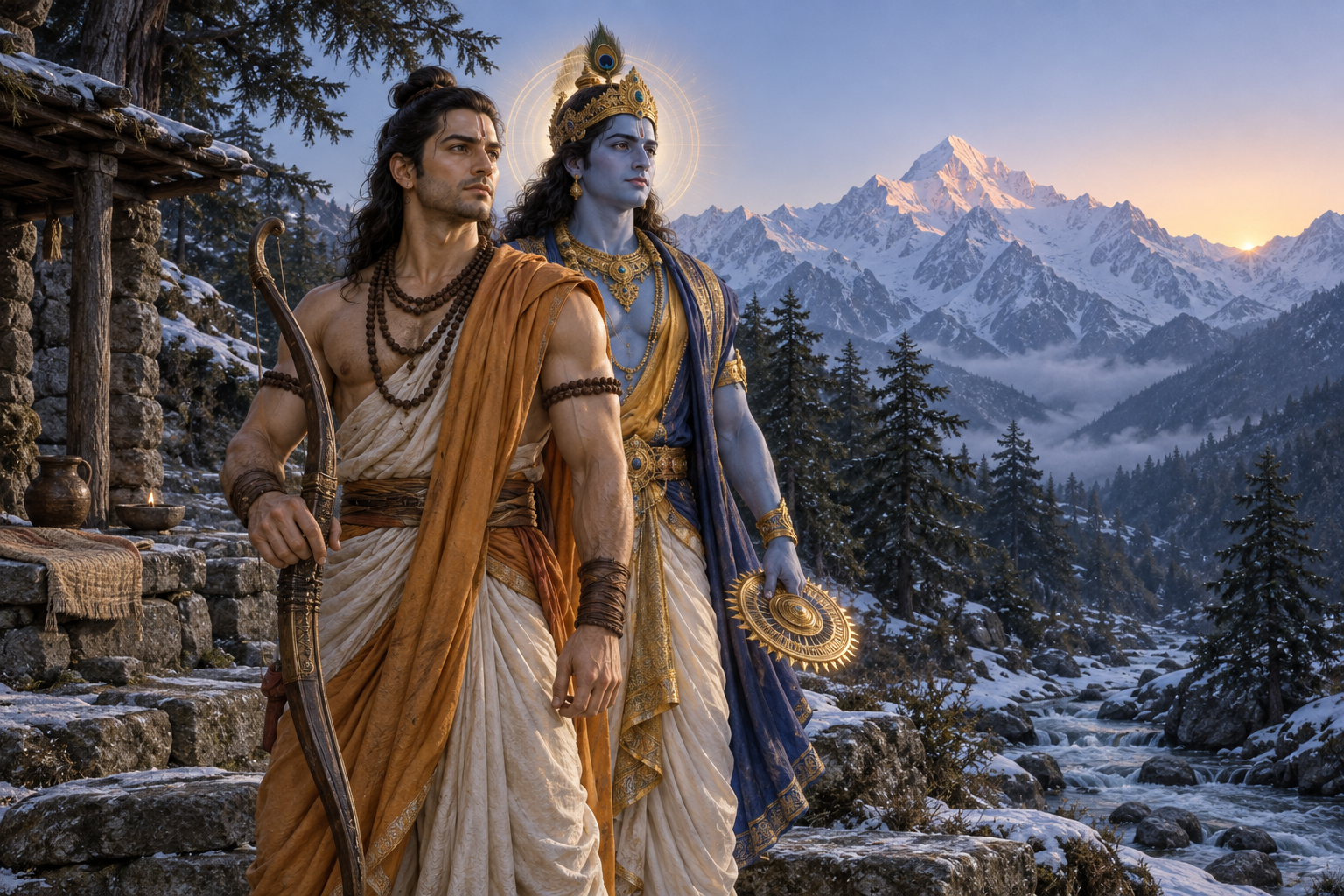
Nara and Narayana are traditionally understood as paired rishis, closely associated with tapas and dharma. Their appearance in battle can therefore seem surprising if tapas is mistaken for withdrawal, softness or an inability to confront disorder.
A useful dharmic reading sees Nara as disciplined human agency and Narayana as divine presence. This is an interpretive lens, not a reason to erase them as figures within the sacred narrative. The pairing matters because it rejects two incomplete positions: that human effort alone is sovereign, and that invoking the Divine excuses human inaction.
- Nara without Narayana can become effort without a higher orientation: capable, energetic and still vulnerable to pride.
- Narayana without Nara, when misunderstood by the devotee, can become an excuse to wait for divine intervention while neglecting one’s duty.
- Nara with Narayana presents action aligned with something greater than appetite, possession or personal victory.
This also clarifies why an ascetic presence can belong on a battlefield. Tapas is concentrated power, not passivity. Self-mastery is what makes force answerable to dharma rather than anger. The person who cannot govern his own impulses is poorly equipped to claim that he is defending cosmic or social order.
The pairing should change how you approach your own duties. Begin by identifying the action that is genuinely yours: the conversation you must have, the boundary you must maintain, the promise you must keep or the harm you must resist. Then examine its orientation. Is it guided by dharma, or have resentment and self-importance borrowed sacred language?
This is a stricter demand than either activism or piety by itself. You must act, but you must also purify the motive and govern the means.
Mohini’s strategy and the battle solve different problems
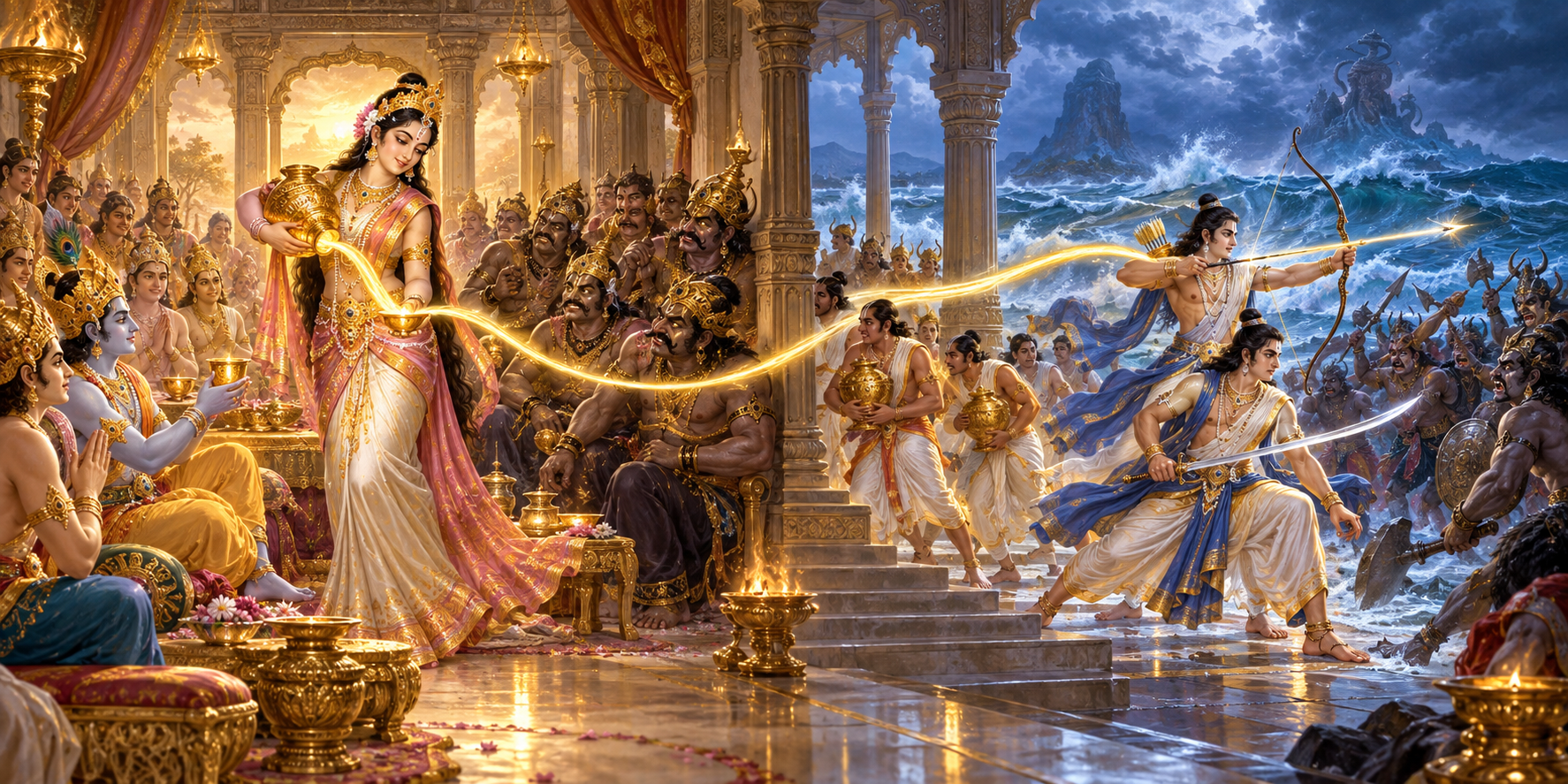
If Vishnu has already intervened as Mohini, why is another intervention necessary? Because the distribution of amrit and the protection of that distribution are different problems.
Mohini’s form addresses a crisis of access. The post-Manthan battle addresses the force that follows when the defeated claimants reject the outcome. One intervention uses appearance, intelligence and the management of desire. The other meets aggression with disciplined resistance. The methods differ because the stages of the crisis differ.
You can read the entire sequence through three functions:
- Production: the churning brings the hidden treasure into reach.
- Allocation: Mohini determines who actually receives it.
- Stewardship: the ensuing battle tests whether the outcome can be defended.
Readers often concentrate on production because churning is the most memorable image. Yet sacred or civilisational work regularly fails after production. Knowledge can be discovered and then misused. An institution can be built and then captured. A spiritual insight can arise during practice and disappear when old habits return. Possession does not guarantee preservation.
The post-Manthan battle therefore supplies the part of the pattern that is easiest to omit: every gain creates a duty of guardianship. The greater the power of what has emerged, the more important that duty becomes.
This does not mean every disagreement should become a confrontation. The narrative itself presents more than one mode of action. First comes cooperation, then strategic discernment, and only then battle. If you invoke the martial part while ignoring the earlier stages, you are not applying the whole pattern. You are selecting the part that flatters aggression.
The fairness question should not be brushed aside
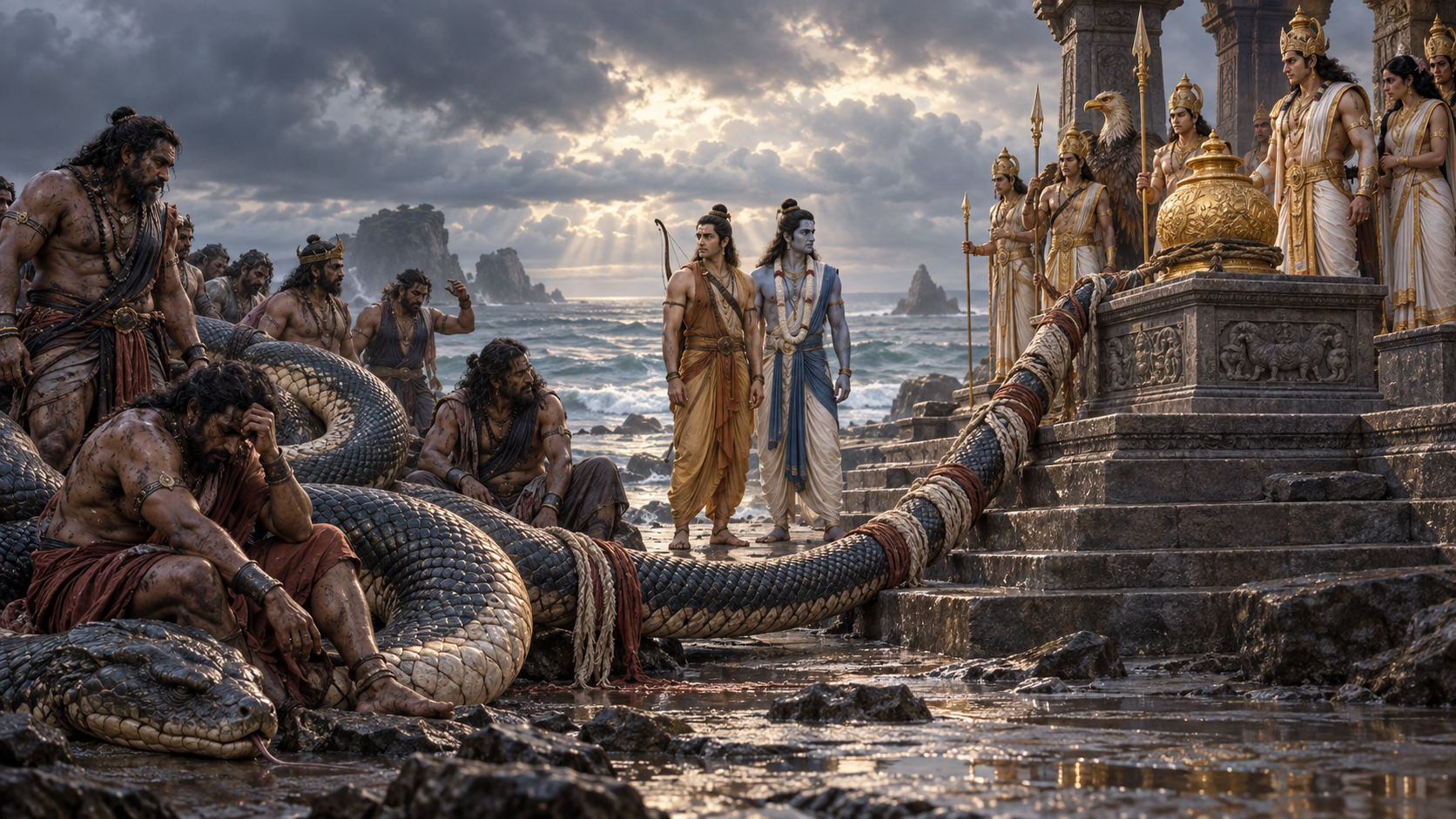
A careful reader may object that the danavas participated in the churning. If they shared the labour and wanted the same nectar, why were they denied it? That is not an irreverent question. It is one of the tensions that gives the episode its moral weight.
The first distinction is between an ordinary share of wages and control of a power that can alter cosmic order. Amrit is not merely another valuable object recovered from the ocean. Its possession would make the existing conflict vastly harder to resolve. The narrative therefore evaluates distribution in relation to dharma and consequence, not labour alone.
The second distinction is between procedural equality and moral equivalence. Two sides may contribute to the same process without intending to use its result in equivalent ways. Hindu narratives do not require you to pretend that power becomes harmless merely because several claimants desire it.
But this is not a blanket permission to deceive anyone you call adharmic. Human beings are very good at placing themselves among the devas and their opponents among the danavas. That convenient classification is precisely why the story must be applied with restraint.
Before using the episode to justify a real-world decision, test your argument with three questions:
- What is at stake? Is this genuinely a dangerous concentration of power, or merely something you do not want to share?
- What evidence concerns the claimant’s purpose? Are you responding to demonstrated conduct, or converting dislike and group identity into a moral verdict?
- What authority and limits govern your action? A divine intervention within a sacred narrative is not automatic permission for a private person, movement or government to abandon truthfulness and accountable process.
If you cannot answer those questions clearly, the episode does not release you from ordinary dharmic obligations. It calls for more self-examination, not greater certainty about your opponent’s wickedness.
The same caution applies when interpreting the devas. Their receipt of amrit does not make every deva flawless, nor does it mean that power validates whoever happens to possess it. The central concern is the preservation of dharmic order. Privilege without responsibility would betray that concern.
A four-pass method for reading the episode well
You do not need to flatten the post-Manthan battle into either literal history or a free-floating psychological metaphor. Read it in four passes, keeping each level distinct.
- Establish the plot. Write the sequence in plain sentences: joint churning, emergence of amrit, contested distribution, Mohini’s intervention and the battle involving Nara-Narayana. Do this before drawing a lesson.
- Identify the mode of each actor. Cooperation produces the nectar; Mohini works through strategic form and attraction; Nara-Narayana embody disciplined action joined to divine orientation. Notice that the narrative does not prescribe one method for every stage.
- Face the ethical pressure point. Ask the strongest question against your preferred reading. Here it is the danavas’ contribution to the churning. If your interpretation cannot acknowledge that difficulty, it is apologetic shorthand rather than serious reflection.
- Make one modest application. Apply the pattern to stewardship, self-mastery or the responsible use of power. Do not map living communities onto devas and danavas, and do not claim that a complex political dispute is settled by a mythic analogy.
For a contemplative reading, you might treat the churning as sustained discipline that brings concealed capacities to the surface. The appearance of amrit then represents attainment, while the battle represents the work required to prevent that attainment from being seized by older patterns of desire. This is an application of the narrative, not a claim that its characters are nothing more than parts of the psyche.
That distinction matters. Symbolic reading should deepen reverence for the narrative’s layers, not dissolve the sacred figures into modern abstractions.
Key takeaways
- Samudra Manthan does not end with Mohini’s distribution of amrit; the battle afterward reveals the cost of preserving the outcome.
- Nara and Narayana can be read as disciplined human effort aligned with divine purpose, without reducing them to mere symbols.
- Mohini’s strategy and Nara-Narayana’s resistance address different stages of the same crisis.
- The danavas’ participation makes the fairness question legitimate, but amrit’s effect on cosmic power prevents it from being treated as ordinary compensation.
- The story does not authorize you to label present-day opponents demonic or to use dharma as cover for anger, deception or unchecked force.
- The most practical lesson is stewardship: after insight, power or achievement emerges, responsibility has only begun.
When you next return to Samudra Manthan, mark every change in the kind of action required: labour, discernment, distribution and protection. Then ask where your own duty actually stands. You may discover that you do not need another dramatic beginning. You need the steadiness to guard what the churning has already brought forth.
References
- Hindu Blog — The War After Mohini Avatar: When Nara and Narayana Fought Demons After Samudra Manthan

Leave a Reply
You must be logged in to post a comment.