
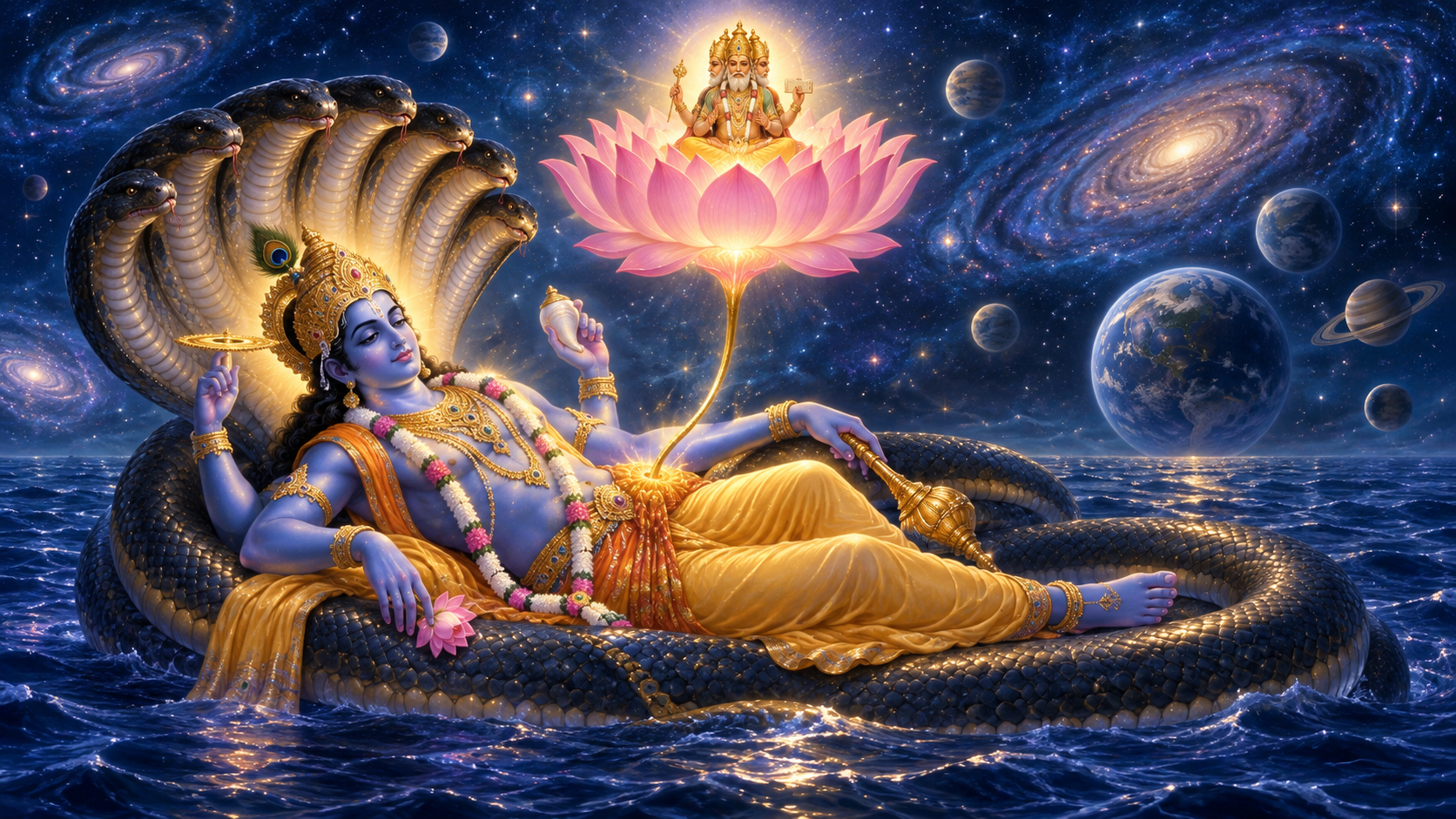
If you reached this verse wondering why meditation on Bhagavan pauses at His navel and chest, do not treat the imagery as a strange piece of divine anatomy. The passage is teaching you how to hold creation, dependence, beauty and devotion together without letting any one of them become an abstraction.
This matters in practice because the mind usually moves in one of two directions. It gets lost in enormous questions about the cosmos, or it gets captured by one small distraction after another. Kapila’s instruction joins the two scales: trace the universe to its divine source, then steady your attention on one precise feature of the Lord.
What the verse asks you to contemplate
The numbering 3.28.29 means the Third Canto, Chapter 28, verse 29. Within Kapila’s instructions on meditation, Srimad Bhagavatam 3.28.29 directs the yogi’s attention first to the Lord’s navel. From it arises the lotus associated with the planetary systems and with Brahma, the first created being. The meditation then turns to the Lord’s chest and two emerald-like nipples, made luminous by the rays of His pearl necklaces.
Those details belong to an ordered meditation on Bhagavan’s form. They are not independent symbols to be decoded according to personal preference. The yogi receives a sequence and follows it. That discipline is important: devotional meditation is remembrance guided by revelation, not the unrestricted production of private imagery.
Notice three things while reading the passage. The navel is presented as a source rather than an isolated bodily feature. The lotus connects that source with an intelligible and inhabited cosmos. Brahma occupies an exalted place, but he still appears within a reality that depends upon Bhagavan. Each detail establishes a relationship.
When you study the verse, therefore, begin with its actual movement: Lord, lotus, worlds and Brahma; then return to the Lord’s beautiful form. If you begin and end with cosmological speculation, you will miss the meditation Kapila is teaching.
The cosmic lotus corrects a common idea of independence
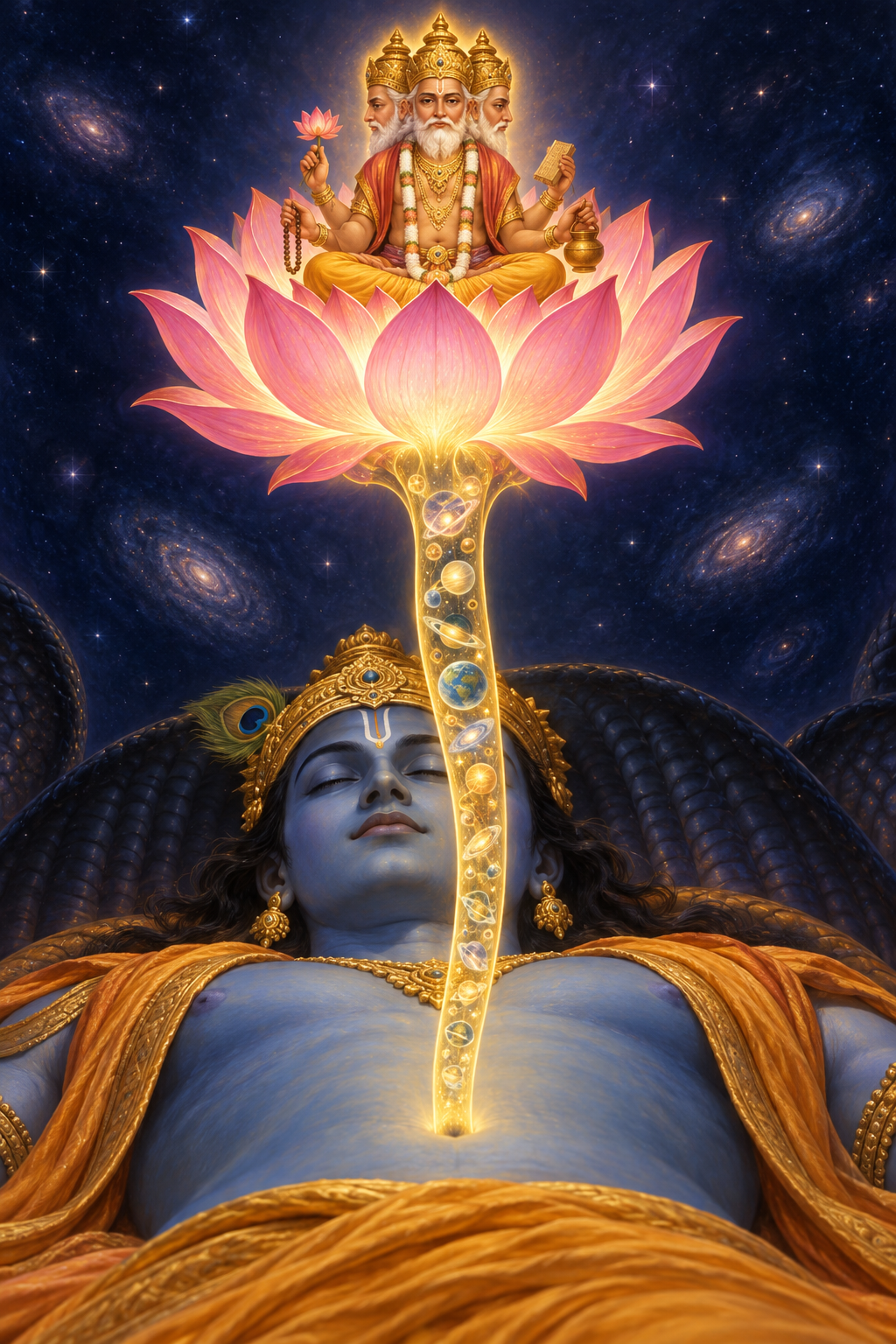
Brahma possesses immense creative responsibility in the Bhagavatam’s sacred cosmology, yet he is not portrayed here as an independent first cause. He appears upon the lotus that springs from the Supreme Lord. His agency is real, but it is received. His greatness does not cancel his dependence.
That distinction gives you a practical way to read the image. Human beings commonly confuse delegated capacity with absolute ownership. Intelligence, authority, skill and social position can make the individual feel self-originating. Brahma’s position exposes the error at its highest conceivable level: even the cosmic administrator has a source.
Use the image as a test of your own agency. When you complete difficult work, lead a family, teach, build an institution or serve a community, ask two questions: What capacity was entrusted to me, and what is that capacity for? The first question interrupts pride. The second interrupts passivity. Dependence on Bhagavan does not mean that your work is unreal; it means that your work should become responsible service rather than a claim of absolute proprietorship.
The lotus also prevents spirituality from shrinking into private mood. The worlds, their inhabitants and the duties performed within them belong to the field of divine dependence. Meditation should consequently sharpen your conduct in the world. If contemplation makes you dismissive of obligations, careless with people or intoxicated with your own spiritual status, the image has not yet been understood.
Why the meditation uses precise bodily imagery

A modern reader may be comfortable with the cosmic lotus but hesitate when the verse turns to the Lord’s nipples and pearl necklaces. Skipping that part would remove an essential feature of the practice. The Bhagavatam does not offer an undefined divine principle here. It directs attention to Bhagavan as a beautiful person whose form can be remembered feature by feature.
Within this Vaishnava meditation, form does not reduce the Supreme to an ordinary material body. The passage presents the divine form as the source within which cosmic manifestation rests. The sequence reverses an everyday assumption: Bhagavan is not one object contained by the universe; the universe depends upon Him.
The details of emerald-like color, pale radiance and pearl ornamentation also give the wandering mind definite work. Vague commands such as concentrating on the divine can leave attention with nothing to hold. A named feature, color, relation and movement provide anchors. When attention drifts, you do not have to invent a new spiritual idea. You return to the next given detail.
Do not turn vividness into a competition. Some practitioners form clear mental pictures; others retain the sequence mainly through words and meanings. The verse asks for steady devotional attention, not a test of cinematic imagination. If the visual image remains faint, contemplate the relations accurately: the navel as source, the lotus arising from it, the worlds situated in dependence, Brahma receiving his place and the Lord remaining the beautiful center.
A disciplined way to meditate on 3.28.29

You can work with this verse without constructing an elaborate routine. Use one complete cycle of attention, and repeat it consistently enough that the sequence becomes familiar.
- Read the verse and its translation slowly. Then read the neighboring verses so that 3.28.29 remains part of Kapila’s progressive contemplation of the Lord’s form.
- Reduce the passage to four anchors: the Lord’s navel, the arising lotus, Brahma and the worlds, and the Lord’s radiant chest. This is a memory aid, not a replacement for the verse.
- Move through the anchors in their given order. Do not rush ahead merely because one image seems more attractive than another.
- Attach one devotional recognition to each anchor. At the navel, remember that existence has a divine source. At the lotus, remember that cosmic order is dependent. At Brahma, remember that great agency can remain received agency. At the Lord’s chest, remember that the source of existence is personal and beautiful.
- When the mind wanders, identify the last anchor you actually held and return there. Do not spend the sitting arguing with the distraction.
- Close by converting contemplation into one act of dharma. Offer the next task, conversation or responsibility as service rather than using the meditation only to produce a private state.
If you practice japa, this contemplation can prepare the mind before chanting or deepen remembrance after scriptural study. Keep the roles distinct: the verse supplies the form and relationships, while the mantra directly engages you in sacred sound. You do not need to force every visual detail into every repetition of the holy name.
Two mistakes are especially easy to notice. The first is strain: tightening the body and trying to manufacture a perfectly stable picture. When that happens, relax the effort and return to one textual anchor. The second is speculation: adding scenery, meanings or mystical claims that the passage has not supplied. When that happens, return to the actual sequence. Fidelity is more useful than novelty.
Key takeaways
- Srimad Bhagavatam 3.28.29 joins cosmology with personal devotion: the worlds arise in dependence upon Bhagavan, who remains the object of loving contemplation.
- Brahma’s position distinguishes genuine agency from absolute independence. Apply that distinction to your own talents, authority and responsibilities.
- The precise bodily and ornamental details train attention. They should not be discarded as decorative language or treated as ordinary material anatomy.
- A faint mental picture is not a reason to abandon the practice. Preserve the sequence and contemplate its relationships without inventing missing details.
- Judge the meditation by whether remembrance becomes steadier and agency becomes humbler, not by whether you experience spectacular internal imagery.
At your next reading, carry only the four anchors through one unhurried cycle. Then take one recognition into the day: whatever power you possess has been received, and its proper direction is service. That is where the cosmic image becomes lived dharma.
References

Leave a Reply
You must be logged in to post a comment.