

If you came looking for the Rupanuga Das memorial service, the essential event detail is simple: His Grace Rupanuga Das, ACBSP, was to be remembered in a service scheduled for live broadcast on September 27, 2026, at 1 p.m. EST. If the live hour has passed, use that page to check whether replay access or a follow-up link has been added.
The more important question is how you participate. Whether you knew Rupanuga Das personally or encountered his name through the memorial, enter ready to listen carefully, distinguish witnessed memories from interpretation, and carry one worthy example into your own seva.
Verify the memorial before sharing a link

A live-event notice and a memorial recording are not the same thing. Once the scheduled time has passed, a notice may remain online even when its player, replay location, or access conditions have changed. Do not describe a link as a recording until you have opened it and confirmed that playback is available.
- Open the linked memorial page and look for an embedded player, replay update, or clearly identified host.
- Confirm that the name is His Grace Rupanuga Das and that the designation ACBSP appears, so you do not circulate an unrelated result.
- If no replay is visible, ask a temple or devotee community connected with the event rather than treating an unidentified re-upload as official.
- When forwarding the link, say whether it is the original live notice, a confirmed recording, or only a page where access may later appear.
This small distinction prevents confusion. It also respects the speakers, whose remembrances can lose context when detached from the complete service.
Listen for testimony, meaning, and context
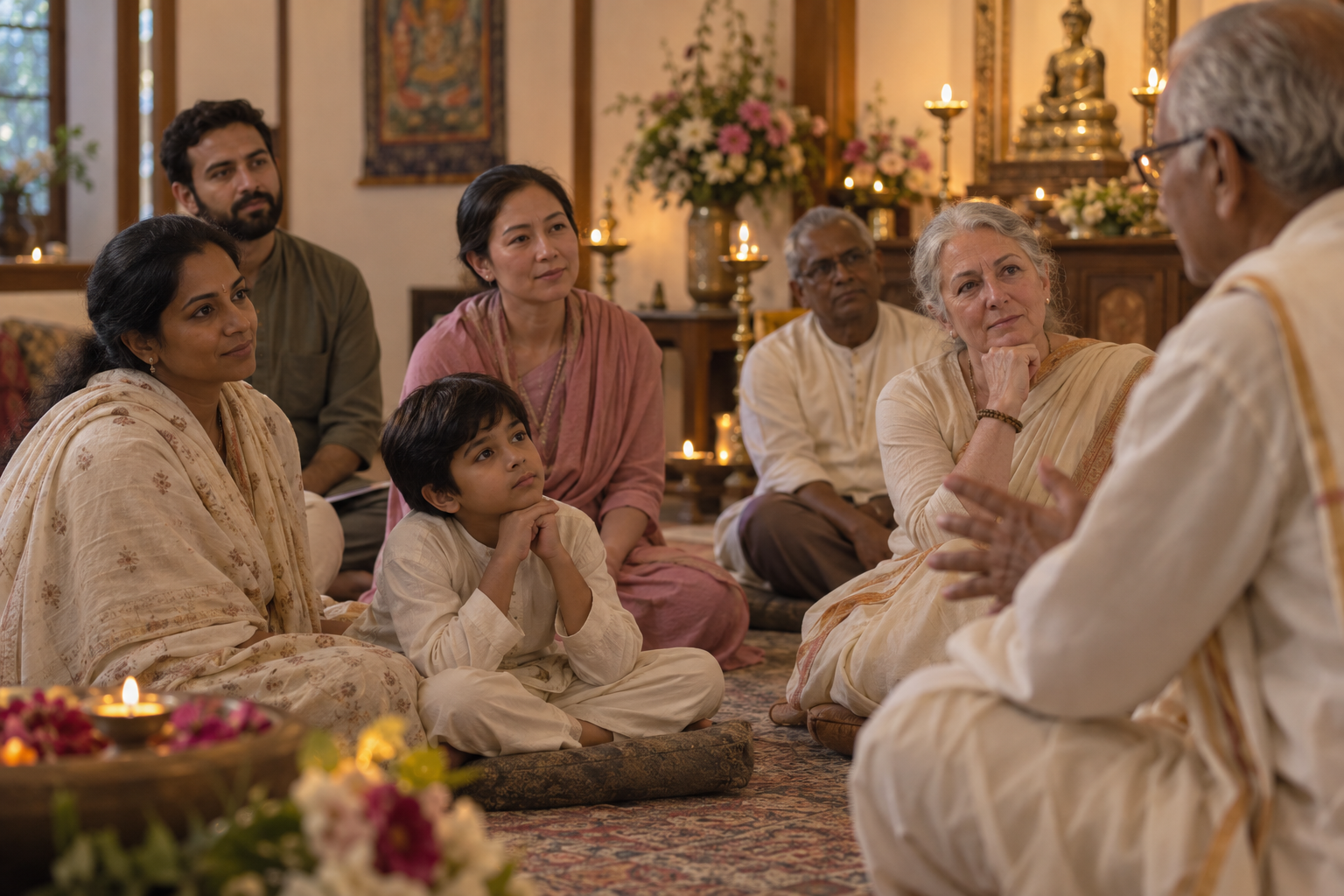
A Vaishnava memorial is more than a sequence of biographical facts. Devotees may speak about character, association, spiritual instruction, service, and the effect a departed Vaishnava had on their own lives. These contributions do not all make the same kind of claim, so listen without flattening them into a single biography.
- Direct recollection: The speaker describes something personally witnessed. Note who is speaking and the setting they identify.
- Attributed recollection: The speaker repeats a memory received from someone else. Preserve that chain of attribution if you later share it.
- Devotional reflection: The speaker draws a spiritual lesson from a life or relationship. Receive it as reflection rather than converting it into an undocumented historical claim.
- Community context: A story may assume knowledge of people, temples, or periods unfamiliar to you. Mark what needs clarification instead of guessing.
A simple notebook can help. Divide your notes into three labels: what was witnessed, what was said about its meaning, and what you want to verify. That preserves both devotional receptivity and factual care.
Key takeaways
- The memorial for His Grace Rupanuga Das, ACBSP, was scheduled to stream live on September 27, 2026, at 1 p.m. EST.
- If you missed the live service, check the original event page for confirmed replay information rather than assuming that every re-upload is authorized or complete.
- Keep direct memories, attributed stories, and devotional interpretations distinct when taking notes or sharing excerpts.
- If you did not know Rupanuga Das personally, participate as a listener; do not write yourself into a relationship you did not have.
- Let the memorial lead to one concrete act of seva instead of ending with passive appreciation.
Offer a remembrance without overstating your connection
If you are invited to speak or leave a written remembrance, clarity matters more than length. A useful contribution tells listeners how you know what you are saying. It does not borrow authority from the affection in the room.
- State the relationship. Say how you knew Rupanuga Das, or explain that you are responding to a remembrance heard during the service.
- Give one bounded memory. Describe the occasion and what occurred without adding motives, private thoughts, or dialogue you cannot verify.
- Name the quality you observed. Connect the incident to a quality such as steadiness, attentiveness, humility, or commitment only when the memory genuinely demonstrates it.
- End with responsibility. State what the example asks you to practice, repair, continue, or take more seriously.
Avoid forwarding private correspondence, confidential counsel, family matters, or personal health details merely because they make a story feel intimate. If another person appears in the memory, consider whether you have the right to identify them. Devotional sincerity does not remove the need for consent and discretion.
If you only encountered Rupanuga Das through the memorial, an honest response is still possible: name the lesson that reached you and the service it prompted. Do not imply a personal association. Truthfulness is itself part of honoring a devotee.
Carry remembrance forward as seva

A memorial can stir admiration without changing conduct. Prevent that by choosing an action before you close the recording or put away your notes. The action should be small enough to begin and clear enough to recognize when done.
- Return to one portion of the service and record the speaker’s name, the memory shared, and the lesson you drew from it.
- Complete a neglected devotional or community responsibility that the memorial brought to mind.
- Ask a knowledgeable devotee to verify an uncertain name, event, or anecdote before you publish it.
- Preserve the event title, date, original link, and speaker information alongside any recording you are authorized to keep.
- Share a lesson in your family, temple, or study circle while clearly distinguishing the speaker’s recollection from your own reflection.
You do not need to manufacture familiarity to take part meaningfully. Locate the memorial through the original event page, give it your undivided attention, and choose the act of service through which its remembrance will continue in your own life.
References

Leave a Reply
You must be logged in to post a comment.