
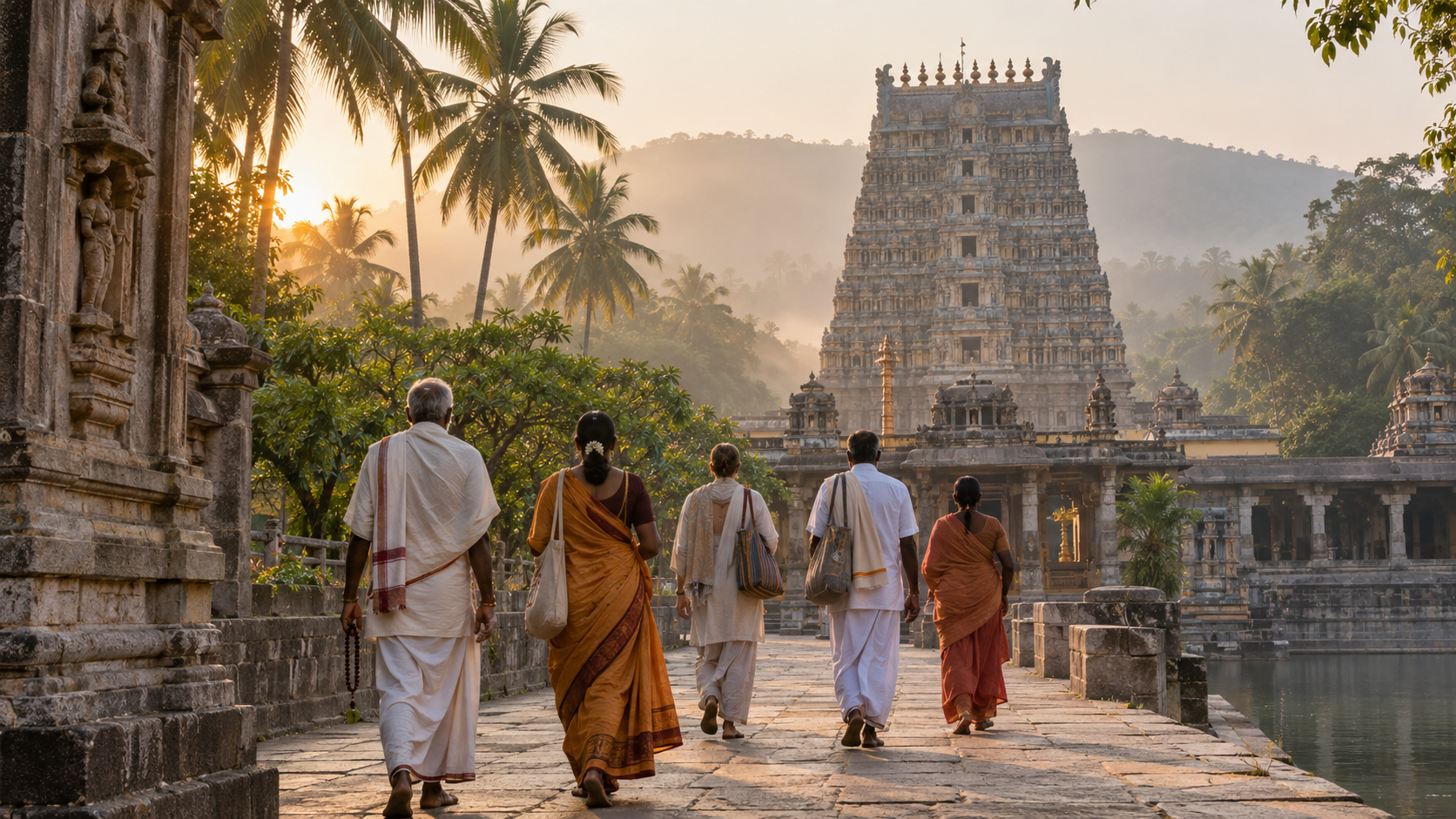
If you are considering a South India pilgrimage, the hard question is not how many famous places you can fit into the journey. It is whether the pace will leave you enough attention for darshan, hearing, prayer and remembrance. A crowded sacred itinerary can still become ordinary tourism if every visit is governed by the next departure time.
A 2027 group yatra led by Kripamoya Prabhu is planned to begin at GEV near Mumbai and continue through Udupi, Mysore, Melkote, Sri Rangam and Kumbakonam. Its stated emphasis is Krishna devotion and the company of fellow devotees. That gives you a useful standard for judging this or any similar journey: the logistics should support the spiritual purpose, not consume it.
Set the purpose before choosing the pilgrimage
Write your reason for going in one sentence before you study rooms, transport or sightseeing options. A clear intention prevents an attractive route from making the decision for you.
- Name the primary aim. You may want to deepen Krishna-bhakti, learn through guided talks, undertake darshan with other devotees, or spend sustained time in sacred places. Choose one as the governing aim.
- Name one secondary aim. This might be understanding South India’s devotional heritage, visiting a place important to your family, or meeting practitioners from another region.
- Name what you are willing to leave out. A pilgrimage cannot remain inwardly spacious if every free period becomes another excursion.
This matters when choosing between a guided yatra and independent travel. A group can provide structure, shared worship, teaching and devotional association. It also means accepting a common timetable and less personal control. Independent travel provides flexibility, but you must arrange the route, verify temple requirements and create your own discipline. Neither form is automatically more spiritual. Choose the form that helps you keep your actual sankalpa.
The devotional orientation matters as well. This 2027 journey has an explicit Krishna-bhakti focus. If that is what you seek, ask how talks, kirtan, reflection and temple visits fit together. If your main interest is comparative sacred history or a broader survey of Dharmic traditions, find out whether the teaching format will serve that purpose. A serious pilgrimage can be rooted in a particular sampradaya without pretending that every sacred itinerary teaches the same theology.
Turn the route into a devotional arc
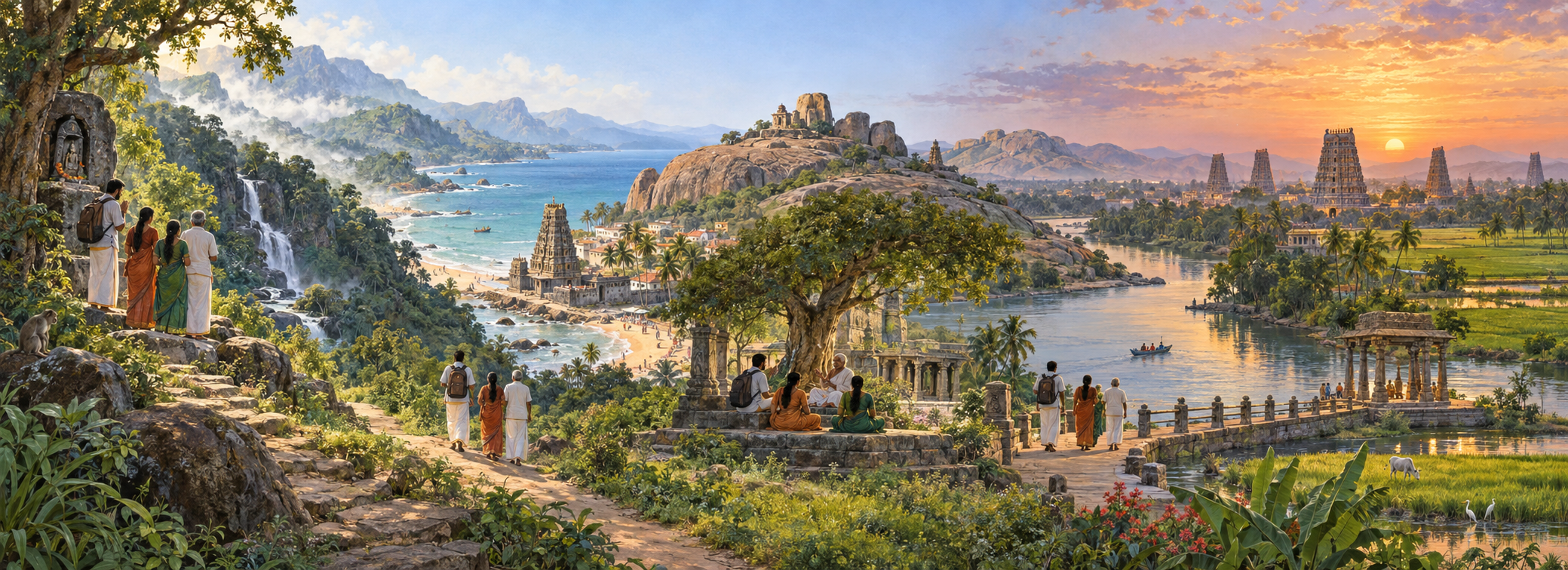
The planned sequence moves from GEV near Mumbai to the holy town of Udupi, the royal city of Mysore, the ancient sacred site of Melkote, the temples of Sri Rangam and the spiritual heartland of Kumbakonam. Do not approach these as six boxes to tick. Give each place a distinct task within the pilgrimage.
- GEV: establish the rhythm. Use the beginning to state your sankalpa, learn the group’s practical discipline and decide what daily practice you will maintain when tiredness or conversation competes for attention.
- Udupi: sharpen the devotional question. Arrive with one question about Krishna-bhakti that you genuinely want the journey to clarify. A precise question will make talks and conversations more fruitful.
- Mysore and Melkote: notice the change of setting. Moving from a royal city to an ancient sacred site is an opportunity to observe how political, cultural and devotional landscapes can stand near one another without being identical.
- Sri Rangam: protect time for temple-centred attention. Do not let the scale or visual richness of a major temple environment reduce darshan to photography. Look first, listen carefully and record impressions later.
- Kumbakonam: consolidate rather than accelerate. At the final destination, review what changed in your understanding or practice. Do not respond to the approaching end by trying to add every possible stop.
Keep a small pilgrimage notebook with one page for each destination. Before arrival, write one question. After darshan, write one detail you want to remember and one practice you intend to carry forward. This is more useful than trying to document everything. It converts movement through sacred geography into sustained attention.
Get written answers before committing money or leave

A route name is not enough for a sound booking decision. The journey is identified as a 2027 yatra, but you should obtain exact departure and return dates before arranging leave, international flights or onward travel. Ask the organiser for written answers to the questions below.
- What are the exact start and finish dates, and at what location and time does the group assemble?
- How many nights are spent at each destination, and how much of each day is likely to be occupied by transfers?
- Which transport, accommodation and meals are included, and which costs remain the traveller’s responsibility?
- Are rooms shared? If so, how are roommates assigned, and is a private-room option available?
- How much walking, standing, stair climbing and luggage handling should a participant be able to manage?
- What temple dress, photography, phone and bag rules should travellers prepare for at each stop?
- What is the daily devotional programme? Ask specifically about talks, kirtan, group prayer, personal reflection and unstructured time.
- How will changes to darshan timings or local access be communicated?
- Can the organiser accommodate dietary, mobility or medical needs in practice, rather than merely in principle?
- What are the payment schedule, cancellation terms and emergency contact arrangements?
If a need is essential, obtain a specific confirmation. For example, “We will try to help” is not the same as an accessible room, suitable transport or a meal you can safely eat. If inclusions, cancellation terms or accessibility remain vague, pause before making a non-refundable commitment.
Pack for repeated temple visits rather than for every imaginable travel scenario. Bring modest clothing that can be adjusted to the requirements communicated for each site, footwear that is easy to remove, a small notebook, essential medicines and a light bag you can manage yourself. Confirm the current rules instead of assuming that one temple’s arrangements apply everywhere.
Use one repeatable practice at every sacred site
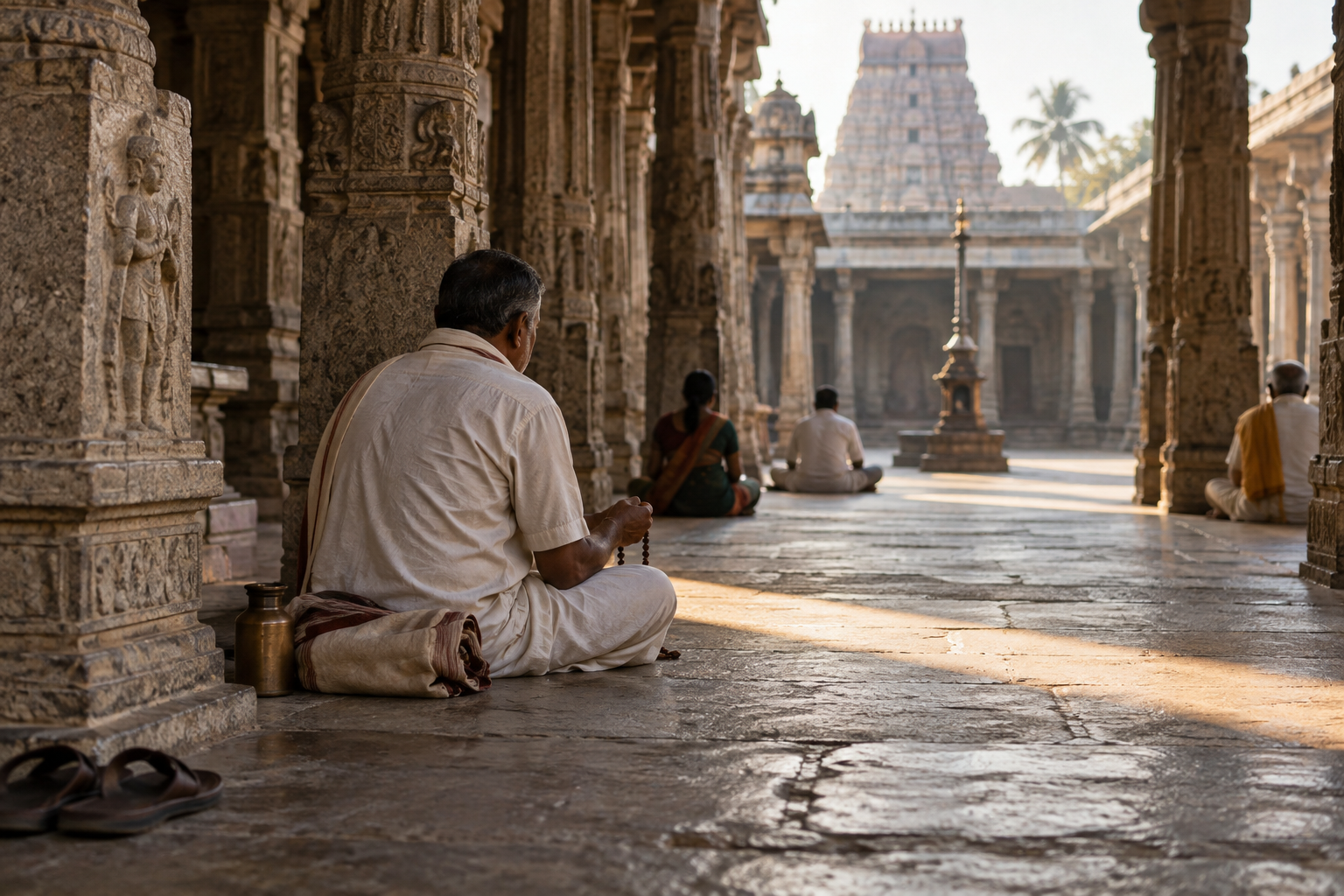
New places produce a great deal of sensory and logistical information. A simple three-part practice keeps that information from displacing the reason you came.
- Before entering, become deliberate. Learn the local instructions, settle your belongings, silence the phone and recall your sankalpa. Decide on one prayer, mantra or question rather than carrying a mental list of demands.
- During darshan, receive before documenting. Follow the local order, avoid obstructing other worshippers and resist the urge to turn every moment into an image. If photography is permitted, it can wait until you have first given the place your undivided attention.
- After darshan, leave space for assimilation. Move aside so others can approach. Sit quietly where permitted, write a few lines in your notebook and postpone casual commentary until the experience has had time to settle.
Devotee association should deepen this practice. Ask fellow travellers what they noticed, compare teachings after reflection and use transfer time for meaningful conversation. Association loses its purpose when the group spends the journey ranking facilities, collecting gossip or complaining about every inconvenience. You do not need to suppress a real practical problem, but raise it with the person who can solve it and then return your attention to the yatra.
Build a small amount of silence into each day, even on a sociable group journey. It can be the first minutes after waking, the period immediately following darshan or the last entry in your notebook before sleep. Without such a boundary, other people’s interpretations can reach you before you have understood your own response.
Key takeaways
- Choose one primary spiritual purpose before comparing itineraries.
- Judge a guided yatra by how well its timetable supports darshan, teaching, practice and devotee association.
- Give every destination a question or devotional task instead of treating all stops alike.
- Verify dates, costs, rooming, physical demands, temple rules and cancellation terms in writing.
- At each sacred site, prepare before entering, receive darshan attentively and reflect before moving on.
Your next step is simple: write your one-sentence sankalpa and send the organiser the practical questions that affect your decision. If the answers leave room for worship, learning and inward attention, prepare for the journey. If the schedule turns sacred places into hurried stops, wait for a pilgrimage whose rhythm matches your purpose.
References

Leave a Reply
You must be logged in to post a comment.