
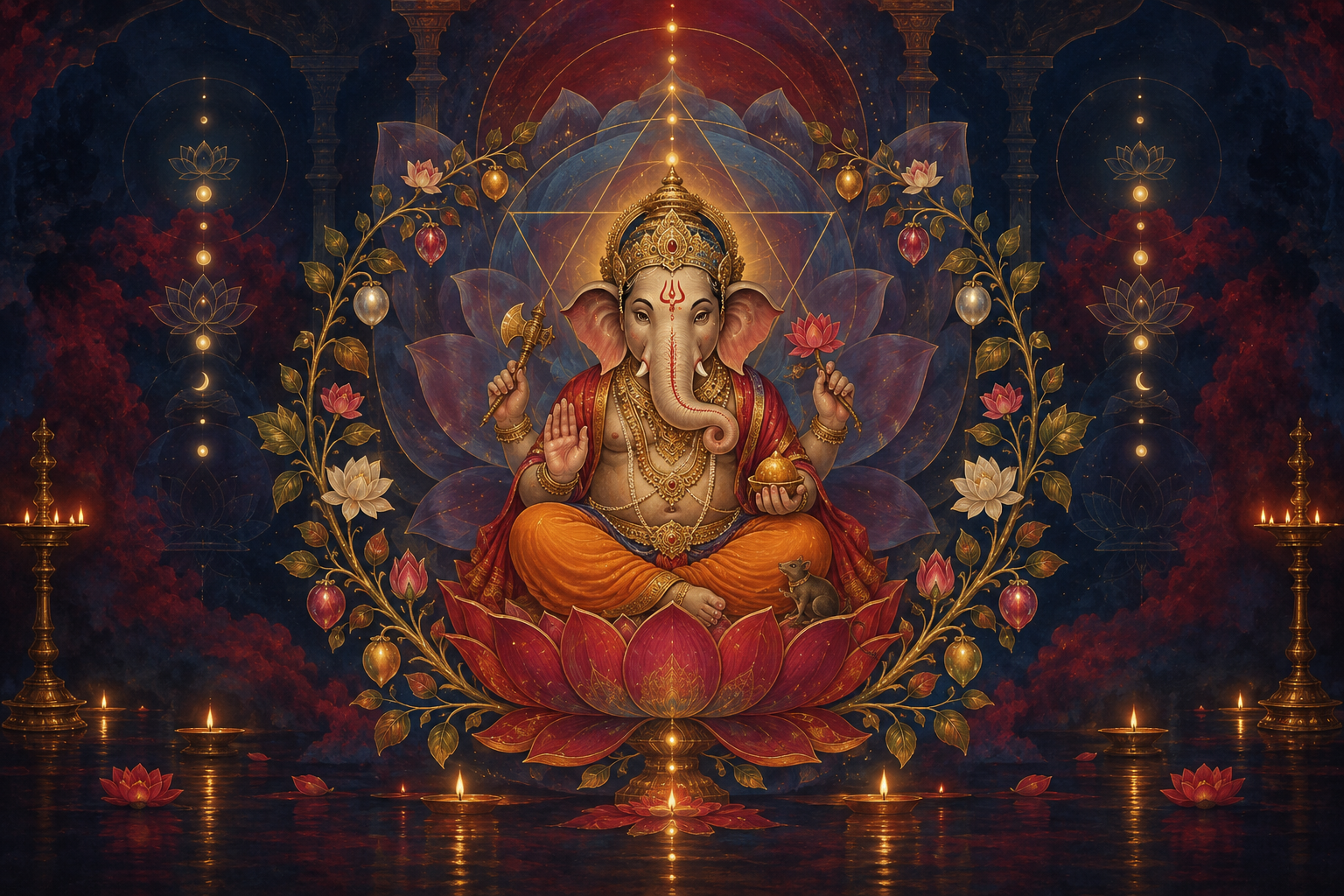
If you have encountered Vancha Kalpalatha Ganapathi in a Srividya discussion and then found Vageshwari described as an eighth chakra or Shakti, you may wonder where both belong on the familiar seven-chakra diagram. The short answer is that neither can be understood safely by adding another deity or lotus to a universal chart.
You need to distinguish a rare form of Ganesha from a lineage-specific way of mapping consciousness. They inhabit overlapping esoteric territory, but that does not make them interchangeable or prove that one presides over the other. Once you keep deity, chakra map, symbolism and ritual function separate, the tradition becomes clearer rather than less mysterious.
Start by asking which chakra map you are looking at

The seven-chakra scheme running from Muladhara to Sahasrara is widely recognised, but familiarity does not make it the only map preserved within Hindu traditions. Chakra systems are not simply anatomical diagrams. They organise contemplative, symbolic and ritual relationships, and different traditions may use them for different purposes.
Certain Kaula and Srividya streams preserve Vageshwari as an eighth Shakti associated with speech, sovereignty and a hidden crown. That claim belongs to a particular esoteric framework. It should not be turned into the universal claim that every practitioner has overlooked an eighth physical energy centre.
The word eighth describes a position within a particular ordering. It does not automatically mean a level superior to every sevenfold system, a recent discovery about the body or an upgrade that should be inserted into every meditation. Before accepting any diagram or practice, ask:
- Which tradition or lineage uses this map?
- Does eighth refer to a chakra, a Shakti, a crown principle or another category within that system?
- Is the map intended for philosophical explanation, contemplation or a transmitted ritual?
- What do speech and sovereignty mean within this teaching, rather than in ordinary conversation?
- Does the teaching explicitly connect Vageshwari with a particular form of Ganesha, or are two nearby ideas being combined by the interpreter?
Those questions prevent a common error: treating every chakra vocabulary as if it came from one standard manual. In Srividya, the name of the map and the purpose for which it is used matter as much as the number of its centres.
What Vancha Kalpalatha Ganapathi actually tells you
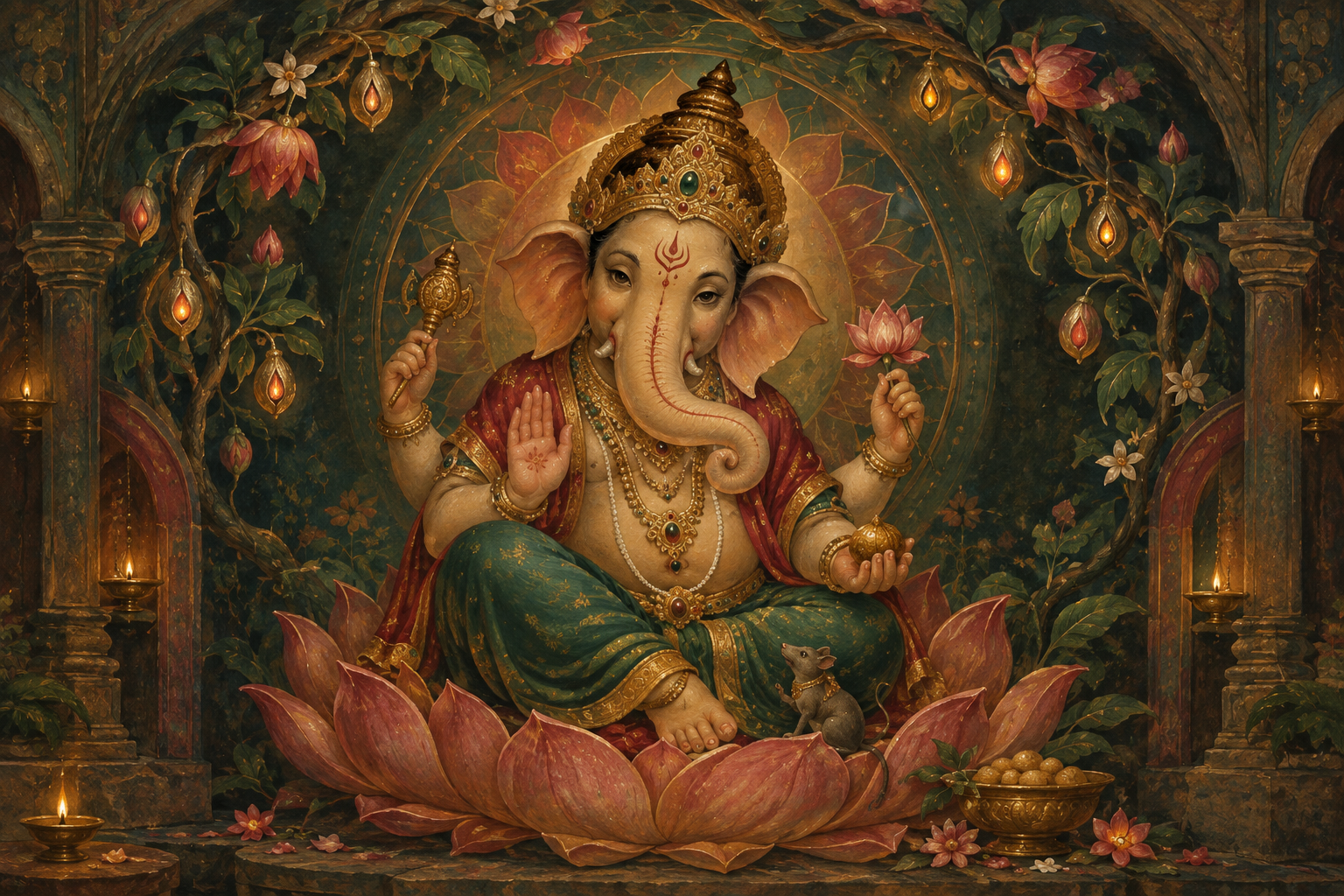
Vancha Kalpalatha Ganapathi is presented as a wish-fulfilling form of Bhagavan Ganesha within Srividya. He is a rare and esoteric form revered mainly among particular devotees in South India, rather than a form commonly encountered in ancient temples or mainstream Ganesha iconography. He has also gained visibility within some spiritual communities.
That limited distribution gives you three important boundaries. First, rarity does not by itself make a tradition false. Hindu practice has always contained regional, familial and lineage-specific forms. Second, present visibility does not establish great antiquity. A sacred form can be meaningful to devotees without being projected backward into every historical period. Third, wish-fulfilling language is devotional language, not a guarantee that every personal desire will be granted on demand.
Ganesha’s familiar relationship with beginnings, obstacles and ordered action makes his presence at the threshold of spiritual work intelligible. But that general understanding does not establish the precise ritual station of every esoteric Ganapathi form. A direct equation such as Vancha Kalpalatha Ganapathi equals the eighth chakra does not follow merely because both appear in Srividya settings.
Keep the categories clear. Vancha Kalpalatha Ganapathi is a deity form carrying a wish-fulfilling devotional meaning. Vageshwari names a hidden principle associated with speech and sovereignty in certain chakra teachings. A lineage may relate such elements in a particular practice, but the relationship must be taught rather than guessed from thematic resemblance.
Read desire, speech and sovereignty as a discipline

You can contemplate the themes publicly without pretending to possess a private ritual. The useful sequence is not a speculative chakra exercise. It is a test of your own intention:
- Name the desire. Replace a vague wish with a precise statement. Ask what would change if it were fulfilled and who else would bear the consequences.
- Identify the obstacle. Distinguish an external obstruction from impatience, confusion, divided effort or unwillingness to accept a limit. Invoking Ganesha should not become a way to avoid this discrimination.
- Examine the speech. Vageshwari’s association with speech directs attention to how desire is formulated and expressed. Ask whether your words are truthful, measured and consistent with the end you seek.
- Test sovereignty as self-command. Before interpreting sovereignty as power over circumstances or other people, ask whether you can govern your own response, promise and action.
- Return the wish to dharma. A desire may be intense and still be poorly ordered. Consider whether fulfilling it would strengthen responsibility or merely reward compulsion.
This reflection does not reproduce a Srividya initiation, reveal a secret technique or replace instruction from a qualified teacher. Its value is more modest and more practical: it stops wish fulfilment from collapsing into magical consumerism, and it stops sacred speech from becoming a slogan for personal power.
The pairing of these themes can therefore be fruitful without being literal. Ganesha turns your attention to the conditions under which action can begin. Vageshwari turns it toward the authority and discipline of expression. The responsible conclusion is not that one deity has been discovered inside a newly numbered chakra, but that desire, obstruction and speech must each be understood within the ritual grammar that joins them.
How to test a Srividya claim before practising it
Esoteric does not mean that every dramatic claim deserves belief. It means that a teaching may depend on context, transmission and disciplined use. When you encounter a rare icon, mantra, visualisation or chakra placement, use the following checks before adopting it:
- Ask for the exact tradition. Srividya is not a sufficient answer if the claim depends on a more specific Kaula, regional or teacher-to-disciple setting.
- Clarify the type of practice. Temple devotion, household worship, philosophical contemplation and initiated ritual are not interchangeable simply because they employ the same divine name.
- Request the relationship, not just the names. Two figures may be analogous, sequential, ritually connected or entirely independent. Proximity in a diagram or online explanation proves none of these.
- Check the status of the chakra language. Determine whether eighth is being used as a precise position within a defined system or merely as a promotional synonym for something higher and hidden.
- Separate attested features from interpretation. The rarity and South Indian devotional presence of Vancha Kalpalatha Ganapathi are different kinds of claims from an alleged mantra, iconographic detail or chakra correspondence.
- Be wary of guaranteed outcomes. Promises of automatic wish fulfilment, instant spiritual rank or power over others replace discipline with sales language.
- Look for boundaries. A trustworthy explanation should tell you what is public, what requires instruction and what it does not establish.
Do not construct a private esoteric practice by collecting disconnected fragments. A genuine element can still be misapplied when its sequence, purpose and interpretive key are missing. You can continue ordinary Ganesha devotion already established in your family or temple life while taking specialised Srividya material to a qualified lineage teacher. Reverence does not require pretending that all sacred knowledge is self-explanatory.
Key takeaways
- The familiar seven-chakra scheme is not an exhaustive catalogue of every map used in Hindu traditions.
- Vageshwari belongs to a particular Kaula and Srividya vocabulary of an eighth Shakti, speech, sovereignty and the hidden crown.
- Vancha Kalpalatha Ganapathi is a rare, wish-fulfilling Ganesha form associated especially with particular South Indian devotees.
- A shared Srividya setting does not prove that this Ganapathi form and Vageshwari are directly or universally paired.
- Public contemplation can examine desire, obstacles, truthful speech and self-command, but lineage-specific ritual should not be reconstructed from isolated descriptions.
- The right question is not only where a figure sits on a chart, but what role it performs in a named tradition.
Your next step is simple: write down the exact claim that brought you here, identify whether it concerns devotion, symbolism or ritual, and ask what named tradition supports the connection. If that information is absent, keep the claim provisional. In esoteric study, refusing to invent the missing link is itself a form of discipline.
References
- Hindu Blog – Vancha Kalpalatha Ganapathi: The Wish-Fulfilling Ganesha of Srividya Tradition
- Hindu Blog – Vageshwari – The Secret Eighth Chakra of the Kaula and Srividya Traditions

Leave a Reply
You must be logged in to post a comment.