
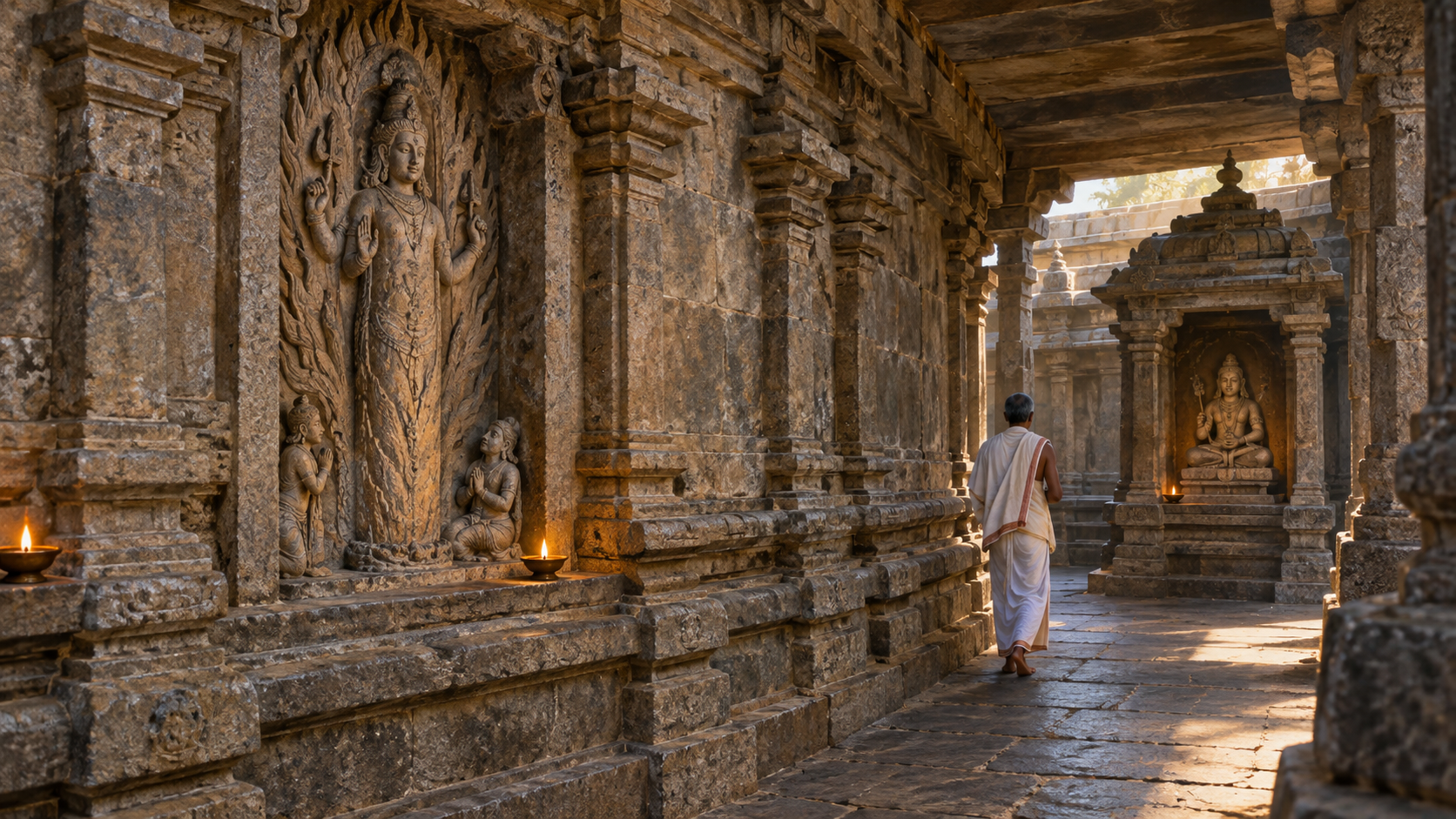
You enter a Shiva temple expecting the linga in the sanctum. Then, while walking around it, you encounter Shiva within a vertical blaze and a separate shrine for a seated devotee. Neither is a decorative afterthought. Lingodbhava reveals what the linga means; Chandesha shows what faithful service to Shiva becomes.
Learning to distinguish those roles changes your visit. You stop treating the temple as a collection of unrelated images and begin reading it as an ordered movement from the immeasurable Divine to the disciplined human response.
Read the temple as arranged theology
A Shaiva temple teaches through placement as well as form. The central linga, the figures around the sanctum, the guardians at thresholds and the shrines of devotees do not all perform the same religious work. Each answers a different question.
- The linga directs attention toward Shiva without reducing him to an ordinary embodied personality.
- Lingodbhava makes the linga’s boundlessness visible through the image of an immeasurable vertical column.
- Threshold guardians mark a transition from ordinary space into consecrated space.
- Chandesha represents devotion entrusted with an enduring place and responsibility within Shiva’s temple.
This distinction prevents two common mistakes. The first is to count every sacred figure as though a temple were displaying a crowd of competing gods. The second is to regard anything outside the central sanctum as secondary ornament. Shaiva iconography works through differentiated relationships: Shiva manifests, attendants guard, devotees serve and pilgrims move among them.
Before trying to identify every sculpture, notice where it stands. Ask whether you are looking at the central object of worship, a manifestation of Shiva, a guardian of a boundary or a devotee incorporated into the temple’s sacred order. Location will often narrow the answer before iconographic details do.
Lingodbhava turns an abstract infinity into a visible encounter
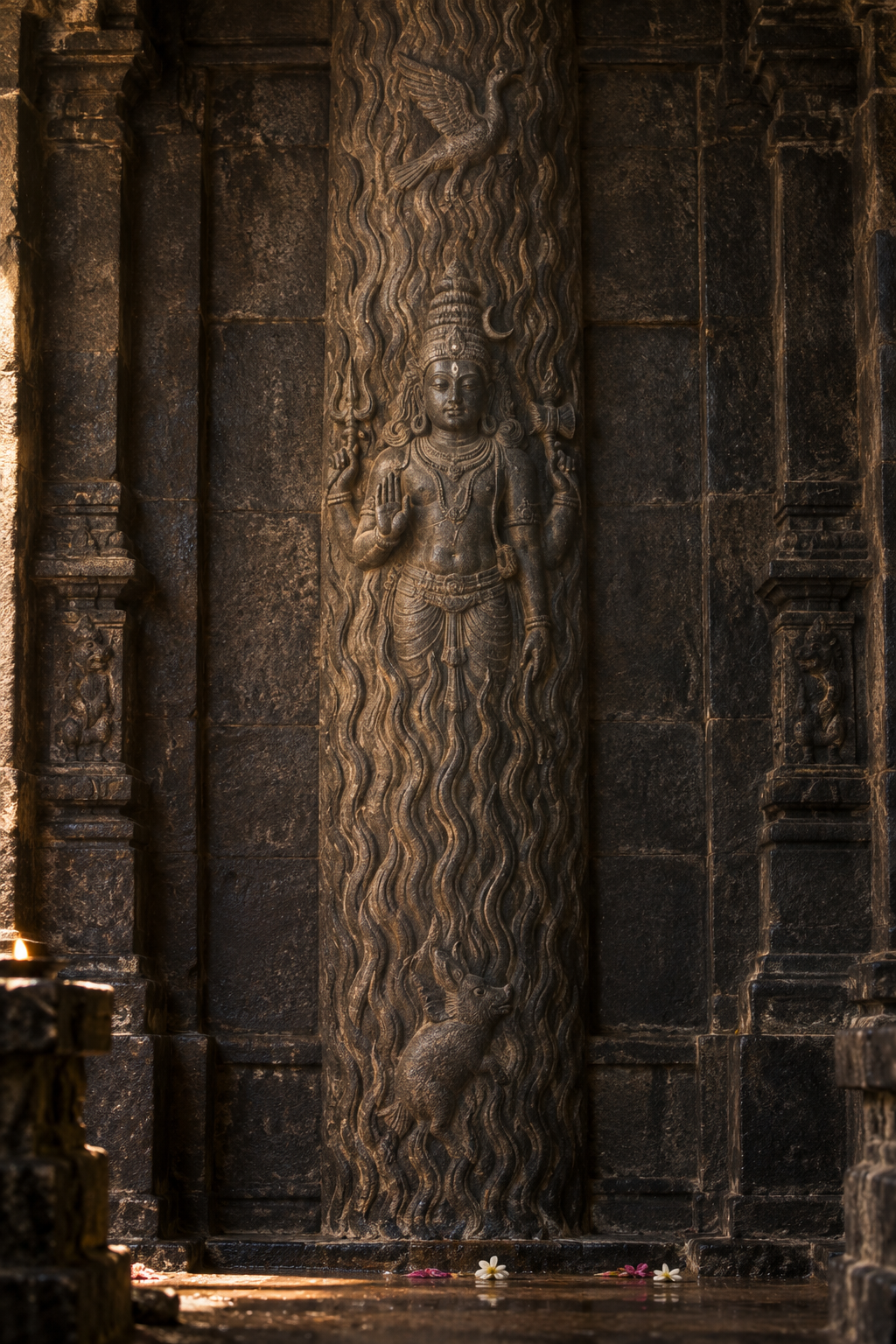
Lingodbhava is Shiva appearing from a column of fire and light that has neither discoverable beginning nor end. The Puranic setting places Brahma and Vishnu amid the primordial waters at the close of a cosmic cycle. Their dispute meets a reality that neither can measure: Shiva as the endless luminous pillar. Versions of this account occur in the Linga Purana, Shiva Purana, Kurma Purana and Vayu Purana.
The practical key is to look at the axis before concentrating on Shiva’s human-like form. If your attention goes immediately to face, hands and ornaments, you may read the image as merely another standing murti. Begin instead with the column. Follow it upward and downward with your eyes. Its implied continuation beyond the sculpted frame is part of its meaning.
Shiva’s emergence does not cancel the linga; it interprets it. Form becomes visible without exhausting the formless reality from which it appears. The image therefore holds together two truths that are easy to separate in speech: Shiva can be encountered in a definite form, yet no definite form contains the whole of Shiva.
When Lingodbhava occupies the rear exterior wall of a sanctum, its placement deserves attention. The linga worshipped inside and the fiery axis represented outside are not rival objects. One receives puja at the temple’s center; the other gives narrative and visual expression to the immeasurability of that center. Temple layouts vary, so follow the actual route and instructions of the shrine rather than forcing a universal map onto every building.
Use the spine comparison as contemplation, not anatomy
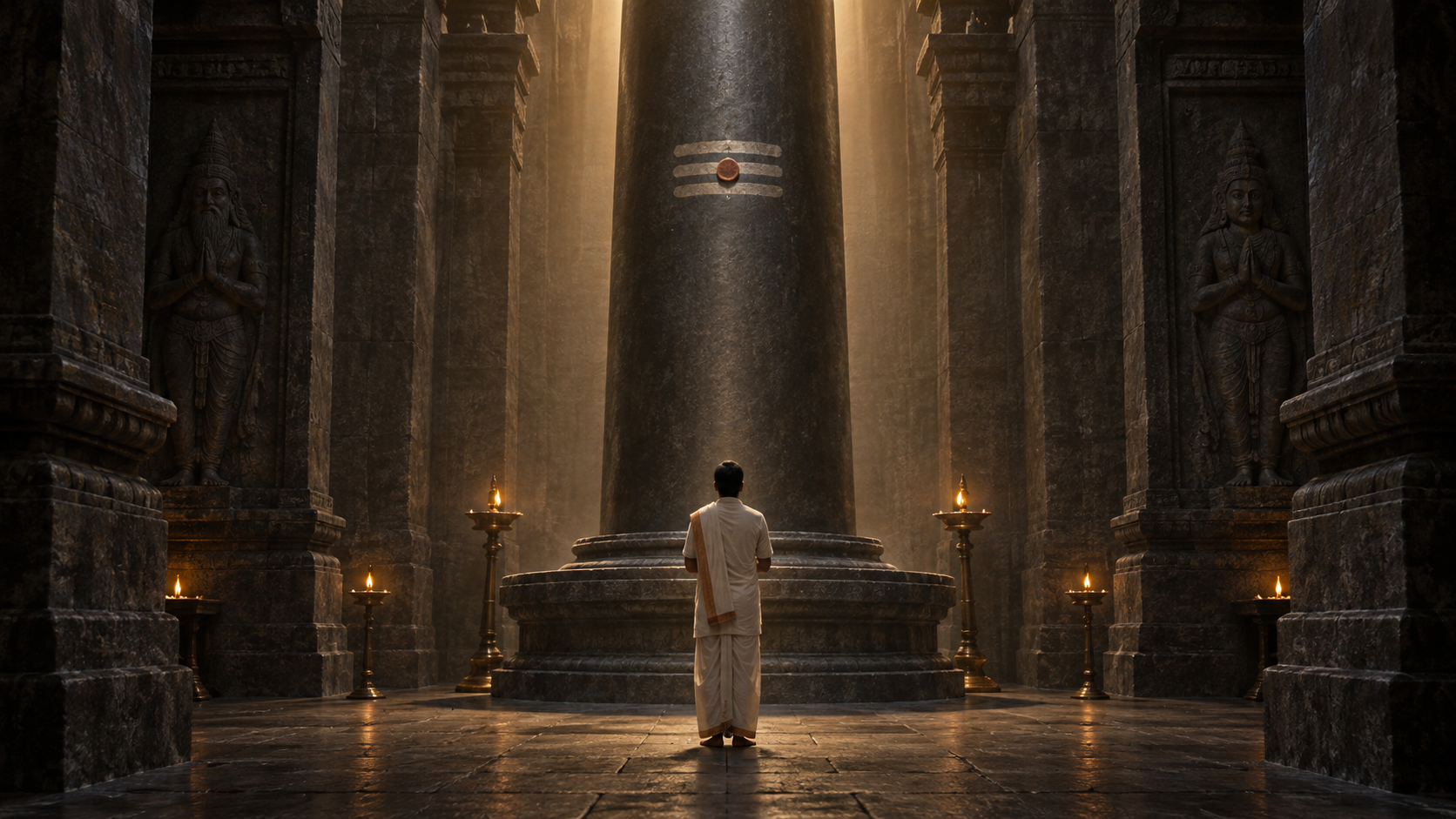
The verticality of Lingodbhava invites comparison with the human spine: an upright axis running through the body, around which posture and orientation gather. That comparison can make the murti personally intelligible. The limitless pillar is no longer only a remote cosmic event; it becomes an invitation to recollect an inner axis amid scattered thought.
Keep the status of the comparison clear. A contemplative analogy is not an anatomical claim, and it does not prove that every sculptor, Agamic tradition or Shaiva lineage intended the same yogic interpretation. It is also not a reason to identify the stone column literally with vertebrae or the spinal cord. The parallel between Lingodbhava and the human spine is most useful when it deepens attention without pretending to settle iconographic history.
You can apply it simply. Stand without strain. Let the body become upright and quiet. Notice the vertical line of your posture while looking at the pillar, then allow the sculpted column to exceed the limits of your mental picture. The movement is from a finite axis you can feel toward an axis you cannot measure. No elaborate physiological theory is needed.
If your guru or lineage teaches a precise yogic reading, receive it within that tradition’s vocabulary and discipline. If not, stay with what the image securely gives you: uprightness, luminosity, emergence and immeasurability. That restraint protects contemplation from turning into invented doctrine.
Chandesha is a devotee entrusted with guardianship
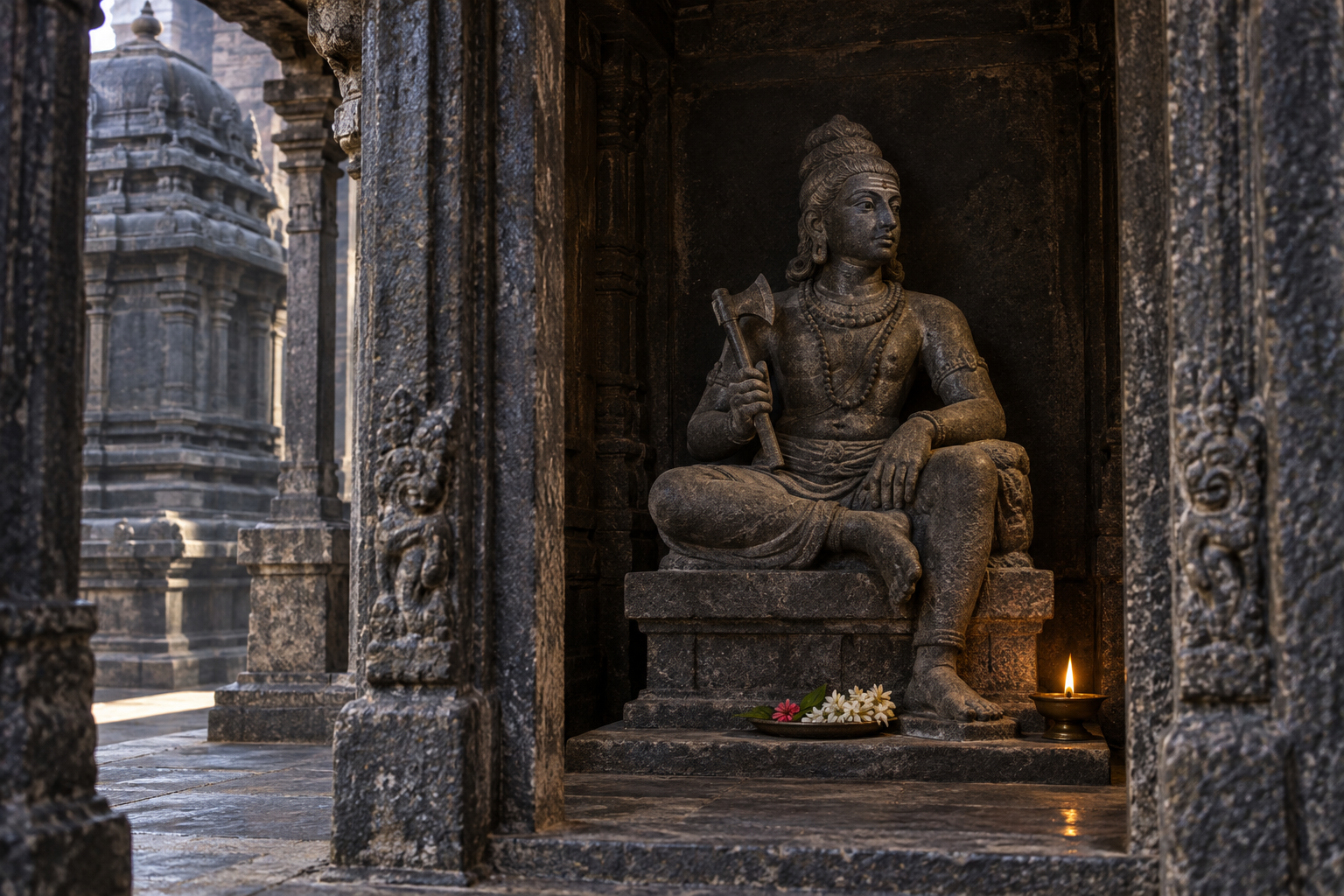
Chandesha, also called Chandikeshvara, occupies a different category. He is one of the sixty-three Nayanars honoured in Tamil Shaivism, but his temple presence is exceptional. In many South Indian Shiva temples, a small shrine dedicated to him stands to the north of the sanctum.
That placement makes a theological claim. Devotion is not left outside after Shiva has been worshipped. A devotee can be drawn permanently into the temple’s sacred order and entrusted with guarding what belongs to Shiva. Chandesha therefore should not be read as an anonymous sentry, a minor deity added to fill space or a substitute form of Shiva.
Nor should he be confused with the imposing dvarapalas positioned at entrances. Dvarapalas guard thresholds. Chandesha has a named devotional identity, a shrine and a remembered life. His story is preserved in Sekkizhar’s twelfth-century Periya Puranam, where he belongs to the Nayanar community rather than to an anonymous class of architectural guardians.
Tamil Shaiva tradition also remembers five Candars as guardian attendants. The plural tradition is a warning against assuming that every guardian figure is interchangeable or that one familiar image exhausts the category. When a temple provides inscriptions, labels or a knowledgeable guide, use them. When it does not, describe what you can actually see rather than assigning a confident name from resemblance alone.
You may observe pilgrims clapping softly, snapping their fingers or making another gesture near Chandesha’s shrine. Explanations and procedures differ, and not every temple expects the same act. Do not copy a conspicuous gesture merely because it looks traditional. Watch the local sequence, ask the priest or an informed devotee when appropriate, and keep the gesture quiet. Reverence is more important than performing a custom whose meaning you do not know.
Chandesha also corrects a shallow understanding of guardianship. Sacred guardianship is not merely the power to exclude. It is stewardship: attention held steady, offerings treated as belonging to Shiva and service protected from carelessness. When you stand before Chandesha, the useful question is not only, “What does he guard?” It is, “What in my own practice have I been entrusted to keep faithfully?”
Key takeaways for your next temple visit
- Look at placement before identification. A figure’s relationship to the sanctum can tell you whether you are seeing a manifestation, guardian or devotee.
- Read Lingodbhava vertically. Attend first to the pillar extending beyond the composition, then to Shiva emerging within it.
- Do not separate form from formlessness. The visible Shiva makes the infinite approachable without claiming to contain it.
- Keep the spine reading modest. Use uprightness as a contemplative aid, not as proof of a universal anatomical or yogic doctrine.
- Find Chandesha north of the sanctum where the layout permits. Recognise him as a Nayanar and guardian attendant, not as an unnamed gatekeeper.
- Follow local practice. Circumambulation routes, gestures and access rules can vary; temple instruction outranks a habit copied elsewhere.
- Carry one question out with you. After contemplating Shiva’s immeasurability, decide what act of worship, responsibility or discipline you will guard with Chandesha-like constancy.
On your next visit, slow down at these two stations. Let Lingodbhava enlarge your understanding of the One you worship, and let Chandesha make your response more exact. The first breaks the conceit that the Divine can be measured; the second asks whether your devotion can be trusted.
References
- Hindu Blog — Shiva Lingodbhavamurti And Human Spine – A Comparison
- Hindu Blog — The Five Candars: Guardian Attendants in Tamil Shaiva Temple Tradition

Leave a Reply
You must be logged in to post a comment.