
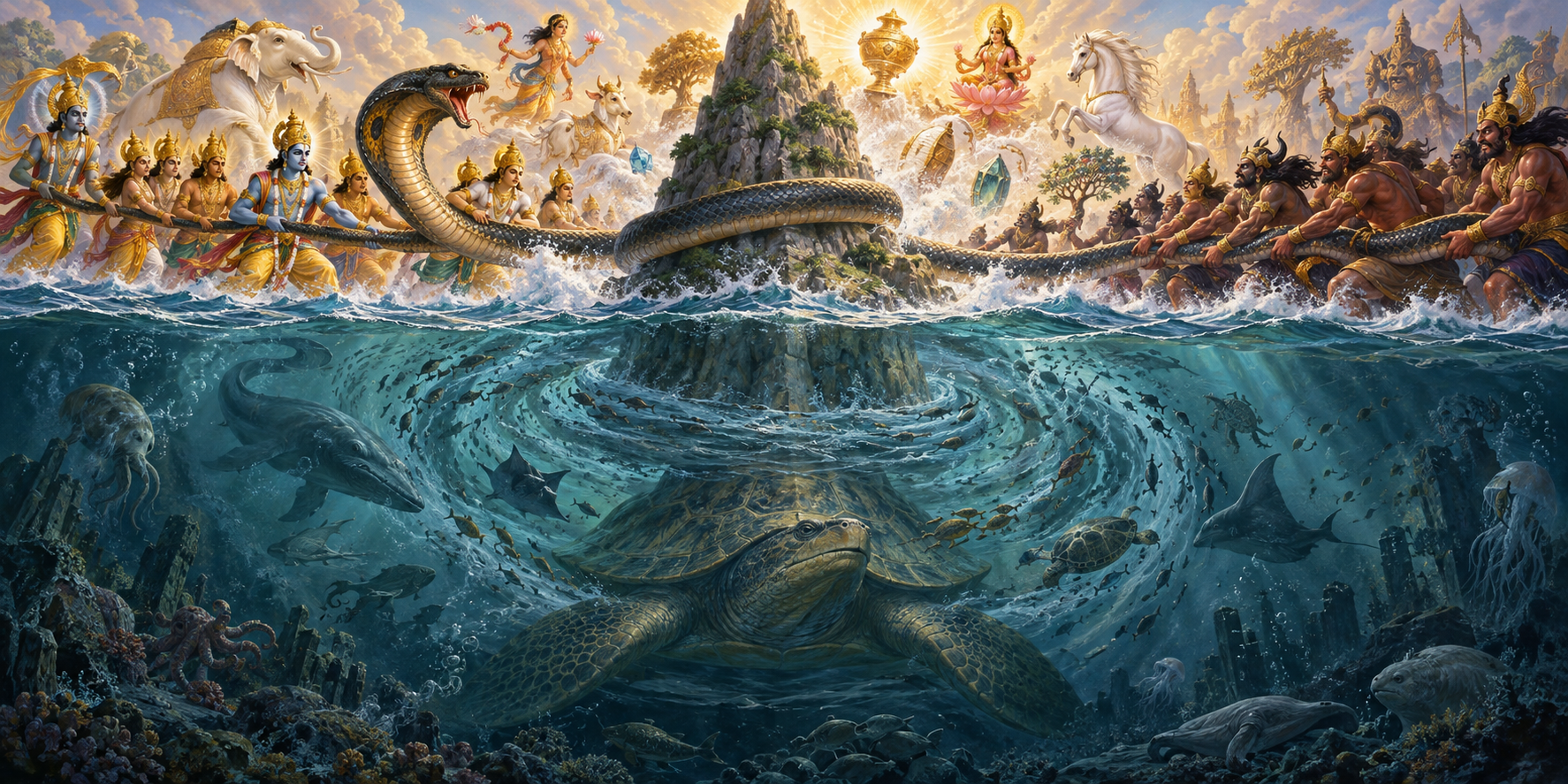
If Samudra Manthan has always sounded like a story of nectar gained and poison contained, one neglected question can change how you hear it: what happened to the lives already in the ocean?
Living creatures perished during the churning. Remembering them does not diminish the sacred narrative. It makes your reading more ethically complete, because dharma cannot be reduced to celebrating a desirable result while ignoring the beings who bore its cost.
The missing victims change the moral centre

Most retellings naturally follow what emerged from the ocean. Amrita commands attention because it is the sought-after nectar. Halahala commands attention because its danger threatens everything around it. The other extraordinary manifestations also draw the eye. The creatures who were harmed are easier to leave outside the frame because they neither sought the prize nor controlled the churning.
That omission matters. If you remember only the beings who act and the objects they obtain, the episode becomes a contest with spectacular rewards. Once you remember the lives caught inside the event, it also becomes a meditation on power, consequence and moral visibility.
The careful claim is not that every recension describes the casualties in the same way, or that the tradition deliberately conceals them. We should not invent a number, a list of species or a scene that the available account does not supply. The sounder point is simpler: living beings suffered within the same churning that produced the celebrated nectar, yet their suffering is often absent from the way the story is remembered.
This changes the question you bring to Samudra Manthan. Instead of asking only, “What came out of the ocean?” ask, “Who paid for what came out?” Amrita remains Amrita, but it is no longer the whole moral ledger.
A dharmic reading can hold achievement and injury together
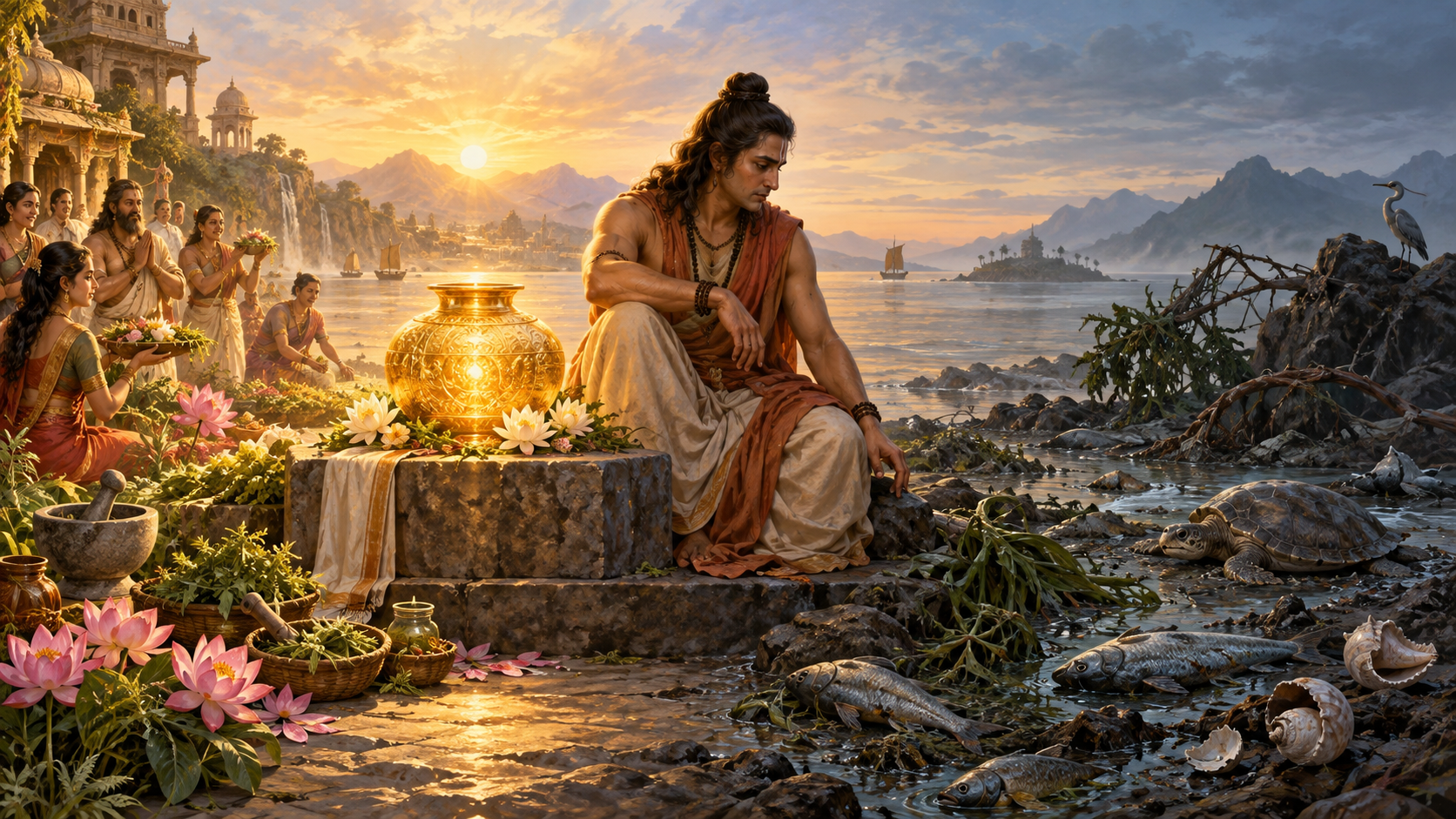
You do not have to choose between reverence for the narrative and concern for its casualties. A mature reading can hold both. Dharmic reflection becomes thinner, not stronger, when reverence is treated as a ban on difficult questions.
Three distinctions help you read the episode without forcing it into a simplistic verdict:
- Purpose is not the same as consequence. The churning had a desired object, but a worthy or necessary aim does not make every consequence disappear. When you assess an action, look beyond what its participants wanted.
- Benefit is not the same as innocence. Something precious can emerge from a process that also causes suffering. Acknowledging the suffering does not require pretending that the benefit was worthless.
- Silence is not the same as insignificance. Beings who receive little narrative attention still possess moral weight. Their absence from the triumphant ending should prompt remembrance, not indifference.
This is where ahimsa becomes more than a slogan. Concern for non-harm is easiest when the victim is visible, named and close to us. The harder discipline is to notice beings who stand outside the main contest but absorb its effects. The ocean creatures occupy precisely that neglected position.
The episode therefore resists two shallow readings. One turns it into an uncomplicated victory and forgets the casualties. The other notices the casualties and declares that the entire sacred narrative has thereby been discredited. Neither response does the intellectual or spiritual work. Dharma asks you to face the cost honestly, weigh actions without evasive certainty and refuse to make vulnerable life disposable in your memory.
Key takeaways
- Samudra Manthan includes not only Amrita, Halahala and wondrous manifestations, but also creatures harmed during the churning.
- Remembering the casualties adds a moral dimension to the narrative; it does not erase its spiritual meaning.
- A beneficial outcome does not cancel the suffering produced along the way.
- Do not embellish the forgotten casualties with unsupported numbers, species or speeches. Honest remembrance is stronger than invented detail.
- When you hear or retell the episode, ask who received the benefit, who bore the disturbance and whose experience vanished from the ending.
How to retell Samudra Manthan without flattening it

If you teach the episode, discuss it with your family or narrate it in a spiritual setting, you can restore the missing ethical dimension without turning the telling into a denunciation. A few deliberate choices are enough.
- Keep the familiar arc. Speak of the churning, the sought-after Amrita, the emergence of Halahala and the remarkable things brought forth. The overlooked suffering makes sense only within the whole event.
- Add one unambiguous sentence. Say that living creatures within the ocean were also harmed and that some perished. Do not hide the fact behind vague language about “disruption.”
- Separate fact from reflection. The casualties belong to the narrative. Questions about responsibility, ahimsa and ecological ethics are interpretations you bring into conversation with it. Marking that difference preserves trust.
- Resist invented precision. If your version does not provide a count or identify particular creatures, do not supply them. The absence of such detail is itself instructive: unnamed life can disappear from collective memory more easily than a famous reward.
- Pause before the triumphant ending. Ask your listeners what changes when the story is viewed from within the ocean rather than only from the side of those doing the churning.
With children, the language can be gentle without becoming evasive: “The churning brought precious things, but it also hurt creatures living in the ocean. What should we learn from remembering them?” With adults, press further: Does responsibility begin only when harm is intended, or also when foreseeable harm is accepted for a desired result?
That second question should remain a question unless the telling you use answers it. The purpose of a responsible retelling is not to force one verdict. It is to prevent moral erasure.
Carry the forgotten lives into your own decisions

Samudra Manthan offers a useful lens whenever a grand undertaking promises something valuable. The analogy must be used carefully: a sacred cosmic narrative is not a direct policy manual, and a modern project is not another Samudra Manthan. Still, the moral questions travel well.
Before judging an undertaking solely by its declared purpose or celebrated result, ask:
- Who is seeking the nectar?
- Who has the power to begin and continue the churning?
- Which living beings bear the disturbance without consenting to it?
- Whose loss will be counted, and whose will remain unnamed?
- Can the harm be prevented, reduced or repaired before the benefit is claimed?
These questions apply especially well when environmental damage is treated as background noise. Human attention tends to follow the visible prize and the powerful actors competing for it. Other life becomes scenery. Remembering the ocean’s casualties trains you to reverse that habit: look first for those who cannot enter the contest but can still be injured by it.
Do this the next time you encounter Samudra Manthan. When the narration reaches Amrita, pause before celebrating. Remember the beings beneath the great action, then ask what dharma demands from anyone who seeks a precious result through a living world. That pause is small, but it restores lives that triumph-centered memory leaves behind.
References

Leave a Reply
You must be logged in to post a comment.