

If you came looking for a neat chart that assigns one Aditya to each modern calendar month, pause before memorising it. The Dwadasha Adityas become much clearer when you separate two related ideas: the older Vedic group called the Adityas and the later vision of Surya manifesting in twelve monthly forms.
That distinction does more than settle a historical question. It gives you a sound way to approach Surya’s annual cycle without reducing it to a list of names. You can see the year as an ordered spiritual discipline: twelve recurring opportunities to notice cosmic regularity, examine your conduct, and bring daily life back into alignment with dharma.
Begin with the two layers of the tradition
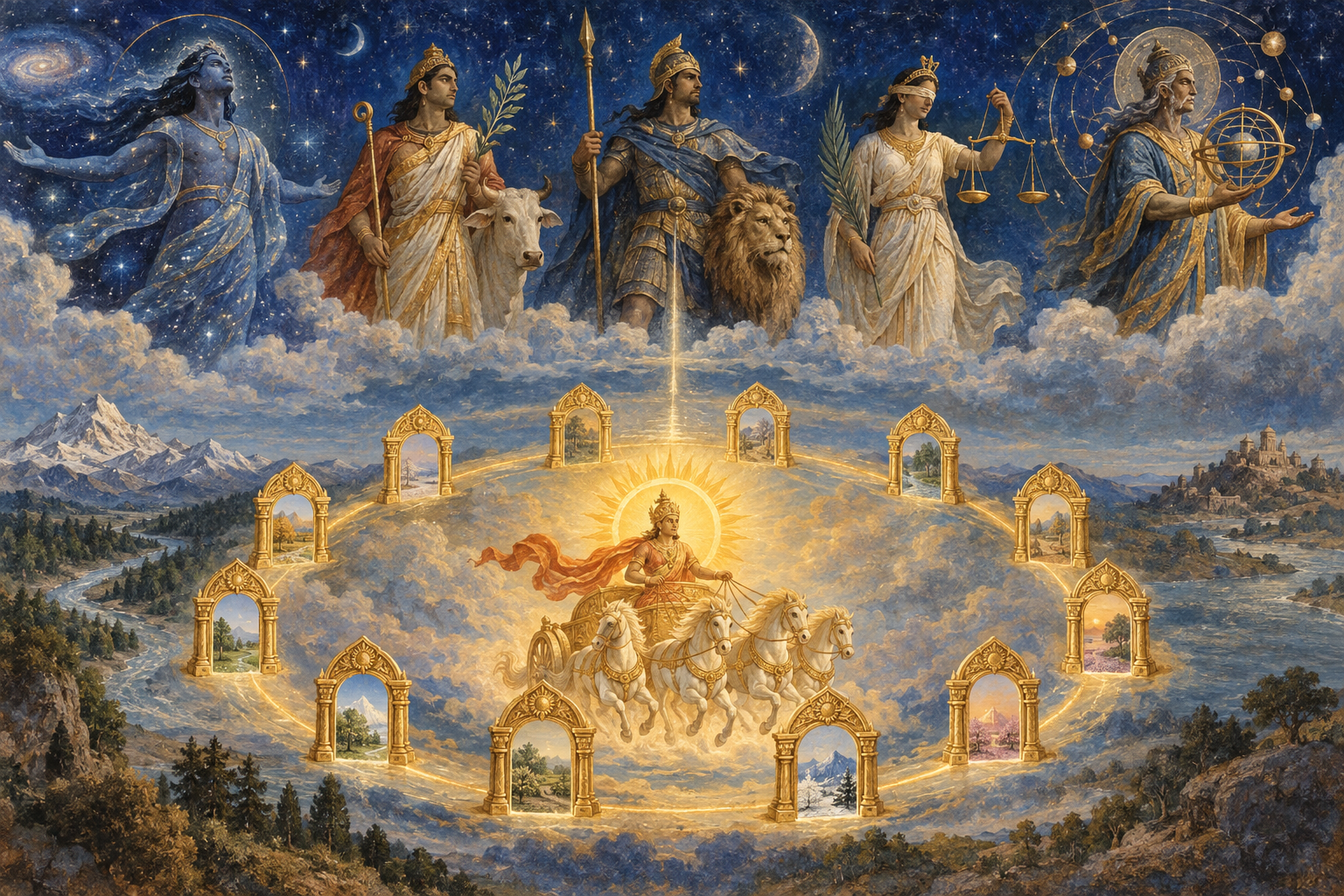
The Adityas did not begin as twelve labels attached to months. In the older Vedic conception, they are celestial beings born of Aditi and Kashyapa, associated with the preservation of rita. Varuna, Mitra, Aryaman, and Bhaga are among the names connected with this group.
Rita is both cosmic and moral order. It is the intelligible regularity by which the world holds together, but it also concerns the right ordering of human life. The recurring dawn, the dependable course of the Sun, truthful dealing, fulfilled obligations, and relationships governed by proper limits belong to one moral vision: reality is sustained through order rather than caprice.
The later twelvefold presentation places that insight within the annual journey of Surya. Each month becomes associated with a particular manifestation of solar divinity. This is not a claim that twelve physical suns take turns in the sky. It is a sacred way of recognising one divine radiance through the changing conditions and responsibilities of a complete year.
Keep both layers in view. If you read every early reference to an Aditya as though it were already part of a monthly chart, you collapse distinct stages of the tradition. If you dismiss the monthly forms because they are later, you miss how Hindu practice makes an ancient principle inhabitable. The earlier layer establishes the theology of sustaining order; the annual cycle turns that theology into lived time.
Why one Surya is contemplated through twelve forms
You encounter the same Sun each day, yet you do not encounter the same year each day. Heat, rain, cultivation, travel, ritual schedules, food, work, and family duties change with the seasons. The twelvefold form allows continuity and change to be held together: Surya remains Surya, while the world receiving his light moves through different conditions.
This is the practical value of the word manifestation. A manifestation does not have to replace or divide its source. It discloses an aspect of that source in a particular setting. The monthly Aditya can therefore be approached as the form in which solar power is contemplated at one station in the yearly cycle.
The number twelve matters because the practice is annual rather than occasional. A single observance can produce a strong mood and then disappear. Twelve returns require steadiness. They make you revisit the same central question under changing circumstances: what does alignment with order require from you now?
This also corrects a common misunderstanding of Hindu sacred time. A calendar is not only a container for festivals. It can train perception. The Sun’s regular movement gives you an external rhythm against which to examine your own regularity. Are your promises dependable? Are duties completed at the right time? Does your household preserve practices that connect gratitude, restraint, worship, and work? Surya’s cycle makes those questions concrete because it does not wait for a convenient mood.
The Dwadasha Adityas are therefore better understood as a framework of recurring attention than as twelve isolated divine personalities competing for notice. The unity is as important as the plurality. One radiance sustains the cycle; twelve forms prevent your contemplation of that radiance from becoming static.
A disciplined way to follow Surya through one year
Set up the observance before collecting names
If your family, temple, guru-parampara, or regional panchanga gives a sequence of monthly Adityas, follow that established sequence consistently. Do not combine the names from one system, month boundaries from another, and interpretations from a third merely to create a fuller-looking chart. A coherent inherited practice is more useful than an impressive but unsupported compilation.
If you have not received a particular sequence, you can still begin responsibly. The following method is a framework for attention, not a claim of scriptural prescription:
- Choose your calendar authority. Use one trustworthy regional panchanga or the calendar followed by your temple. Note whether the observance is organised by solar months, another traditional reckoning, or a lineage-specific rule. Do not simply equate the twelve forms with January through December.
- Mark all twelve transitions at once. Enter them in your calendar for the whole year. This prevents the practice from depending on whether you happen to remember at the start of a month.
- Use one stable form of worship. Keep the core simple: cleanliness, a respectful salutation to Surya, water offered according to your tradition, a known Surya prayer or stotra, and a few minutes of reflection. If Aditya Hridayam is already part of your practice, it can serve as that stable element. Do not invent a mantra or ritual rule and then present it as inherited authority.
- Add the month’s recognised Aditya only when verified. Record the name exactly as your chosen tradition gives it. If no reliable assignment is available, honour Surya without pretending certainty.
- Make one measurable commitment to order. Choose something small enough to sustain until the next transition: performing a daily prayer at its appointed time, completing one neglected duty, keeping a promise, correcting disorder in household accounts, or restoring regularity to study.
- Review before moving forward. At the next transition, write down whether the commitment was kept, what interrupted it, and what must change. The review turns a pleasant monthly ritual into an annual discipline.
A simple notebook is enough. Give each monthly entry four lines: the Aditya named by your tradition, the calendar boundary used, the duty you chose, and the result. After twelve entries, you will have something more valuable than a memorised table: a record of how sacred time affected your conduct.
Use four questions to connect worship with rita
When the month changes, ask the same four questions. Repetition is intentional; the circumstances and answers will change even when the questions do not.
- What is becoming visible? Surya reveals. Identify one fact, duty, or consequence that you have avoided seeing clearly.
- What needs regularity? Select one practice whose value depends on timing and repetition rather than intensity.
- What sustains me? Name the people, natural conditions, inherited knowledge, and forms of labour on which your life depends. Express gratitude through a concrete act rather than a private feeling alone.
- What must I uphold? Connect the month to one obligation involving truthfulness, reciprocity, restraint, care, or timely action.
These questions do not assign invented attributes to particular Adityas. They help you apply the governing principle of rita while leaving specific names and theological meanings with the tradition that transmits them.
Avoid the shortcuts that distort the cycle
- Do not force the sequence onto the Gregorian year. January is not automatically the first station of a traditional twelvefold solar observance. Follow the calendar basis actually used by your community.
- Do not treat every list as equally authoritative. Ask where a sequence comes from and whether its month names follow the same calendar you are using.
- Do not flatten the Adityas into aliases. The older Vedic group and the later monthly manifestations are connected, but they are not interchangeable descriptions.
- Do not turn a full-year vrata into name collecting. If learning another name leaves your conduct unchanged, the calendar has become trivia rather than discipline.
- Do not abandon a sound family practice for an attractive online chart. Bring questions to a knowledgeable teacher, priest, or lineage authority before replacing what has actually been transmitted to you.
- Do not turn Surya worship into sun-gazing. Looking directly at the Sun can injure your eyes. A devotional salutation does not require staring at the solar disc.
Key takeaways
- The Vedic Adityas precede their later identification with the twelve months; begin by respecting that historical distinction.
- Varuna, Mitra, Aryaman, Bhaga, and other Adityas belong to an older vision centred on the preservation of rita, the cosmic and moral order.
- The monthly forms of Surya allow one divine radiance to be contemplated through the changing conditions of an entire year.
- Use one lineage, temple calendar, or regional panchanga consistently rather than assembling an unverified hybrid sequence.
- Pair every monthly observance with one specific duty that can be reviewed at the next transition.
- If you cannot verify a month’s assigned name, worship Surya without inventing certainty.
Let the cycle change how you keep time
The most useful first step is not to find the longest possible list. Find the calendar and practice that genuinely belong to your family, temple, region, or sampradaya. Mark the next transition, choose one sustainable form of Surya worship, and attach it to one duty you can actually complete.
Then continue for twelve transitions. The Dwadasha Adityas disclose their practical depth when the year stops being an empty succession of dates and becomes a repeated invitation to see clearly, act at the proper time, and uphold the order on which shared life depends.


References

Leave a Reply
You must be logged in to post a comment.