
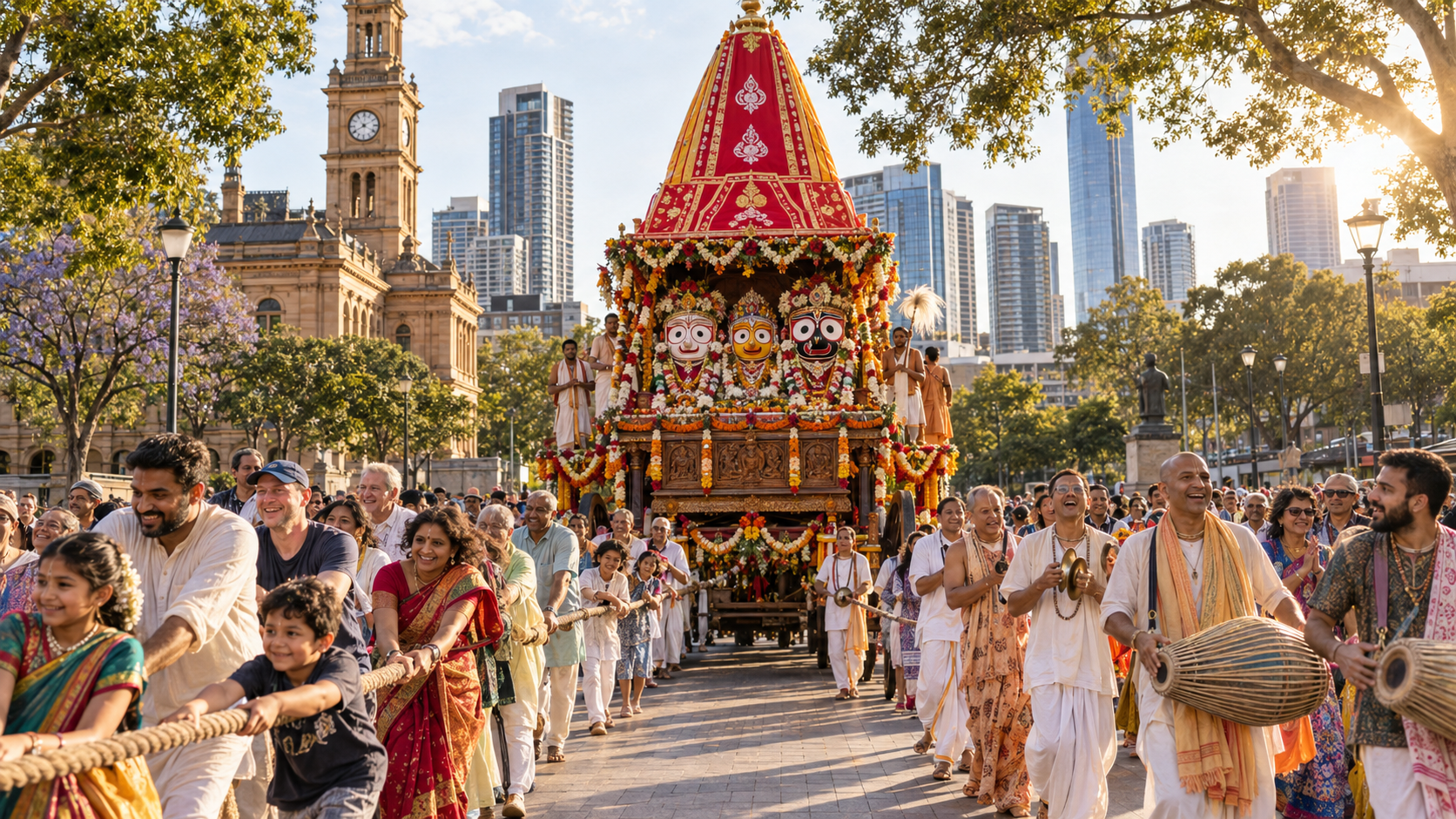
If you encountered Parramatta Rathayatra through a photograph, a procession in the street, or the sound of kirtan, you may be wondering what actually took place and whether someone unfamiliar with the tradition could meaningfully join it. The clearest answer is that this was both a devotional observance and an open civic event.
Parramatta’s second Rathayatra brought a parade, spiritual teaching, congregational chanting, and prasadam into the town square. That combination matters. It allowed people to encounter dharma through movement, sound, reflection, and a shared sacred meal rather than requiring them to understand everything before approaching.
What happened at the second Parramatta Rathayatra
Devotees organised Parramatta’s second Rathayatra parade and festival in the town square. Local councillors came to support the occasion, and His Holiness Jayadvaita Maharaja addressed the gathering from the stage. After the procession, participants continued with kirtan and prasadam.
It is easy to see only the most visible element: a religious procession passing through an urban centre. But the full sequence reveals the event’s purpose:
- The parade carried devotion into a space shared by the wider public.
- The stage address gave people an opportunity to hear and reflect, not merely watch.
- Kirtan changed the gathering from an audience into a participating congregation.
- Prasadam completed the occasion through hospitality and the respectful sharing of food offered in worship.
These are not interchangeable attractions added to fill a programme. Together they express a recognisable devotional movement: the sacred comes into public view, people hear about its meaning, voices gather in remembrance, and food is shared as grace.
Why the Parramatta setting carries unusual weight
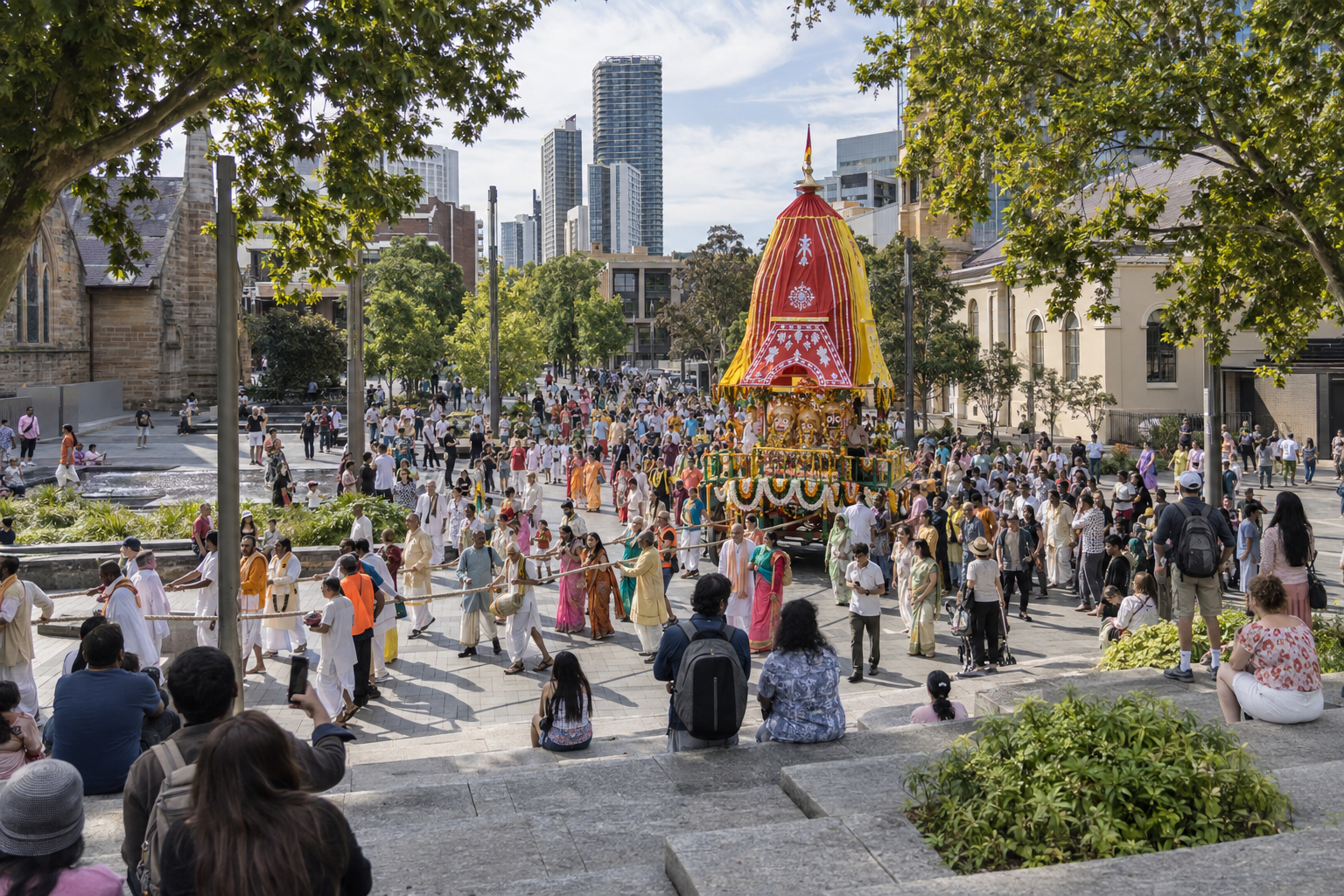
Parramatta is not a remote venue selected only for convenience. It is a major commercial centre in Greater Western Sydney, about 24 kilometres west of Sydney’s central business district, and is commonly regarded as metropolitan Sydney’s second CBD. A Rathayatra in its town square therefore places a living Dharmic tradition within the ordinary civic life of the region.
That distinction is important. A temple invites you to cross a threshold into a deliberately sacred setting. A public procession reverses the direction: worship moves outward and becomes visible to people who may never have planned a temple visit. You might first encounter it as colour, music, or movement, but you are also being offered a doorway into devotional life.
The attendance of local councillors should also be understood precisely. Their presence showed public support for the festival and the community holding it. It does not, by itself, establish council funding, formal sponsorship, or agreement on every religious proposition. The meaningful point is simpler: Dharmic practice was received as a legitimate part of the city’s public life.
For Hindu communities outside Bharat, that public legitimacy matters. Visibility should not mean diluting a festival until it becomes a generic multicultural performance. Nor should civic recognition become the festival’s spiritual centre. Parramatta’s combination of procession, teaching, kirtan, and prasadam kept devotion at the centre while allowing the wider city to meet it openly.
The devotional grammar behind the procession
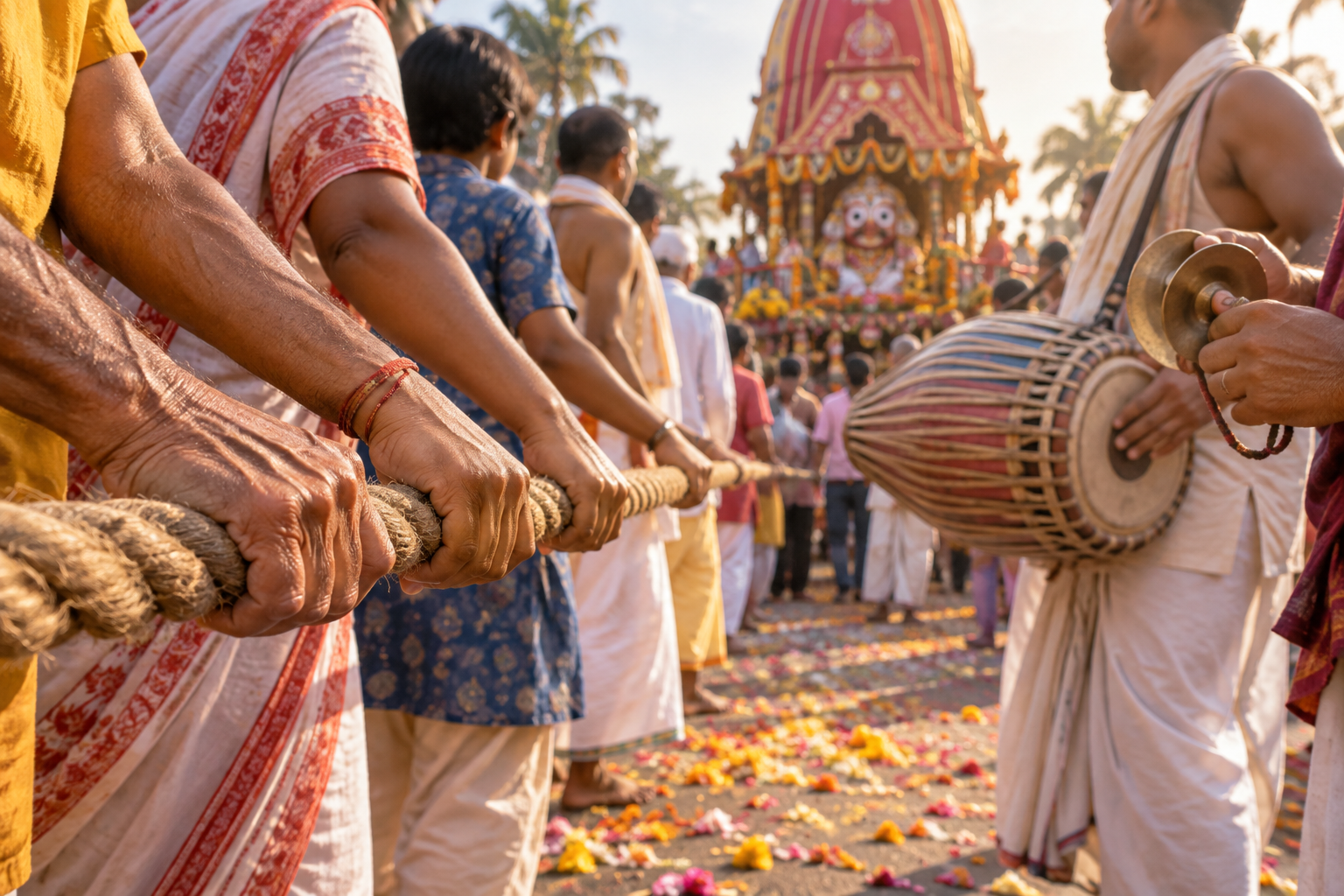
Rathayatra is often encountered first as spectacle, but its inner logic is relational. Sacred presence is not kept at a distance. It comes out among the people, while the people respond through attention, movement, chanting, and service.
- Seeing becomes darshana. You do not need to treat the procession as an exhibit to be decoded from the outside. In Dharmic practice, seeing the sacred and presenting yourself before it can itself be a form of participation.
- Listening gives the celebration context. A spiritual address helps connect the public event with the devotional understanding that sustains it. Staying for the teaching can reveal what the visual procession alone cannot explain.
- Kirtan makes participation accessible. Its call-and-response form allows you to listen for a phrase and answer when comfortable. Perfect pronunciation is not an admission requirement; attentive participation matters more than performance.
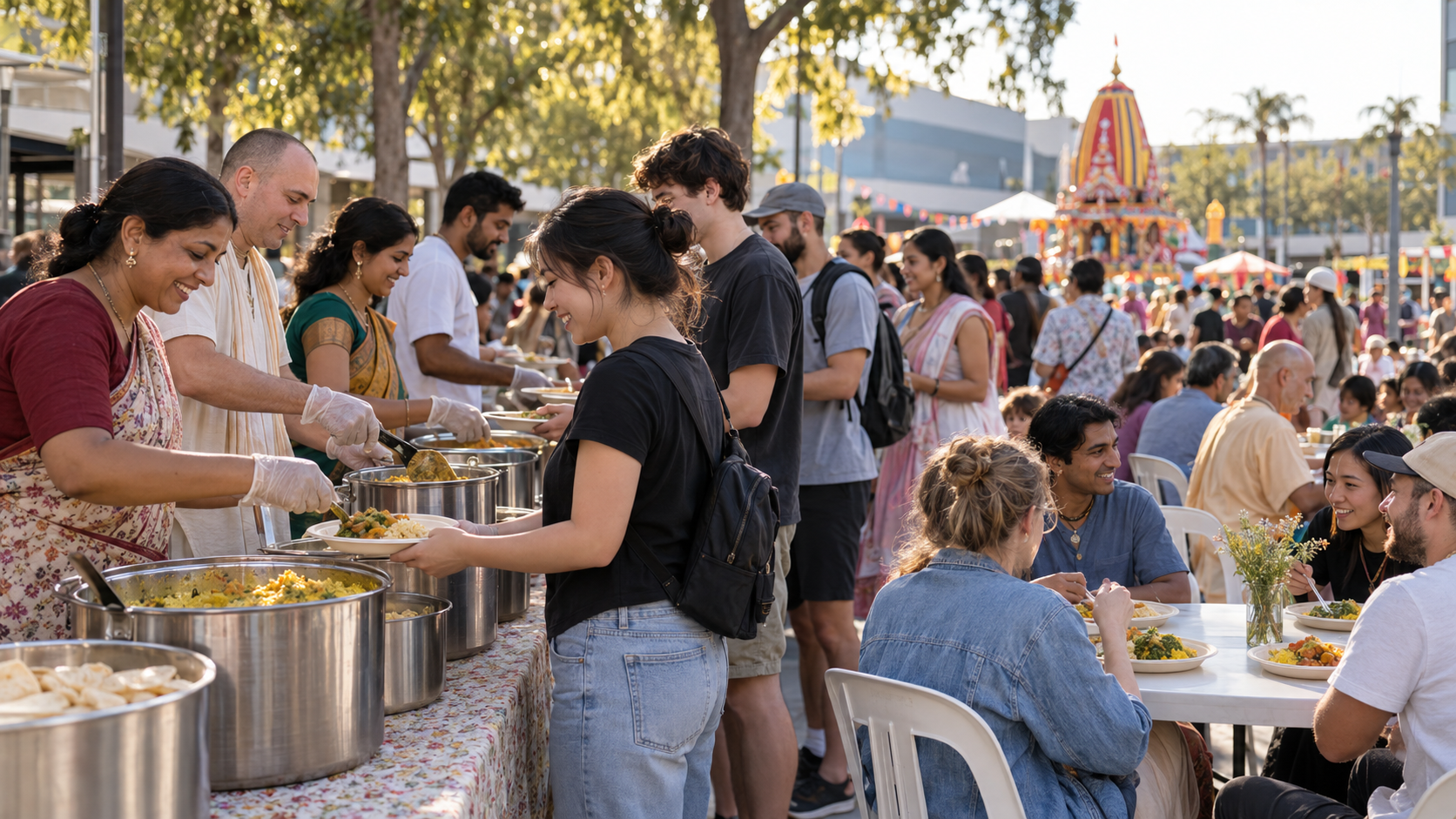
- Prasadam turns hospitality into practice. It is not simply catering after the main event. Food offered in worship and then shared is received with gratitude, linking spiritual remembrance with an everyday human act.
This is why leaving as soon as the chariot or procession has passed can mean missing much of the festival. The movement through the street attracts attention, but the gathering that follows helps turn curiosity into understanding and spectatorship into relationship.
How to take part if Rathayatra is new to you
You do not need prior knowledge, Indian ancestry, or mastery of ritual language to attend respectfully. You do need to recognise that you are entering a devotional occasion rather than consuming a street performance. A few practical choices make that difference visible.
- Verify the current arrangements before travelling. The completed second festival does not establish the date, route, assembly point, or accessibility arrangements of any future Rathayatra. Check a current announcement from the local organisers rather than treating an older festival account as a timetable.
- Follow the procession without obstructing it. Take your cues from event stewards and regular participants. If there are ropes, restricted areas, or instructions for joining the procession, wait to be invited or directed.
- Join kirtan at your own pace. Listen to the lead singer, notice the response, and repeat what you can. You may also listen quietly. Respectful attention is better than self-conscious imitation.
- Remain for the spoken programme. The stage address is where a first-time visitor may gain the context needed to understand why the procession, chanting, and food belong together.
- Receive prasadam respectfully. Take only what you expect to eat and avoid wasting it. If you have a food allergy or dietary restriction, ask about the ingredients before accepting a serving; sacred regard does not require you to disregard a medical risk.
- Ask specific questions. Instead of asking someone to explain all of Hinduism, ask what the procession represents, what is being sung, or why prasadam is offered. Focused questions are easier to answer and often open a better conversation.
If you already belong to the community, your conduct helps determine whether newcomers can cross the distance between watching and participating. Clear directions, patient explanations, orderly movement, and generous hospitality are not secondary logistics. In a public Rathayatra, they are forms of seva.
Key takeaways
- Parramatta has now hosted a second Rathayatra, giving the festival the beginnings of continuity rather than leaving it as a one-time appearance.
- The town-square location placed Dharmic worship in one of Greater Western Sydney’s most important civic and commercial centres.
- Support from local councillors signalled civic welcome, while the procession, spiritual address, kirtan, and prasadam preserved the event’s devotional character.
- A newcomer can participate meaningfully by following event guidance, listening to the teaching, responding to kirtan when comfortable, and receiving prasadam with care.
- The festival’s significance should not be measured only by the visibility of its parade. Its deeper achievement lies in creating an accessible path from public encounter to devotional participation.
When you next encounter a Rathayatra, do not remain at the edge simply because the tradition is unfamiliar. Confirm the practical details, enter respectfully, stay beyond the procession, and allow the teaching, kirtan, and prasadam to show you why the chariot journey belongs in the heart of a modern city.
References

Leave a Reply
You must be logged in to post a comment.