
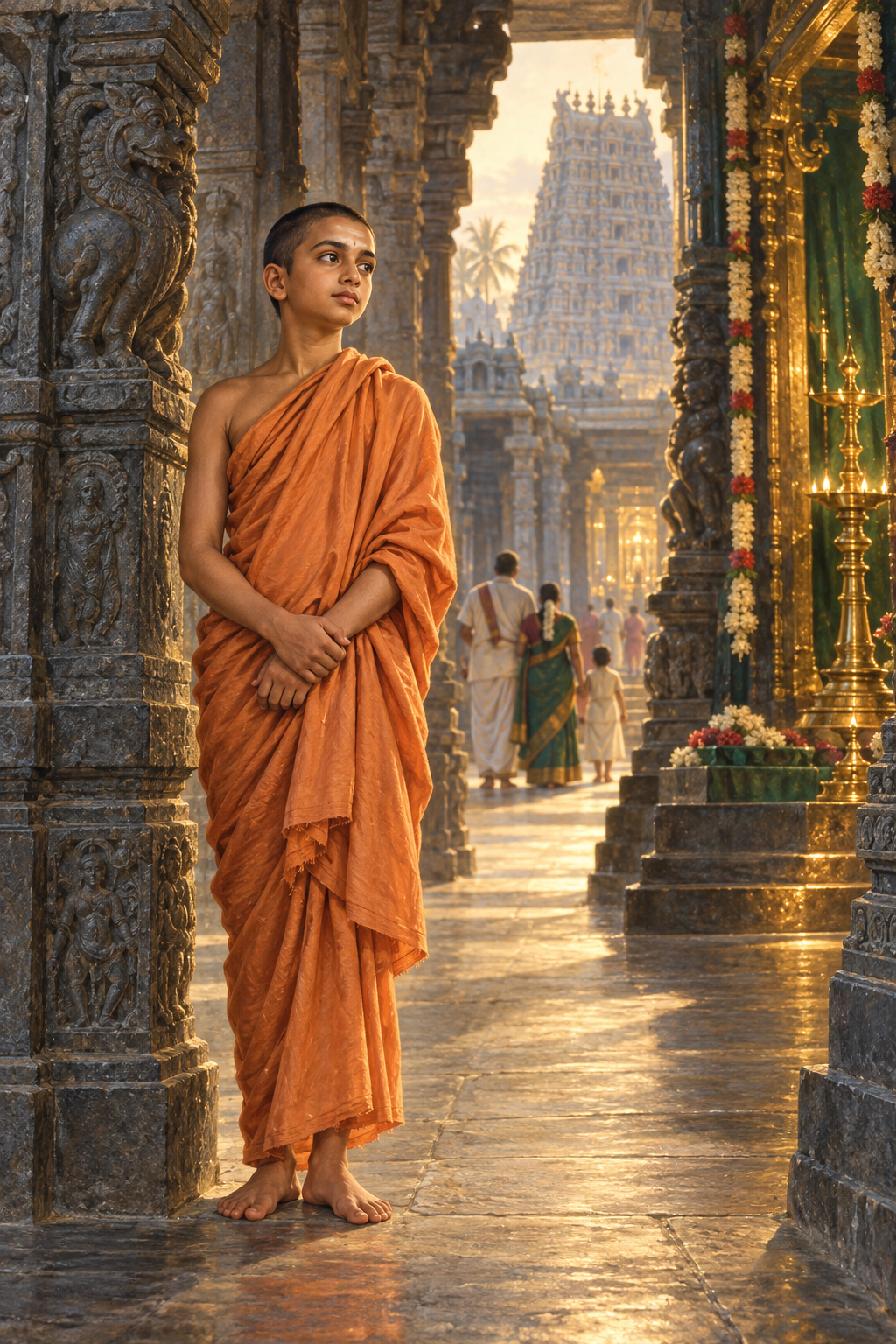
If you have encountered the name Kuzhandai Ananda Swamigal and wondered who he was, you need more than a reverent title. You need to know what the tradition actually preserves, what its sacred language means, and which details should not be added merely to make the story feel complete.
The firm ground is a family’s devotion to Goddess Meenakshi near Madurai. That beginning explains why Kuzhandai Ananda Swamigal is remembered as Meenakshi Maindhan, the child of Meenakshi. It also shows you how to relate his story without turning devotional interpretation into unsupported biography.
What can be said with confidence
The remembered life of Kuzhandai Ananda Swamigal begins around 1607 CE in Samayanallur, a village near Madurai. Ramaswamy Iyer and Tripurasundari Ammal lived there as devotees of Goddess Meenakshi.
Years passed without the couple having a child. Their response was a vow: if Meenakshi granted them a child, they would dedicate that child to the Goddess. This is the central fact needed to understand the Swamigal’s devotional identity. He is not remembered simply as a holy person who happened to worship Meenakshi. His life is framed from its beginning as belonging to her grace.
The word around in around 1607 CE matters. It gives an approximate historical setting, not an exact birth date. If you write or speak about him, retain that qualification. Turning an approximate date into a precise birthday gives the appearance of certainty without supplying evidence.
Preserve the geography as carefully as the date. Samayanallur is near Madurai; it is not merely another name for Madurai. The distinction keeps the family’s home separate from the sacred centre of their devotion. Reducing both places to Madurai removes a small but meaningful part of the story.
The parents’ vow is the key to the whole tradition
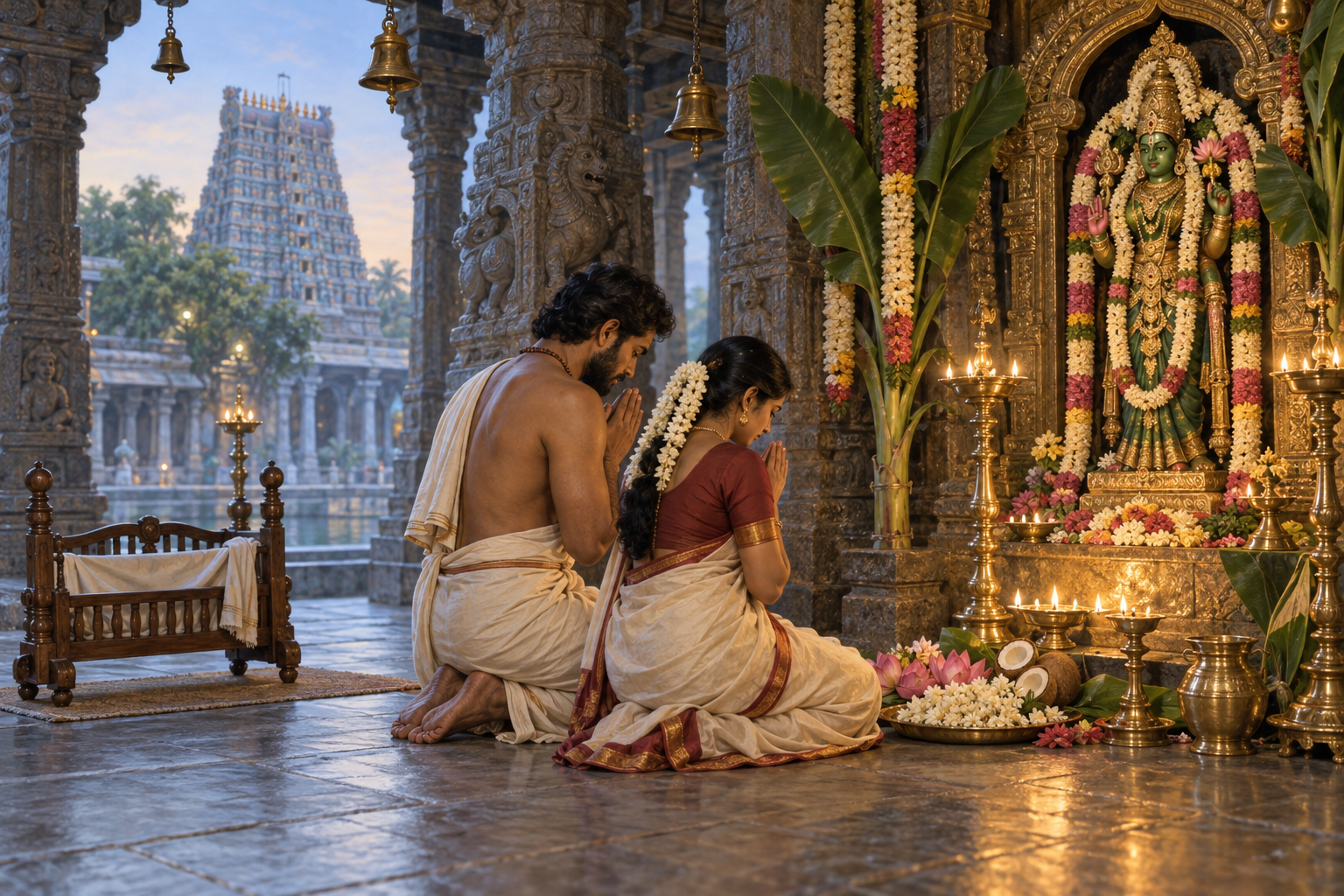
Read superficially, the vow can sound like a transaction: the couple asks for a child and promises something in return. Its devotional logic is deeper. The desired child is not treated as a possession secured through prayer. The parents promise that the blessing will be directed back toward its divine giver.
This turns longing into responsibility. The couple’s prayer is joined to a commitment, and the anticipated grace is joined to service. That pattern is one reason the opening episode carries more spiritual weight than a bare account of parentage would.
At the same time, do not make the word dedicate more specific than the known facts permit. We are not told here whether dedication meant temple service, formal initiation, eventual renunciation, or some other arrangement. Those possibilities are not interchangeable. Unless a further record identifies the form, the accurate wording is simply that the parents vowed to dedicate the child to Meenakshi.
For a present-day devotee, the principle is more useful than a literal imitation. A historical promise concerning a child should not become permission to determine another person’s vocation without consent. If you make a devotional vow, attach it to conduct you can undertake yourself: regular prayer, seva, dana, disciplined study, or another clearly defined responsibility. The enduring lesson is that receiving grace should change how you live.
How to understand the name Meenakshi Maindhan

Kuzhandai is the Tamil word for child, while the devotional title Meenakshi Maindhan presents the Swamigal as the child or son of Meenakshi. These names tell you how the tradition understands his relationship to the Goddess. They do not, by themselves, establish an exact age, a chronology of later events, or the details of a miracle.
The story therefore needs to be read on two registers. On the biographical register, it gives an approximate period, a village, the parents’ names, their childlessness, their devotion, and their vow. On the sacred register, the child’s advent is received as Meenakshi’s grace and his identity is understood through belonging to her. The two registers need not be set against each other, but an honest retelling should make clear which one is operating.
This distinction gives you useful language. Say that Kuzhandai Ananda Swamigal is remembered or revered as Meenakshi Maindhan when describing the theological identity. State the parents’ names, location, approximate period, and vow directly as the preserved biographical core. This neither diminishes faith nor makes a historical claim stronger than its support.
It also prevents a common mistake in writing about Hindu saints: treating reverence as though it requires invented precision. Devotional truth does not become more honourable when missing dates, lineages, travels, or miracles are filled in from imagination. Restraint protects the distinctiveness of the saint rather than flattening him into a familiar template.
Key takeaways
- Kuzhandai Ananda Swamigal is remembered as Meenakshi Maindhan, the child of Goddess Meenakshi.
- His family story is placed around 1607 CE in Samayanallur near Madurai; around should not be converted into an exact date.
- His parents were Ramaswamy Iyer and Tripurasundari Ammal, devotees who had spent years without a child.
- They vowed to dedicate the child to Meenakshi if the Goddess answered their prayer.
- The precise institutional or religious form of that dedication is not established by the known opening episode.
- When sharing the story, distinguish its preserved biographical details from its devotional interpretation and omit unsupported additions.
How to investigate or share his life responsibly

A complete life of Kuzhandai Ananda Swamigal would require evidence beyond this origin episode. Do not fill the missing years by borrowing the usual features of another swami’s biography. A guru, pilgrimage, miracle, institution, teaching lineage, temple, or samadhi site should be named only when you can identify the tradition or record preserving that claim.
Begin further inquiry with four exact anchors: Kuzhandai Ananda Swamigal, Meenakshi Maindhan, Samayanallur, and the names Ramaswamy Iyer and Tripurasundari Ammal. These details are more discriminating than a broad search for a saint associated with Madurai. Material in Tamil and material tied to Samayanallur or Madurai may deserve particular attention, but locality alone is not proof of accuracy.
For every additional claim, ask who preserves it, whether a named text or custodian can be identified, and whether it is presented as oral tradition, devotional testimony, inscriptional evidence, or a later biography. Oral tradition need not be discarded. It should simply be labelled as oral tradition rather than silently converted into documented chronology.
If you prepare a temple note, satsang introduction, classroom paragraph, or social-media post today, a disciplined starting statement is enough: Kuzhandai Ananda Swamigal is remembered as Meenakshi Maindhan. His life story begins around 1607 CE with Ramaswamy Iyer and Tripurasundari Ammal of Samayanallur, whose prayer for a child included a vow to dedicate the child to Goddess Meenakshi.
Start there. Add to the story only when you can name the basis for the addition. That care is not hesitation; it is a form of respect for both the Swamigal and the tradition that remembers him.
References

Leave a Reply
You must be logged in to post a comment.