
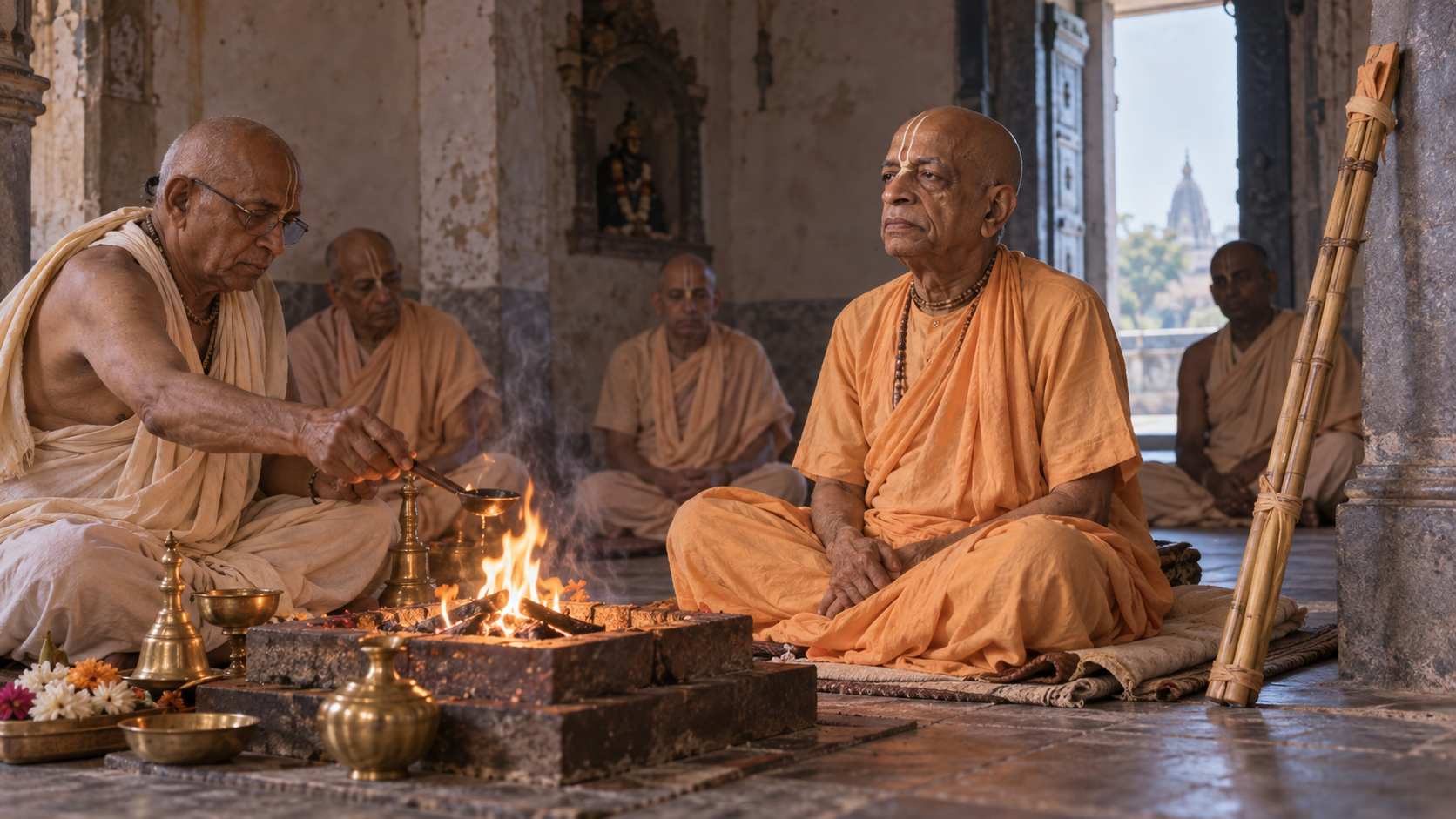
If you have come to Srila Prabhupada’s sannyasa lila wondering what it should mean for your own life, the question is not merely what happened. The harder question is how you should honor a renunciation that most devotees are neither qualified nor expected to imitate outwardly.
The answer begins with service. This lila does not teach that holiness starts when family, work, and ordinary obligations disappear. It shows why spiritual life becomes serious when comfort, prestige, and personal ownership no longer dictate the terms on which you will serve.
Read the lila through its purpose, not only its outer form

In devotional language, a lila is more than an entry in a chronology. It is a sacred action remembered in relationship with Bhagavan, guru, and the community of devotees. Remembering it properly therefore requires more than collecting biographical details. You have to ask what the action reveals and what response it calls forth.
Sannyasa is the formally renounced ashrama. Its visible form can include a changed manner of life, but the visible form does not explain its spiritual purpose by itself. A robe may identify an ashrama; it cannot prove freedom from ego, possessiveness, or the desire for recognition. Those are tested through conduct.
When contemplating Srila Prabhupada’s acceptance of sannyasa, use three questions: What claim over the self is being relinquished? To whom is the life being offered? What service becomes possible because that claim has been released? In a Vaishnava understanding, renunciation receives its meaning from devotion. Giving something up is not automatically sacred; it becomes sacred when it removes an obstacle to service to Krishna and guru.
This distinction prevents a shallow reading. The point is not that Srila Prabhupada ceased to act. The point is that action became increasingly ordered around service rather than private preference. His sannyasa lila should therefore direct your attention away from the romance of withdrawal and toward the discipline of availability: being ready to do what service requires, even when personal ease points elsewhere.
The distinction that protects householders from false renunciation
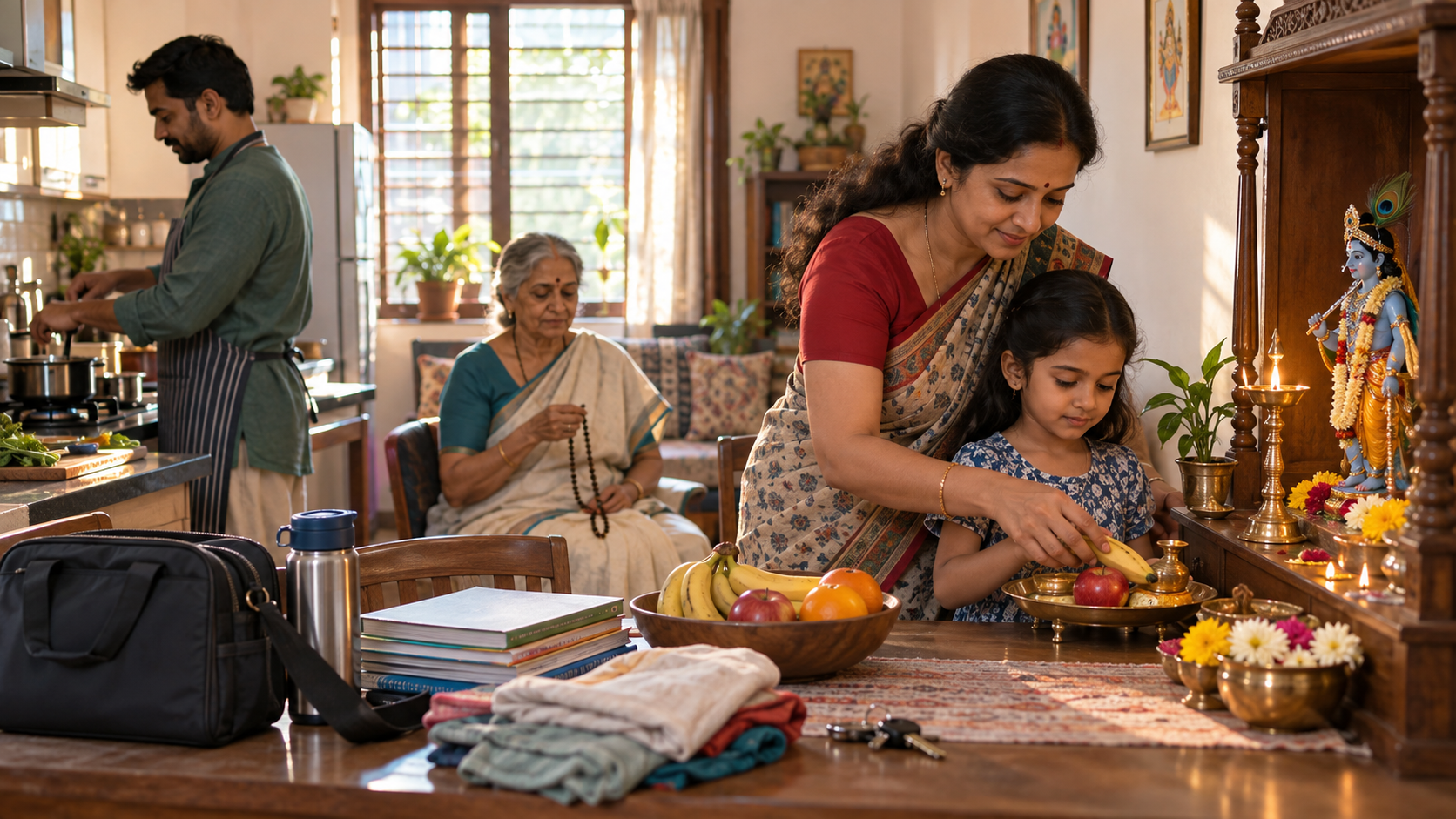
Most readers are not deciding whether to enter the sannyasa ashrama. You may instead be wondering whether serious devotion requires you to reject your present life. This is where admiration can turn into imitation, and imitation can become neglect.
- Renunciation releases possessiveness. It challenges the belief that your time, ability, property, or reputation exists only for your enjoyment.
- Simplicity removes excess. It reduces what distracts you without turning deprivation into a performance.
- Duty protects relationships. If another person rightfully depends on you, abandoning that responsibility is not made spiritual by calling it detachment.
- Sannyasa is an ashrama, not a private mood. It should not be reduced to frustration with work, family, institutions, or the slow pace of one’s own practice.
If you have household responsibilities, the practical question is not, “What can I escape?” Ask, “What personal claim can I release so that I perform my dharma more faithfully?” You can renounce the demand to receive credit while keeping your promise. You can renounce convenience while caring for someone who depends on you. You can renounce resentment while still setting a necessary boundary. You can renounce needless consumption without making your family carry the burden of a dramatic gesture.
This is not the same as pretending that every ashrama has identical obligations. It means that the principle of offering can enter every ashrama without erasing its duties. Srila Prabhupada’s sannyasa should make a householder more conscientious, a student more disciplined, a temple servant more dependable, and a teacher more careful with the trust of listeners. If remembrance makes you less responsible to people placed in your care, you have drawn the wrong lesson.
Turn remembrance into a disciplined observance

Devotees continue to glorify Srila Prabhupada’s sannyasa lila. Glorification, however, is not devotional flattery. It is truthful remembrance that makes a quality of service visible and then asks you to respond.
You can observe the lila without staging a large event. Use a simple sequence that moves from hearing to discernment and then to action:
- Hear with a question. Listen to a trustworthy Vaishnava discussion of the lila while asking what obstacle to service renunciation removed. Do not listen only for dramatic details.
- Verify what you repeat. If you share a quotation or episode, use material whose origin you can identify. An unattributed image, clipped sentence, or forwarded message should not become evidence merely because it sounds devotional.
- Name the principle. Put the lesson into plain words: obedience to guru, freedom from the demand for comfort, steadiness in service, or willingness to accept sacrifice for Krishna.
- Choose an action within your present dharma. Complete a promised seva, protect your time for japa, remove a recurring distraction, make amends for careless speech, or do necessary work without seeking applause.
- Offer the result. Do not turn the observance into a new claim of spiritual importance. Let the action be gratitude rather than self-advertisement.
Keep the commitment modest enough to be truthful. A dramatic vow born during an emotional commemoration can disappear when the mood passes. A small act repeated with steadiness is a more reliable test of what you have understood.
Afterward, examine something concrete. Did the remembrance change your calendar, speech, attention, consumption, or treatment of another devotee? If nothing moved beyond admiration, the lila may have touched your emotions without yet shaping your practice. That is not a reason for guilt; it is a reason to choose a clearer action.
Avoid the common ways glorification becomes distortion
Devotional affection does not require careless history or exaggerated claims. In fact, affection gives you a reason to be more exact. When speaking or teaching about Srila Prabhupada’s sannyasa lila, avoid these common errors:
- Do not treat sannyasa as theatre. Clothing, titles, solemn language, and public praise cannot substitute for disciplined service.
- Do not invent biography to make the occasion sound grander. Keep documented events, devotional interpretation, and your personal application distinct. Each can be meaningful without being presented as the others.
- Do not weaponize the lila against another ashrama. Renounced life should not be praised by belittling marriage, family care, honest work, or other legitimate forms of service.
- Do not confuse glorification with personality worship detached from teaching. Honor becomes substantial when it strengthens your commitment to Krishna-bhakti and guru-seva.
- Do not judge renunciation by dramatic appearance. Look for steadiness, truthfulness, restraint, and service rather than spectacle.
If you are introducing the lila to children or newcomers, keep the explanation in a clear order. Begin with the event: Srila Prabhupada accepted sannyasa. Then give its devotional meaning: renunciation placed life more fully in the service of Krishna and guru. End with the response: we honor that offering by becoming more faithful in the responsibilities and seva already entrusted to us. This preserves reverence without inviting theatrical imitation.
The same discipline applies when you hear an unfamiliar detail. You do not have to reject it or repeat it immediately. Hold it as unverified until you can identify where it came from. Accuracy is itself a form of seva because it protects both the dignity of the acharya and the trust of the listener.
Key takeaways for honoring the sannyasa lila

- Read Srila Prabhupada’s sannyasa as renunciation for service, not as escape from action.
- Distinguish the formal sannyasa ashrama from the renunciation of ego and possessiveness required in every ashrama.
- Never use detachment as a spiritual name for neglecting people who rightfully depend on you.
- Let hearing lead to a specific act: a duty completed, a distraction removed, a promise kept, or credit surrendered.
- Separate documented history, devotional meaning, and personal application when you speak about the lila.
- Measure remembrance by greater steadiness in service, not by the intensity of a passing emotion.
Choose the obstacle that most often bargains with your service: comfort, recognition, distraction, resentment, or delay. Release its claim in one duty already before you. That is a fitting way to let Srila Prabhupada’s sannyasa lila move from honored memory into lived discipleship.
References

Leave a Reply
You must be logged in to post a comment.