
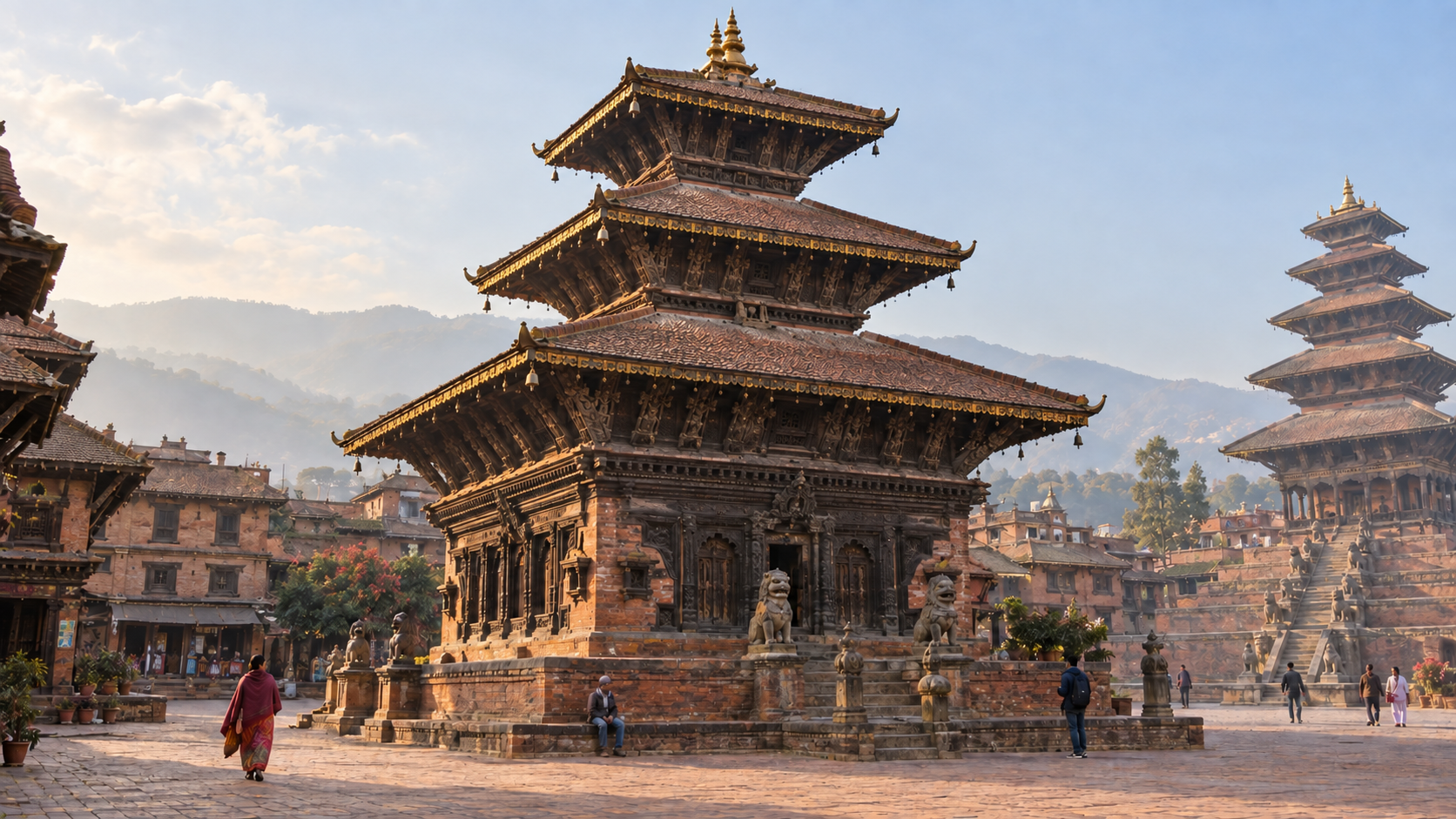
If you are going to Taumadhi Square, you may wonder whether Bhairavnath Temple should be approached as a historic monument, a place of worship, or the setting of a sacred story about a divine head. The clearest answer is that you need all three, but in the right order.
Begin with the relationship the tradition affirms: Bhairavnath guards Bhaktapur. Then notice how the temple’s position, the surrounding city and its festival processions make that guardianship public. This approach will help you understand the place without reducing living worship to architecture or turning its sacred story into a curiosity.
Begin with guardianship, not the spectacle of a divine head
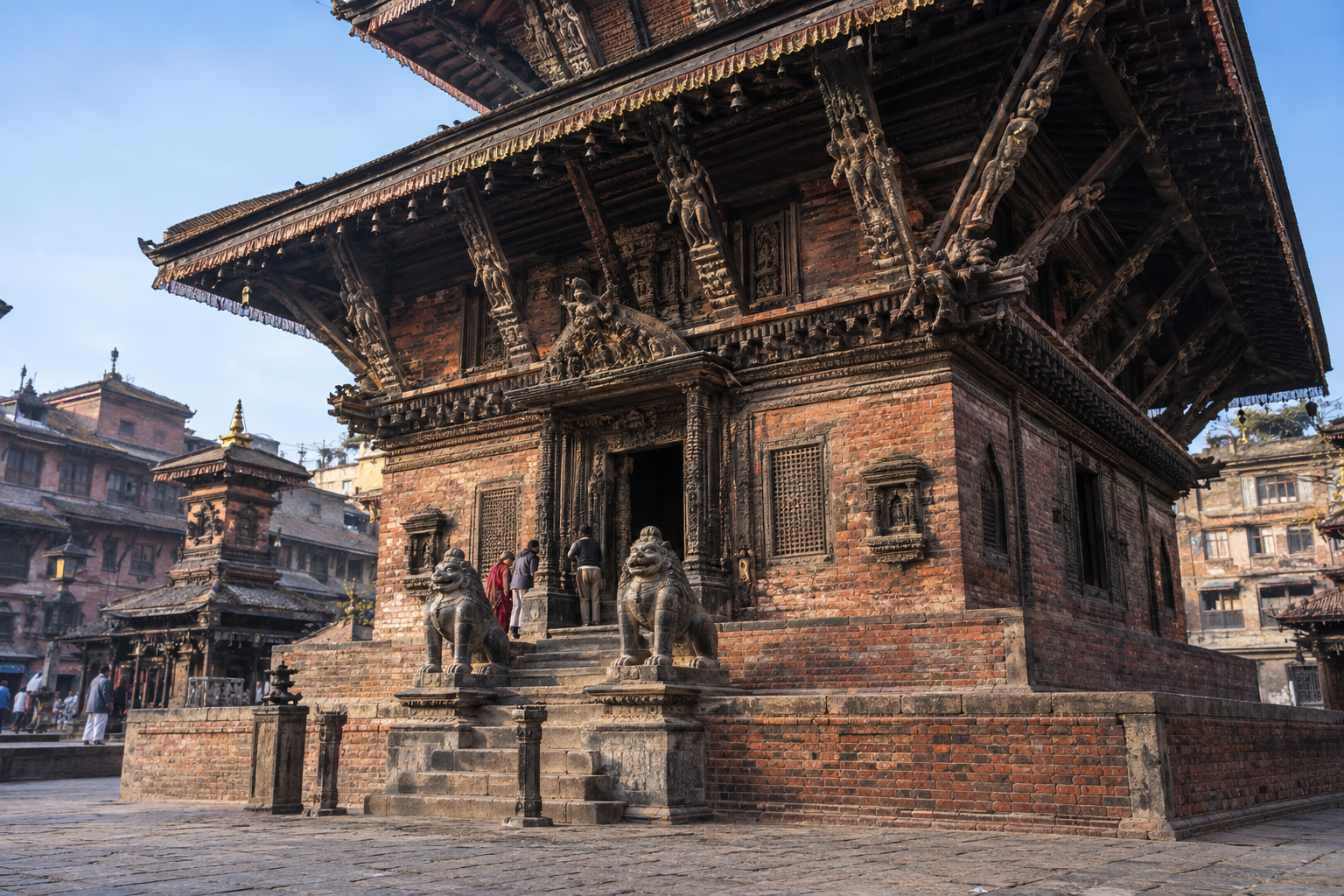
The tradition’s central claim is concise: Bhairavnath is the divine head that guards Bhaktapur. Its two essential elements are the sacred form and its function. The head identifies Bhairavnath’s presence; guardianship describes his continuing relationship with the city.
That distinction matters. If you isolate the image of the head, the story can sound like an unusual episode from the past. If you begin with guardianship, it becomes a statement about the present identity of a sacred city. Bhairavnath is not remembered merely as a deity associated with one building. He is understood in relation to Bhaktapur as a whole.
You do not need to embellish the account to make it meaningful. An invented king, battle, date or supernatural adversary would only obscure what the tradition already communicates: the divine presence has a defined place, a protective function and a community to which it belongs.
If you hear a fuller telling during a visit, keep three layers separate in your notes:
- The central tradition: the divine head of Bhairavnath guards Bhaktapur.
- The particular telling: any additional people, events or ritual details supplied by the local narrator.
- Your interpretation: what you think the story means about protection, sacred authority or the city’s identity.
This separation prevents a personal interpretation from quietly becoming a supposed historical fact. It is especially important when writing about an oral or locally embodied tradition for readers who cannot check your account against the place itself.
Read Taumadhi Square as part of the temple’s meaning
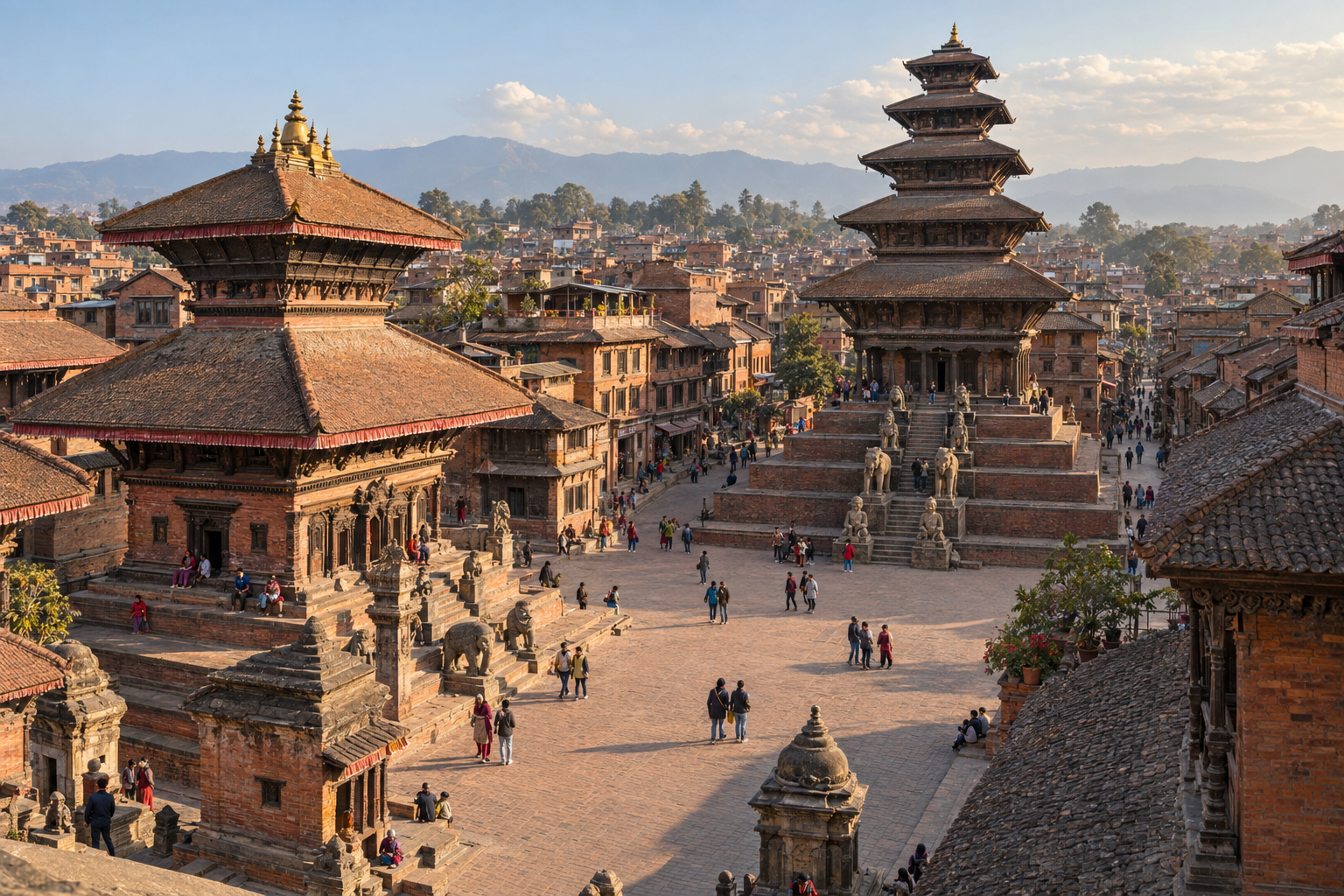
Bhairavnath Temple stands in Taumadhi Square at the heart of Bhaktapur, an ancient Kathmandu Valley city shaped by brick, wood, courtyards, temples and festival processions. That location is not incidental scenery. A guardian shrine positioned in the city’s public heart expresses its meaning spatially.
Look at the setting in three connected rings:
- The temple gives the divine presence a visible focus.
- The square places that presence within shared public life rather than behind a purely private boundary.
- Bhaktapur is the larger community named as the object of Bhairavnath’s guardianship.
A close photograph of the temple may preserve its facade while missing this entire relationship. Step back far enough to see how the building occupies the square. Notice the approaches, the open space and the movement of people around it. You are not looking only at an object; you are reading a sacred centre in relation to the city it protects.
This is also a useful lesson in Dharmic sacred geography. Modern habits often divide the religious building from the civic environment and treat the space outside a shrine as neutral. Bhaktapur instead invites you to notice how temple, square and city can participate in one spiritual landscape.
For readers accustomed to encountering Hindu temples mainly through Bharat, the location is a necessary reminder that Hindu sacred life is not contained by the borders of the modern Indian state. At the same time, Bhaktapur should not be reduced to an extension of somebody else’s story. Its temple belongs to Nepal and to the local community that has carried its meaning. Civilizational connection and local distinctiveness can both be true.
Festival movement carries sacred presence into the city
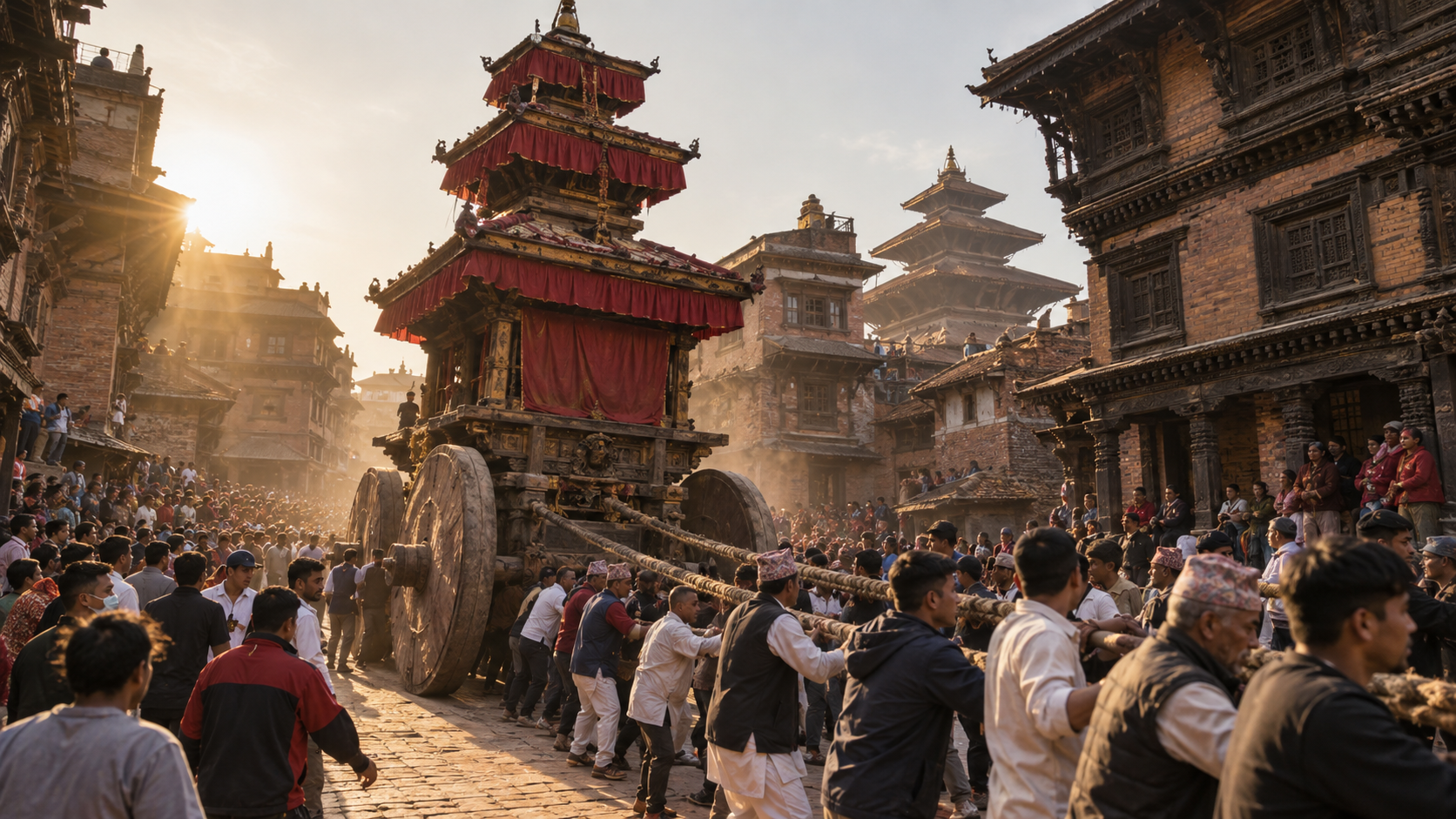
A temple establishes a sacred centre, while a festival procession makes sacred presence mobile. When worship moves through streets and courtyards, the city is not merely watching a performance. Its inhabited spaces become part of the religious action.
This helps explain why Bhaktapur is better understood as a living spiritual landscape than as a collection of old buildings. Architecture holds memory in place. Procession activates relationships among deity, route, neighbourhood and community. The two forms of continuity reinforce one another.
Do not infer a particular calendar date, route, vehicle, offering or sequence of rites from the guardian story alone. Those are concrete local details and should come from current local guidance. If you are present during a procession, useful things to observe include:
- how participants make space for the procession;
- where movement slows or pauses;
- how people orient themselves toward the sacred focus;
- which areas are treated as routes of worship rather than viewing positions; and
- how the square connects the temple to the surrounding city.
These observations reveal the structure of the event without requiring you to interrupt it. Keep out of the route, follow local instructions and give worshippers priority over photographs. A public festival may be visible to everyone, but visibility is not permission to obstruct or closely document every participant.
If you visit when no procession is taking place, do not mistake stillness for the absence of tradition. The temple’s location and the continuing memory of Bhairavnath’s guardianship remain meaningful outside festival time. A procession is one especially visible expression of a relationship that is larger than a single event.
Use a respectful method when you visit or write about it
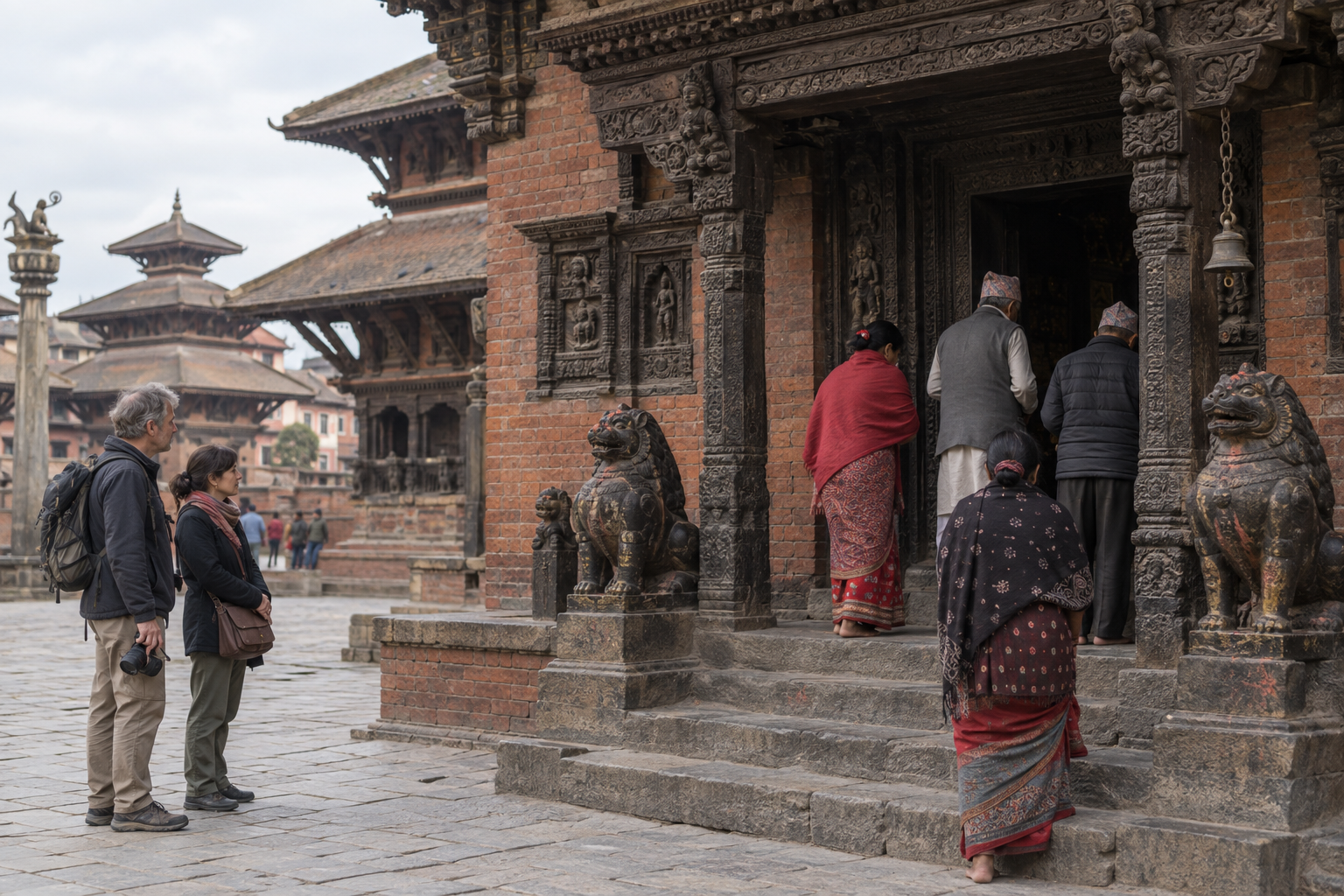
The most useful visit is not necessarily the one that produces the most images. It is the one that leaves you able to describe what you actually encountered, what the tradition explicitly claims and what remains outside your knowledge.
- Pause at the edge of the square. Before approaching the temple, locate the shrine within Taumadhi Square and the square within the surrounding city.
- Check whether worship or ceremonial movement is active. Follow posted instructions and local direction. Do not cross a queue, a ritual boundary or a processional path for a better view.
- Describe the tradition accurately. Say that Bhairavnath is revered as the divine head that guards Bhaktapur. Avoid presenting it as a bizarre head legend stripped of its protective meaning.
- Ask before photographing people or rites closely. A temple’s public exterior does not make every devotional act available for personal documentation.
- Mark interpretation as interpretation. If you understand the head as a symbol of awareness, authority or concentrated presence, identify that as your reading unless a local explanation explicitly supports it.
- Leave unsupported details out. Do not supply an exact origin date, patron, architect, festival schedule or ritual procedure unless you have reliable information for that particular claim.
If your purpose is darshan rather than sightseeing, the same discipline applies. Observe how the space is being used, approach only in the manner locally permitted and allow established practice to correct your assumptions. Respect here does not require silence about meaning. It requires precision about what you know and humility about what you do not.
Key takeaways
- The tradition is best understood through its central relationship: the divine head of Bhairavnath guards Bhaktapur.
- Taumadhi Square is part of the meaning because it places the guardian temple in the city’s public heart.
- Festival processions show sacred presence moving through the inhabited city, but their specific routes and rites should not be guessed.
- A responsible visitor gives worship priority, asks before close photography and distinguishes fact from personal interpretation.
- Bhaktapur demonstrates the reach of Hindu sacred life beyond modern India’s borders without diminishing Nepal’s distinct local inheritance.
When you reach Taumadhi Square, give yourself ten quiet minutes before raising your camera. Identify the temple, take in the square and then look outward toward the city named in the tradition. Hold one sentence in mind: Bhairavnath guards Bhaktapur. That sequence will let the place disclose more than a hurried architectural checklist ever could.
References

Leave a Reply
You must be logged in to post a comment.