
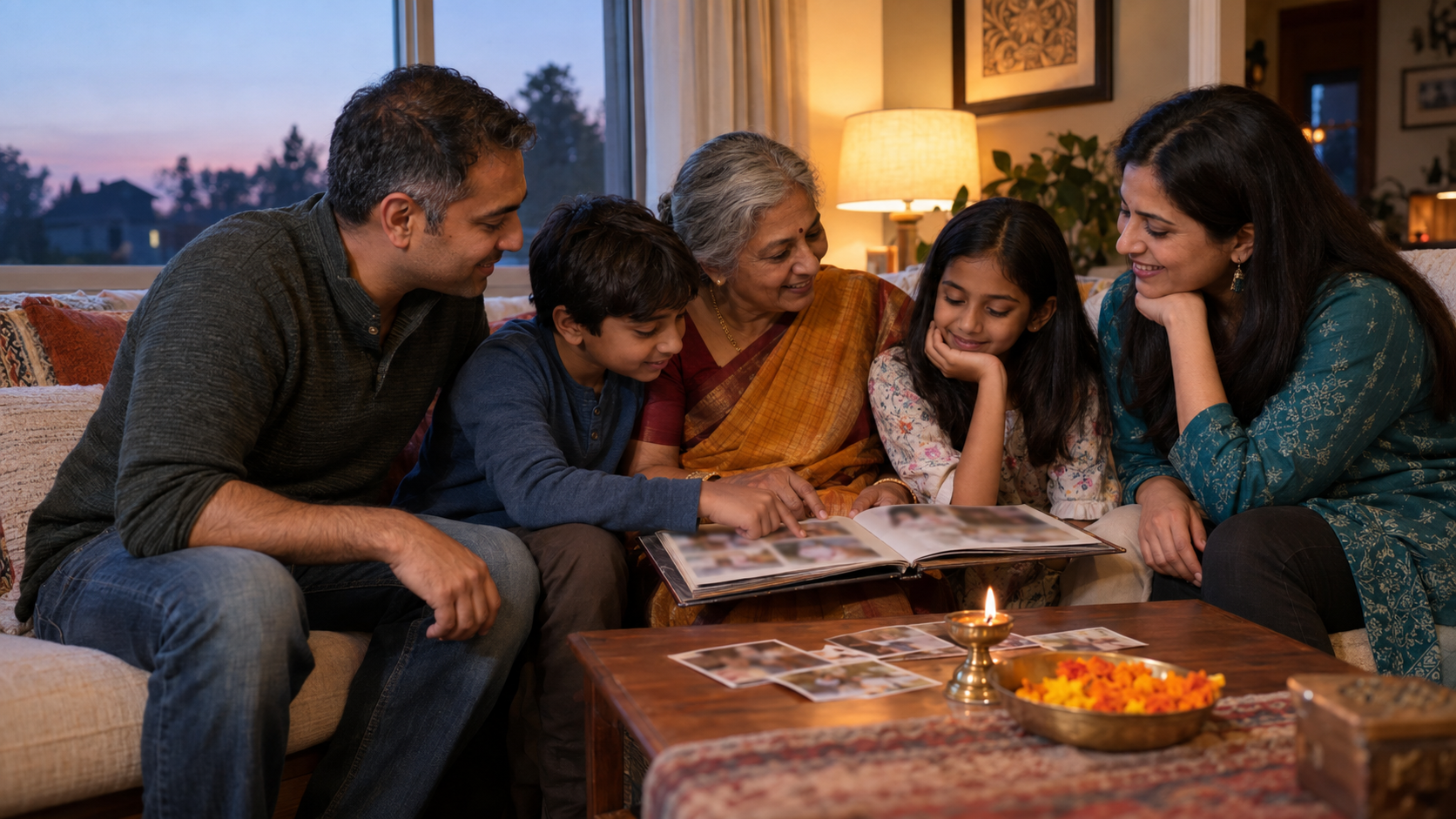
If your child can participate in a puja but cannot explain why your family observes it, the missing piece may not be religious instruction. It may be family narration. A practice becomes easier to carry when a young person knows who preserved it, what it demanded of them, and why it still matters.
You do not need to teach the whole of Hindu civilization in a single conversation. You need a repeatable way to preserve lived memory, invite honest questions, and let the next generation speak in its own voice. The aim is not a perfectly rehearsed child. It is a young Hindu who knows where to look, whom to ask, and how to say, without embarrassment, ‘This is what my family has taught me.’
Begin with lived memory, not a lecture on Hinduism
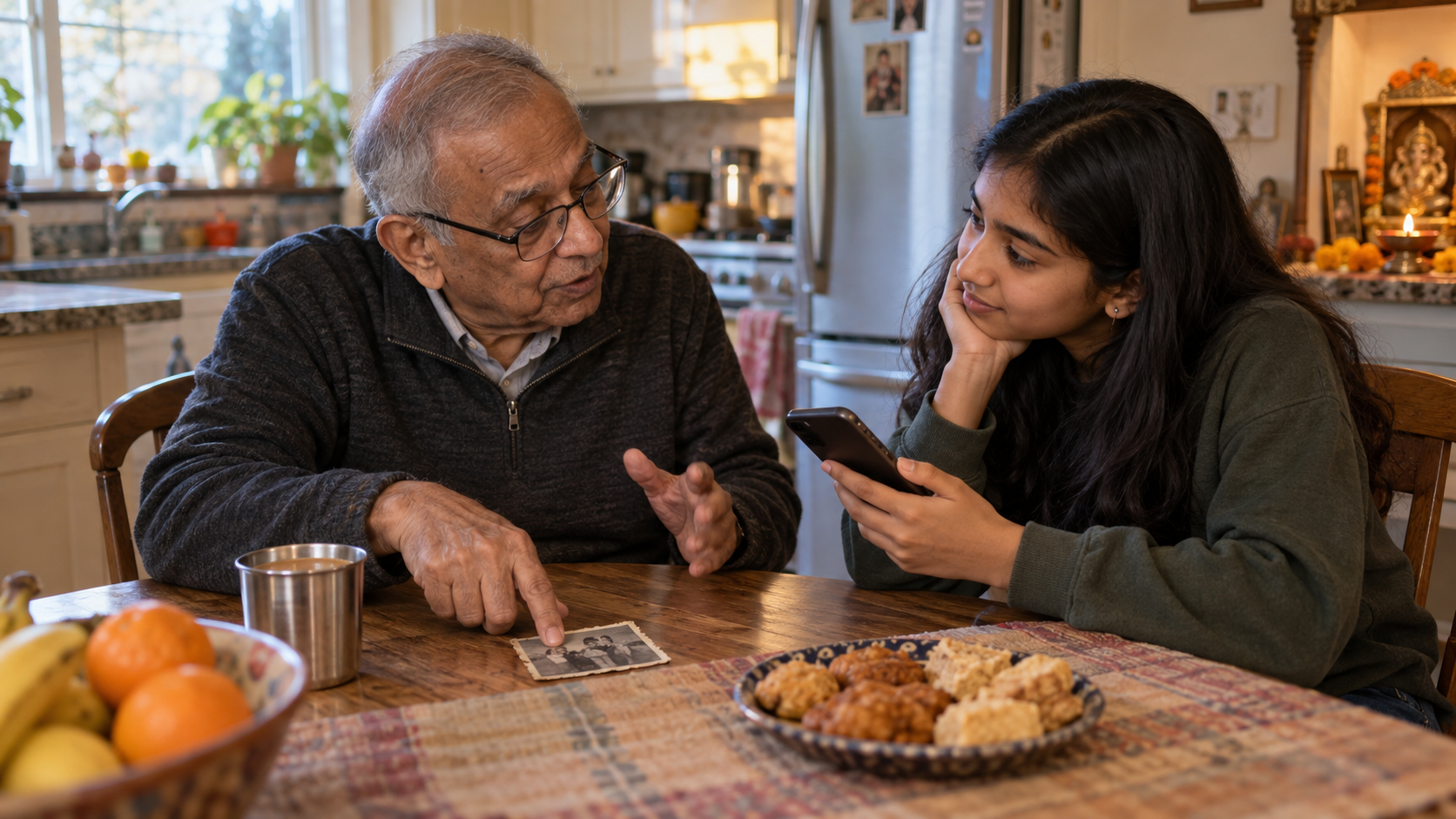
A sweeping explanation of Hinduism cannot tell your child why a particular murti travelled with the family, why an elder maintained a vrata in difficult circumstances, or why a familiar bhajan still changes the atmosphere of the home. Begin with the part of the tradition that has a name, a place, a voice, and a consequence.
Ask an elder a question narrow enough to produce a scene rather than a speech. Useful prompts include:
- Who first taught you a prayer, mantra, bhajan, or ritual action?
- Which Hindu practice became harder to maintain after migration?
- Was there a time when you had to explain or defend your faith?
- Which festival felt most different in America, and what did the family change?
- Which object in the home carries a story that younger relatives do not know?
- What did your parents teach through conduct rather than direct instruction?
- Which part of our family history are you afraid we may forget?
Listen for four elements: the setting, the choice, the cost, and the meaning. ‘We celebrated Deepavali’ is information. ‘Your grandmother worked late, came home tired, and still lit the lamps because she did not want the children to associate migration with the disappearance of worship’ is a story. Do not manufacture a moral. Ask the narrator what the act meant to them.
Preserve the family’s own vocabulary. If an elder says seva, ishta-devata, sampradaya, vrata, or dharma, record the term before replacing it with an approximate English equivalent. Then ask what that word meant in that household. The answer may be more revealing than a dictionary definition, and it prevents a living tradition from being flattened into generic language.
Do not force every memory into a direct Bharat-to-America migration story. Hindu families have reached the United States through different routes. An Indo-Caribbean experience described as a ‘double diaspora’ shows why the intermediate places matter: they may have shaped language, music, food, worship, family names, and the very methods by which tradition survived. Record every meaningful stop in the journey.
Memory is not the same as verified history. If relatives disagree about a date, sequence, or motive, do not quietly choose the smoothest version. Label the uncertainty: ‘This is how Nani remembers it; Mama remembers the order differently.’ That distinction protects trust while preserving both voices.
Build a family archive that people will actually use
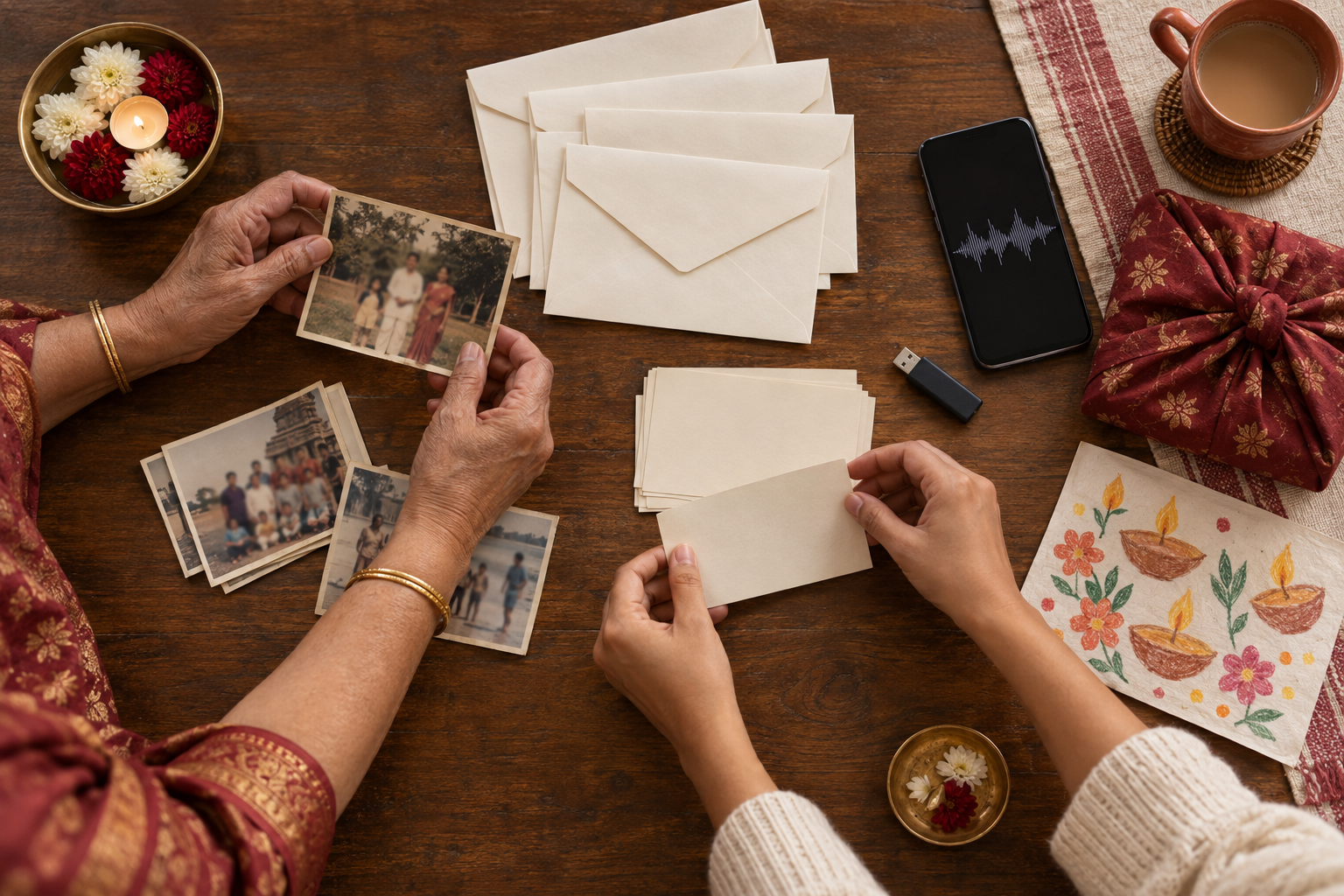
A folder full of unnamed recordings is not yet an inheritance. Stories survive when the family can find them, understand their context, and know whether they may be shared. Give the work a simple structure.
- Choose a recurring cue. Use a moment already present in family life: festival preparation, the drive home from the mandir, a meal with grandparents, or the cleaning and putting away of puja items. A reliable cue is more useful than waiting for an ideal recording day.
- Ask a single focused question. Let the answer develop before moving to another subject. Rapid-fire questioning produces fragments; patient follow-up reveals decisions and consequences.
- Capture exact nouns. Record the names of people, towns, temples, deities, texts, songs, foods, languages, and ritual objects. These are the details most likely to disappear when a story is repeatedly paraphrased.
- Separate memory from interpretation. Note what happened, what the narrator believes it meant, and what a younger listener thinks it means now. All are valuable, but they are not interchangeable.
- Keep the original and an accessible version. Preserve the audio or video when the narrator consents, then add a transcript or short written summary. Retain the original language alongside any translation.
- Name the next custodian. Give a relative responsibility for organizing the file, checking missing details, and bringing the story back to the family at an appropriate occasion.
A compact record for each story can contain:
- A descriptive title that the family will recognize.
- The narrator’s name and relationship to the family.
- The relevant place and approximate period.
- The practice, decision, or event at the center of the memory.
- Important words in the language in which they were spoken.
- Points that remain uncertain or disputed.
- Who may hear, read, quote, or publish the account.
- The next question another relative should answer.
Consent must be part of the archive, especially when a memory includes family conflict, discrimination, financial hardship, migration difficulties, or another person’s private conduct. Permission to record at home is not automatically permission to place a clip online. Ask the narrator what may remain inside the family, what may be shared in a community setting, and what may be published with names attached.
Do the same for children. A young person should not become the family’s public spokesperson merely because they speak confidently or understand social media. Let them decide what they are ready to share. Adults remain responsible for judging the audience, protecting private information, and helping with any difficult response.
Hand authorship to the next generation

Transmission is incomplete if children only receive stories. They must eventually select, interpret, and retell them. That handoff is where cultural memory becomes cultural confidence.
A useful family process looks like this:
- The elder tells the memory without being interrupted for a lesson.
- The younger listener identifies the moment that stayed with them.
- The younger person retells the event in their own words.
- The elder corrects factual errors but does not replace the younger person’s voice.
- They discuss what should remain private and what can be shared.
- The younger person chooses a form for carrying the story forward.
That form does not have to be an essay. At a Minnesota Hindu community gathering, young people spoke about identity and belonging while Bharatanatyam and sacred-themed paintings carried meaning without a conventional speech. A family story can become a dance introduction, an illustrated family tree, a short audio recording, a festival booklet, a recipe with its ritual context, or a conversation between grandparent and grandchild.
Match the responsibility to the child’s stage of life. A younger child may remember an object, an action, and a person: who lights the diya, what happens next, and whose hands taught the movement. An adolescent can engage the harder questions: why a custom changed, why relatives disagree, what felt unfair, or how a Hindu identity operates among friends and at school. An adult descendant can verify names, compare memories, translate carefully, and decide how to preserve the material for relatives not yet born.
Do not treat English, code-switching, or a new artistic form as proof that the tradition has weakened. Ask whether the meaning has been understood and represented honestly. A memorized account that the child cannot question is more fragile than a retelling that uses contemporary language while preserving names, relationships, choices, and dharmic significance.
Correction also needs discipline. Correct a misremembered name, an inaccurate sequence, or a mistranslated term. Do not correct away a child’s real reaction. If a young person says that part of a story confuses or troubles them, that response belongs in the conversation. Confidence built on forbidden questions will not survive contact with the wider world.
Prepare children for questions without teaching them fear

Hindu American children may have to explain themselves before they feel ready. An eleven-year-old speaker in Minnesota described growing up Hindu, religious freedom, and anti-Hindu prejudice; two high-school students joined her in discussing misconceptions, identity, and belonging. The practical lesson for a family is not that every child must give a public speech. It is that children need usable language before a difficult classroom or peer conversation arrives.
Give them sentences that are accurate without making them responsible for representing every Hindu tradition:
- ‘In my family, we understand and practise it this way.’
- ‘Hindu traditions are diverse, so another Hindu family may answer differently.’
- ‘I do not know the answer, but I know whom I can ask.’
- ‘That description does not match what I have been taught or experienced.’
- ‘You can ask me a sincere question, but I am not comfortable with mockery.’
Teach children to distinguish curiosity, error, and hostility. A sincere question can receive a short personal answer. A mistaken claim can be corrected calmly and specifically. Repeated mockery, exclusion, or pressure should be brought to a trusted adult; the child should remember or write down what happened rather than carrying the burden of resolving it alone.
Religious freedom includes Hindus without requiring them to dilute their identity first. Young Hindu speakers have connected that principle with a wider duty to oppose injustice. Family storytelling can prepare a child to make that connection: ‘This is what our family preserved’ can lead naturally to ‘This is why everyone should be free to preserve and practise their faith.’
Still, do not build the entire family narrative around defence. If every story begins with a threat, children may inherit vigilance without joy. Preserve accounts of devotion, humour, hospitality, music, philosophical inquiry, pilgrimage, service, adaptation, friendship, and ordinary home life as well. The tradition must be something they know how to protect, but also something they know how to inhabit.
Key takeaways
- Begin with a named person, place, object, or decision rather than a general lecture about Hinduism.
- Record the family’s original religious vocabulary, then explain what those terms meant in that household.
- Mark uncertain or conflicting memories instead of turning them into false certainty.
- Ask permission separately for recording, family circulation, community use, and public publication.
- Let young people retell stories in their own words and chosen medium; correct facts without erasing their voice.
- Prepare children to answer from personal knowledge, acknowledge Hindu diversity, and seek adult help when a conversation becomes hostile.
Choose the oldest relative you can reach and ask: ‘Which Hindu practice did you most want the next generation to keep, and why?’ Record the answer with permission. Before the conversation ends, ask a younger family member to say what they heard and what they still want to know. That second voice is the beginning of the handoff.
References

Leave a Reply
You must be logged in to post a comment.