

You may be deciding whether to attend a Vaishnava event, what to ask when you get there, or whether a campus devotional community deserves more of your time. Do not let charisma, unfamiliar Sanskrit, or the warmth of the room make that decision for you. A worthwhile encounter should help you identify the tradition’s claims, understand its practices, and see clearly what is being asked of you.
A Boston University talk by HG Anuttamma Prabhu and HG Rukmini Mataji offers a concrete occasion for that kind of encounter. Its larger significance lies in the question every campus outreach effort must answer: can an ancient devotional tradition speak intelligibly in a modern university without diluting its theology or pressuring its listeners?
Key takeaways
- Treat a campus talk as an invitation to inquire, not as proof that every claim has been established.
- Ask which Vaishnava lineage, texts, teachers, and definitions are shaping the presentation.
- Separate each theological claim from the practice associated with it and the result being promised.
- Try only a bounded, clearly explained practice before considering a deeper commitment.
- Judge a community by its transparency, treatment of questions, and respect for your freedom to leave.
A university talk is a doorway, not a verdict
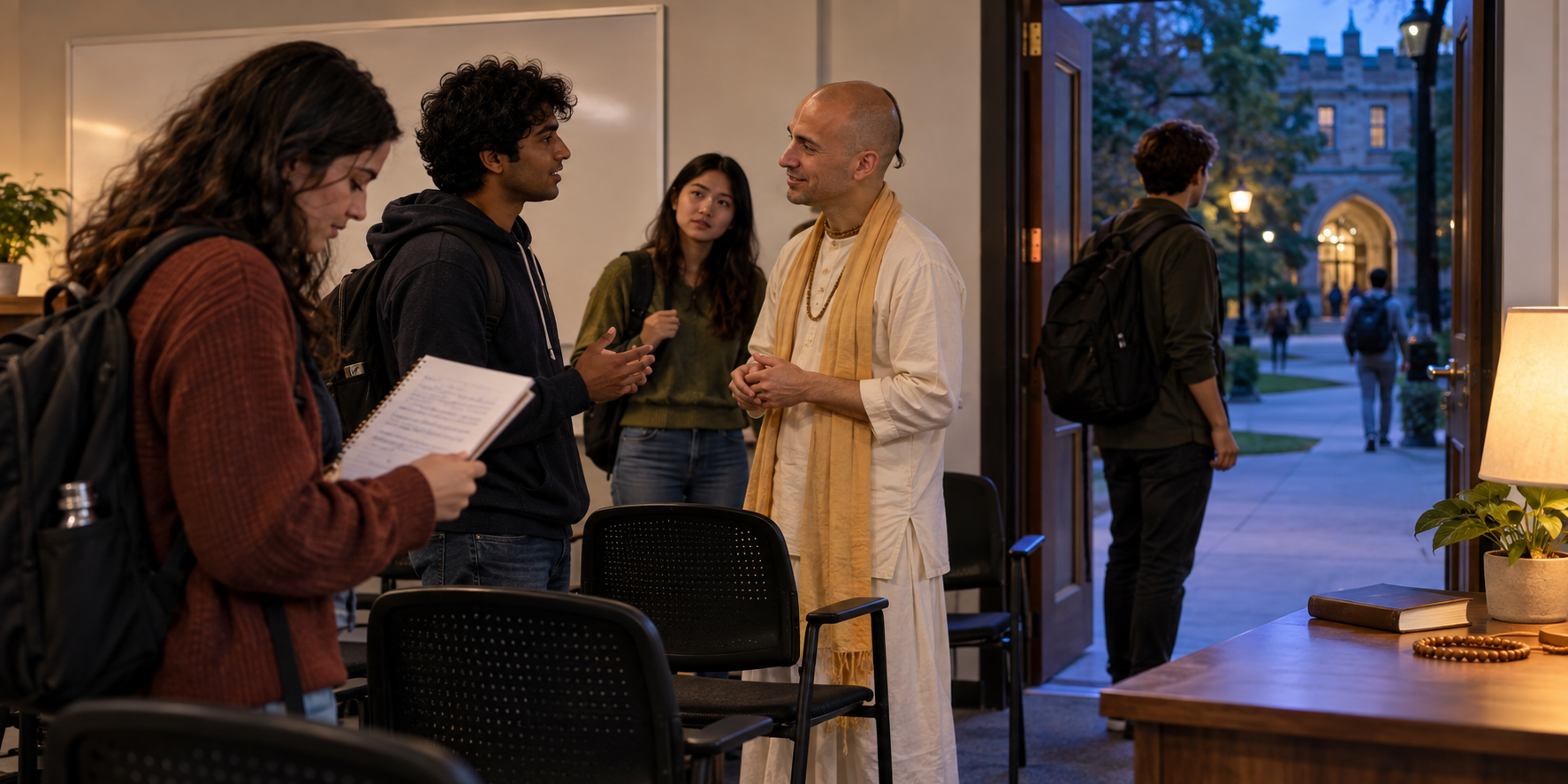
A university is one of the better places for Vaishnava outreach because it brings conviction and inquiry into the same room. Students should be free to hear a theological position presented in its strongest form. They should also be free to question its assumptions, request definitions, and decline its conclusions.
That balance matters. Devotional traditions are weakened when they are reduced to stress relief, cultural entertainment, or a collection of agreeable quotations. Academic openness is also weakened when a religious speaker’s claims receive either automatic reverence or automatic dismissal. Listen respectfully, but keep your judgment active.
Begin by establishing the frame. Is the speaker presenting a personal account, the teaching of a particular lineage, or a claim intended to describe all Vaishnavas? Those are not interchangeable. A sincere testimony can show what a practice means in one person’s life, but it cannot by itself settle a historical, philosophical, or metaphysical question.
Carry several questions into the room:
- Which Vaishnava lineage or theological school informs this presentation?
- Which primary texts support its central claims?
- What is shared across Vaishnava traditions, and what is specific to this community?
- Which practice can a newcomer explore without making a formal commitment?
- What would participation require in time, conduct, association, or money?
Clear answers do not require you to agree. They give you enough information to know what you are actually evaluating.
Translate Vaishnava ideas without flattening them

Vaishnavism is not a generic synonym for Hindu spirituality. Vaishnava traditions center devotion on Vishnu and divine forms such as Krishna and Rama, but their lineages do not explain every theological question in exactly the same way. Their teachings on the soul, divine grace, the guru, liberation, and the relationship between the Divine and the world can differ substantially.
That diversity should be named rather than hidden. When a speaker says that Vaishnavism teaches something, ask whether the claim is broadly shared or belongs to a particular school. When Sanskrit vocabulary appears, ask for more than an English substitute. You need the meaning of the term within the tradition being presented.
Bhakti, for example, should not be translated merely as an uplifting feeling. It involves an orientation of devotion expressed through practices such as hearing, chanting, remembrance, worship, and service. Seva is not simply volunteering when it is performed as an offering. Guru is not merely another word for motivational teacher. Translation works only when it makes the tradition understandable without removing the commitments that give its terms meaning.
The same care is needed when discussing the wider Dharmic family. Hindu, Buddhist, Jain, and Sikh traditions developed within a connected civilizational world and can share ethical concerns or philosophical vocabulary. That does not make their accounts of self, divinity, liberation, scripture, or authority identical. Good Vaishnava outreach speaks confidently from its own position while allowing neighboring traditions to retain their distinct voices.
If you are organizing the event, define essential terms at first use and state the lineage from which you are speaking. If you are attending, write down any term whose meaning remains vague. A polished answer built on an undefined word is still an unclear answer.
Use the claim-practice-accountability test

You can evaluate almost any spiritual presentation by separating what it says into three parts: a claim, a practice, and a line of accountability. This keeps inspiration from outrunning understanding.
- State the claim plainly. Rewrite it without devotional shorthand. Is it a claim about the nature of the self, the identity of Krishna, the purpose of human life, the effects of chanting, or the authority of a teacher? If you cannot restate it, ask for clarification before deciding whether you accept it.
- Identify the practice. Determine what action expresses or tests the teaching. Ask how the practice is performed, what intention belongs with it, and whether any preparation is expected. Do not combine fragments from unrelated traditions and then assume you have tested the practice that was actually taught.
- Locate accountability. Ask who interprets the teaching, how leaders are corrected, and where a student can bring difficult questions. A tradition may value spiritual authority while still explaining the limits, duties, and accountability attached to that authority.
This framework also helps you notice an important logical boundary. A period of chanting may affect your attention, habits, or sense of devotion. That experience is worth examining, but it does not automatically prove every metaphysical claim connected with the practice. Conversely, the fact that an experience is subjective does not make it meaningless. Describe what happened first; interpret it carefully afterward.
Listen for the movement from description to conclusion. If someone describes personal transformation, receive it as testimony. If the same experience is offered as universal evidence, ask what additional reasoning supports the move. This is not hostile questioning. It is the disciplined attention that both spiritual inquiry and university life require.
Make the next step small, clear, and reversible

The weakest campus events end with inspiration and no intelligible next step. The other danger is a leap from first exposure to a commitment the newcomer does not yet understand. A better path sits between those extremes.
If you want to explore further, choose a bounded practice that was clearly explained during the encounter. Learn its wording, purpose, and method from the community presenting it. Set aside a sustainable place for it in your ordinary routine, then keep a brief record of what you did, what you noticed, and what remains unclear. Consistency gives you something more useful to discuss than a first impression.
Keep practice and commitment distinct. You should be able to attend another discussion, read a recommended text, or learn a devotional discipline without pretending to hold convictions you have not reached. Formal initiation, substantial donations, abrupt changes to major responsibilities, and exclusive dependence on a teacher require much more discernment than attendance at a campus talk.
Before becoming closely involved with any spiritual community, look for the following signs:
- The organization, lineage, teachers, and institutional affiliations are stated plainly.
- Open events are clearly distinguished from practices or commitments intended for initiated members.
- Questions about doctrine, authority, money, conduct, and disagreement receive direct answers.
- Hospitality is not made conditional on surrendering personal information or accepting repeated contact.
- Members can maintain family, educational, and professional responsibilities without being treated as spiritually inferior.
- You can pause or leave without threats, humiliation, secrecy demands, or social punishment.
Organizers at Boston University and other campuses can build trust by designing the follow-through around the same standards. Provide a concise explanation of the tradition represented, the speakers’ affiliations, the practices introduced, and an appropriate starting text. Explain which gatherings are educational, which are devotional, and what participation involves. Offer a contact route for questions, but obtain consent before adding attendees to messages or mailing lists.
Most importantly, make room for the question that does not fit the prepared presentation. Outreach becomes credible when students discover that inquiry is not merely tolerated during recruitment but remains welcome after they become familiar faces.
If you are considering the Boston University encounter, arrive with a written question and leave with three things clearly identified: the tradition being represented, a properly explained next practice, and a place to ask what still troubles you. If any of those remains vague, seek clarity before going further. Disciplined openness is a sound beginning for both study and bhakti.
References

Leave a Reply
You must be logged in to post a comment.