

If you encountered the name Kari Kuttichathan and are wondering whether you should attempt the worship yourself, the practical answer is simple: learn first, and do not improvise an invocation. Curiosity about a Kerala tradition is legitimate. Curiosity, however, is not initiation.
You do not have to dismiss the tradition as superstition or accept every claim about it literally. The sound Dharmic response is disciplined respect: understand what is being named, distinguish cultural knowledge from ritual authority, and refuse practices whose context you cannot verify.
First decide whether you want knowledge or ritual involvement

Within Hindu belief in Kerala, Kari Kuttichathan, also called Karim Kuttichathan, is described as an ancient and fearsome tantric deity. The tradition understands this presence as older than the codified forms of temple worship that later organized much of public religious life.
That is a statement about traditional antiquity, not a securely dated historical origin. Descriptions are associated with old Malayalam palm-leaf manuscripts and Kerala tantric texts, but a general reference to manuscripts does not establish a precise century. If someone gives you an exact date, ask for the manuscript’s name, approximate date, provenance, edition and the passage being interpreted. Without those details, treat the chronology as inherited sacred memory rather than settled documentary history.
Your purpose determines the next step. If you want cultural knowledge, you can study the name, setting and way the tradition understands itself without performing anything. If you want ritual involvement, the standard becomes much stricter: you need a living, accountable context capable of explaining what the practice is, who may undertake it and what obligations it creates.
Worship, reverence and invocation are different commitments

The word worship can conceal several very different actions. It may refer to acknowledging a sacred presence, participating in a public observance, following a household custom or undertaking a specialized ritual. Those acts are not interchangeable merely because English places them under one label.
Invocation is the decisive distinction here. In practical terms, invocation means deliberately performing a rite intended to call upon or establish contact with the invoked presence. That is not the same as reading about the tradition, viewing an image or respectfully acknowledging that the belief exists.
Nor should fearsome be translated automatically as evil. Hindu traditions contain formidable divine forms whose appearance or function cannot be reduced to a simple good-versus-demonic scheme. At the same time, a fearsome tantric identity is not an invitation to experiment. Respecting a tradition includes respecting the limits it places around practice.
Tantra should not be treated as a synonym for sinister magic or as a shortcut to extraordinary results. In this setting, the important point is that tantric practice is structured and contextual. A mantra, gesture, offering or ritual fragment detached from its system is not the system itself. Consequently, Kari Kuttichathan should not be invoked casually or without qualified guidance.
Why an improvised invocation is a poor decision
You do not need to make unverifiable claims about supernatural punishment to justify caution. There are immediate, understandable reasons not to assemble a ritual from stray instructions.
- You cannot verify completeness. A copied mantra or short set of directions may omit preparation, restrictions, corrections or the conditions under which the rite is not performed.
- You cannot verify authority. Confidence, dramatic language and claims of secret knowledge do not establish lineage, competence or accountability.
- You may mistake symbolism for procedure. A narrative description, devotional image or reference to an offering does not necessarily authorize a reader to reproduce a rite.
- Fear can become self-reinforcing. Once an anxious person interprets ordinary setbacks, dreams or coincidences as ritual consequences, every new event can appear to confirm the fear.
- Secrecy can enable exploitation. A person who threatens spiritual harm, demands escalating payments or forbids you from seeking a second opinion is using pressure, not demonstrating religious authority.
These concerns do not prove or disprove the metaphysical claims surrounding Kari Kuttichathan. They tell you something more immediately useful: you lack the basis for informed participation when the practice, teacher and obligations cannot be examined. In that situation, abstaining is discernment, not disrespect.
How to approach the tradition without trivializing it
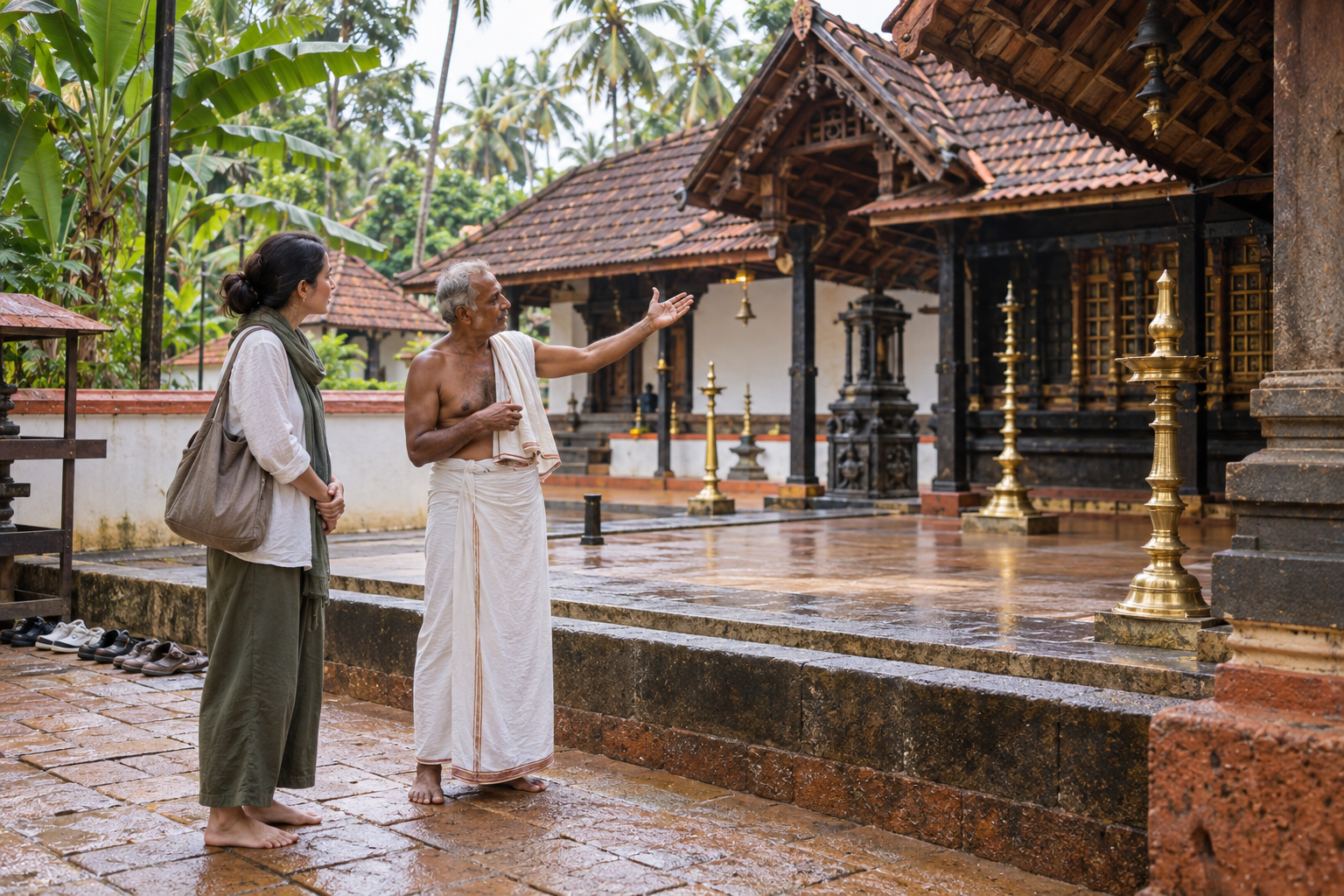
If you want to proceed responsibly, use a sequence that keeps learning separate from ritual commitment.
- Write down your actual purpose. Are you researching Kerala culture, investigating a family memory, seeking help during a crisis or looking for a dramatic spiritual experience? The last two motives make you especially vulnerable to hasty decisions.
- Keep descriptive material descriptive. Record what a name, story or symbol means before assuming it is a ritual instruction. Do not chant, offer, vow or invoke merely because an isolated direction is available.
- Look for accountability, not mystique. Speak with a trusted elder or established practitioner who is known to a real community. A responsible person should be able to explain whether a practice is public, familial or restricted without frightening you into immediate compliance.
- Ask about obligations before participating. Find out whether you may observe without joining, whether initiation is required, what continuing commitments are expected and whether you are free to decline. Do not accept an irreversible promise you do not understand.
- Use a familiar devotional practice for an immediate need. If your concern is peace, steadiness or protection, remain with a prayer or practice already accepted in your family or sampradaya while you seek reliable counsel. Urgency is not a reason to enter an unfamiliar rite.
- Leave when coercion begins. Threats, isolation, demands for secrecy from everyone you trust and repeated requests for money are reasons to stop contact. Preserve threatening messages and seek support from trusted people or the appropriate authorities.
If fear about the deity or a supposed ritual consequence is causing persistent panic, sleeplessness or compulsive behaviour, seek qualified mental-health support as well as any spiritual counsel you choose. Religious guidance and clinical care can coexist; one should not be used to block the other.
Key takeaways
- Kari Kuttichathan, or Karim Kuttichathan, belongs to Kerala’s old tantric religious world and is represented as a fearsome deity.
- A traditional claim of great antiquity should not be converted into an exact historical date without a named and datable manuscript.
- Learning about the tradition is not the same as invoking the deity.
- Fearsome does not automatically mean evil, but specialized tantric worship should not be improvised.
- Do not treat online fragments, dramatic claims or anonymous instructions as ritual authorization.
- Walk away from anyone who uses threats, secrecy or escalating payments to control your decision.
Your next step need not be dramatic. Decide whether you are seeking knowledge or practice, write down the questions you still have, and take them to someone whose standing can be verified within a community. Until the context and obligations are clear, do not invoke. In a living Dharmic tradition, restraint can itself be a form of reverence.
References

Leave a Reply
You must be logged in to post a comment.