
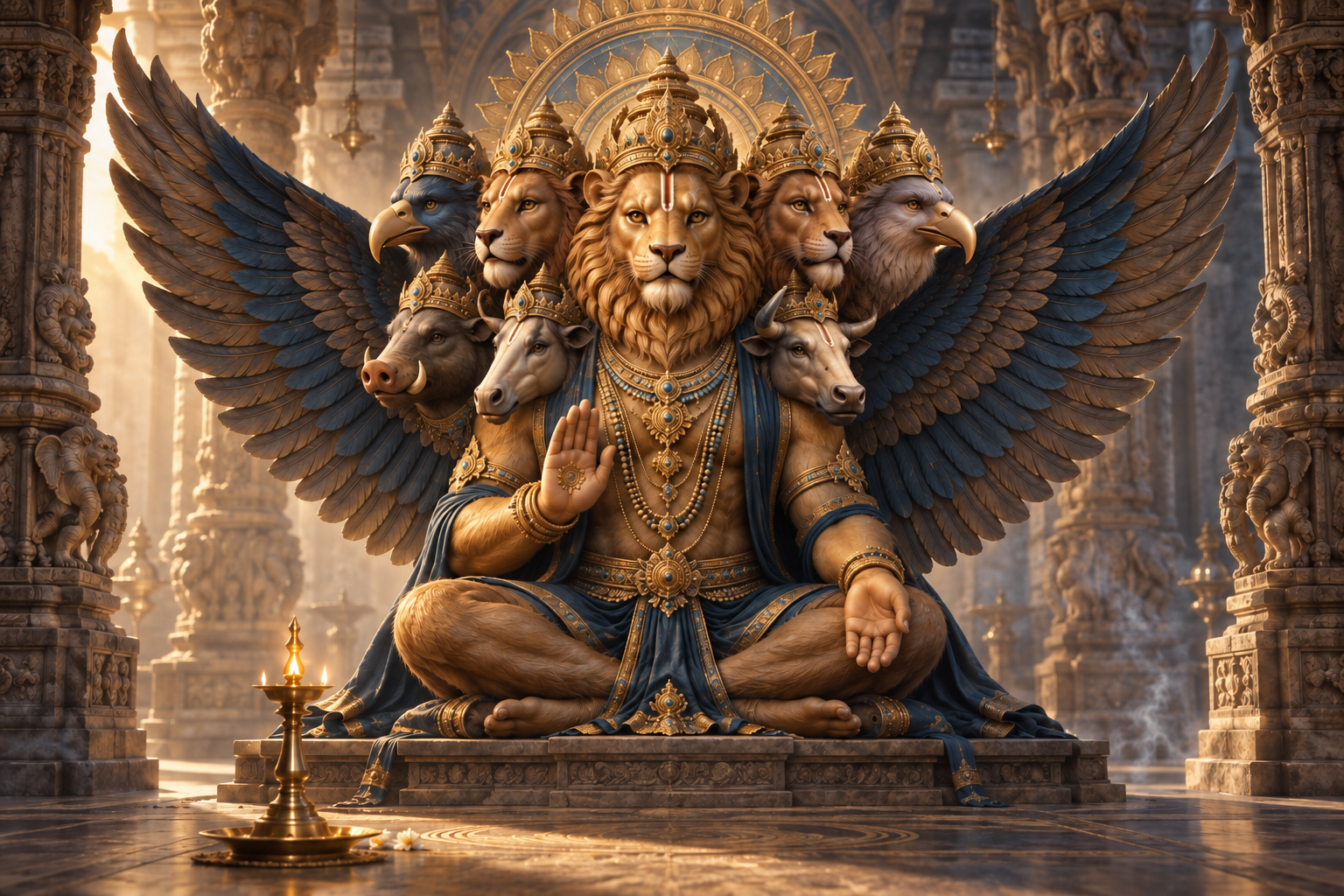
You may have encountered the name Ashtamukha Gandabherunda Narasimha beside a formidable image, a mantra, or a claim about a battle between divine forms. The name can invite two opposite mistakes: reducing the deity to an exotic curiosity, or treating every ritual instruction found online as permission to practise it.
A sound approach is both devotional and disciplined. You can understand what the name securely establishes, respect the boundaries around its sadhana, and avoid turning Shaiva-Vaishnava sacred imagery into sectarian scorekeeping.
Begin with what the name establishes

The firm starting point is modest but important: Ashtamukha Gandabherunda Narasimha is identified as an eight-faced and exceptionally fierce form of Narasimha Swamy. Narasimha is the man-lion manifestation of Vishnu, revered as the divine power that protects dharma when ordinary limits appear unable to contain adharma.
Ashtamukha tells you that the form has eight faces. It does not, by itself, identify the name, direction, colour, weapon, mantra, or ritual function of every face. Those further details require a traceable textual or lineage-specific basis. An attractive diagram or confidently labelled social-media image is not enough.
When you encounter a representation, record four things before drawing conclusions: the exact name attached to it, where it appeared, whether it is a temple murti or a modern illustration, and which text, temple, teacher, or parampara is said to preserve its interpretation. If those details are missing, restrict your claim to what the title actually tells you.
This restraint is not a lack of shraddha. It protects the tradition from invented iconography. Sacred complexity deserves more care, not more confident guessing.
Read the Sharabheshwara encounter within its tradition
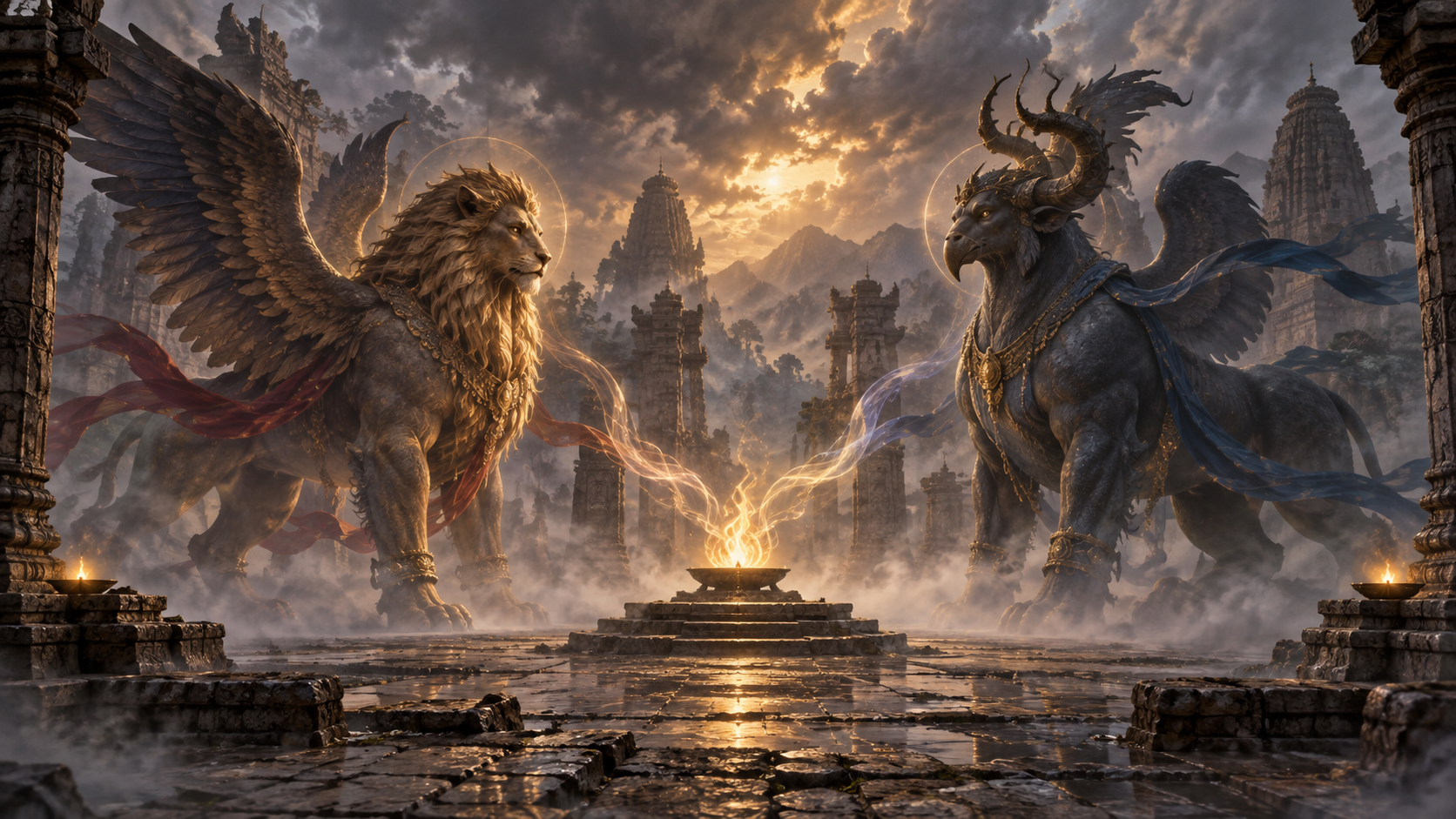
A named ritual account, the Ashtamukha Gandabherunda Narasimha Kalpam, places this form at the height of a confrontation between an intensely furious Narasimha and Sharabheshwara, identified as a form of Shiva. That is the relevant narrative frame; it should not be inflated into a universal verdict that every Hindu sampradaya must express in the same way.
Accounts involving supreme or fierce divine forms often communicate the theology of the community transmitting them. If you immediately reduce such an account to “Who defeated whom?”, you lose the more useful questions: What quality of divine power is being revealed? What ritual context surrounds the telling? How does the lineage understand fury, protection, restraint, and restored order?
- Ask whether the claim is explaining an icon, prescribing a ritual, or asserting a sectarian theology. These are different kinds of statements.
- Ask for the exact textual or parampara connection. A reference to “the scriptures” is too vague to verify.
- Separate what the named account explicitly teaches from conclusions added by a later speaker.
- Do not use the narrative to insult Shiva, Vishnu, Shaivas, or Vaishnavas. Polemical triumphalism does not deepen your understanding of either tradition.
You do not have to erase real theological differences to remain respectful. Dharmic traditions can preserve distinct accounts and hierarchies without requiring devotees to turn sacred forms into mascots for online rivalry.
Esoteric sadhana requires real boundaries
The worship associated with this form is described as an extremely secretive method of sadhana within Vaishnava Agama, Nigama, and Tantra Shastras. Treat that description as a practical boundary. It is not an invitation to assemble a ritual from fragments found across websites and videos.
In tantric practice, restriction commonly indicates that a method depends on more than words printed on a page. Pronunciation, sequence, ritual competence, preparation, discipline, correction, and adhikara—the practitioner’s fitness and authorization—can all matter. A detached mantra fragment cannot carry that complete framework.
What you can do without claiming initiation
- Offer a respectful namaskara and pray in your own words for courage, protection, self-restraint, and fidelity to dharma.
- Study public narratives and hymns of Narasimha already accepted in your family, temple, or sampradaya.
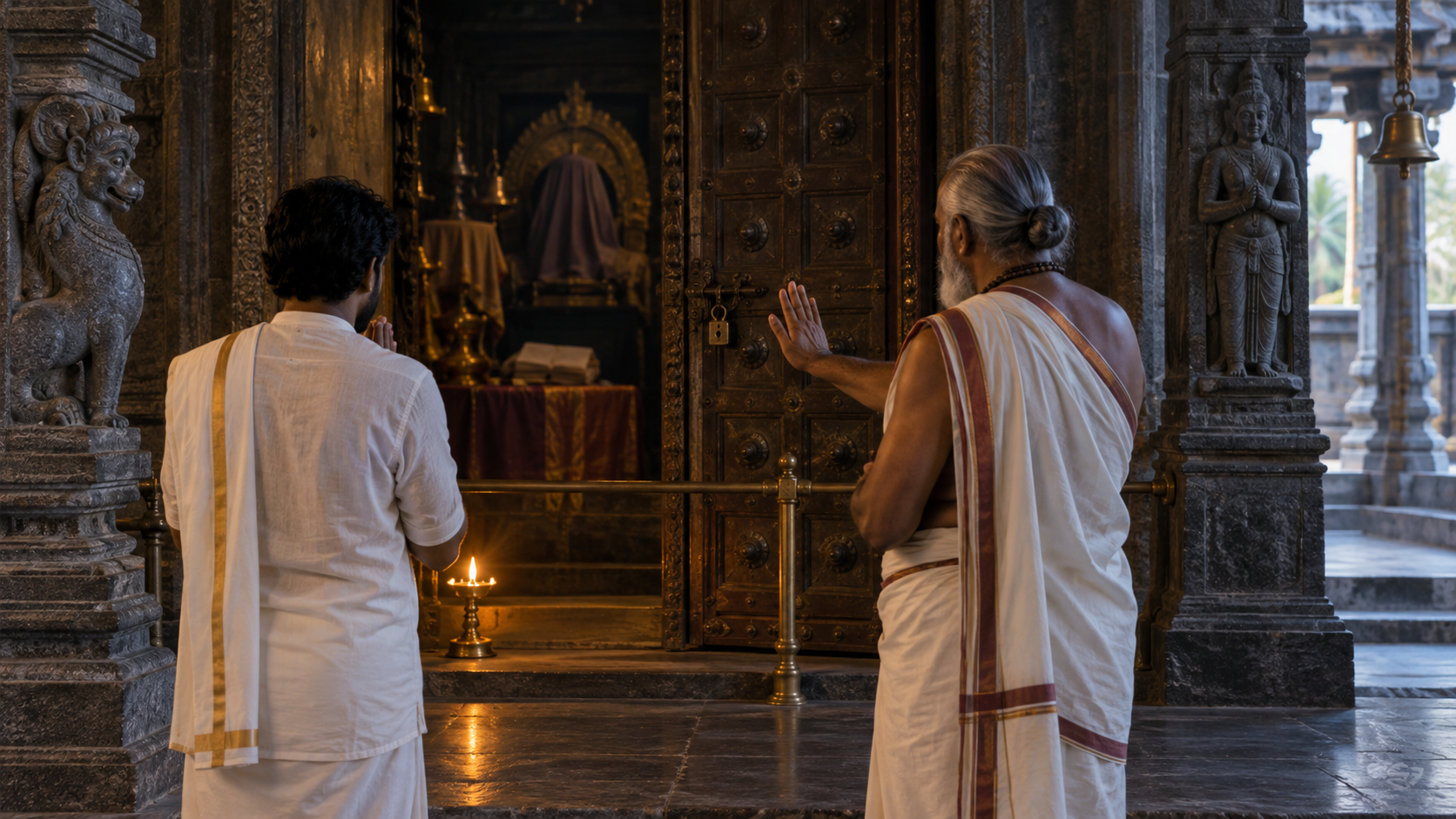
- If a temple identifies a murti as this particular form, ask its priest how devotees are expected to approach it. Follow the temple’s practice rather than importing a procedure from elsewhere.
- Preserve the exact spelling, image caption, and stated lineage of anything you want an acharya to evaluate.
What should wait for qualified instruction
- Initiatory mantras or bija syllables copied from anonymous graphics, comments, or unattributed recordings.
- Nyasa, mudra, yantra installation, or homa sequences presented as stand-alone techniques.
- Ritual combinations assembled from unrelated Shaiva, Vaishnava, and tantric materials merely because their imagery appears connected.
- Any practice marketed with guaranteed victory over enemies, instant siddhis, or fear-based claims that disaster will follow unless you perform it.
A responsible teacher should be able to state the parampara, say whether diksha is required, explain the practitioner’s obligations, and distinguish public devotion from restricted practice. If someone offers dramatic promises but cannot give basic provenance, do not treat confidence as competence.
Use a five-step test for images, mantras, and claims
Information about rare forms often arrives as a bundle: an image, several divine names, a battle narrative, and ritual instructions are presented as though each automatically proves the others. Unbundle them before deciding what to believe or practise.
- Classify the claim. Decide whether you are looking at a name, an iconographic description, a theological narrative, or a ritual prescription. Evidence for one does not automatically establish the rest.
- Preserve the exact wording. Transliteration differences can conceal whether two people are discussing the same form. Save the original name rather than silently “correcting” it.
- Trace the provenance. Look for a named text, recension, temple, acharya, or parampara. “Ancient tantra” and “secret Vedic practice” are labels, not usable citations.
- Compare within the same lineage first. A Vaishnava tantric explanation and a Shaiva theological account may be answering different questions. Their disagreement should not be erased, but neither should it be mistaken automatically for historical fraud.
- Match your action to the evidence. A descriptive claim may help you recognise a form. A ritual prescription requires a much stronger chain of transmission and, where stipulated, initiation.
A beautiful devotional image may succeed as art while remaining an unreliable ritual manual. A sincere speaker may repeat something received orally while being unable to establish its wider authority. You can honour the devotion involved without accepting every attached detail as settled fact.
Key takeaways for devotees and researchers
- Ashtamukha Gandabherunda Narasimha is an eight-faced, exceptionally fierce form of Narasimha; the title alone does not supply a complete iconographic chart.
- The Ashtamukha Gandabherunda Narasimha Kalpam connects the form with the climactic encounter between Narasimha and Sharabheshwara.
- The associated sadhana is presented as secretive and tantric. Public reverence is not the same as authorization to perform its restricted rites.
- Facial identities, exact mantras, ritual sequences, and universal sectarian conclusions all require more provenance than an image caption can provide.
- Your best next step is to take the exact claim—not a paraphrased version—to a Vaishnava acharya or temple priest who can identify the relevant parampara and its requirements.
If you want to go further, begin with provenance rather than procedure. Save the precise name and context you encountered, then ask a qualified teacher what belongs to public understanding and what requires diksha. Reverence becomes stronger when curiosity accepts discipline.
References

Leave a Reply
You must be logged in to post a comment.