
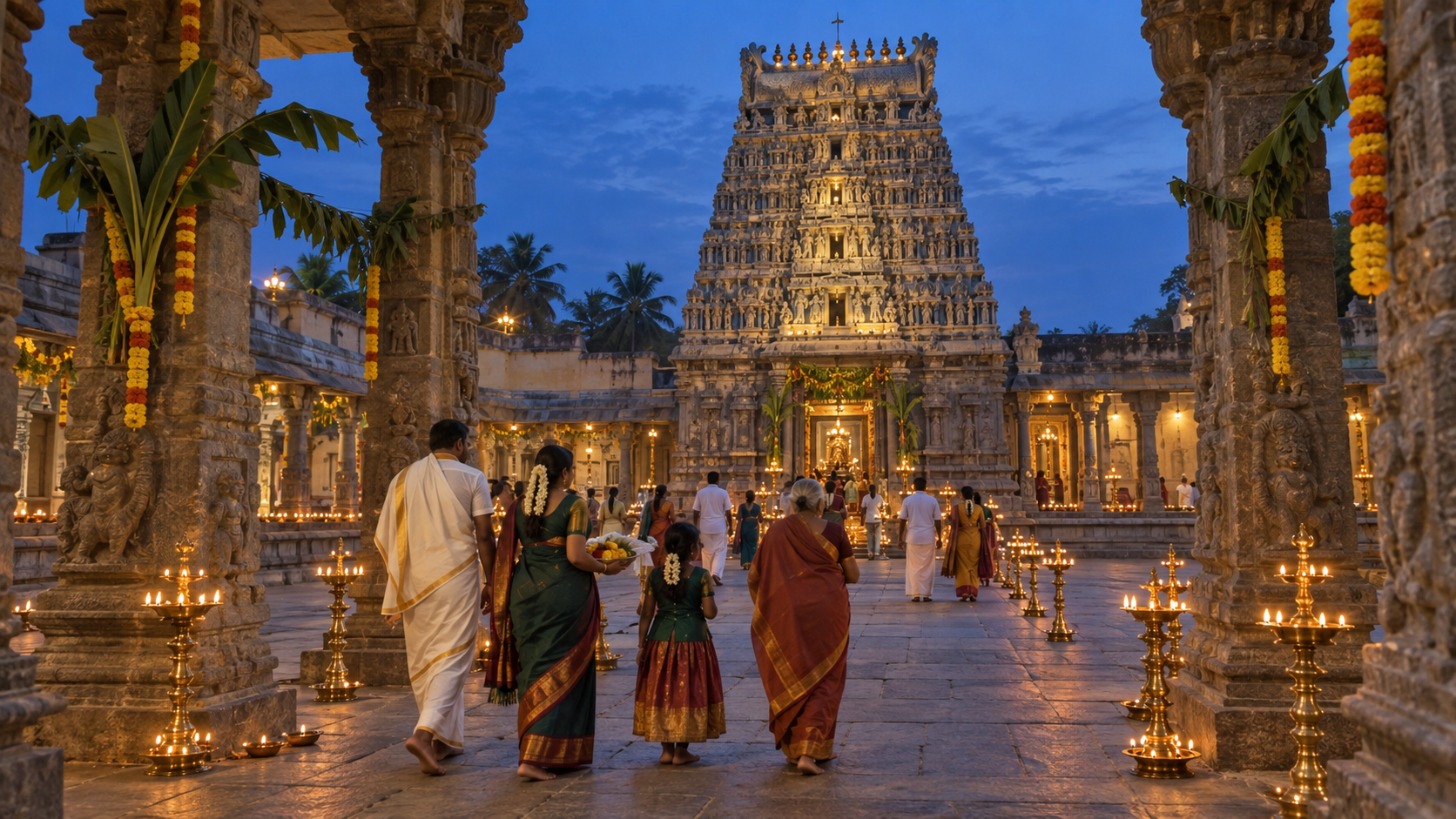
If you are planning temple visits in Tamil Nadu during Navaratri, the important question is not how many shrines you can fit into a day. It is how to make each darshan deliberate when festival activity, travel, and a long wish list are all competing for your attention.
A sound pilgrimage plan has three parts: a devotional purpose, one principal temple, and enough uncommitted time to receive the worship without rushing it. Begin there, then add other temples only if they deepen that purpose.
Read the festival before you build the route
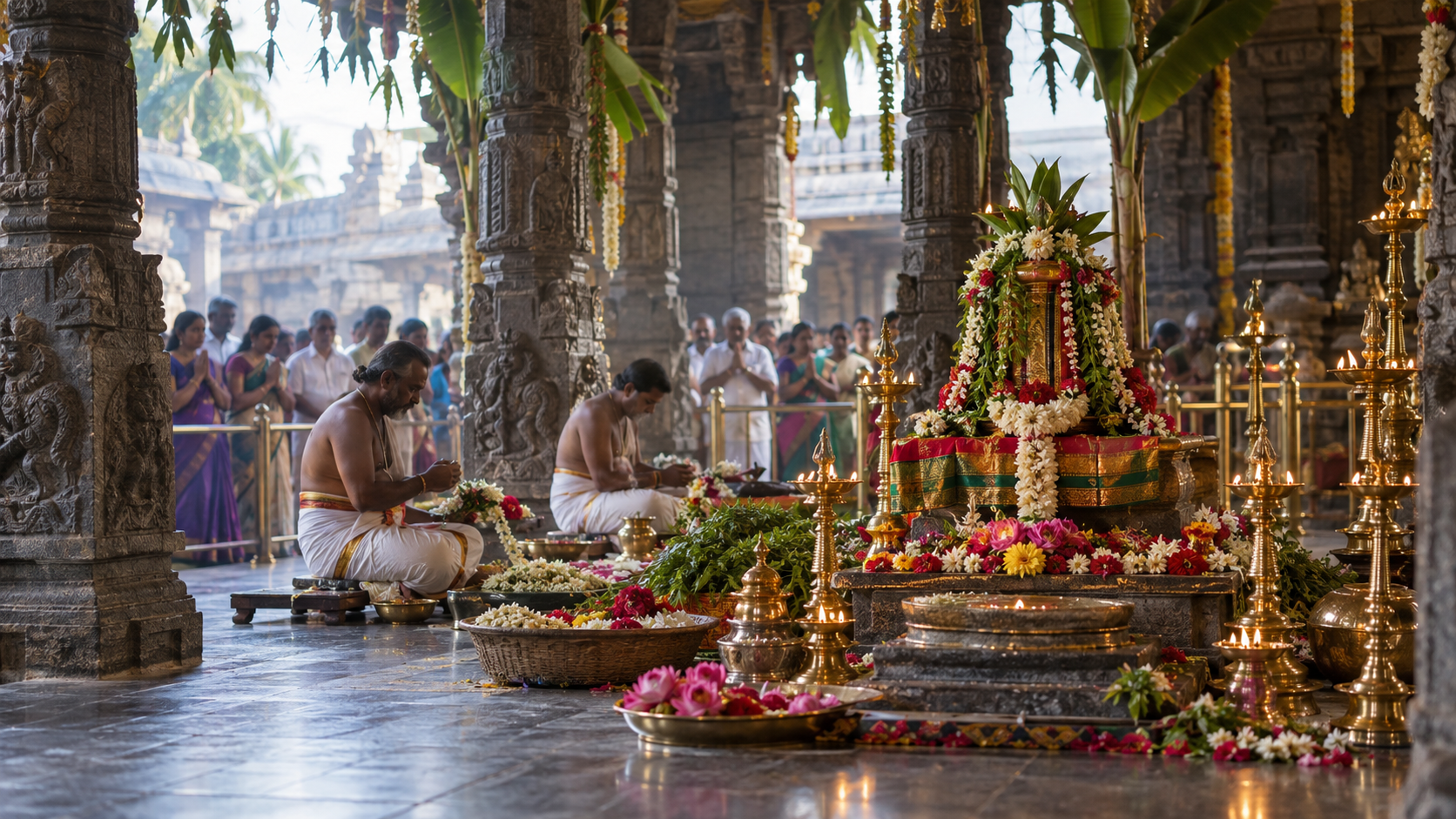
Tamil Nadu’s temple observance gives you a clear spiritual center. Navaratri is understood as Devi’s dwelling within each temple, with Durga especially foregrounded. That changes the character of the visit. You are not merely inspecting seasonal decorations; you are approaching a sacred presence that the temple community is serving through worship.
The observance begins with Devi Paksha in the month of Ashwin, generally in September or October, and concludes with Vijayadashami. Use the calendar for the exact year of your journey. Do not assume that a date remembered from a previous year will remain correct.
Within the temple, expect the devotional environment to be formed by decoration, ceremonial lamps, and Vedic chanting. These are not three unrelated attractions. The visual beauty directs the eye, the lamp concentrates attention, and the recitation gives the worship an audible sacred order. When you plan enough time to notice all three, the visit ceases to be a quick visual stop.
Lakshmi, Saraswati, and Durga all belong to Tamil Nadu’s historic Navaratri tradition. Their presence can also give your pilgrimage a personal structure. You may approach Devi through the need for steadiness and protection, through right prosperity and household well-being, or through learning and clarity. Treat this as your own devotional frame, however, not as a claim that every temple assigns the same form or sequence to a particular day. Ask the temple what is actually being observed when you visit.
Choose a pilgrimage shape that matches your real purpose

A pilgrimage becomes hurried when the route is chosen before the purpose. Decide first whether you want sustained worship at one shrine, a compact city circuit, or a longer journey through several cities. Each can be valid, but they demand different discipline.
One temple for unhurried darshan
Choose one temple if this is your first Tamil Nadu Navaratri visit, if you are travelling with children or anyone who tires easily, or if you have a specific vow or family connection. A single-temple plan lets you arrive before the worship you hope to attend, receive darshan without watching the clock, and remain for chanting where the temple permits it.
This is also the right choice when the temple is your kuladeivam shrine or another place of established family devotion. In that case, do not weaken the central visit merely to increase the number of locations on your itinerary.
A compact Chennai pilgrimage
Chennai offers a practical base when you want more than one darshan without turning the journey into a statewide expedition. One clear anchor is Ashtalakshmi Temple in Besant Nagar, on the shore of the Bay of Bengal, where the Lakshmi dimension of Navaratri gives the visit a distinct devotional focus.
Make the anchor temple non-negotiable and every additional stop optional. Select only temples that fit naturally into the same part of the city and the same half of the day. Map distance alone is not enough: confirm the opening window, the festival program, and the time at which you actually hope to be present. If a second visit would force you to leave the principal temple before chanting or worship is complete, remove it.
A city-by-city Tamil Nadu journey
For a longer pilgrimage, use a city-by-city approach to Tamil Nadu’s Navaratri temples. Choose the cities first, then name one anchor temple in each. Do not assemble a statewide list of shrines and only afterward try to force it into a workable route.
Give each city a devotional role. One may center on your family deity, another on a form of Devi especially meaningful to you, and another on Vijayadashami. This prevents the journey from becoming a collection exercise. It also gives you a simple rule when plans tighten: preserve the anchor temple and release the optional visits.
Plan the day around worship, not just opening hours
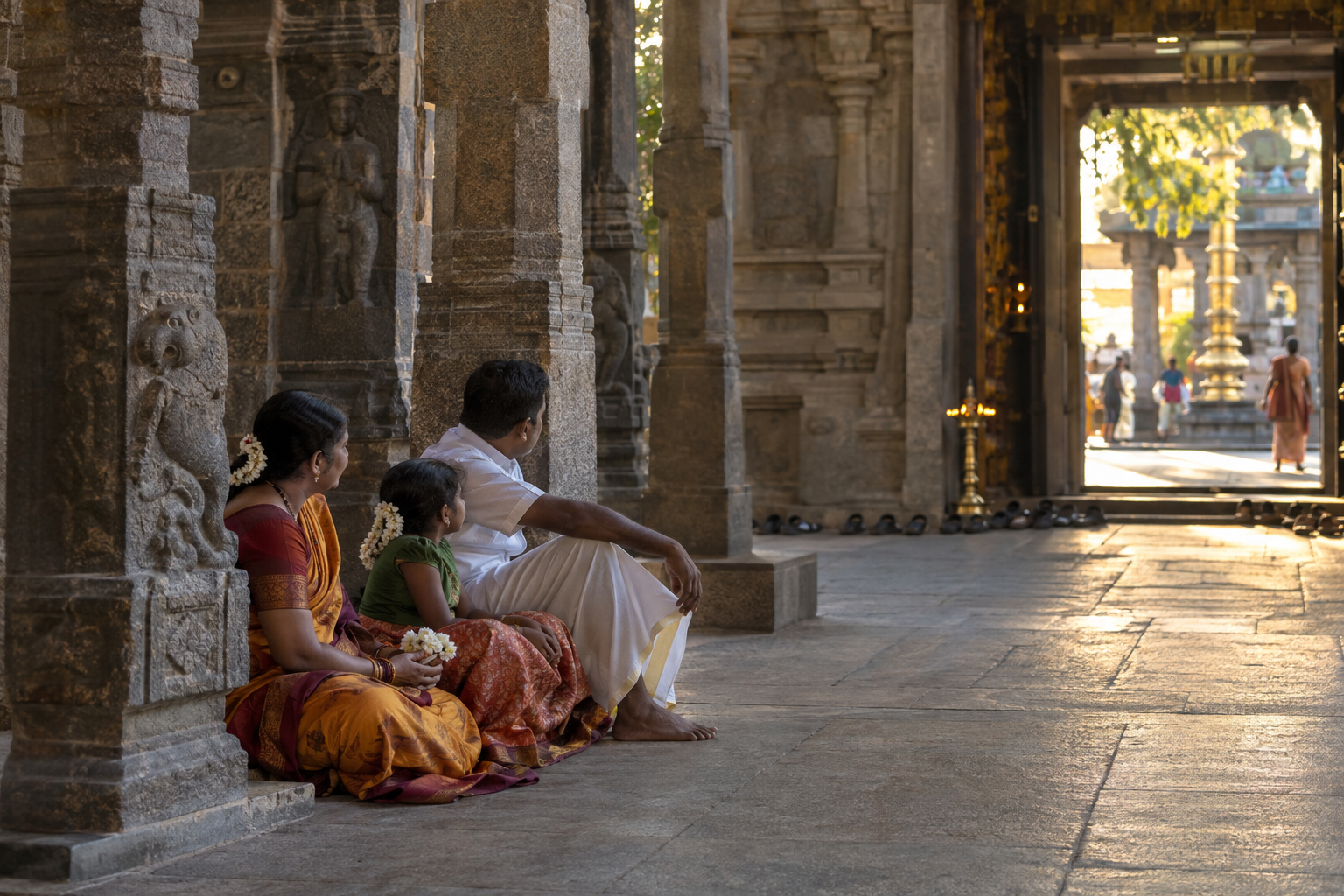
A general festival description cannot tell you the exact program at a particular shrine. Temple practice, special observances, access arrangements, and permitted activities may differ. Verify the details directly before setting out, especially if your journey depends on witnessing a particular ceremony or recitation.
- Write one sentence of intention. Decide what you are bringing before Devi: gratitude, a difficulty requiring courage, a commitment to study, concern for the household, or a prayer for dharmic clarity. One sentence is enough.
- Choose the exact festival day. Check the Navaratri calendar for the year of travel, then confirm that the date and observance match your aim. If the conclusion of the festival matters to you, identify Vijayadashami explicitly rather than relying on a remembered date.
- Contact the anchor temple. Ask for that day’s opening windows, the expected time of special worship or chanting, queue arrangements, accessibility, and rules governing bags, footwear, and photography. Ask precise questions; a general inquiry may produce only general information.
- Build backward from the worship. Treat the time you want to be inside the temple as the fixed point. Add travel, entry, and a reasonable margin before it. Do not make the temple visit the leftover interval between meals and sightseeing.
- Limit optional stops. For a city visit, keep one principal temple and no more optional visits than you can abandon without disappointment. A stop that is emotionally compulsory is not optional and should be planned as an anchor.
- Set a stopping rule. Decide in advance that you will drop the next temple if the principal darshan runs long, a companion becomes tired, or the route begins to feel hurried. This protects the spiritual purpose without requiring a debate in the middle of the day.
If you are travelling as a family, share the purpose and the stopping rule before departure. One person can confirm temple information, another can manage transport, and everyone should know which darshan has priority. This small division of responsibility keeps practical interruptions from dominating the sacred visit.
Make darshan a practice rather than a checklist
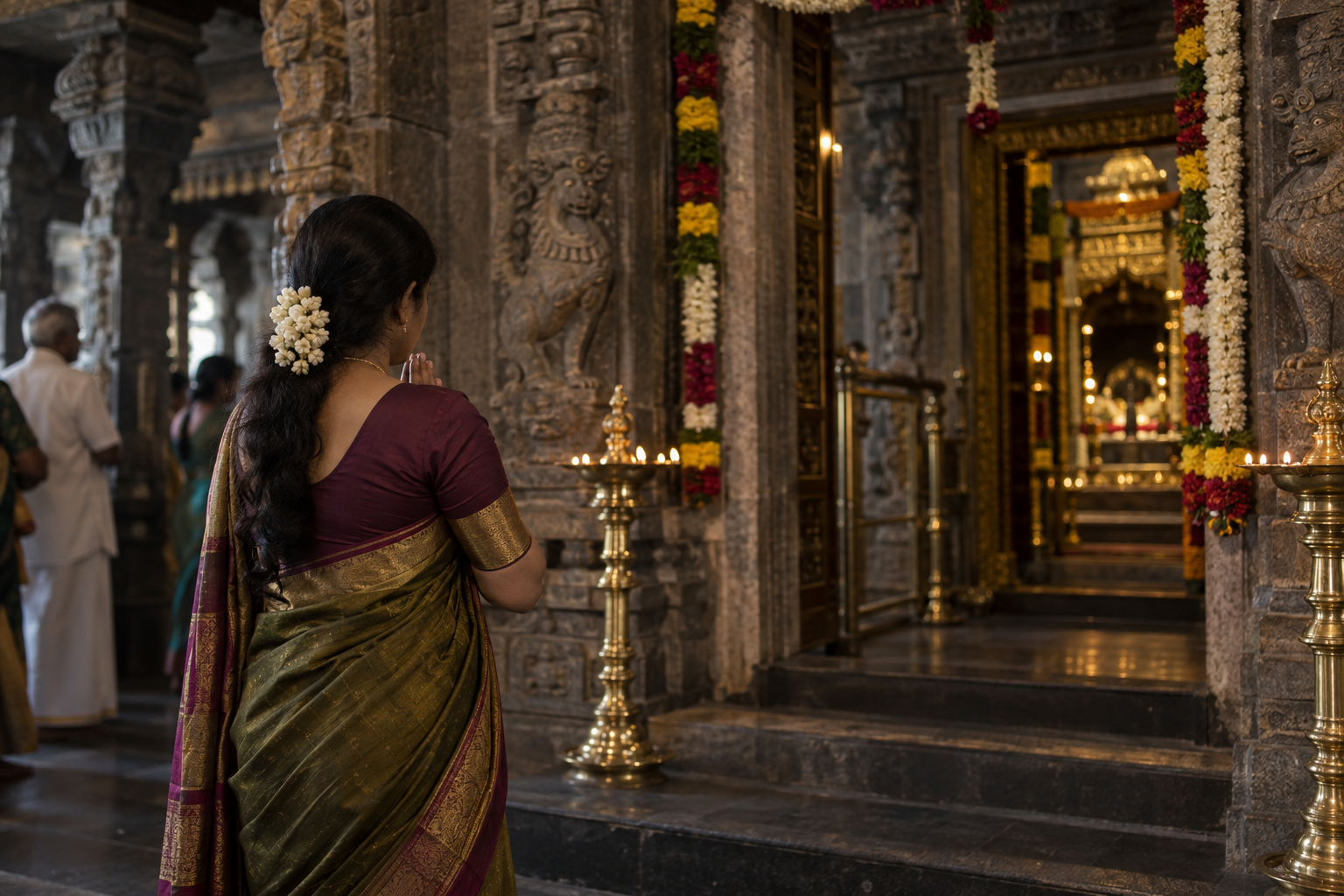
The easiest way to lose the meaning of a Navaratri circuit is to treat every temple as a backdrop for the same photograph. Instead, give each visit a beginning, a center, and a close.
- Before entering: silence your phone, recall your one-sentence intention, and learn which form of Devi is being worshipped. Follow that temple’s instructions on dress, footwear, offerings, movement, and photography.
- During darshan: look first at the deity rather than the decoration. Notice how the lamps illuminate the sacred form. If Vedic chanting is underway and you are allowed to remain, listen instead of treating it as background sound.
- After darshan: step aside without obstructing other devotees. If the temple permits you to sit, remain quietly for a short period. Translate the prayer into one dharmic duty you will carry home.
Navaratri also has a material culture of devotion: devotees create sacred images and toys representing deities. When you encounter such a display, do more than scan it for familiar figures. Notice the relationships among the forms, ask a host or temple volunteer about an unfamiliar image when conversation is welcome, and do not touch or rearrange anything without permission. The arrangement can teach through form, sequence, and memory, but only if you slow down enough to read it.
Respect for other worshippers is part of the pilgrimage. Do not block the darshan line for a photograph, speak over recitation, or turn a ceremonial lamp into a photo prop. Beauty is integral to Tamil temple worship, but it directs attention toward Devi rather than toward the visitor.
Key takeaways for your Navaratri pilgrimage
- Begin with a devotional purpose, not a target number of temples.
- Use one anchor temple for each city and classify every other stop as genuinely optional.
- Check the exact year’s calendar because Navaratri begins in Ashwin and ends with Vijayadashami rather than occupying fixed Gregorian dates.
- Confirm the individual temple’s program and practical rules directly; a common Tamil Nadu tradition does not guarantee identical schedules.
- Give attention to Devi, ceremonial lamps, and Vedic chanting before turning to photographs or the next destination.
- If the route begins to undermine the worship, shorten the route rather than shortening the darshan.
Your next step is simple: choose the city, name the anchor temple, confirm the festival day and worship window, and write the prayer you intend to carry through its doors. Leave enough space in the schedule for the pilgrimage to become more than the itinerary.
References
- Hindu Pad — Navaratri Celebrations in Tamil Nadu
- Hindu Pad — List of Temples to have darshanam in Navaratri in Tamil Nadu cities
- Hindu Pad — Chennai Temples for Navaratri Festival 2026
- Hindu Pad — Navaratri celebrations in Tamil Nadu Temples

Leave a Reply
You must be logged in to post a comment.