
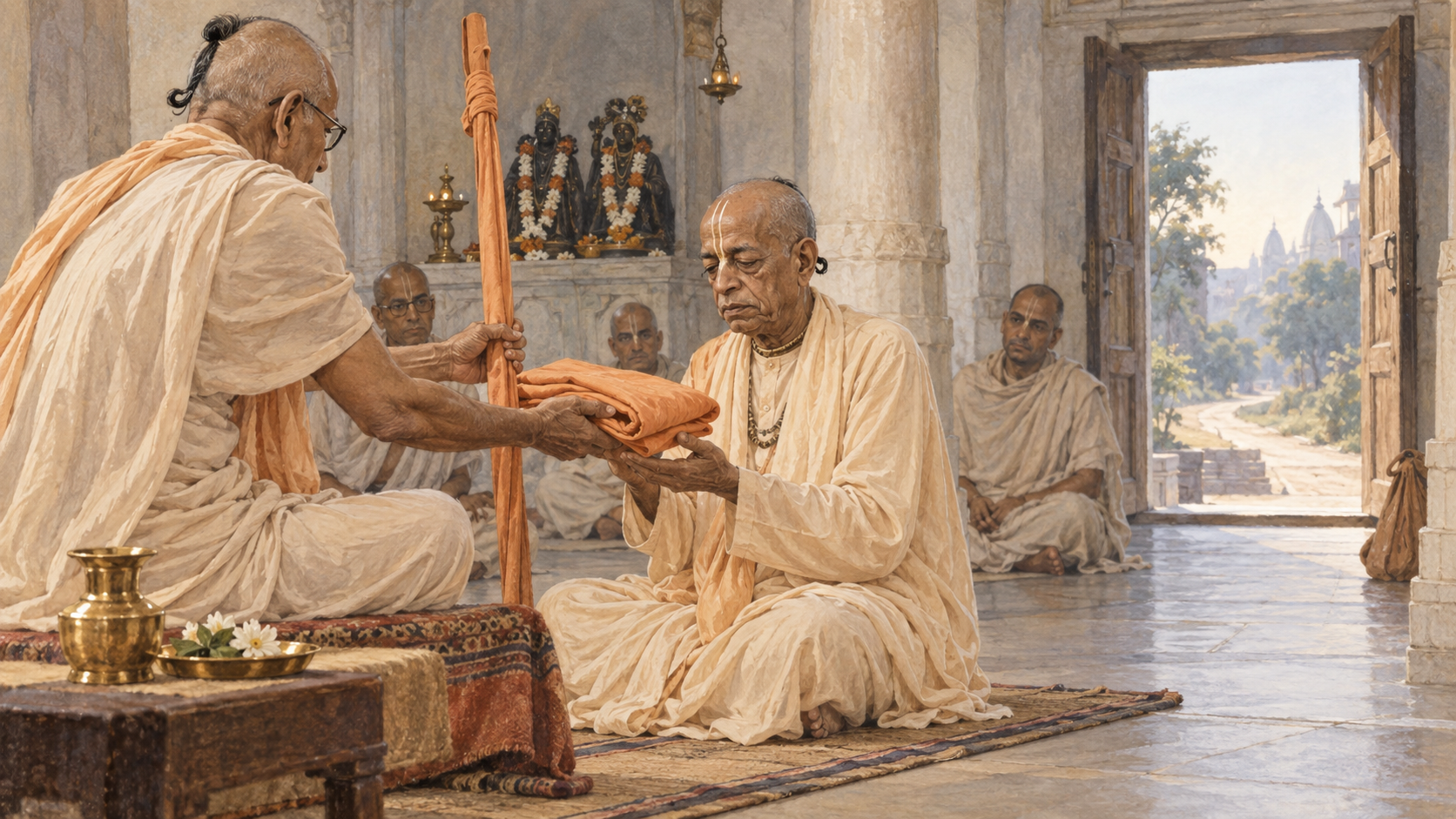
If you are trying to understand why Srila Prabhupada’s acceptance of sannyasa mattered, do not reduce it to a change of clothing, title, or social position. The more useful question is this: what did accepting the renounced order place at the centre of his life?
It is remembered as a decisive turning point because renunciation became inseparable from fidelity to the instructions of his spiritual master, Srila Bhaktisiddhanta Sarasvati. That connection helps you see the event as an act of disciplined service rather than a retreat from responsibility.
The turning point was a reordering of obligation
Sannyasa is the formal renounced order of life. Its significance cannot be measured merely by asking what a person gives up. You must also ask what becomes non-negotiable after the renunciation. In Prabhupada’s case, the essential fact is that his acceptance of sannyasa expressed dedication to the direction received from his guru.
This distinction matters. Giving something up can be temporary, emotional, or centred on the self. A vow becomes spiritually meaningful when it places the person more fully at the service of a duty beyond personal comfort. The external form announces the commitment, but the governing purpose gives that form its value.
When you read this part of Prabhupada’s life, look for that movement from preference to obligation. The question is not simply whether renunciation made life harder. The question is whether it removed competing claims on a service he had accepted as authoritative. That is why the moment deserves to be called a turning point: it marked not a passing mood, but a new ordering of life around spiritual responsibility.
Sannyasa did not mean disappearing from useful work
Renunciation is often misread as withdrawal, inactivity, or indifference to the world. That reading does not fit a service-centred understanding of sannyasa. In a devotional life, relinquishing personal claims can make purposeful action more concentrated. One renounces the demand that work serve one’s own status, possession, or comfort; one does not renounce the obligation to serve.
Three distinctions will keep your understanding clear:
- Renunciation is not resentment. Leaving an obligation because it is frustrating is different from relinquishing personal attachment so that a higher obligation can be fulfilled.
- Detachment is not passivity. Freedom from possessiveness can support sustained work when the work is undertaken as seva rather than self-promotion.
- Austerity is not the goal by itself. Hardship has no automatic spiritual value. Its value depends on whether it strengthens truthfulness, steadiness, humility, and service.
Use these distinctions whenever a biography presents an act of renunciation. Ask what duty the renunciation served, what attachment it displaced, and what kind of action followed from it. If those questions are ignored, sannyasa can be romanticised as spiritual drama. If they are asked, its ethical seriousness comes into view.
Guru-directed service is the interpretive key
Prabhupada’s dedication to the instructions of Srila Bhaktisiddhanta Sarasvati is not a decorative detail added to the story of his sannyasa. It supplies the event’s inner logic. The vow was connected to a received spiritual responsibility, not merely to a private desire for elevation or recognition.
This is where guru-nistha, steadiness in relation to one’s spiritual teacher, must be understood carefully. It is not demonstrated by repeating a guru’s name while protecting every personal convenience. Nor is it permission to invent commands that make a story more dramatic. It is shown by taking authentic instruction seriously enough to reorganise one’s conduct around it.
When you assess claims about obedience to a guru, apply a simple test:
- Identify the instruction actually established. Do not substitute an attractive slogan for what is known.
- Notice the cost of fidelity. A serious instruction normally challenges some preference, attachment, fear, or habit.
- Look for service rather than self-display. Genuine obedience directs attention towards the entrusted work, not towards the disciple’s image as an obedient person.
- Examine the spiritual fruit. Greater steadiness, responsibility, humility, and usefulness are better indicators than theatrical austerity.
This test also protects the sacredness of the guru-disciple relationship. Reverence does not require exaggeration. In fact, refusing to embellish what is known allows the real principle to appear more clearly: Prabhupada’s renunciation mattered because it embodied commitment to guidance he regarded as spiritually binding.
Key takeaways
- Srila Prabhupada’s acceptance of sannyasa should be read as a turning point in commitment, not merely a ceremonial change.
- The governing connection is between renunciation and dedication to the instructions of Srila Bhaktisiddhanta Sarasvati.
- In a service-centred understanding, sannyasa does not abolish responsibility; it removes personal claims that compete with spiritual duty.
- External austerity is not self-validating. Its purpose and fruit determine its spiritual meaning.
- The responsible lesson for most readers is not to imitate a formal vow, but to identify and relinquish attachments that obstruct duties already accepted.
How to honour the example without imitating the order
A biography of a sannyasi can inspire you, but inspiration does not qualify you to copy the formal act. Sannyasa is a serious religious commitment with personal and communal consequences. It belongs under qualified spiritual guidance, not under the pressure of a sudden emotional response.
You can still apply the principle immediately. Begin with a duty that you already recognise as yours: a spiritual discipline, an act of seva, a responsibility to family or community, or an instruction legitimately received from a teacher. Then name the particular attachment that repeatedly interferes with it. Be exact. “Distraction” is vague; protecting leisure at the appointed time for practice is specific.
Next, choose a renunciation proportionate to that obstacle. Remove the avoidable indulgence, convenience, or claim that competes with the duty. The sacrifice should make service more dependable. If it merely makes you feel severe, visible, or superior, it has missed the point.
Finally, judge the result by conduct. Are you more reliable? Is your practice steadier? Do other people receive better service from you? Are you becoming less preoccupied with recognition? These questions translate the meaning of renunciation into something you can honestly examine.
The next time you contemplate Prabhupada’s acceptance of sannyasa, ask what claim upon your own comfort is obstructing a duty you already know. Relinquish that claim in a measured way, place the recovered energy into service, and let consistency—not display—show what the lesson has changed.



References

Leave a Reply
You must be logged in to post a comment.