
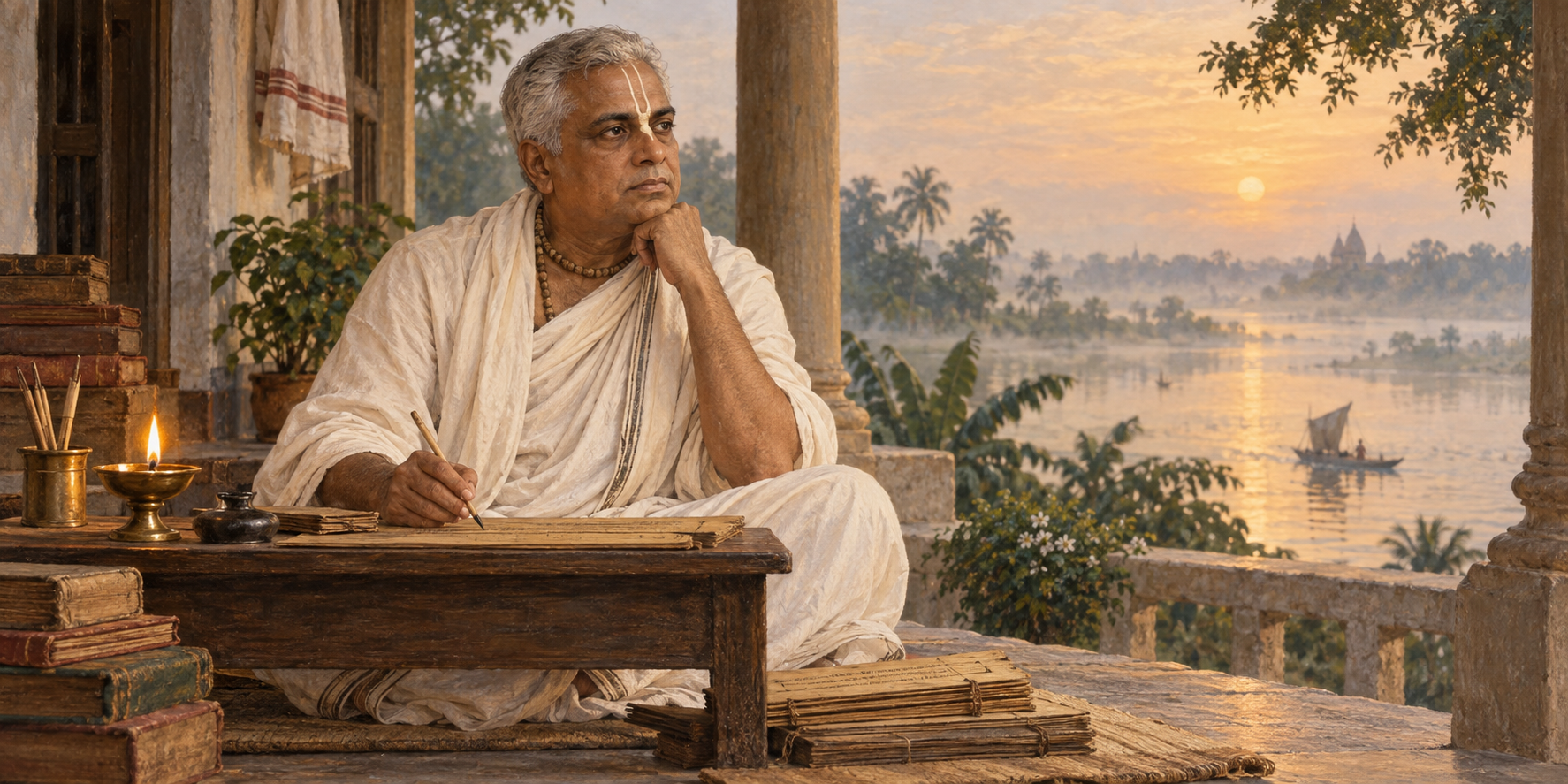
You want to honor Srila Bhaktivinoda Thakura, but perhaps you do not know the customary program, cannot reach a temple, or worry that a few ceremonial gestures will become a substitute for meaningful remembrance. The day can still be observed with integrity.
Build your observance around three things: hear carefully, remember purposefully, and accept one form of service. Whether you spend the day in a temple or at home matters less than whether something you hear changes how you practise bhakti afterward.
Treat the day as a meeting with an acharya
In Vaishnava practice, an acharya’s appearance day is not merely a birthday commemoration. It is an opportunity to approach the acharya through his life, teaching, example, and service. The central question is therefore not, “How much did I fit into the program?” It is, “What am I now prepared to receive and practise?”
Set your intention before the observance begins. Write one sincere question about your present spiritual life. It might concern steadiness in daily practice, inattentive hearing, pride, service, relationships with other devotees, or the gap between what you understand and what you actually do. Carry that question into the discourse or reading. A focused question helps you hear as a practitioner rather than as a collector of religious information.
You do not need to invent a prayer and attribute it to Srila Bhaktivinoda Thakura. A plain request in your own words is enough: ask for the honesty to recognise what must change and the strength to begin changing it.
Choose a temple observance or a simple home practice
Start by confirming the date and schedule with the Vaishnava community you intend to follow. Festival dates and programs may be organised according to a particular calendar, location, and temple routine. A 2026 appearance-day address by His Grace Kripanidhi Prabhu is dated 24 September, but that does not tell you the start time, fasting practice, or full program at your local temple. Ask the temple directly instead of copying customs from an unrelated online notice.
If you are going to a temple
- Confirm the program before leaving. Ask specifically about the discourse time, any congregational chanting, offerings, prasada, fasting guidance, and opportunities for service.
- Arrive before the discourse rather than entering midway through it. Use the quiet interval to recall the question you prepared.
- Bring something on which you can record one teaching and one action. Do not try to transcribe everything.
- Keep your phone out of your hands unless the organisers have asked you to help with recording or communication. Documentation can serve the community, but casual filming easily displaces hearing.
- Offer practical help through the organisers. Cleaning, welcoming visitors, preparing the space, distributing prasada, or supporting another assigned task can become part of the observance when it is actually needed.
- Follow the temple’s guidance on ritual and food. Do not impose a practice learned elsewhere on the local program.
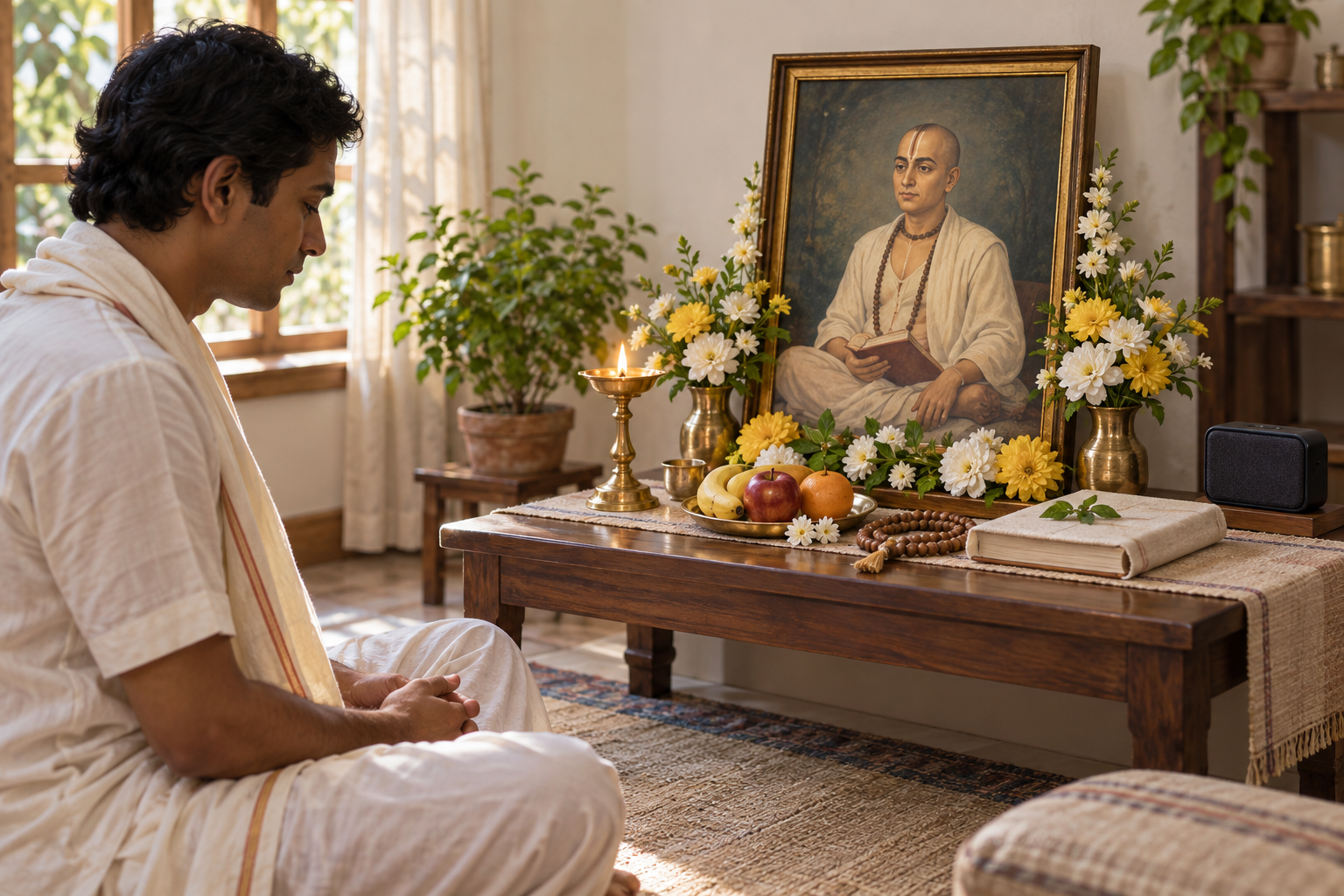
If you are observing at home
Do not attempt to imitate a full temple festival by yourself. Give the day a clear structure that you can complete attentively:
- Continue your established daily sadhana. A festival should deepen regular practice, not replace it.
- Prepare a clean, quiet place for hearing. Put away the tasks and devices that normally fragment your attention.
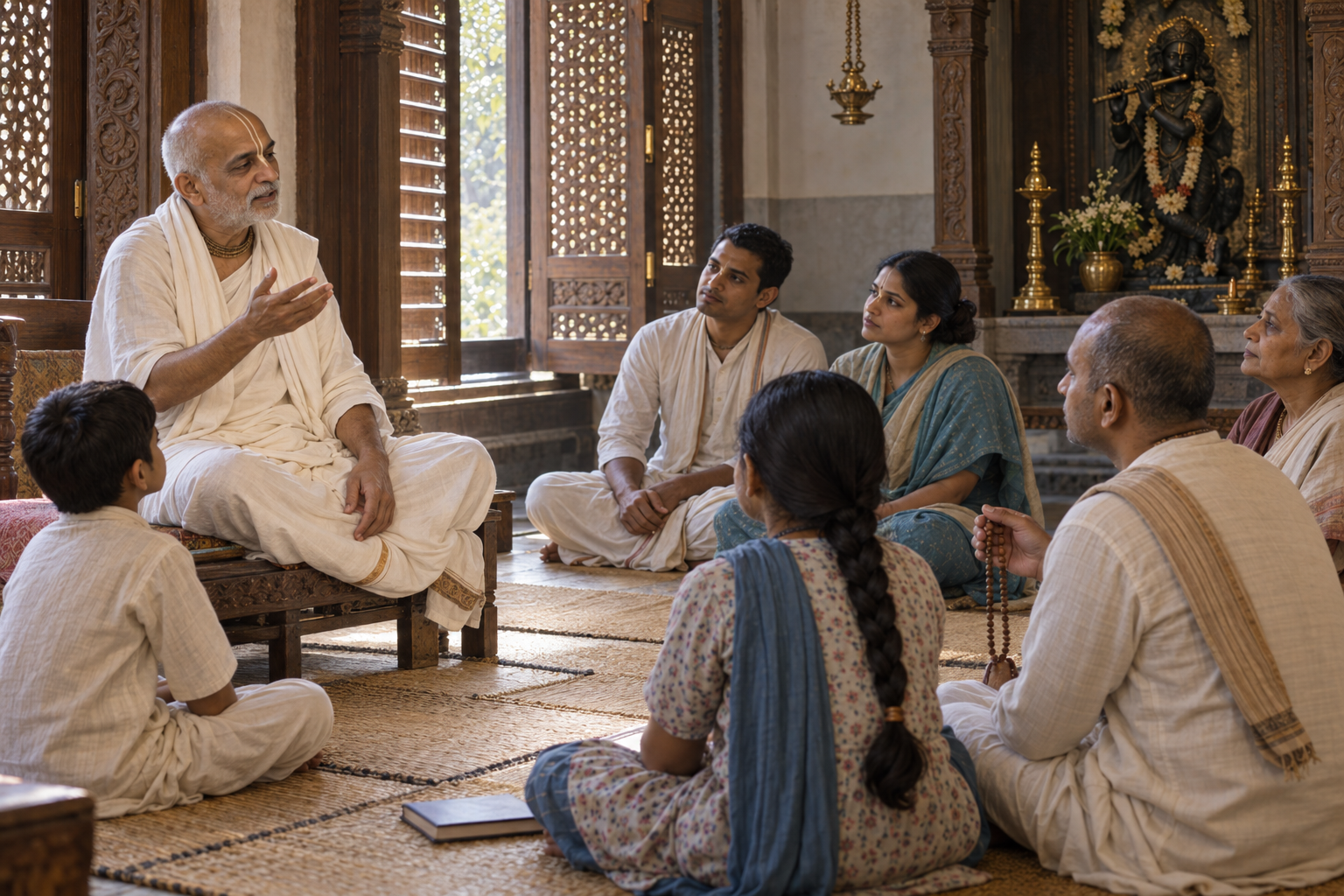
- Hear an appearance-day discourse or read reliable material about Srila Bhaktivinoda Thakura from a Vaishnava institution you trust.
- Pause when a teaching challenges you. Write it in your own words before moving on.
- Choose a service you can actually perform. It may be a household responsibility done without resentment, assistance to a devotee, support for a temple, or careful sharing of an authentic teaching with someone who has asked.
- Close by stating the practice you will carry into the next ordinary day.
If kirtana, an offering, or honoring prasada already belongs to your established practice, include it according to the guidance you follow. If you are new to Vaishnava practice, ask a knowledgeable devotee rather than assembling ritual instructions from disconnected clips.
Listen for one instruction you can carry into tomorrow
An appearance-day discourse may contain biography, theology, praise, and practical instruction. All of these have value, but they do not ask the same thing from you. Biography tells you what happened. Praise directs your gratitude. Theology clarifies what you understand. Instruction asks for a response.
Listen with three filters:
- What quality is being shown? Name it precisely. “Devotion” may be too broad; careful hearing, perseverance, humility, courage, or responsibility gives you something observable.
- What obstacle in me resists that quality? Avoid a general confession. Identify the recurring situation in which you become distracted, defensive, careless, or passive.
- What action would express the teaching? Choose conduct you can recognise when it happens: begin sadhana before opening messages, finish an accepted service, apologise without defending yourself, verify a quotation before sharing it, or give undivided attention during a set period of hearing.
After the program, complete four short lines: “The teaching I heard was…”; “The habit it challenges is…”; “My next action is…”; and “I will review this after…”. Supply a real occasion for the final line, such as your next temple visit or conversation with a mentor. Without a review point, a good intention can disappear as soon as the festival atmosphere passes.
Keep devotion and factual care together
Reverence does not excuse careless attribution. Appearance days often bring a flood of quotations, images, anecdotes, and short videos. Some may be accurate; others may omit context or attach a respected name to words that merely sound devotional.
Before repeating a quotation, locate it in an identifiable work, recording, or trusted institutional publication. Preserve the surrounding point rather than circulating one attractive sentence alone. If you cannot verify the wording, share the idea in your own words and do not place quotation marks or Srila Bhaktivinoda Thakura’s name beneath it.
Apply the same care to biographical claims. Record the speaker, occasion, date, and hosting institution when those details are available. Separate what was explicitly stated from what you inferred. If two retellings differ, leave the disputed detail out until you can consult a dependable account. Accuracy is not a cold academic addition to devotion; it is part of serving an acharya without making him answer for words he may not have spoken.
This also changes how you use social media. Share less, but make what you share traceable. A direct link to a complete discourse is generally more useful than an unattributed quotation card. Add a brief note about the teaching you are trying to practise rather than presenting the post itself as the completion of your observance.
Key takeaways for the day
- Confirm the local date, schedule, food guidance, and service arrangements instead of assuming that every temple follows the same program.
- Bring one honest spiritual question to the observance.
- Hear for a quality, the obstacle that opposes it, and a concrete action that expresses it.
- At home, keep the observance simple enough to complete with full attention.
- Verify quotations and biographical claims before sharing them under Srila Bhaktivinoda Thakura’s name.
- Carry one commitment into ordinary life and arrange a definite occasion to review it.
Before the day ends, put your chosen action where tomorrow can reach it: in your sadhana space, calendar, service notes, or a message to the mentor who will ask you about it. Then let the appearance-day observance continue in the place where homage becomes visible – your conduct.

References

Leave a Reply
You must be logged in to post a comment.