
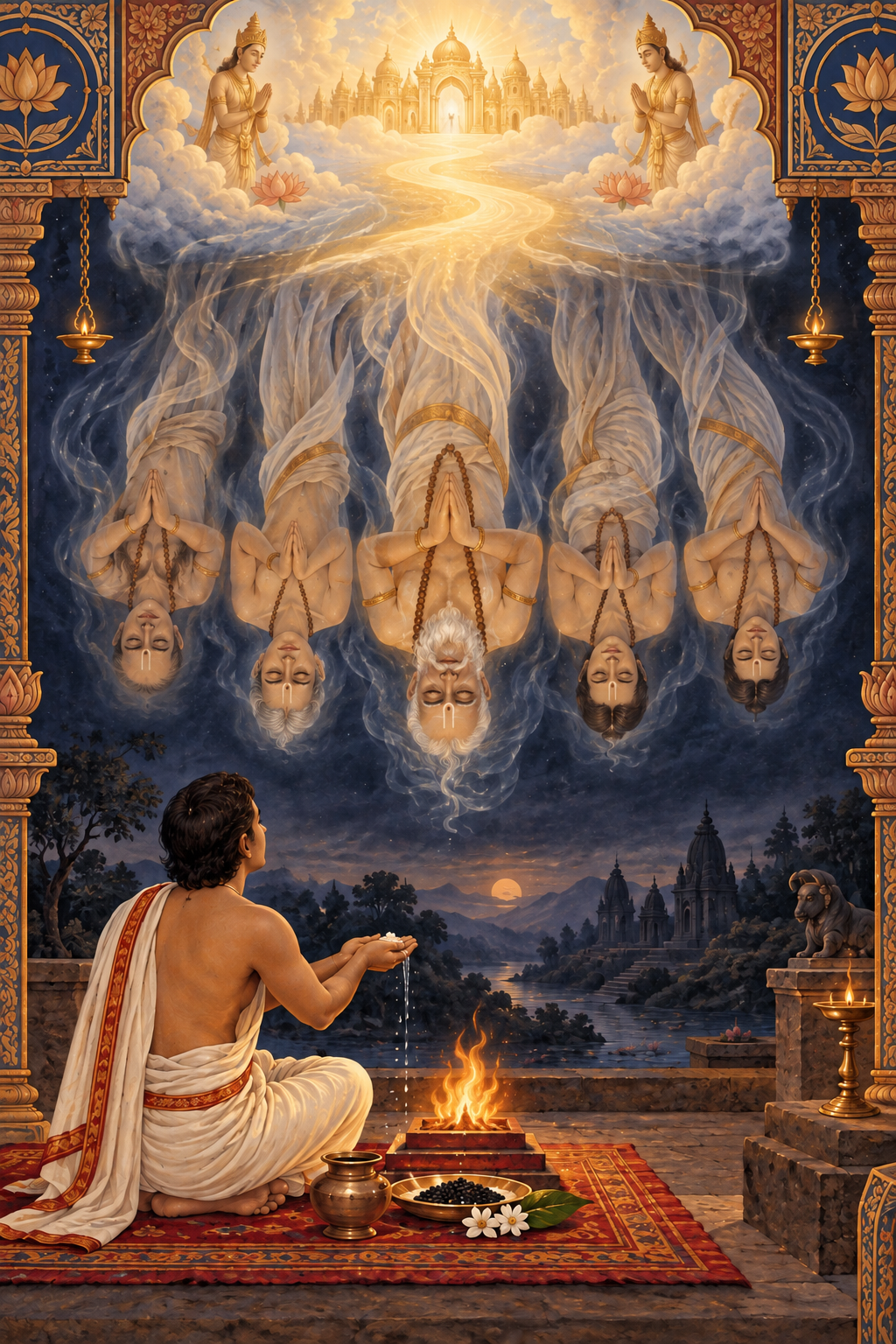
You have seen the Pitrs hanging upside down in a painting, illustration, or sacred narrative, and the image seems disturbing. Does it mean that the ancestors are being punished? Is it a warning to their descendants? Or is the posture simply a dramatic artistic choice?
The safest answer begins with a distinction: the inversion describes a spiritual condition, not the normal anatomy of the ancestral realm. It turns the familiar order upside down so that you notice an existence that is no longer embodied, yet not entirely free from the cycle of existence.
Read the posture as a condition, not a literal portrait

An upside-down figure immediately tells you that something is out of its ordinary alignment. The symbol works because you already know what uprightness means: stability, orientation, agency, and a secure place in the visible world. Inversion withdraws that security.
That does not automatically make the image a scene of torment. Hindu symbolism often uses physical position to make an invisible state intelligible. A figure may be seated to convey steadiness, elevated to indicate transcendence, or inverted to express suspension and dependence. The posture is therefore a prompt to ask what remains unresolved, not permission to assume that every inverted Pitr is suffering a punishment.
Begin with three observations whenever you encounter such a representation:
- Identify who is inverted. The meaning changes if the figures are ancestors rather than enemies, demons, ascetics, or ordinary human beings.
- Notice whether the image shows a permanent destination or a precarious condition within a larger story. Inversion often carries meaning through its context.
- Ask what restores order. If remembrance, continuity, duty, or liberation resolves the tension, those themes help explain why the figure was inverted in the first place.
This method keeps you from making the two most common mistakes: treating symbolic art as a photograph of the afterlife, or stripping the image of spiritual meaning and calling it mere decoration.
Who the Pitrs are changes the meaning of the image
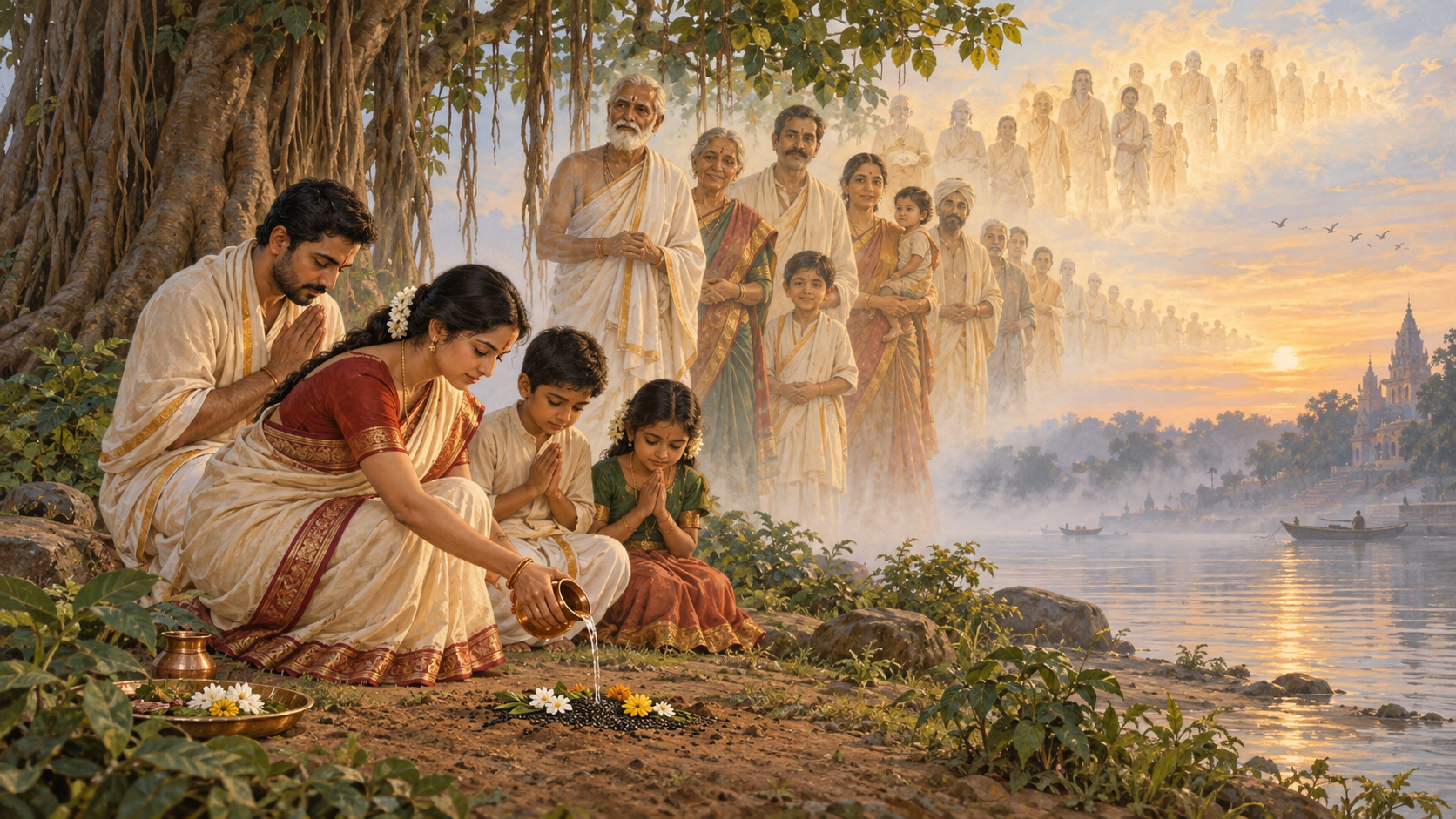
Pitrs are not merely bodies that have died. They are departed ancestors, male or female, who have left mortal life while remaining within the cycle of existence. The category describes an ancestral relationship across death. It does not reduce the ancestor to a corpse, an anonymous ghost, or a frightening supernatural intruder.
That distinction matters because an inverted stranger can look threatening, while an inverted ancestor presents a question of relationship. You belong to a line that existed before you. Its members are absent from ordinary sight, but their lives continue to shape your inheritance, obligations, memory, and sense of place.
A devotional explanation also connects the word Pitr with “one who protects”. Protection and inversion may initially appear contradictory. They are not. A being can remain related to the living, and even protective toward them, without being omnipotent or liberated from every bond. The image becomes more meaningful when you allow both ideas to stand: the ancestors matter to the living, and the ancestors themselves remain within a larger spiritual order.
Keep three distinctions clear:
- A Pitr is an ancestor in a continuing sacred relationship, not simply the physical remains of a deceased person.
- Departure from mortal life is not identical to liberation from conditioned existence.
- The conventional masculine form of the term should not lead you to erase mothers, grandmothers, and other female ancestors from the ancestral field.
These distinctions prevent a shallow reading. The inverted Pitrs are not there merely to make death look frightening. Their posture makes the tension between departure, continuity, dependence, and freedom visible.
Three layers of meaning in the inversion

They have departed, but they are not beyond becoming
The first layer is liminality. The Pitrs no longer occupy the living person’s ordinary position, yet they remain bound to the cycle of existence. The inverted posture gives this in-between condition a visual form. They are outside the arrangement you know, but not necessarily beyond all movement, relationship, or consequence.
When you read the image this way, the useful question is not, “Where in physical space are the ancestors hanging?” Ask instead, “What distinction is being made between death and final freedom?” That question opens the spiritual teaching without forcing the symbol into a crude map of the unseen world.
Ancestral continuity can become precarious
Inversion can also show that ordinary continuity has been disturbed. A family normally imagines its generations in an intelligible order: those who came before, those living now, and those who may follow. Turning the ancestors upside down makes that order feel unstable. The past is still present, but its relationship to the future cannot be taken for granted.
This reading gives you something concrete to examine. Is your family’s inheritance being remembered truthfully, or only romantically? Have names, stories, duties, and hard-earned knowledge been preserved? Are inherited wrongs being repeated under the excuse of loyalty? Honouring the ancestral line need not mean pretending that every ancestral choice was flawless. Mature remembrance carries gratitude forward while refusing to perpetuate adharma.
Protection and dependence can coexist
The Pitrs’ protective relationship with descendants does not require a one-way picture in which powerful ancestors give and passive descendants receive. The inversion can be read as a sign of mutuality. The living inherit protection, identity, and accumulated wisdom; they answer through memory, dharmic conduct, and responsible continuity.
This is not a commercial exchange with the dead. Nor should every setback be interpreted as ancestral anger. The more disciplined lesson is that relationship creates responsibility. If you want to honour your ancestors, begin with conduct that would make remembrance truthful: preserve what deserves preservation, repair what can be repaired, and do not use tradition to conceal harm.
What you should do with the symbol

An image can awaken a duty without supplying the complete ritual for fulfilling it. If you encountered inverted Pitrs and now wonder whether you must perform shraddha, tarpana, or another observance, do not derive a universal prescription from the posture alone. Ritual details belong to particular family traditions, regions, and sampradayas.
Use this sequence instead:
- Locate the context. Record where you found the image or narrative, who the figures are, and what happens before and after the inversion.
- Separate meaning from procedure. The symbol may communicate ancestral dependence or disrupted continuity without specifying a particular rite.
- Begin with reliable remembrance. Learn the names and stories available to you, preserve photographs or records responsibly, and acknowledge the people whose sacrifices shaped your family.
- Test inheritance by dharma. Continue virtues such as care, courage, learning, and service; do not repeat cruelty, prejudice, addiction, or exploitation merely because it is old.
- For a concrete ritual decision, take the exact context to a knowledgeable elder, acharya, or priest within your tradition. Ask what applies to your family rather than requesting a generic remedy detached from lineage and practice.
There is also an ethical boundary worth keeping. Do not use this image to frighten a grieving person, blame a relative for an ancestor’s supposed condition, or make confident claims about the destiny of a particular deceased person. A symbol can teach about obligation and spiritual incompleteness; by itself, it cannot establish an individual metaphysical diagnosis.
If formal rites are unavailable to you, that does not make responsible remembrance meaningless. You can preserve family history, express gratitude, care for living elders, settle neglected duties where possible, and refuse to transmit inherited harm. These acts do not replace a tradition’s prescribed ceremonies, but they ensure that ancestral reverence reaches your conduct instead of remaining an idea.
Key takeaways
- The inverted posture is best read as symbolic language for an unsettled or dependent condition, not as a literal description of every Pitr.
- Pitrs are departed ancestors, including women as well as men, who remain connected with the cycle of existence.
- Death and liberation are not interchangeable ideas. The inversion makes that distinction difficult to overlook.
- The image can express disrupted continuity, suspended order, and a reciprocal bond between ancestors and descendants.
- An illustration may reveal meaning without prescribing a ritual. For ritual action, consult the practice of your own family and sampradaya.
- Honouring the Pitrs means carrying forward dharma, not reproducing every inherited habit without examination.
The next time you meet this image, resist both fear and casual dismissal. Name what it places before you: an ancestor has left embodied life, yet remains within relationship and conditioned existence. Then look at the surrounding context and ask what kind of order is waiting to be restored. If the question leads to ritual, bring that precise context to someone who knows your tradition. If it leads to memory or duty, choose one neglected act of remembrance and complete it.
References

Leave a Reply
You must be logged in to post a comment.