
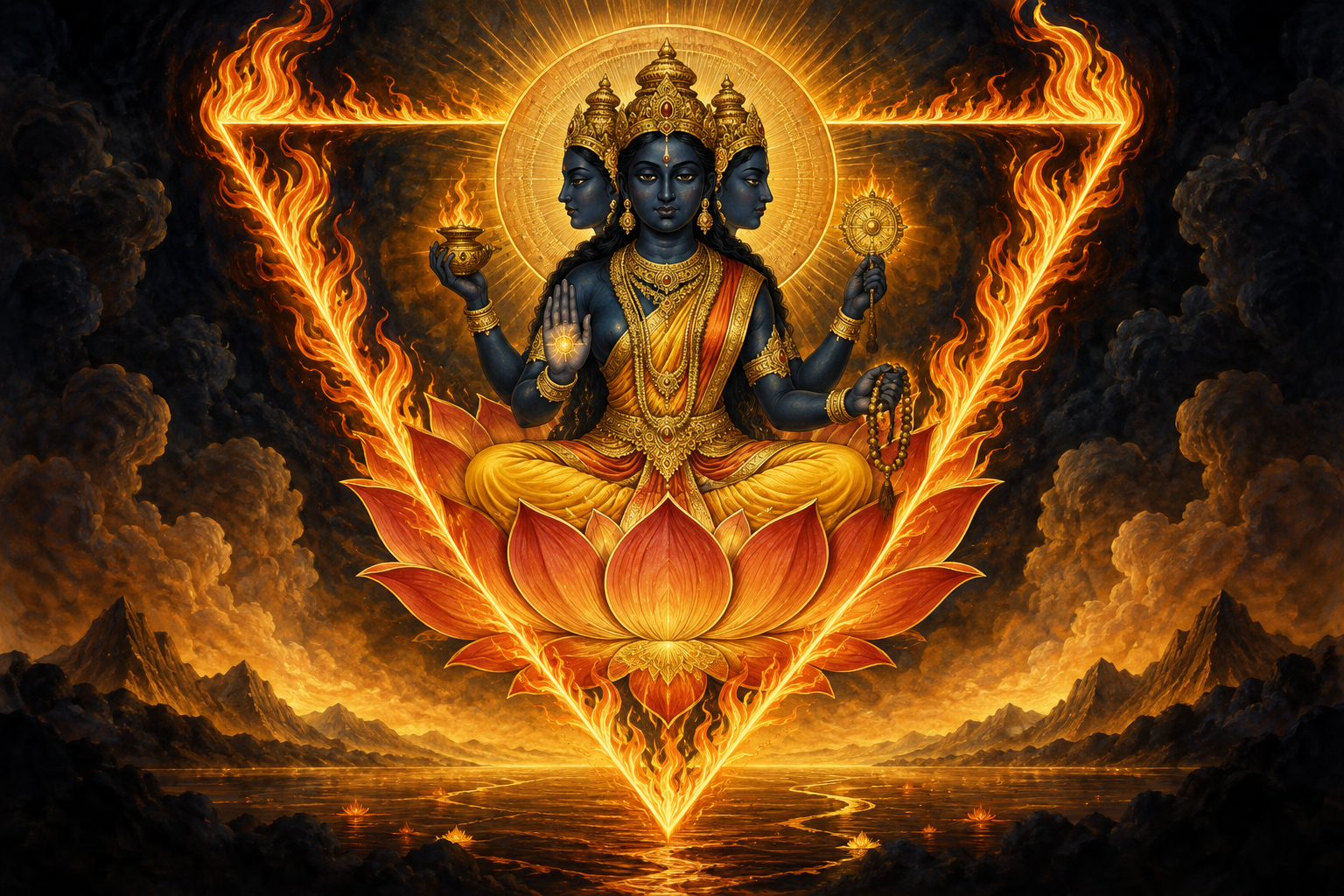
You may have encountered Lakini’s name beside the Manipura chakra and wondered what the connection actually means. Is she the chakra itself, a symbol for personal confidence, or a deity approached through Tantric practice? The clearest answer begins by keeping those ideas distinct.
Lakini is the fierce Shakti associated with Manipura, the subtle center at the navel and the seat of transformative fire in this Tantric framework. If you approach her only as a shortcut to confidence or achievement, you miss the religious meaning. If you treat the symbolism as a claim about physical anatomy, you miss the kind of map being used. A sound approach joins reverence, discernment, and disciplined action.
Lakini is the Shakti of Manipura, not another name for it
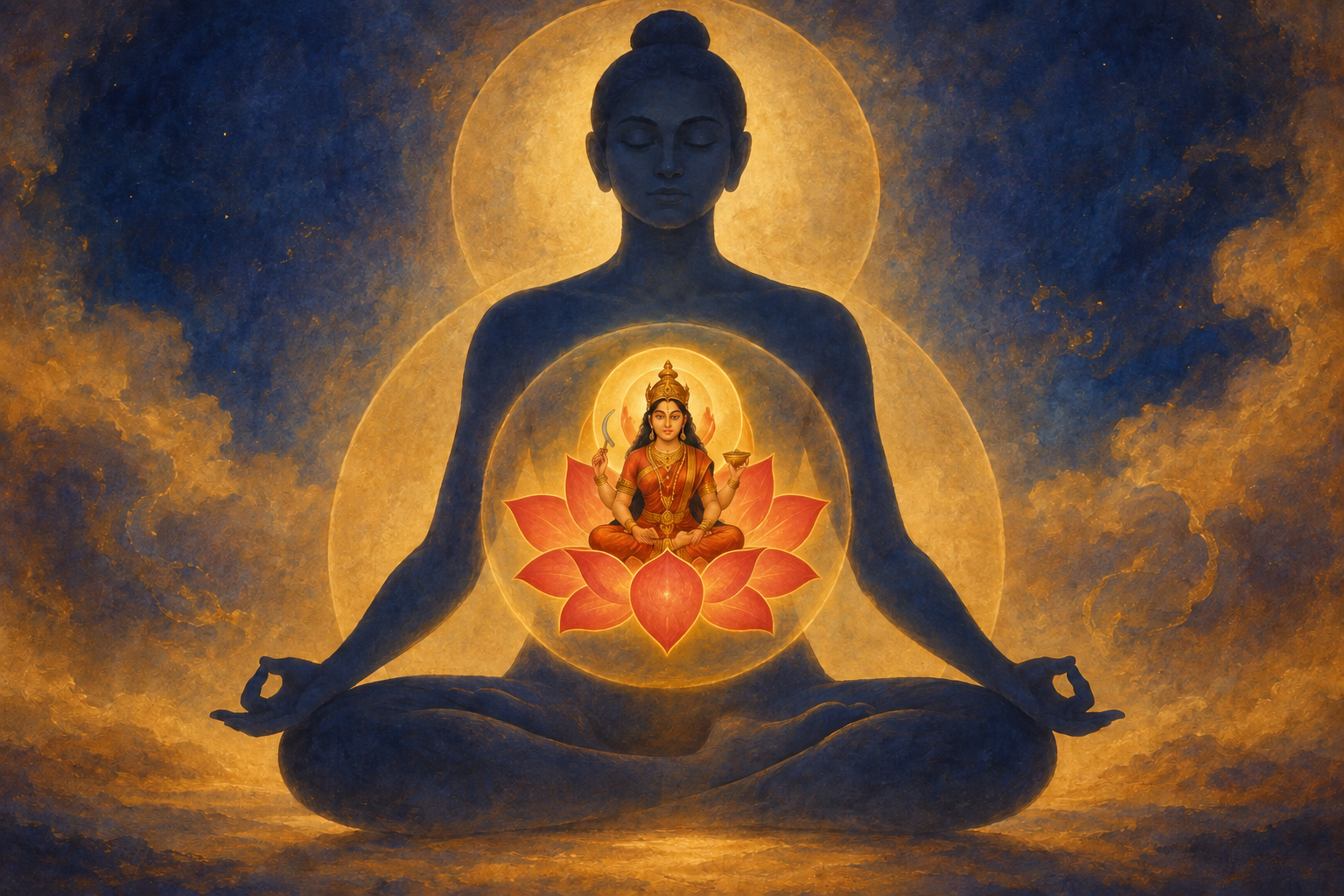
Manipura names a center within the subtle body. Lakini names the divine power associated with that center. Fire expresses the center’s transformative character. These three belong together, but they are not interchangeable.
- Manipura is the sacred location: the navel center within the familiar seven-chakra arrangement.
- Lakini is the divine presence: the Shakti through whom the center’s power is encountered and understood.
- Fire is the governing image: the power by which what enters one condition is changed into another.
This distinction matters because modern chakra language often reduces every center to a personality trait. Manipura then becomes little more than “confidence,” and Lakini becomes decorative mythology. The Tantric vision is more demanding. It treats the human body as sacred geography and a microcosm of the cosmos. The chakra is therefore not merely a label for a mood. Nor is its presiding Shakti merely a poetic way to describe that mood.
You can engage this teaching at more than one level. A devotee may approach Lakini as Goddess. A contemplative reader may attend to the discipline expressed by her fire. A practitioner within a lineage may receive a more detailed ritual understanding. What should not happen is an unnoticed slide from one level to another. Psychological reflection can accompany worship, but it should not silently replace the deity with a self-help concept.
The subtle body also should not be confused with the anatomical body. Manipura’s navel location gives attention a bodily focus, but Lakini is not an organ that could be found by dissection. The map belongs to a sacred and contemplative account of embodied existence. That difference lets you take the tradition seriously without making medical claims on its behalf.
Her fire is about transformation, not mere intensity

Fire does not simply produce heat. It changes the condition of what it receives. That is the useful key to Lakini’s relationship with Manipura: power becomes spiritually meaningful when it can transform confusion into clarity, hesitation into responsible action, and undirected impulse into disciplined purpose.
This also explains why Lakini’s fierceness should not be mistaken for aggression. Fierceness, read within the discipline of transformation, is the refusal to protect what must be changed. It asks whether you can look directly at an attachment, habit, excuse, or ambition without dressing it up as virtue. Anger may feel fiery, but uncontrolled anger is often a failure to transform energy before acting on it.
The same test applies to willpower. A strong will can keep a vow, complete difficult work, or defend what is right. It can also serve vanity, domination, and resentment. The existence of force tells you nothing about its moral direction. Manipura practice becomes Dharmic only when power is made answerable to a worthy purpose.
When you contemplate Lakini, therefore, do not ask only, “How can I become more powerful?” Ask three sharper questions:
- What in me needs to be transformed rather than indulged?
- What responsibility have I been avoiding because action is uncomfortable?
- If my strength increases, whom or what will that strength serve?
These questions turn the symbol of fire into a practical standard. They also prevent the common error of treating every strong desire as guidance from the chakra. Desire is something to examine in the fire of discernment, not automatic proof that the fire has awakened.
A simple Lakini contemplation without claiming initiation

You do not need to invent a complex ritual to begin learning from this relationship. The following exercise is an introductory contemplation, not a substitute for lineage instruction or a claim to reproduce a formal Tantric practice. It deliberately avoids prescribed mantras, forceful breathing, and detailed deity visualization.
- Choose one real matter. Bring to mind a decision, duty, habit, or conflict that genuinely requires transformation. Do not start with a vague wish to “activate” the chakra.
- Sit steadily and let the breath remain natural. Bring gentle attention to the navel area without tightening the abdomen, holding the breath, or trying to create an unusual sensation.
- Recall Lakini’s relationship with transformative fire. Hold the understanding that sacred power is not mere intensity; it changes what is unformed, confused, or undisciplined.
- Name what must change. Use a precise statement such as, “I need to turn avoidance into one honest conversation” or “I need to turn scattered effort into a kept commitment.”
- Test the intended action against dharma. Ask whether it is truthful, proportionate, and responsible. If the action depends on humiliation, revenge, deception, or domination, more heat will not purify it.
- End with one concrete commitment. Decide what you will do next and when you will do it. An optional English intention such as “May this strength serve dharma” can close the reflection; it is a personal prayer, not a traditional mantra.
The final step is essential. A contemplation of transformative power that never changes your conduct easily becomes spiritual theatre. The action need not be dramatic. Sending the necessary message, keeping a promised period of work, apologizing without qualification, or refusing an unethical request may reveal more disciplined fire than chasing an extraordinary inner experience.
Do not strain for heat, visions, shaking, or altered breathing. Such sensations are not reliable measures of spiritual attainment. Stop if the exercise makes you dizzy, panicked, or physically unwell. Formal practices involving intensive breath control or elaborate ritual belong with competent instruction. Persistent abdominal pain, digestive trouble, anxiety, or other symptoms require appropriate professional care; a chakra interpretation should not delay medical or psychological help.
Common mistakes that distort Lakini and Manipura
The language of chakras travels easily across devotional, yogic, therapeutic, and commercial settings. That makes several confusions especially common.
- Calling every lack of motivation a “blocked Manipura.” Low energy or difficulty acting can have many ordinary causes. The phrase may be useful as a personal metaphor, but it is not a diagnosis.
- Measuring progress by intensity. Heat, excitement, forceful breathing, or a rush of emotion can feel significant without producing clearer judgement or better conduct. Look for transformation in what you actually do.
- Turning Lakini into a productivity mascot. The Goddess is not a technique for extracting more output from yourself. Her connection with power carries a religious and ethical demand.
- Equating will with domination. The ability to overpower someone is not evidence of an awakened center. Strength that cannot govern itself is still undisciplined.
- Mixing teachings without noticing. Chakra descriptions and deity practices can vary across traditions. If you receive formal instruction, follow its vocabulary and method instead of assembling a ritual from unrelated fragments.
- Treating the subtle map as medical anatomy. The navel focus belongs to a subtle-body framework. It does not establish a biomedical cause for symptoms or replace clinical evaluation.
Key takeaways
- Lakini is the Shakti associated with Manipura; she is not simply another word for the chakra.
- Manipura’s fire is best understood through transformation, not excitement, aggression, or raw ambition.
- A safe introductory contemplation uses natural breathing, a clear ethical question, and one concrete action.
- Traditional deity practice deserves more respect than reducing Lakini to a personality trait or motivational device.
- Physical and psychological symptoms should be addressed on their own terms, not diagnosed as chakra problems.
Make the fire answerable to dharma
The most useful sign of this contemplation is not that you feel powerful. It is that your power becomes more governable. You can act without recklessness, hold a boundary without cruelty, accept correction without collapse, and keep a commitment after the first surge of enthusiasm has passed.
This is where Lakini’s fierceness becomes constructive. The fire exposes the difference between a sacred purpose and an ego that wants sacred language. If you want recognition, say so honestly. If you are avoiding a duty, name the avoidance. If a goal is worthy but your method is not, change the method rather than using spirituality to excuse it.
A simple decision filter can keep the practice grounded:
- Purpose: What exactly am I trying to transform?
- Motive: Is this driven by duty and clarity, or by fear, vanity, and retaliation?
- Method: Does the next action respect truth, proportion, and the dignity of others?
- Discipline: What will I do when motivation fades?
- Service: What becomes better if this power is used well?
Choose one unresolved responsibility and take it through that filter. Then perform the smallest truthful action that advances it. Let that act – not a dramatic sensation and not a claim of chakra activation – be your first offering to the fire of transformation.
References

Leave a Reply
You must be logged in to post a comment.