
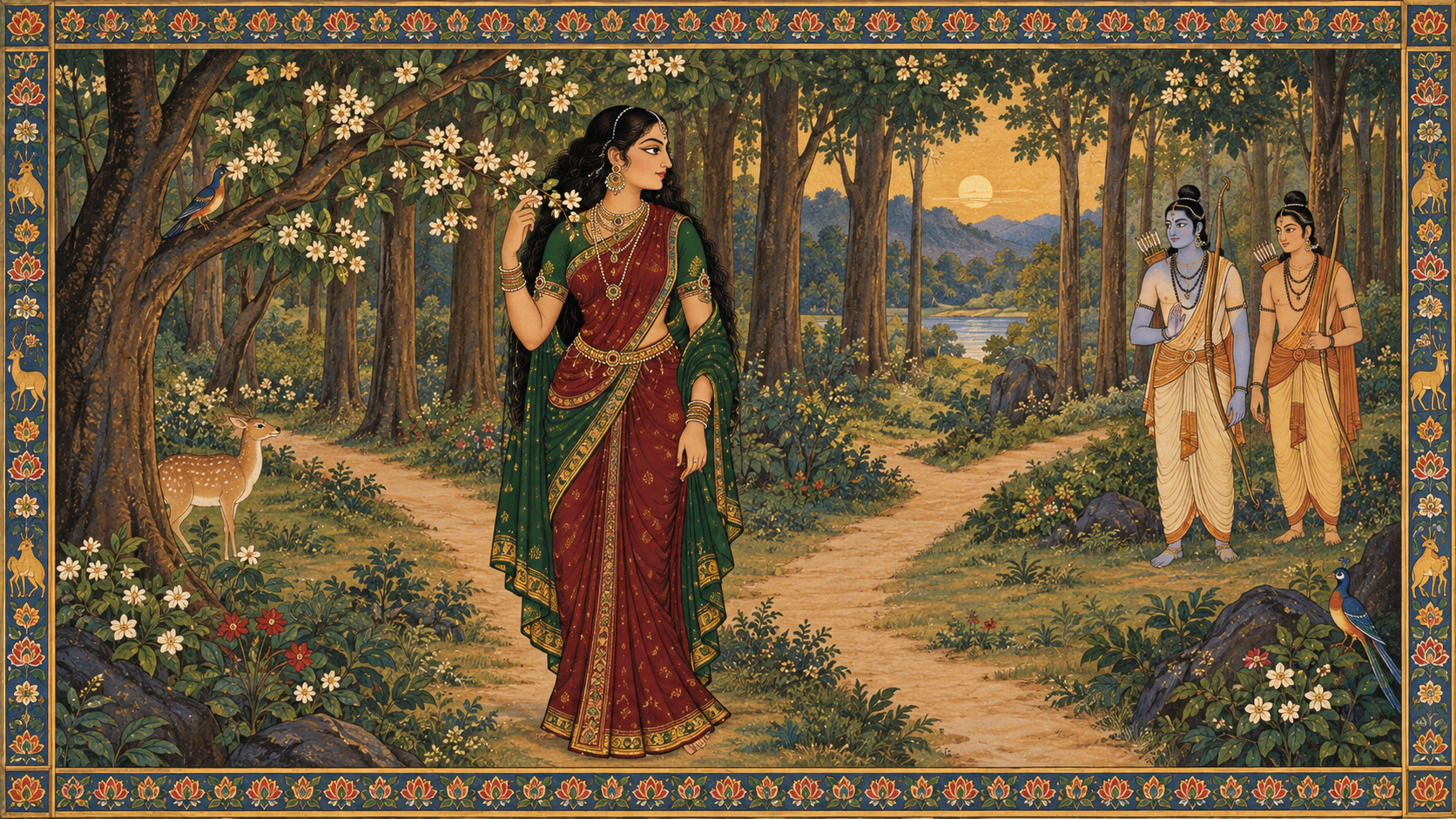
If the Surpanakha episode leaves you wondering how a Dharmic epic can hold rejection, conflict and bodily punishment in the same scene, the Jain Ramayana offers a sharply different way into the question. It does not require you to dismiss the telling you already know. It asks you to notice what changes when ahimsa governs the retelling.
The useful question is not, “Which version is the real Ramayana?” It is, “What moral work does the omitted violence perform?” That question turns a striking narrative variation into a practical lesson in how Jain sacred literature receives and reshapes a shared civilizational story.
The missing injury is the interpretive clue
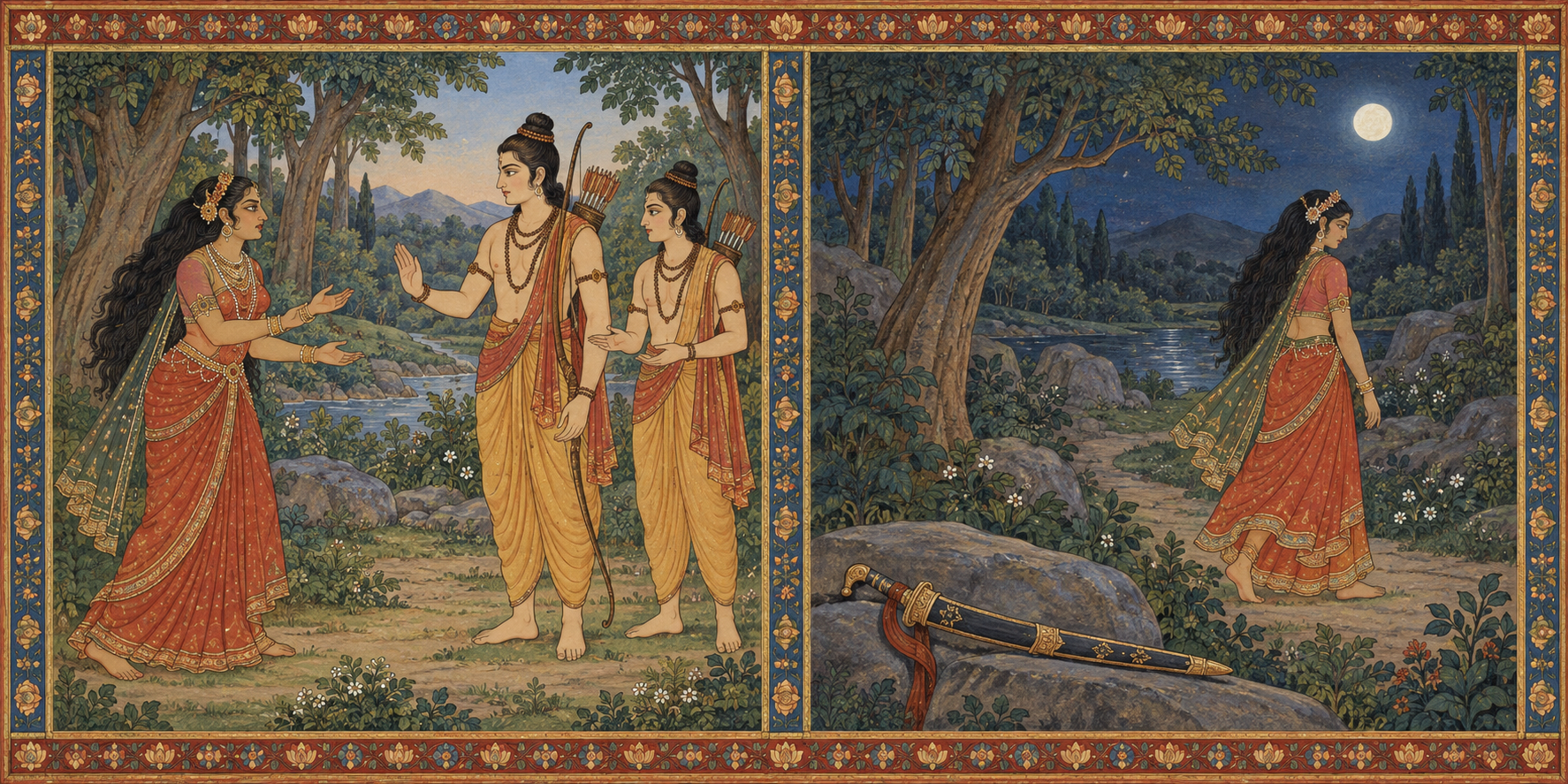
Valmiki’s Sanskrit Ramayana holds a foundational place in Hindu understanding, and its familiar Surpanakha episode includes her bodily mutilation. In the Jain Ramayana tradition represented by the Paumachariyam, however, Surpanakha’s mutilation is avoided. That absence is the first fact to keep steady.
Do not treat the difference as a missing page that must be repaired from another version. A retelling can preserve recognisable characters and conflicts while refusing to carry over every action. At a morally charged moment, that refusal becomes part of the meaning.
Three distinctions will keep your reading accurate:
- Omission is not denial. The Jain telling does not need to deny the existence or importance of the Valmiki tradition in order to make a different narrative choice.
- Variation is not carelessness. When an act of bodily punishment disappears, you should examine the ethical effect of its absence rather than assume that the reteller forgot it.
- Difference is not automatic condemnation. A Jain recasting need not be read as a verdict that Hindu devotion to the Ramayana is mistaken. It shows how a shared narrative can be arranged within another Dharmic discipline.
This is why calling the Paumachariyam merely a softened copy misses the point. The nonviolent choice affects what you are invited to admire, question and remember.
Ahimsa changes what the episode asks you to see
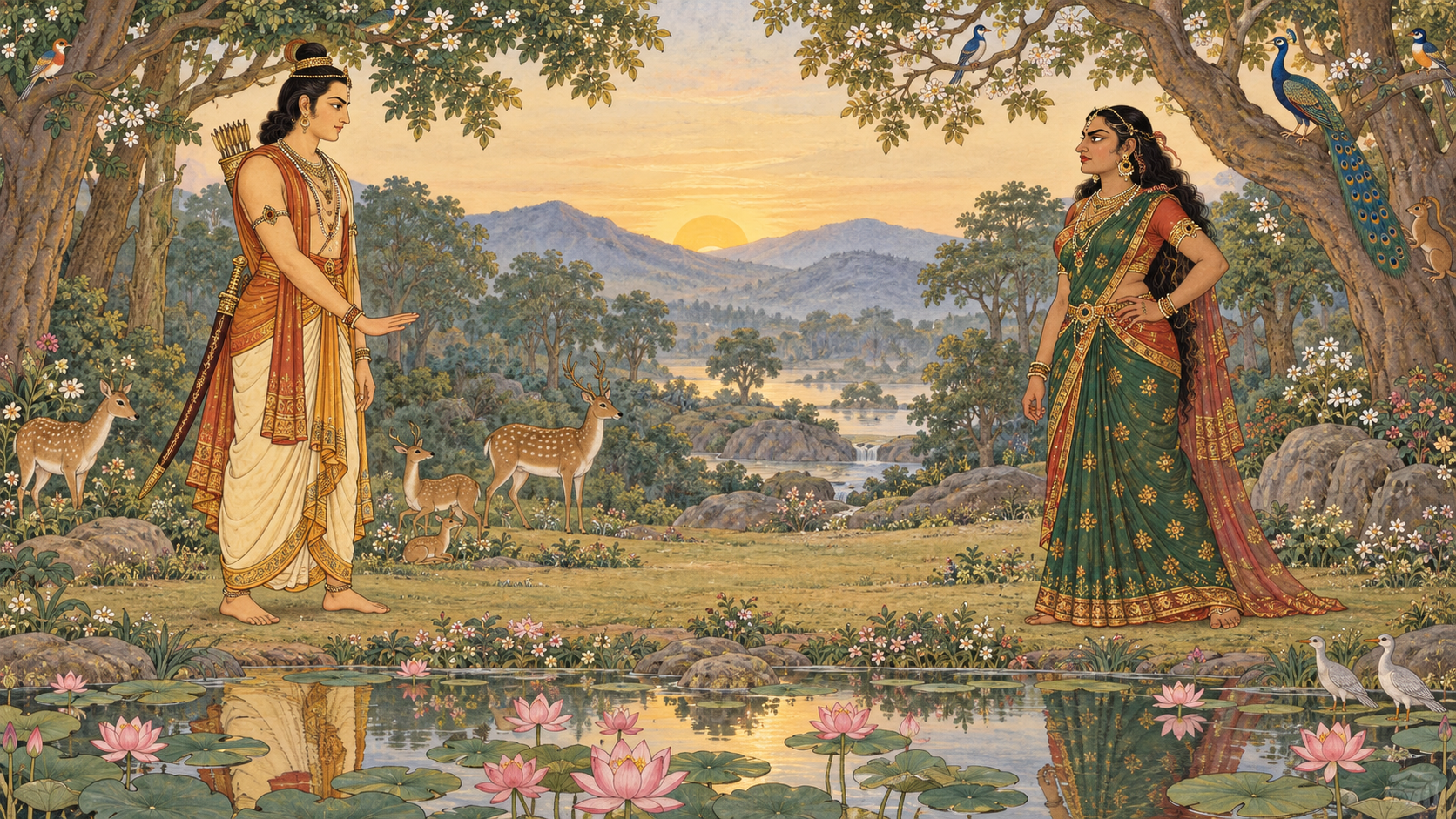
Ahimsa is not only the absence of killing. It directs attention toward intentional harm, restraint and the consequences of injuring another living being. In a Jain moral frame, violence cannot be treated as ethically weightless simply because it occurs during a dramatic confrontation or is performed by a favoured character.
Bodily mutilation does more than move a plot forward. It makes punishment visible, permanent and difficult to separate from the audience’s emotional response. It can turn a wounded body into proof that a character has been defeated or disgraced. Remove that act, and the scene can no longer rely on physical disfigurement to deliver its moral punctuation.
The omission therefore redirects your attention from spectacle to conduct. You still have to think about desire, refusal, provocation, boundaries and responsibility, but you are not given bodily injury as an easy substitute for moral reasoning.
When you read the episode through ahimsa, ask four concrete questions:
- Was physical injury necessary to answer the immediate conflict?
- Does the punishment exceed the conduct to which it responds?
- Could firmness and restraint operate together?
- Does the scene invite satisfaction in another being’s pain, or does it make that pain morally consequential?
These questions do not force a predetermined verdict. They stop heroic status, comic treatment or narrative familiarity from ending the ethical inquiry before it begins.
Surpanakha cannot be reduced to a wounded body
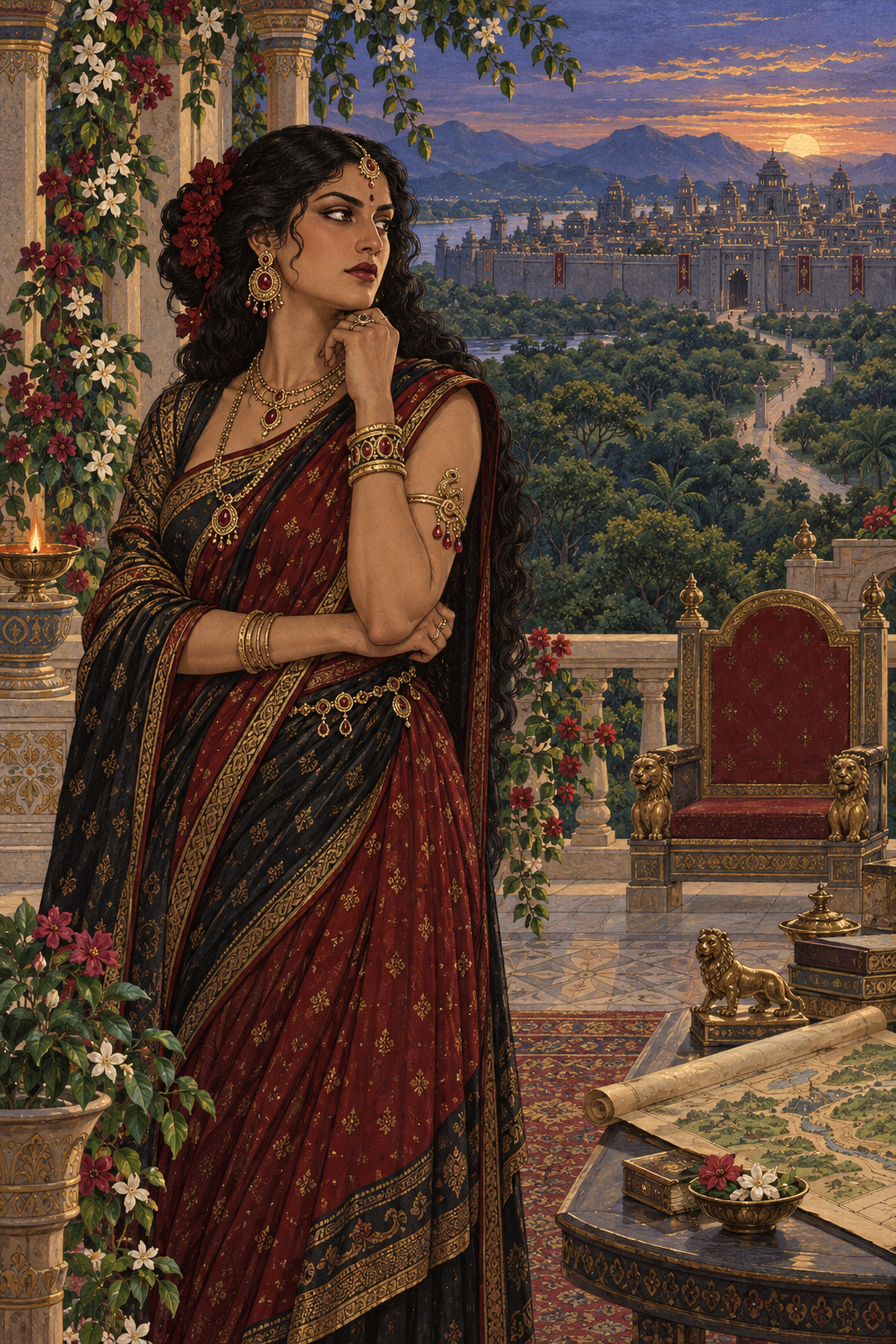
If your strongest memory of Surpanakha is her disfigurement, the violent act has become the shorthand for the entire character. The Jain omission removes that shortcut. You must consider what she does, how others answer her and how the narrative judges those responses as separate matters.
That separation matters because rejecting violence does not require declaring every character innocent. A person can behave wrongly without thereby deserving mutilation. Equally, questioning a punishment does not erase the right to refuse unwanted desire or enforce a boundary. The ethical challenge is to hold both propositions at once.
A disciplined reading uses three levels:
- Action: Identify what Surpanakha seeks or does without making her later suffering the definition of her character.
- Response: Examine the range of possible answers to her conduct, including refusal, restraint and physical retaliation.
- Narrative judgement: Notice which response the telling makes memorable and what emotion it asks the audience to attach to that response.
This also opens a careful question about gender without reducing the episode to a modern slogan. When a woman expresses desire and her body becomes the site of punishment, you should ask whether disfigurement is functioning only as defence or also as humiliation. The Jain version’s avoidance of the injury does not settle every question about Surpanakha, but it prevents humiliation through mutilation from doing the scene’s moral work.
The result is not necessarily a more flattering portrait of her. It is a less bodily punitive way of organising the conflict. That is a precise claim, and it is more useful than saying vaguely that one tradition is compassionate while another is violent.
A reliable way to read the two traditions
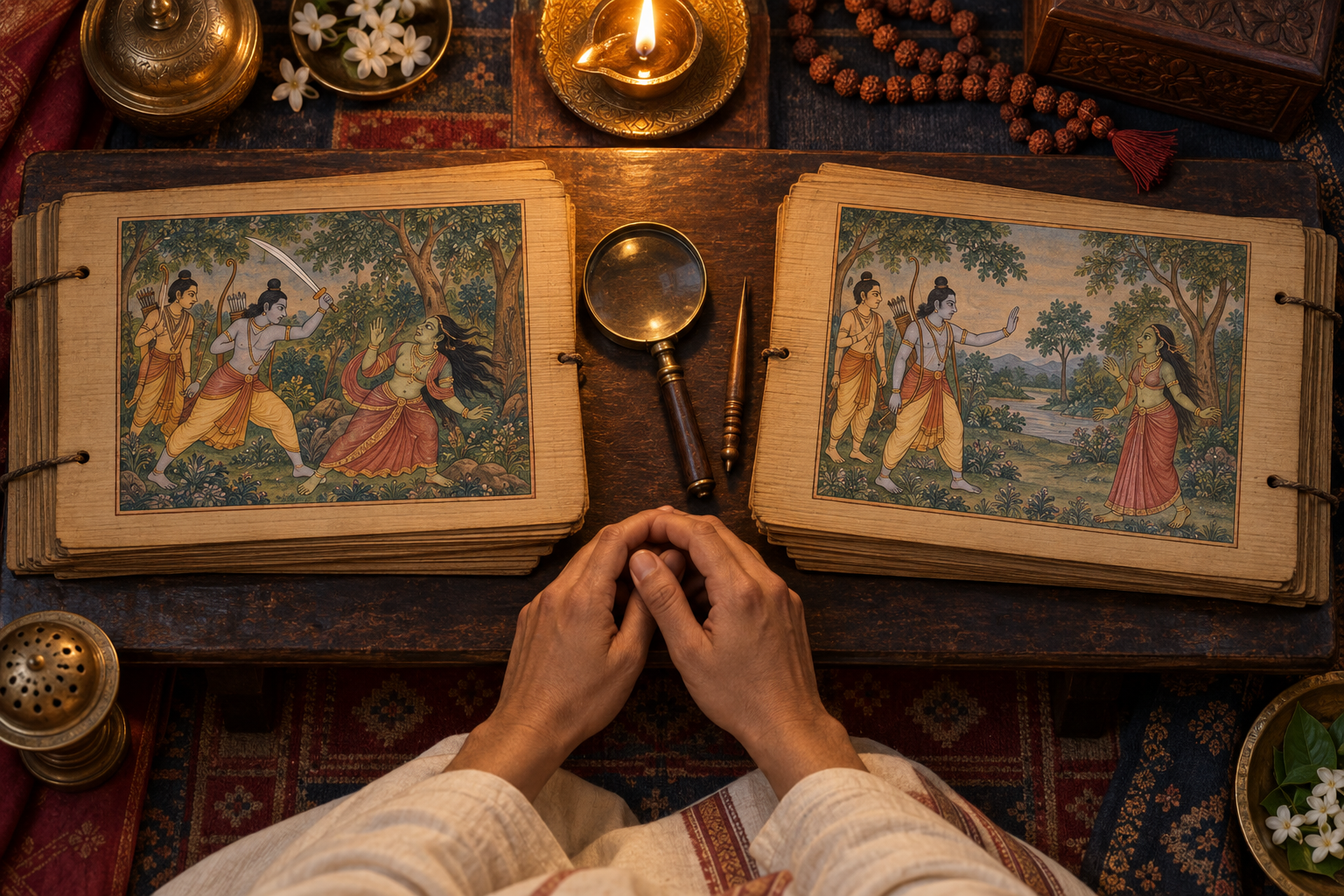
Comparing Ramayana traditions becomes misleading when every difference is turned into a contest for ownership. You can read the variation more responsibly with a repeatable method:
- Name the actual text. Say Valmiki Ramayana or Paumachariyam when that is what you mean. “The Hindu version” and “the Jain version” are often too broad.
- State the variation neutrally. Here, the relevant difference is simple: the familiar mutilation is present in the Valmiki-centred telling and absent from the Jain retelling under discussion.
- Identify the ethical lens. Ahimsa gives the omission a coherent Jain context. Present that as an interpretation of the narrative choice, not as access to an author’s unrecorded private intention.
- Track the consequence. Ask what the story can no longer communicate through injury and where your attention moves instead.
- Preserve the integrity of both traditions. Do not use the variation to ridicule Hindu reverence for Valmiki’s Ramayana or to dismiss the Jain work as an unauthorised alteration. Each text must be read within its own moral and theological setting.
This method is especially important when you encounter isolated quotations or short online retellings. Before making a claim about “the Ramayana,” verify which work, recension or tradition is actually being discussed. Plurality is not confusion, but it demands accurate naming.
The larger Dharmic lesson is not that all tellings secretly say the same thing. Their kinship is more substantial than sameness: traditions can share characters and civilizational memory while disagreeing about which actions should carry moral force. The disagreement is worth reading because it reveals the ethical priorities that simple plot summary hides.
Key takeaways
- The Paumachariyam’s avoidance of Surpanakha’s mutilation is an ethical narrative choice, not a blank to be filled automatically from the Valmiki tradition.
- Ahimsa shifts attention from spectacular punishment toward restraint, proportionality and the consequences of harm.
- Questioning mutilation does not require excusing Surpanakha’s conduct or denying another character’s right to refuse her.
- The most accurate comparison names the particular texts, isolates the exact variation and then asks how that variation changes the reader’s moral attention.
- Respect for Ramayana plurality means neither flattening all tellings into one nor using one Dharmic tradition as a weapon against another.
When you next read the episode, place the two tellings beside each other and mark three things: the event retained, the violence omitted and the ethical question that becomes harder to avoid. That small exercise will give you a clearer view of Surpanakha, ahimsa and the interpretive depth of India’s Ramayana traditions.
References

Leave a Reply
You must be logged in to post a comment.