
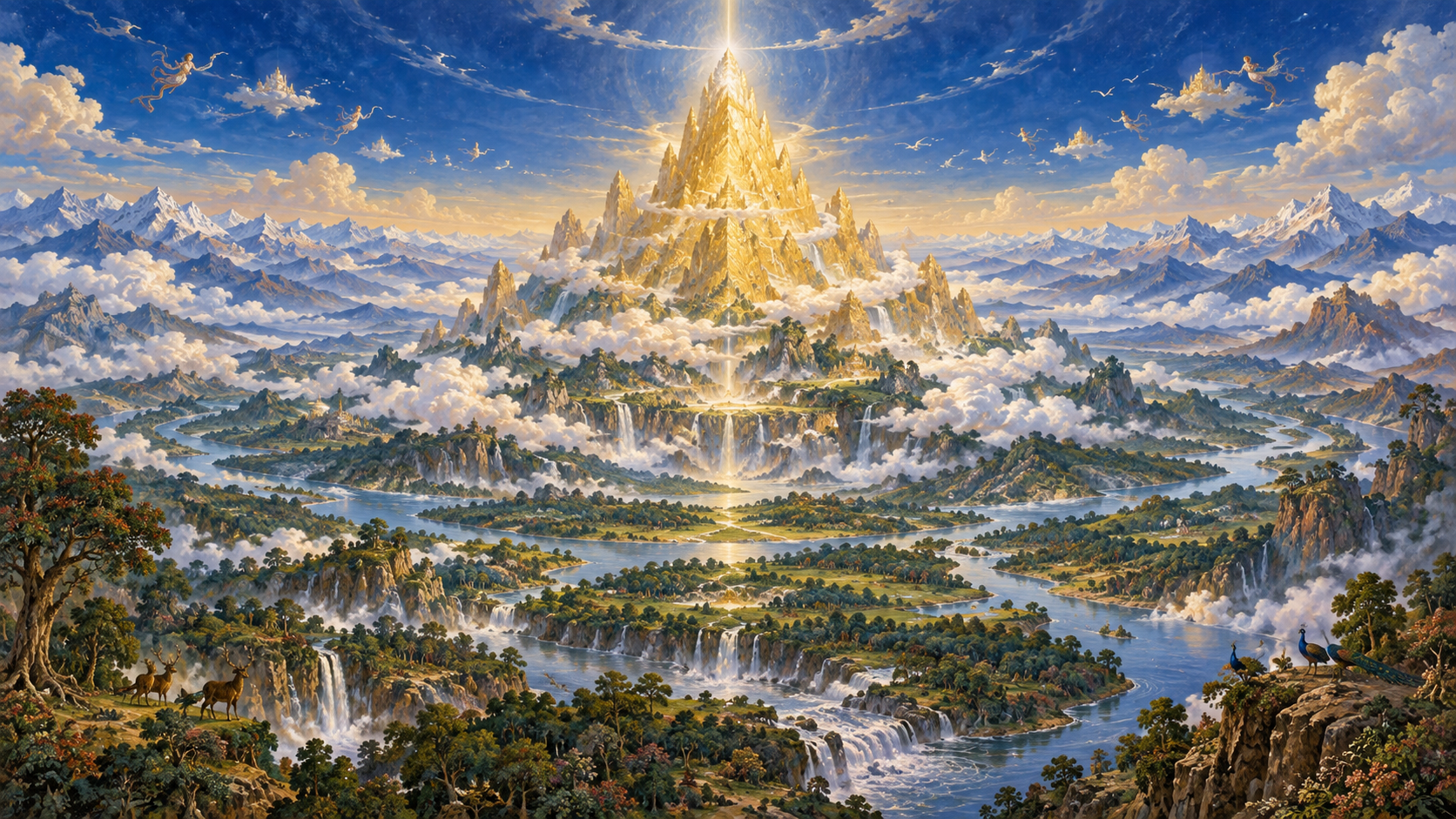
If you came looking for Mount Meru’s latitude and longitude, the Mahabharata can seem frustratingly indirect. Yet if you dismiss Meru as a decorative myth, you miss the work the image is doing. The better starting point is sacred geography: a mountain presented not merely as terrain, but as an organizing centre of reality.
In the Astika Parva within the Adi Parva, Meru is supreme, golden and radiant with extraordinary energy. It functions as a divine axis rather than an ordinary mass of stone and soil. Once you distinguish those textual claims from later attempts to identify Meru on a modern map, the passage becomes much easier to read responsibly.
Read the passage before trying to locate the mountain
The first useful fact is textual: this description belongs to the Astika Parva, which forms part of the Adi Parva of the Mahabharata. That location gives you a precise place to begin whenever a discussion about Meru becomes vague. Ask which parva and passage are under consideration before accepting claims about what “the Mahabharata” supposedly says.
Next, record what the passage actually attributes to Meru. It is a mountain, but it is also supreme, golden or radiant, filled with energy, and central to the sacred order. These are not the normal identifying features of a peak in a surveyor’s record. They tell you that the description is operating cosmologically as well as geographically.
Sacred cosmography is an ordered picture of the universe expressed through places, directions, levels and centres. It is neither a modern atlas nor a meaningless fantasy map. Its purpose is to show how reality is structured and where sacred power is concentrated. When Meru occupies the centre, centrality is part of its meaning rather than an incidental detail.
This changes the order of your questions. Do not begin with, “Which present-day mountain is it?” Begin with, “Why must this mountain be supreme and central within this passage?” A possible physical identification can be examined later, but it should not replace the function the text has already given Meru.
Supreme, radiant and central: the image’s working parts

Each major feature of Meru directs your attention differently. Reading them separately prevents the familiar mistake of treating a sacred description as though it supplied only topographical data.
- “Supreme” establishes rank. Meru is not introduced as one interchangeable mountain among many. The description places it at the summit of a sacred hierarchy. When reading, therefore, look for relationships of precedence and dependence, not only dimensions or location.
- Golden radiance establishes distinction. The immediate point is not a geological claim about an ore deposit. Gold, brilliance and blazing energy set Meru apart from ordinary terrain. Even if translations choose different English words for its luminosity, the passage’s contrast between the sacred mountain and ordinary matter remains the important feature.
- Centrality establishes function. Calling Meru an axis is a useful way to describe an organizing centre around which a world is imagined. “Axis” should not be mistaken for a guarantee that every translation uses that exact English term. It names the function conveyed by Meru’s sacred centrality.
A centre in sacred cosmography does not have to be the midpoint of a flat, measurable map. It may be the point from which order becomes intelligible. You can test that reading by asking what would be lost if Meru were reduced to an unnamed rocky peak. Its supremacy, radiance and organizing role would disappear. Those features are therefore essential, not ornamental.
Keep one distinction especially clear: a description may be spatial without being cartographic in the modern sense. The Mahabharata can present Meru as a mountain while also giving it a scale and significance that exceed ordinary geography. You do not have to erase either side of that presentation.
Literal mountain and cosmic symbol are not opposites
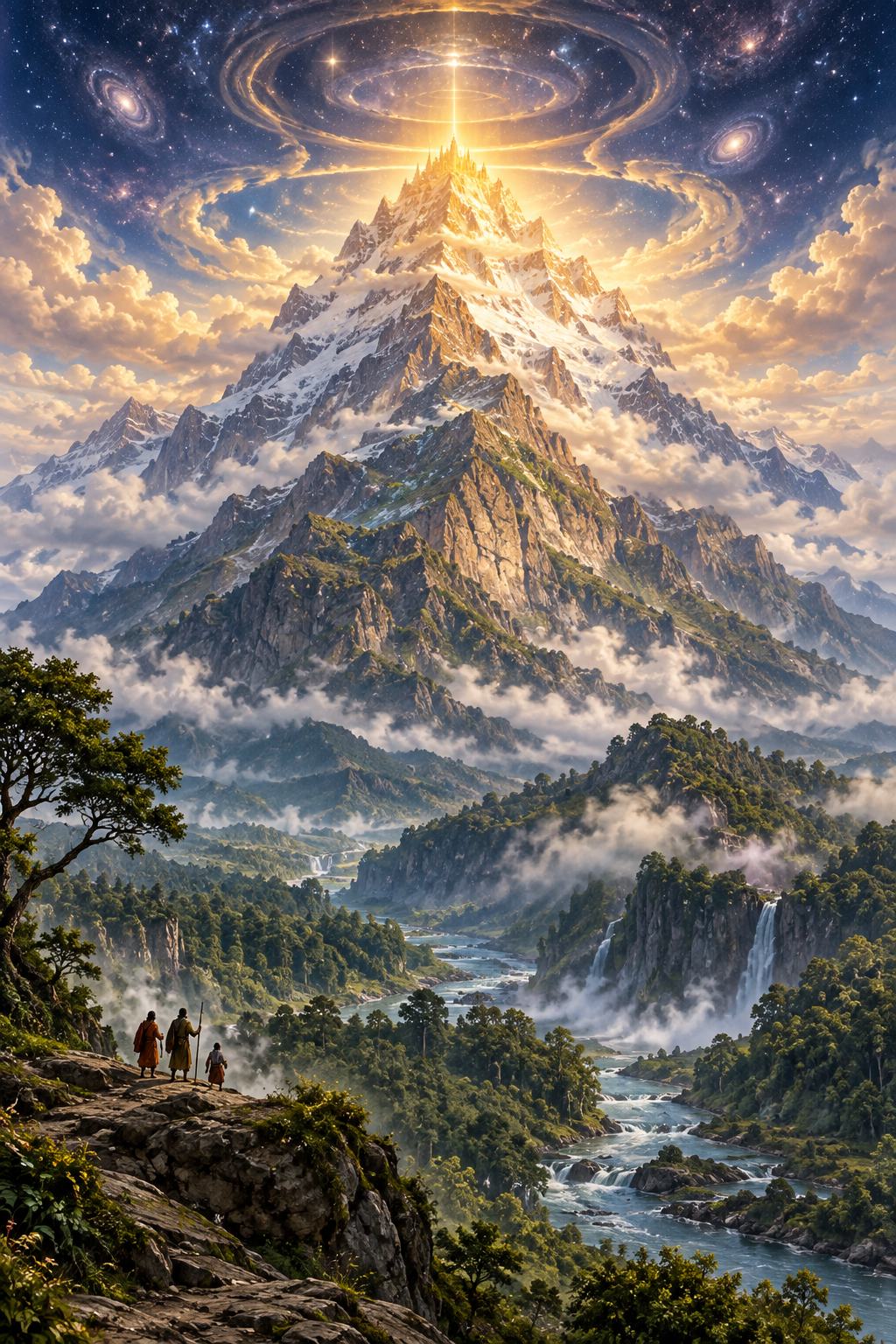
People often ask whether Meru is a real mountain or a symbol. That question creates a false choice. A sacred place can be narrated as a place and carry meaning beyond its physical features. Calling something symbolic does not make it false, just as calling it a mountain does not exhaust what the passage communicates.
The responsible answer stays close to the strength of the available claim: in this part of the Mahabharata, Meru is presented as a superlative mountain and a sacred cosmic centre. A confident identification with a particular modern peak would require additional textual or historical evidence. The description itself should not be converted into coordinates it does not provide.
Two opposite reading errors are worth noticing:
- Reductive literalism searches for a point on the map while ignoring why Meru must be radiant, supreme and central.
- Reductive dismissal labels Meru “only a metaphor” and treats its sacred status as disposable decoration.
Both approaches flatten the passage. The first loses cosmology; the second loses the text’s own presentation of Meru as a mountain. A more disciplined reading allows physical, literary and theological dimensions to coexist without claiming that they are identical.
This distinction also improves conversations among readers. When someone proposes a geographical identification, ask whether the claim is explicit in the passage, inferred from it, or supplied by a later interpretive tradition. That is a request for precision, not an attack on faith. It lets devotional conviction and textual accuracy support each other.
A reliable method for reading any reference to Meru
You can use the following sequence whenever Meru appears in an epic discussion, translation, discourse or online claim:
- Locate the textual unit. Record the epic, parva and sub-section before interpreting an isolated sentence. Here, the relevant setting is the Astika Parva of the Adi Parva.
- Underline the actual predicates. Note what Meru is and what qualities are assigned to it: mountain, supreme, golden or radiant, blazing with energy, and cosmically central.
- Separate statement from inference. “Meru is presented as a sacred centre” stays close to the description. “Meru is certainly present-day peak X” adds a separate identification that needs separate support.
- Name the question you are asking. A geographical question asks where; a cosmological question asks how the universe is ordered; a literary question asks what the image does; a devotional question asks how it should orient your understanding. Do not answer one as though it settled all the others.
- Check translation choices. If two translations describe brilliance differently, note the variation rather than combining every adjective into a new imaginary verse. Do not claim knowledge of a Sanskrit term unless you have checked it.
- State your conclusion at the right strength. Prefer “Meru functions here as the sacred centre” to “the epic proves this modern location.” The first reports the passage’s role; the second makes a larger historical-geographical claim.
Key takeaways
- The relevant description occurs in the Astika Parva within the Mahabharata’s Adi Parva.
- Meru is not treated as ordinary terrain; its supremacy, radiance and energy establish sacred distinction.
- Its centrality concerns the order of the cosmos, not necessarily the midpoint of a modern flat map.
- “Real mountain” and “cosmic symbol” are not mutually exclusive categories in sacred literature.
- A modern geographical identification should be presented as an interpretation unless the cited passage explicitly supplies it.
Let Meru change both your reading and your orientation

After establishing the textual meaning, you can make a devotional application without pretending that your application is another verse. Meru invites a question about centre: what is the fixed point around which your own choices, loyalties and duties are ordered? That reflection follows naturally from the image of a sacred axis, but it should remain clearly distinguished from translation or textual commentary.
A simple practice keeps both sides honest. Divide a page into two columns. In the first, write only the explicit description: supreme, radiant, energetic and central. In the second, write what each quality asks you to notice in your understanding of dharma. The first column prevents invention; the second prevents the passage from becoming a lifeless catalogue.
When you next encounter a confident claim about Mount Meru, return to the Astika Parva and perform that separation yourself. Identify what the text presents, what the interpreter infers and what remains uncertain. You will preserve Meru’s sacred force more faithfully by reading its language at full depth than by forcing it into either a modern atlas or an empty metaphor.
References

Leave a Reply
You must be logged in to post a comment.