

When you turn to Narasimha in a time of fear, the practical question is usually not whether He is powerful. It is whether divine protection means the danger will disappear, whether you should wait for intervention, and how you can keep acting according to dharma while you are afraid.
Prahlada’s answer is demanding but usable: protection begins by keeping fear from taking possession of your conscience. Help may change your circumstances, but devotion first changes what intimidation can command from you.
Divine protection does not mean a life without danger

Prahlada was not kept outside suffering. He faced intense persecution from his own father, Hiranyakashipu, and yet remained absorbed in remembrance of Vishnu. Narasimha’s intervention came within that ordeal, not as a guarantee that a devotee will never enter one.
That order matters. If protection is understood only as the instant removal of discomfort, every prolonged difficulty can begin to look like divine abandonment. Prahlada shows a deeper pattern: danger may be present while devotion is real, and fear may be present without becoming your master.
You can understand Narasimha’s protection on three connected levels:
- Inner protection: fear does not erase remembrance of the Divine.
- Moral protection: pressure does not make adharma acceptable.
- Deliverance: oppression does not possess the final word, even when it appears to have closed every ordinary route of escape.
The first two are already visible in Prahlada before the pillar opens. Hiranyakashipu could threaten his body, isolate him and demand conformity. He could not compel the child to surrender his devotion or reproduce his hatred. Narasimha then made the protection outward and unmistakable.
This distinction gives you two useful questions in a crisis. First, what needs to change now to protect life, dignity or safety? Second, what must you refuse to become while seeking that change? The first question prevents passive fatalism. The second prevents fear from turning you into an imitation of the person or force you oppose.
Narasimha’s form answers the illusion of total control
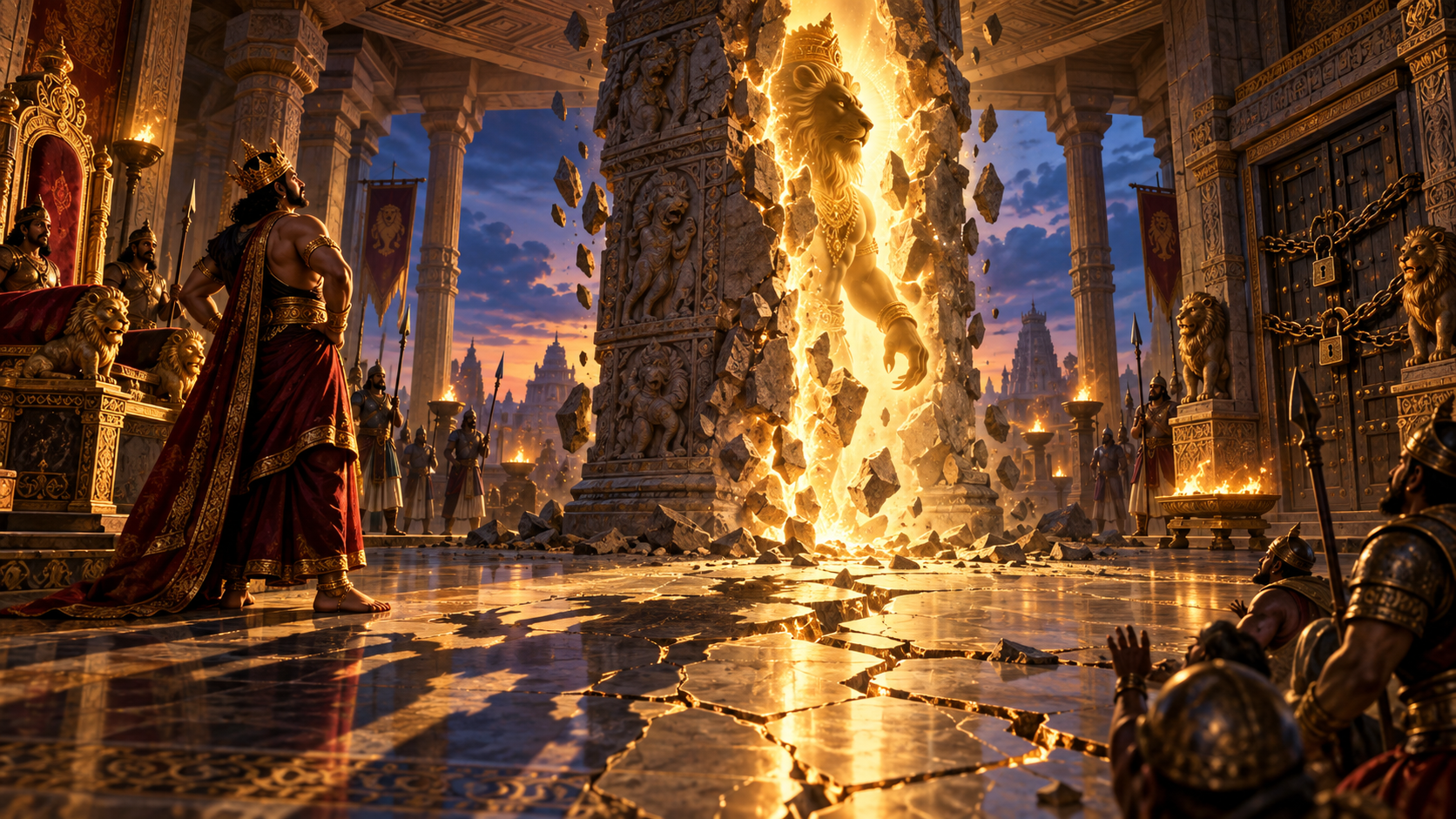
Hiranyakashipu had performed severe austerities and obtained extraordinary boons from Brahma. His security rested on conditions that appeared to exclude every possible cause of death. Narasimha did not fit the categories on which that confidence depended.
- He appeared in a form that was neither fully human nor fully animal.
- He confronted Hiranyakashipu at twilight, neither day nor night.
- He acted on a threshold, neither inside nor outside.
- He placed the tyrant on His lap, neither on the ground nor in the sky.
- He used His nails rather than a conventional weapon.
These are not merely clever solutions to a puzzle. The apparently exhaustive conditions of the boon could not bind the Supreme. Hiranyakashipu mistook control over familiar categories for control over reality itself. Narasimha’s form exposed the mistake.
The pillar carries the same lesson. Narasimha emerged from an object that appeared inert, affirming divine presence where the tyrant expected emptiness. The protector was not absent simply because He could not be seen in advance. Nor was He required to arrive through a channel that worldly calculation could anticipate.
This matters when your own fear insists that every option is closed. Fear usually presents a false map: either the obvious solution works, or no help is possible. Narasimha does not teach you to predict a miracle. He teaches you not to confuse the limits of your prediction with the limits of divine agency.
When you feel trapped, write down the conditions that make the situation seem impossible. Then separate facts from assumptions. A closed familiar route is a fact; the belief that no other route can exist is an assumption. Do what dharma requires with the facts you possess, but do not make an idol of your present field of vision.
Prahlada’s courage came from remembrance, not retaliation

Prahlada’s strength had three concrete features: constant remembrance of Vishnu, refusal to compromise his spiritual conviction, and absence of hatred toward his tormentor. Each feature corrects a common misunderstanding of courage.
Constant remembrance did not mean pretending that the threat was unreal. It meant that the threat was not the only reality occupying his attention. Refusal to compromise did not require him to dominate his opponent. It required him to remain truthful. Absence of hatred did not mean approving injustice. It kept Hiranyakashipu from determining the moral condition of Prahlada’s heart.
This is why Prahlada matters beyond one Vaishnava retelling. He is also remembered in the Guru Granth Sahib with the line, “Prahlad udharia har har naam” – Prahlada was saved by the Name of Hari. Another passage remembers the Lord as the destroyer of pride who showed mercy and saved Prahlada.
This shared remembrance should not be used to flatten distinct Dharmic traditions into one theology. Its value is more precise. Across devotional communities, Prahlada stands as a witness that tyranny cannot command the soul’s deepest allegiance, that remembrance has power under pressure, and that pride is not invincible.
Notice, too, where Narasimha’s ferocity is directed. It is not a licence for a devotee’s uncontrolled anger. The Lord is terrifying before oppressive arrogance and gentle before Prahlada. This union of fierceness and tenderness expresses bhakta-vatsalya: affectionate care for the devotee. If invoking Narasimha makes you more eager to condemn personal enemies but less willing to examine your own pride, you have reversed the spiritual movement of the episode.
How to seek Narasimha’s protection without becoming passive

You do not need to imitate Prahlada’s danger to imitate his orientation. A practical response joins remembrance, moral clarity and appropriate action.
- Name the fear and the duty separately. Complete two sentences: “I am afraid that…” and “My next dharmic responsibility is…” Fear often becomes unmanageable because it mixes possible outcomes, wounded pride and immediate duties into one mass. Separating them reveals what you can do now.
- Establish a fixed point of remembrance. Before answering a hostile message, entering a difficult conversation or making a pressured decision, pause and remember Hari or the divine name familiar to your tradition. Repeat it steadily until you can describe the next action without exaggeration. The purpose is not to control God through a formula; it is to stop fear from controlling your attention.
- Pray for protection of dharma, not victory for the ego. A plain-language prayer might be: “Protect what is truthful here. Remove arrogance from me. Give me courage for the next right action.” This is not presented as a canonical mantra. It is a way to align your request with Prahlada’s example.
- Use the human means of protection available to you. If you face an immediate physical threat, move to safety and contact emergency services or trusted people. If the danger involves abuse, coercion, health, employment or legal exposure, seek the appropriate professional help. Devotion is not an instruction to remain exposed to preventable harm, and taking sensible precautions is not a failure of faith.
- Refuse both submission to adharma and hatred of persons. Set boundaries, document misconduct, tell the truth and seek protection where needed. At the same time, do not let the wrongdoer’s conduct choose the contents of your mind. Non-hatred and firm resistance can coexist.
- Read the outcome soberly. Do not turn every coincidence into an omen, and do not interpret a delayed resolution as proof that you have been abandoned. Look for the next truthful duty, the support that has actually become available and whether remembrance is making your conduct clearer rather than more impulsive.
Three distortions to avoid
- “Narasimha will punish anyone I dislike.” Hiranyakashipu represents persecuting pride, not every person who frustrates a devotee. Divine wrath cannot honestly be reduced to a weapon for private resentment.
- “Faith means I should take no precautions.” Trust in divine protection does not require you to ignore danger, reject help or remain in an abusive situation.
- “If relief is not immediate, my devotion must be false.” Prahlada’s devotion was unwavering while persecution was still occurring. The presence of an ordeal does not by itself prove the absence of grace.
Narasimha worship is therefore not an escape from responsible action. It is a way of acting without surrendering to panic, moral compromise or vindictiveness. The devotee asks for safety, but also for a heart that remains fit to receive and use that safety well.
Key takeaways
- Narasimha protects more than physical circumstances: He protects devotion and dharmic integrity from the rule of fear.
- His form shows that no set of material conditions can place the Divine inside a tyrant’s system of control.
- Prahlada’s courage consisted of remembrance, refusal to compromise and freedom from hatred.
- Remembering Hari should support truthful action, sound precautions and clear boundaries, not replace them.
- Narasimha’s fierceness is directed against oppressive arrogance; His relationship with the devotee is marked by tenderness.
The next time fear narrows your field of vision, do not begin by demanding certainty about the outcome. Name the duty that needs protection, remember Hari, take the safest dharmic step available, and leave room for help to arrive in a form you could not have predicted.
References

Leave a Reply
You must be logged in to post a comment.