
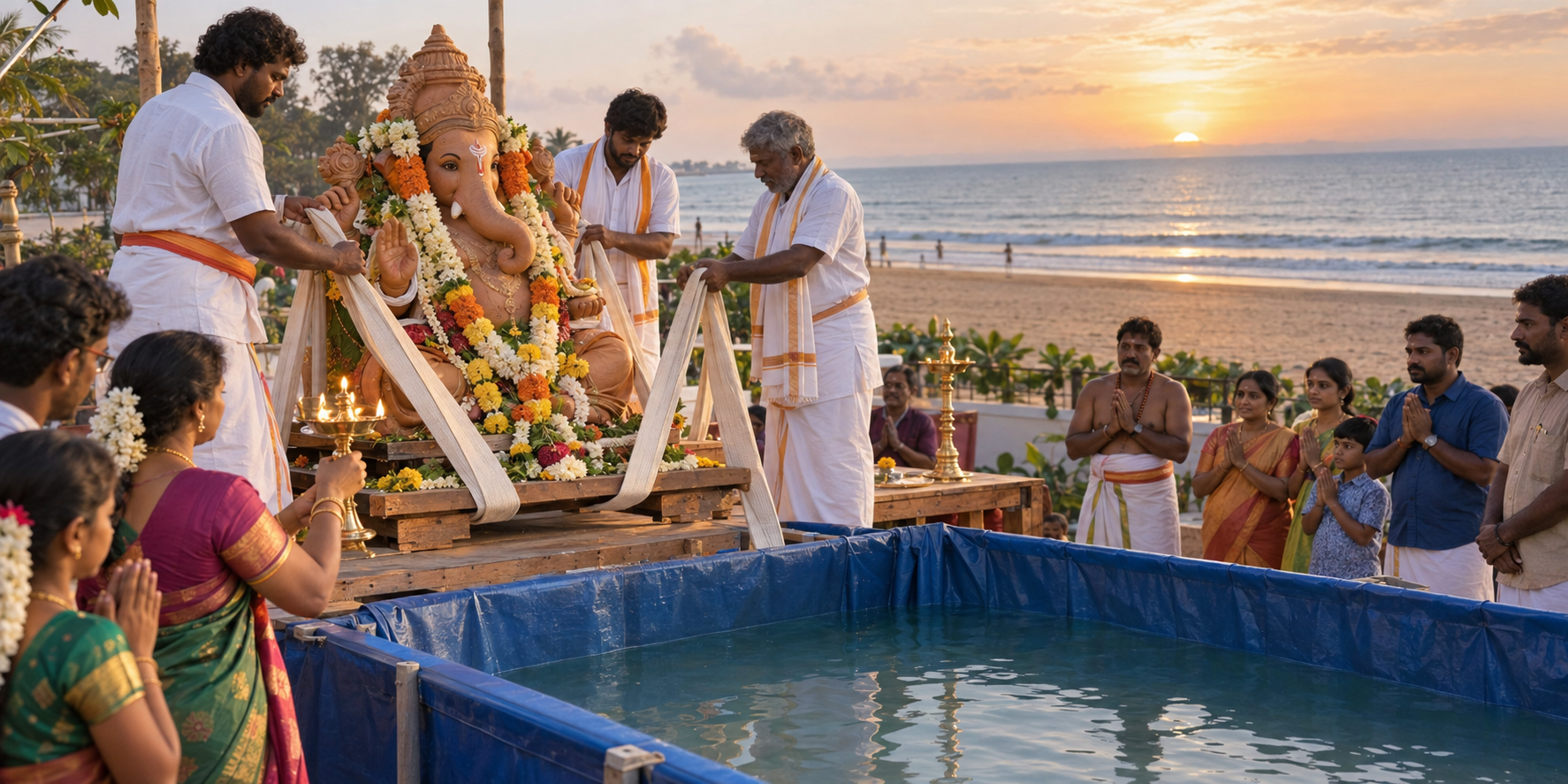
If you organise a Ganesh Chaturthi celebration in Tamil Nadu, do not build your next visarjan plan around last year’s route or permission. Your immediate task is to establish where murti immersion will be allowed, which written direction applies, and whether the authorities will provide a ritually workable alternative.
The policy direction is significant: Tamil Nadu has informed the National Green Tribunal that immersion will be barred at two Chennai beaches before a planned complete phase-out in natural water bodies by 2027. That gives devotees, temples, Ganesh mandals, artisans and civic groups a narrow window to seek clarity and shape the arrangements that replace traditional sites.
What the 2027 announcement does and does not settle
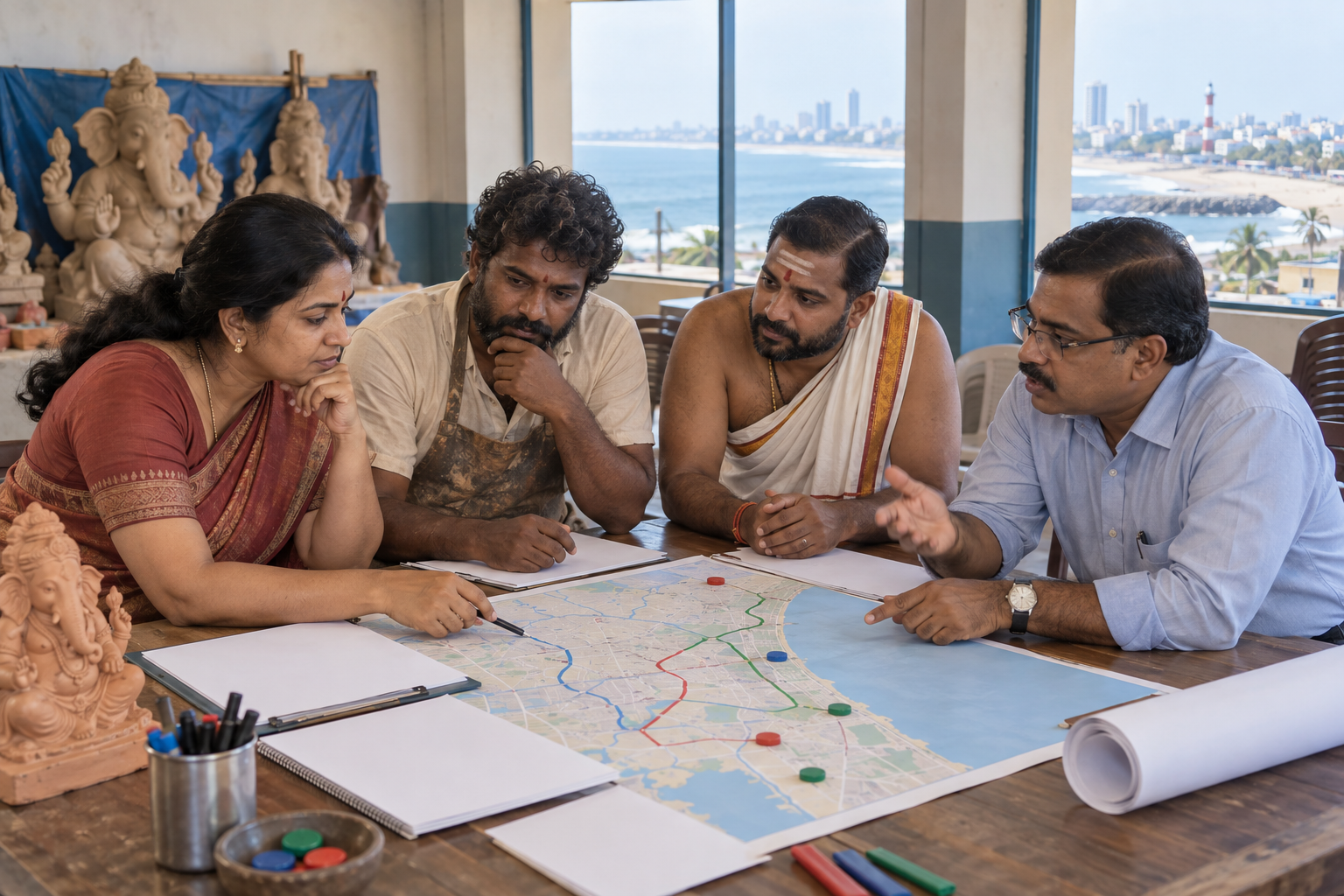
The announced direction identifies an intended destination, not the full operating procedure for every celebration. It does not, by itself, tell you whether a particular beach, river, lake, pond or temple tank is covered on a particular date. Nor does it establish what permissions, exemptions, transition arrangements or replacement facilities will apply to your event.
That distinction matters. A statement made before the National Green Tribunal may lead to binding directions and local implementation, but your committee must work from the final order, notification, permit condition or official instruction that governs the chosen site. A headline is not a substitute for that text.
Before you commission a murti, announce a procession route or collect money from devotees, obtain these items in writing:
- The exact order, circular or notification governing immersion in your locality.
- A dated list or map of authorised immersion facilities, including their operating hours and access conditions.
- Any limits concerning murti dimensions, construction materials, procession routes, vehicles, sound, crowd size or advance permission.
- The name and office of the authority responsible for answering site-specific questions.
- The procedure for receiving changes if a location is withdrawn or replaced close to the festival.
Ask precise questions. Is the restriction already operative at your intended location, or is it scheduled for a later date? Does it apply to household murtis as well as community murtis? What does the government mean by a natural water body? Is a designated contained tank available nearby? How will ritual residue and collected murtis be handled? Request an acknowledgement number or stamped copy for every written representation.
Do not treat silence as permission. Equally, do not assume that every conceivable form of visarjan has already been prohibited. Confirm the rule that actually applies.
Build a compliant plan without emptying the ritual of meaning
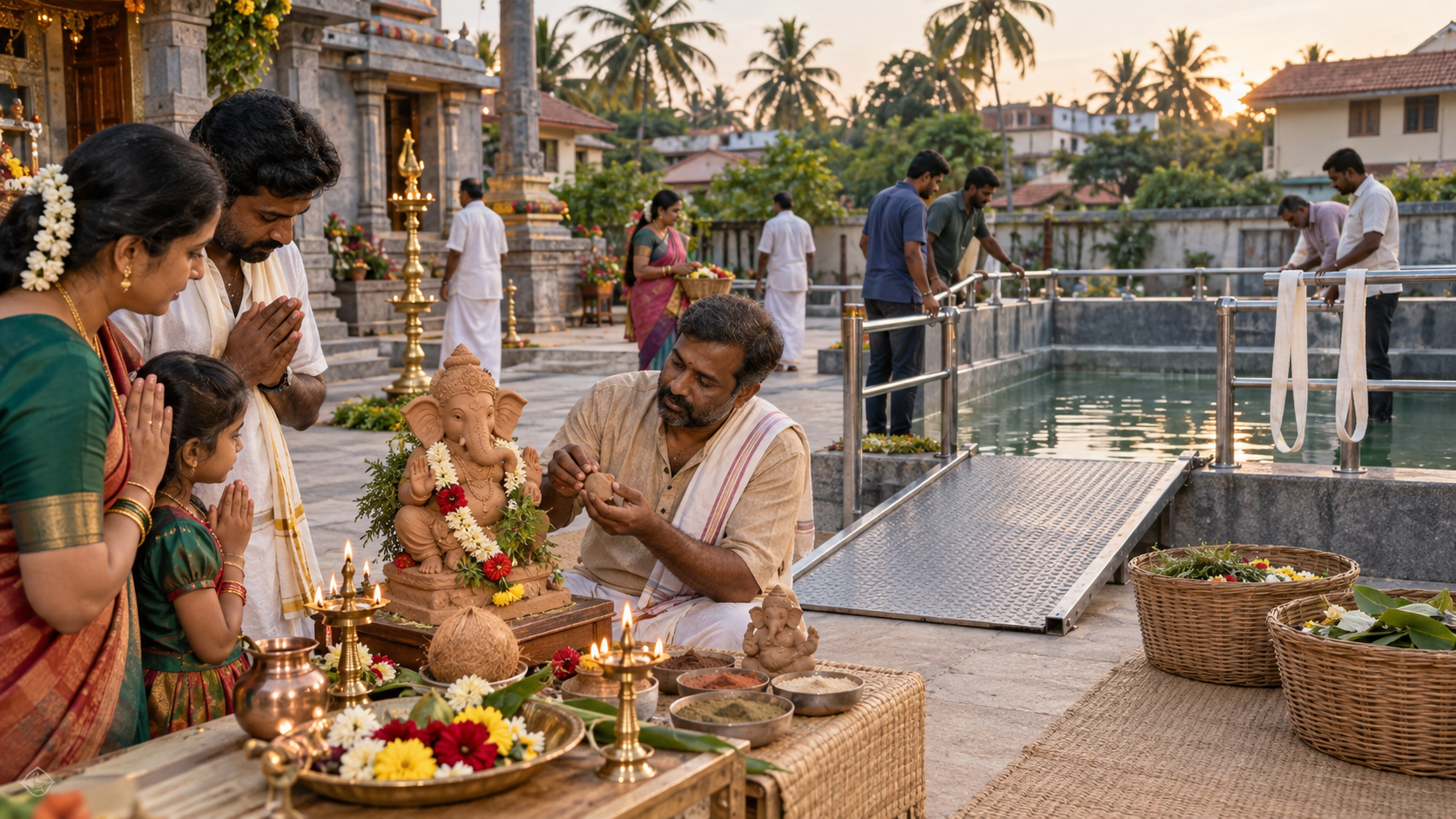
Visarjan is not merely the disposal of an object. It concludes a sequence of worship and expresses the return of a consecrated temporary form to the elements. A replacement arrangement that handles murtis like ordinary refuse will understandably fail devotees, even if it is administratively convenient.
Begin with the ritual requirements of your family, temple or sampradaya. Ask a knowledgeable priest which parts must occur beside the murti, which can occur at the place of worship, and how a contained or managed immersion may be incorporated without improvising theology at the last moment. Traditions differ, so one universal ceremony should not be imposed on every community.
Then build the practical plan around the confirmed rules:
- Select the immersion method before selecting the murti. A large community murti designed for open-water immersion may not fit a managed tank. Obtain the facility’s written size and material conditions before placing the artisan’s order.
- Reduce avoidable material problems. Where your tradition permits, choose an unpainted clay murti or water-soluble natural finishes, minimal non-biodegradable decoration and components that can be removed before immersion. Ask the artisan to disclose the materials used. This is environmental prudence, not proof of compliance with any particular Tamil Nadu rule.
- Secure an authorised alternative. Ask whether a government-managed tank, temporary lined facility, collection point or another approved arrangement will operate near the customary route. Obtain an exact location and schedule rather than relying on a verbal assurance.
- Keep ritual offerings separate. Provide labelled containers for flowers, leaves, cloth, plastic packaging and other materials so that volunteers do not send everything into the immersion facility. Confirm how the authority wants each category handled.
- Design the procession for the new endpoint. Check vehicle access, turning space, queues, lighting, barriers and safe access for children and older devotees. Assign named volunteers to carry the written permission and coordinate with officials.
- Prepare a lawful fallback. If a designated site becomes unavailable, use only an alternative that the competent authority has approved. Do not redirect the procession to an unverified lake, beach or tank in the heat of the moment.
Household immersion in a container may be suitable for some families, but it is not automatically appropriate for every murti or lineage. Before adopting it, settle both the ritual procedure and the authorised handling of the remaining water and clay. Do not pour residue into a street drain simply because the main immersion occurred at home.
Test the restriction by ecology, fairness and religious dignity
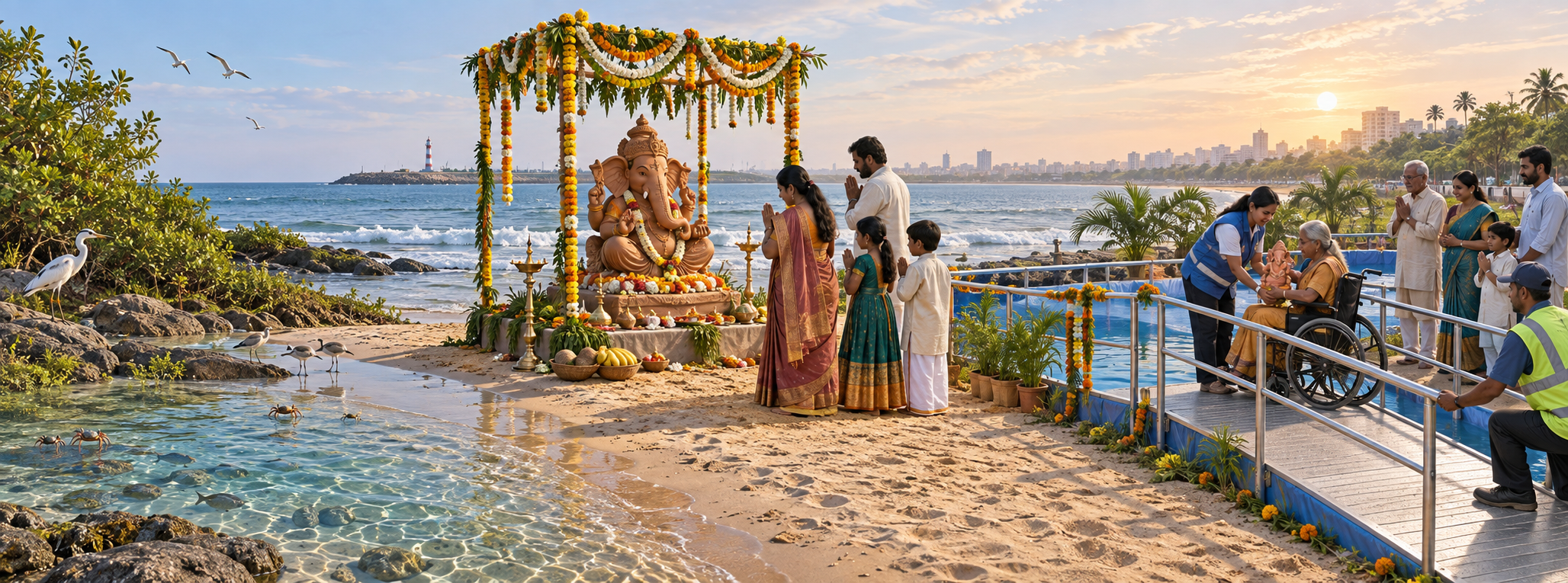
Devotees do not have to choose between environmental responsibility and cultural continuity. Care for water is compatible with dharma. But invoking the environment cannot end the public discussion; a broad restriction should still be specific, evidence-led, even-handed and accompanied by workable alternatives.
Use five questions when evaluating the final policy:
- What precise harm is being addressed? The government should distinguish problems caused by particular materials, coatings, decorations, crowd arrangements or locations from the religious act of visarjan itself.
- Is the response narrower than necessary? Ask whether material standards, designated zones, controlled schedules, collection systems or contained facilities could address the identified harm without eliminating access more broadly than required.
- Are comparable activities treated by comparable standards? Environmental rules gain legitimacy when the same measurable criteria are applied consistently rather than selectively to a Hindu festival.
- Can the alternative actually serve devotees? Capacity, distance, transport access, waiting time, safety, ritual space and respectful handling matter. An alternative that exists only on paper is not a meaningful accommodation.
- Were affected communities given notice and a voice? Families, temples, public mandals, priests and murti artisans all make commitments before the festival. Consultation after murtis have been commissioned is too late to prevent disruption.
This framework also sharpens advocacy. A demand for unrestricted immersion regardless of materials or local conditions is easy to dismiss. A documented request for a clay-only option, sufficient managed tanks, transparent criteria, dignified handling and equal enforcement requires a substantive answer.
How devotees can advocate effectively before 2027
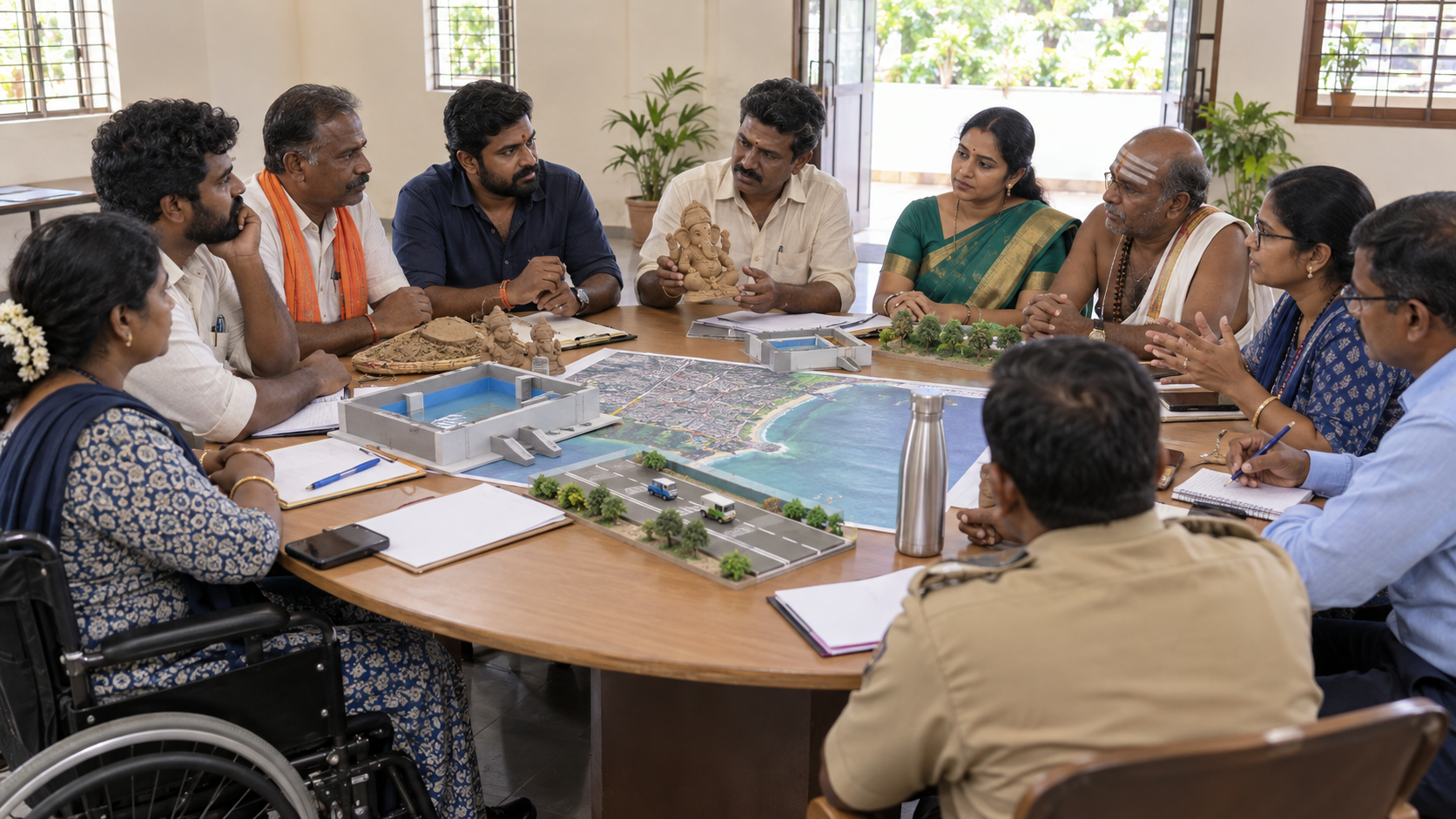
Start locally and start early. Form a small working group representing household worshippers, temples, community organisers, priests and artisans. Give one person responsibility for official correspondence and another for maintaining copies of orders, acknowledgements, site maps and meeting notes.
Submit a written representation that identifies your customary immersion site, the approximate character of your event, the type of murti normally used, the likely transport route and the practical effect of losing that site. Keep every number event-specific and support it from your own records; do not inflate attendance or costs for rhetorical effect.
Request concrete remedies rather than a vague reconsideration. Possible proposals include sufficient managed immersion tanks near established routes, timed access slots, clearly published material standards, authorised collection points, respectful handling protocols and a transition period that gives artisans and organisers time to adapt. These are proposals to place before the authorities, not claims about what Tamil Nadu has already approved.
Ask officials to publish the final rules in Tamil as well as any other administrative language used, together with maps, contact numbers and responsibility for each facility. Accessibility is part of implementation: a rule that ordinary families cannot locate or understand will produce confusion even among people trying to comply.
Keep the engagement peaceful and factual. Record cancelled permissions, inadequate capacity, inconsistent instructions or disrespectful handling with dates, locations and copies of official communications. Do not obstruct officials or encourage an unauthorised immersion to create a confrontation. That can expose participants to legal and safety consequences while weakening the case for accommodation.
If a formal challenge is contemplated, take the actual order and the complete correspondence to a lawyer familiar with public and environmental law. The legal options will depend on the wording, authority, scope and implementation of the final instrument; general commentary cannot determine the position at a particular site.
Key takeaways
- Tamil Nadu has indicated a prohibition at two Chennai beaches and a planned complete phase-out of immersion in natural water bodies by 2027.
- The policy direction does not replace the site-specific order, permit conditions or implementation instructions your celebration must follow.
- Confirm the authorised immersion method before commissioning the murti, fixing the procession route or announcing arrangements to devotees.
- Ask for alternatives that are large enough, accessible, safe and capable of treating the ritual with dignity.
- Environmental responsibility strengthens cultural advocacy when devotees propose material standards, managed facilities and measurable safeguards.
- Challenge unclear or unequal implementation through documented representations and qualified legal advice, not an improvised confrontation at the water’s edge.
Begin with a written information request now, while there is still time to influence facilities, routes and material choices. The strongest response will preserve both responsibilities at stake: clean water and a living, publicly respected Ganesh tradition.
References

Leave a Reply
You must be logged in to post a comment.