

If you found Kakini’s name beside Svadhisthana on a chakra diagram, you may be wondering whether she is a separate goddess, a symbolic detail, or someone a practitioner is expected to worship. The most useful answer begins by refusing to isolate her from the seat over which she presides.
Kakini, the pelvic seat, the water element, and creative energy belong to one symbolic arrangement. Read together, they offer a disciplined way to contemplate how energy moves, receives form, and becomes expression. Read as disconnected labels, they quickly turn into vague personality claims that the traditional image was never meant to support.
Start with the whole symbol, not a one-word meaning
Within the tantric and yogic subtle-body map, the human frame is represented as more than its physical structure. A column of consciousness is organized around seven principal chakras along the spinal axis. Each chakra is a peetha, or seat, where a tattva finds expression and a Devi presides.
That description gives you an important boundary: a chakra is not simply an anatomical organ, and its presiding Devi is not decorative artwork. The arrangement joins place, elemental quality, and sacred presence. At Svadhisthana, the place is the pelvic seat, the tattva is water, and the presiding Devi is Kakini.
| Part of the symbol | Established anchor | How to read it carefully |
|---|---|---|
| Svadhisthana | A peetha associated with the pelvic region | Treat it as a subtle seat, not a medical structure or personality category |
| Water | The tattva expressed at this seat | Contemplate movement, receptivity, continuity, and the need for a container |
| Kakini | The Devi who presides at Svadhisthana | Keep sacred agency at the centre instead of reducing the chakra to an impersonal mechanism |
| Three faces | A defining feature of Kakini’s form | Do not assign each face a fixed meaning unless a lineage or text actually supplies one |
This integrated reading is more useful than saying that Svadhisthana merely means creativity. It tells you what kind of creativity is being contemplated: power that must move, relate to conditions, and take a suitable form.
Water turns creativity into a question of movement and form
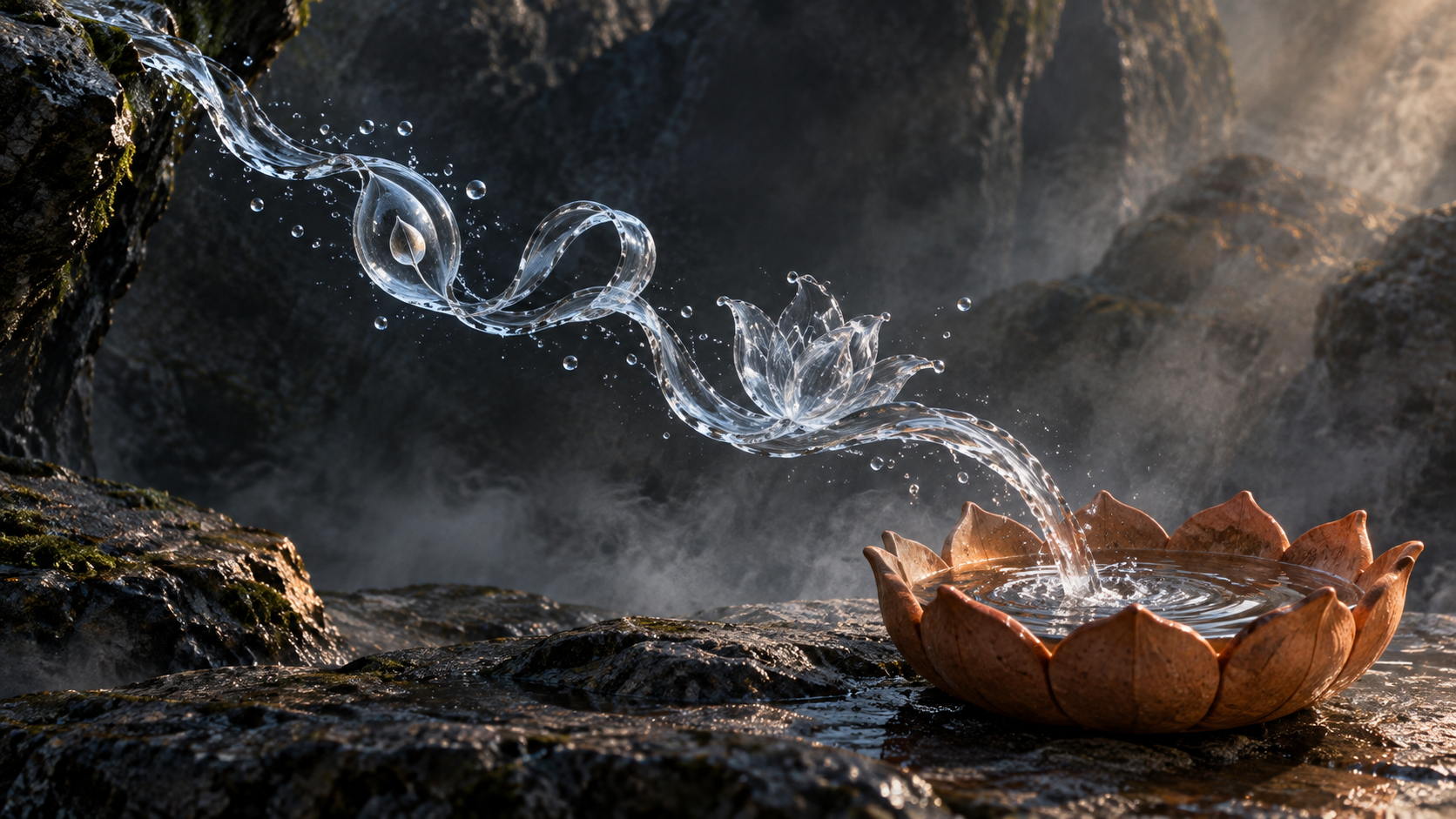
Water does not keep one shape regardless of its surroundings. It moves, gathers, disperses, and assumes the form of what contains it. You can use those familiar qualities as contemplative prompts without pretending that every quality is a fixed doctrinal definition.
In practical terms, creative energy is not limited to artistic talent. It can be understood more broadly as the capacity through which an impulse becomes expression. Water sharpens the inquiry: Is that impulse moving, or are you gripping it? Does it have a container, or is it diffusing into many unfinished intentions? Is the container serving the movement, or constricting it?
This also corrects a common misunderstanding. Flow does not mean the absence of boundaries. Water without any container disperses; a container without movement holds something inert. If you want to apply the symbolism, give one meaningful impulse an adequate form: a scheduled practice, a page on which to write, a conversation you have been postponing, or a clearly bounded piece of work. The point is not constant production. It is conscious passage from potential to form.
Keep that inquiry symbolic. Pelvic pain, changes in bodily function, or persistent psychological distress should not be labelled a blocked Svadhisthana. A subtle-body image cannot diagnose a physical or mental-health condition; symptoms that concern you belong with an appropriate qualified professional.
Read Kakini’s three faces without inventing doctrine

Kakini is presented as a three-faced Devi. The responsible response is not to fill the apparent gap with the first attractive triad you encounter. Past, present, and future; body, speech, and mind; or any other set may sound plausible, but plausibility does not make an interpretation traditional.
Use a simple rule: distinguish description, received interpretation, and personal reflection.
- Description: Kakini is the three-faced presiding Devi of Svadhisthana within this subtle-body arrangement.
- Received interpretation: If your lineage, teacher, or an identified text explains the faces, retain that explanation in its proper context.
- Personal reflection: You may let the multiple faces remind you that creative movement can be viewed from more than one angle, but identify this honestly as your contemplative use rather than inherited doctrine.
This distinction matters because chakra symbolism is easy to personalize and then misremember as scripture. You do not need to suppress reflection. You need to know when you are receiving a teaching and when you are making an interpretive association of your own.
Kakini’s presence also changes the tone of the inquiry. You are not merely trying to optimize an internal energy system. You are approaching a Devi who presides over a sacred seat. Even if your immediate practice is contemplative rather than ritual, reverence calls for attention, restraint, and accuracy.
A simple contemplation that does not pretend to be initiation
You can work with this symbolism without inventing a mantra, claiming an initiation, or copying an elaborate ritual from an unattributed diagram. The following is a reflective exercise, not a substitute for lineage instruction.
- Sit in a position that requires no strain. Let your breathing remain ordinary; there is no need to force breath, hold it, or create a pelvic contraction.
- Bring gentle attention to the pelvic region as the symbolic seat of Svadhisthana. Do not hunt for heat, vibration, colour, or any other expected sensation.
- Recall the water tattva. Notice the difference between allowing attention to move and pushing it toward a result.
- Bring the name Kakini to mind as the Devi presiding at this seat. If you have received a formal practice from a qualified teacher, follow that instruction. Otherwise, remain with the name and the relationship already established: Devi, seat, water, and creative energy.
- Ask one grounded question: What in your life needs freer movement, and what needs a better container? Wait without manufacturing an answer.
- Close by choosing one proportionate action. Give an emerging intention a page, a time, a boundary, or another concrete form. The outer action tests whether the contemplation has made your attention clearer.
A quiet session is not a failed session. Chakra practice becomes distorted when every sitting is judged by unusual sensations. The more reliable signs of a useful contemplation are modest: you see an impulse more clearly, stop confusing intensity with direction, or give a worthwhile intention a workable form.
Key takeaways
- Kakini should be understood together with Svadhisthana, the pelvic peetha, the water tattva, and creative energy.
- The chakra is a subtle seat, not an anatomical diagnosis, and physical or psychological symptoms should not be explained away as an energetic blockage.
- Water offers a practical contemplation of movement and containment: creative potential needs enough freedom to move and enough form to become real.
- Kakini’s three faces should not be assigned fixed meanings without a named textual or lineage basis.
- Personal reflection is legitimate when you label it as reflection rather than inherited doctrine.
The next time you meet Kakini on a diagram, resist the urge to collect another one-line chakra meaning. Hold the complete relationship in view, then give one genuine creative impulse an honest container. That small act will tell you more than a catalogue of correspondences ever could.
References

Leave a Reply
You must be logged in to post a comment.