

Perhaps you know Srila Prabhupada as the acharya who brought Krishna bhakti to a global audience, but the names Bhaktivinoda Thakur and Bhaktisiddhanta Sarasvati Thakur still blur together. If you want to understand Prabhupada’s journey, start before the voyage and before the international movement.
The useful map is a transmission: a devotional inheritance rooted in Bengal, received through a spiritual master, and carried outward through teaching, practice, and organized service. That frame helps you distinguish spiritual lineage from family history, institutional history, or a collection of revered personalities.
Read the lineage as transmission, not a list of names
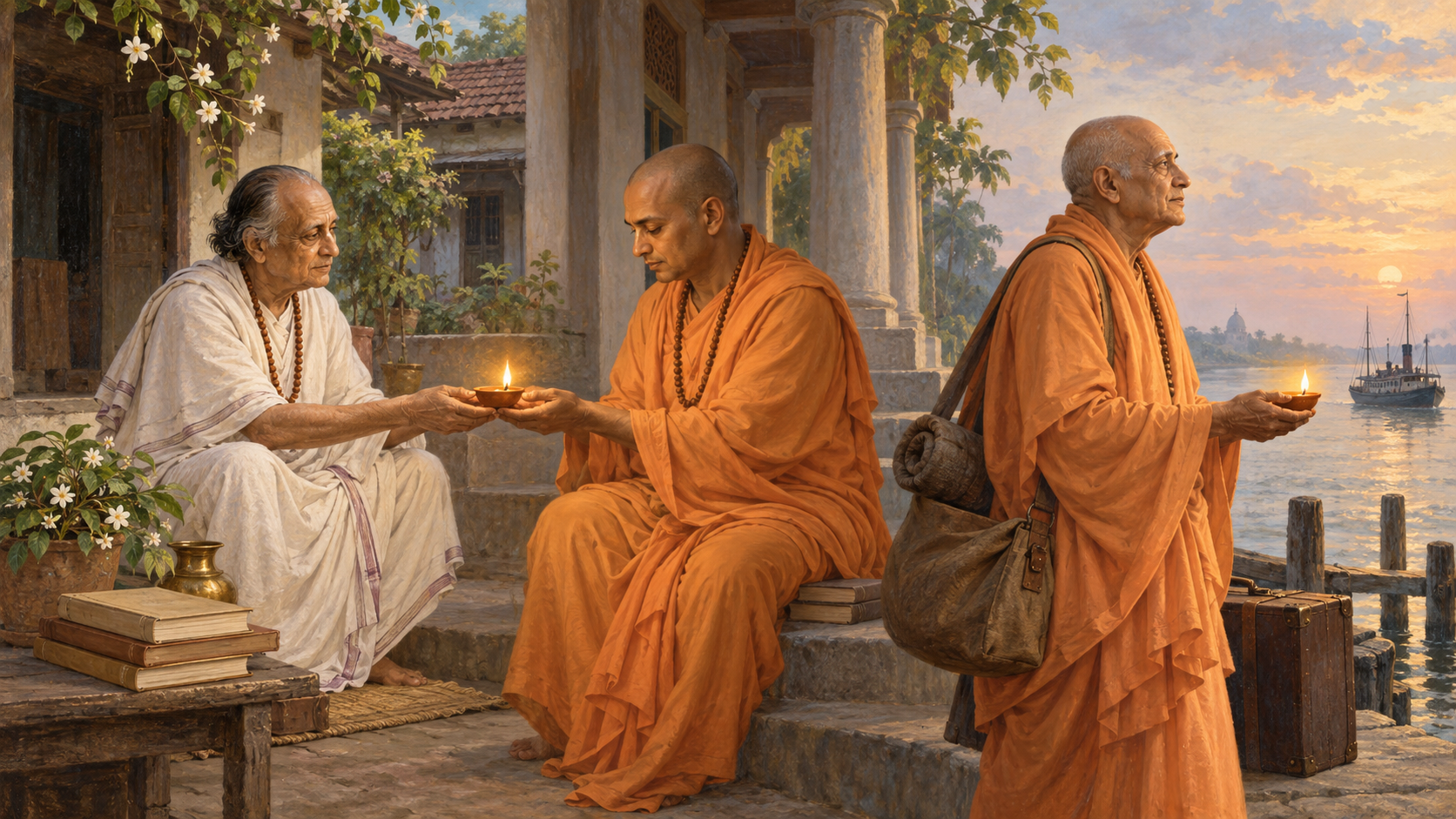
In a guru-parampara, continuity depends on teaching being received and lived. Birthplace, surname, robes, or institutional office cannot establish that continuity by themselves. The central questions are who taught whom, what was received, and how that teaching became disciplined practice.
- Bhaktivinoda Thakur provides an earlier devotional and historical anchor. Bhakti Bhavan in Kolkata was his home and the place where he left his body.
- Bhaktisiddhanta Sarasvati Thakur was Srila Prabhupada’s spiritual master. He is the direct guru-disciple link through which the earlier inheritance became a personal obligation for Prabhupada.
- Srila Prabhupada received that obligation and carried the tradition into an international setting. His 1965 voyage to America belongs to this outward movement of the lineage.
This three-name map is a historical spine, not a complete chart of the Gaudiya Vaishnava disciplic succession. Keep that limitation in view. A formal initiation lineage and a wider history of teaching influence are related, but they are not automatically identical. If you study a fuller lineage chart, check whether each connection represents diksha, siksha, institutional succession, family relationship, or broader devotional influence.
That distinction protects you from two common mistakes. The first is treating lineage as hereditary prestige. The second is drawing a simple arrow between every admired figure without identifying the nature of the relationship.
Why the first Kolkata meeting is the decisive hinge
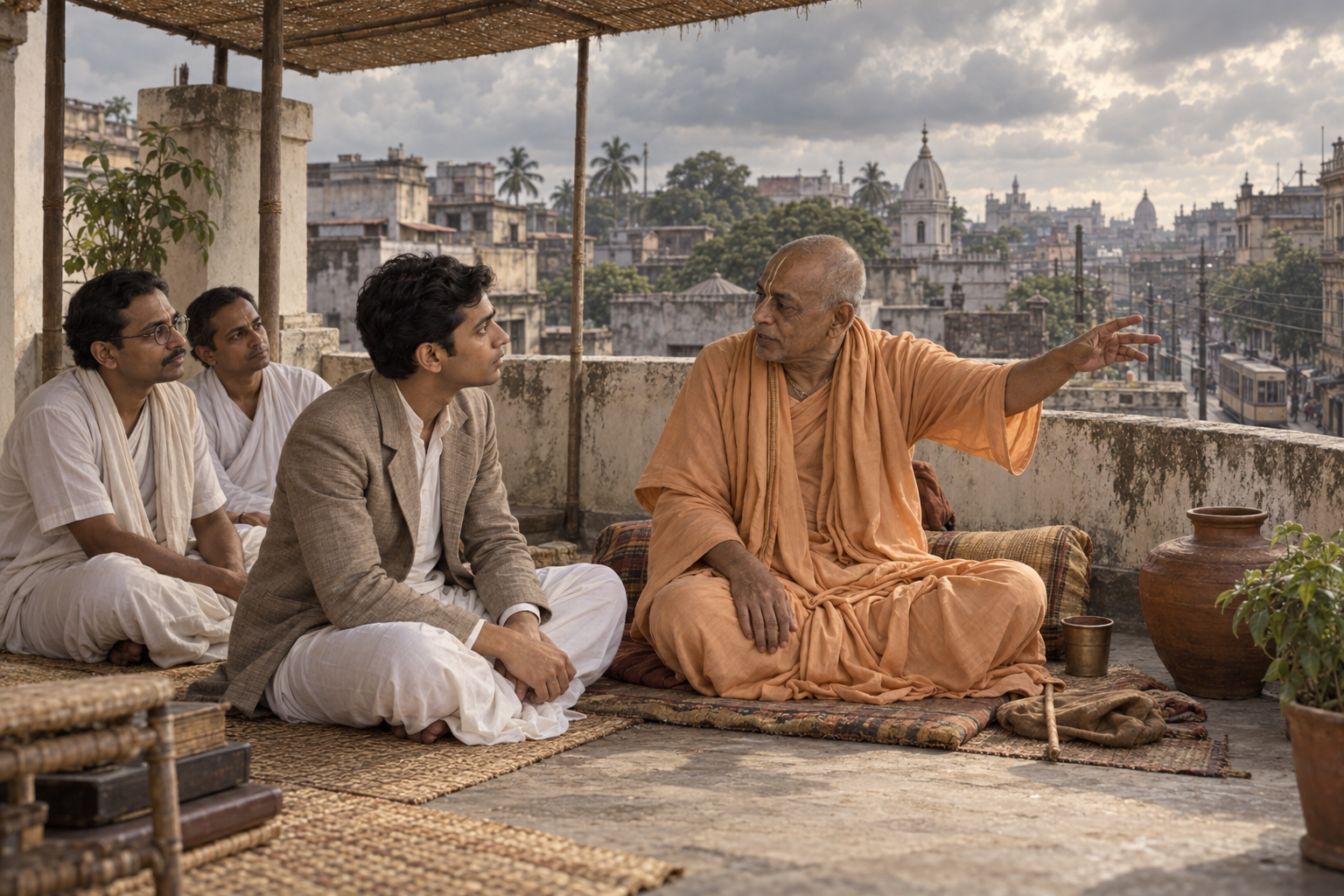
Bhaktivinod Asan is where Srila Prabhupada first met Srila Bhaktisiddhanta Sarasvati Thakur. That meeting is more than an interesting stop in a biography. It joins an individual seeker to a living teacher and places the later global mission inside an existing discipline.
The location also helps you read the story in the right order. The international work did not create Prabhupada’s spiritual authority. It expressed a responsibility that arose within the guru-disciple relationship. Geography explains where his work later travelled; lineage explains why he undertook it as service.
Be careful when reading dramatic retellings of this encounter. A remembered location, an attested meeting, an exact quotation, and a later interpretation are four different kinds of claim. Do not merge them merely because they appear in the same narrative.
- Record the meeting itself as the historical event.
- Record Bhaktivinod Asan as the associated place.
- Treat any precise dialogue as a quotation only when its wording has a traceable citation.
- Describe the meeting as spiritually formative without inventing details that are not established.
This discipline does not make the account less devotional. It prevents piety from depending on words that may have been polished or expanded in later retelling.
The voyage carried a lineage, not an isolated personality

The voyage to America is the most visible part of Prabhupada’s journey, but it is not its origin. If you begin with the voyage alone, the story can look like the achievement of an unusually determined religious founder. Begin with the guru-disciple relationship, and the same journey becomes an act of transmission.
This changes how you assess Prabhupada’s global influence. Audience size can show reach, but it cannot establish fidelity. A lineage survives abroad when people can receive its teachings intelligibly, enter its disciplines, form communities around its practices, and transmit it without severing it from its spiritual origin.
When you read any account of the international mission, ask three practical questions:
- What remained continuous? Look for the devotional aim, the authority of the guru, and the disciplines expected of practitioners.
- What had to become accessible? Notice how language, explanation, publication, and community life allowed people outside Bengal to approach the tradition.
- What could be reproduced? A lasting mission needs practices and responsibilities that disciples can carry forward, not only admiration for its founder.
These questions also expose a weak interpretation of Prabhupada’s life: one that celebrates travel and expansion while ignoring obedience, practice, and succession. His geographical journey matters because it served a spiritual journey already underway.
Two Kolkata places make the lineage tangible
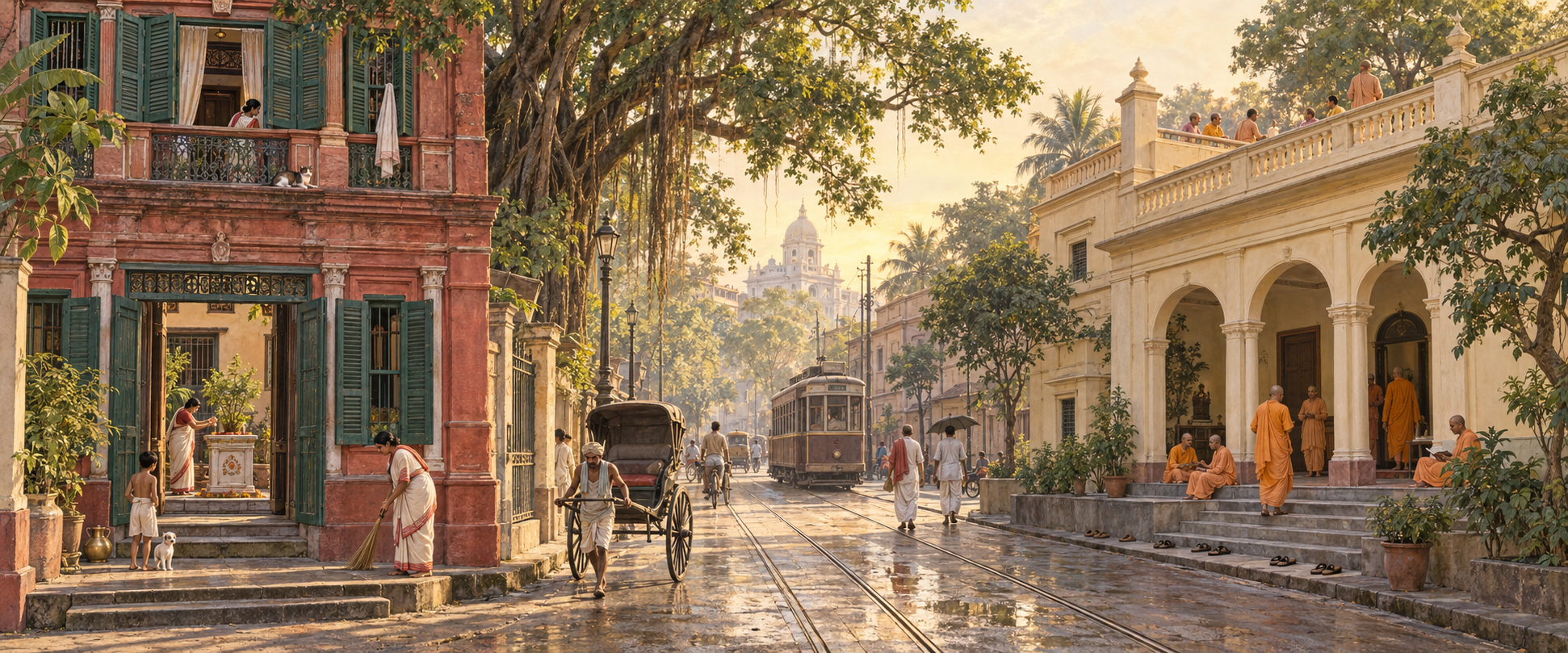
Bhakti Bhavan and Bhaktivinod Asan should not be treated as interchangeable names. Each preserves a different relationship to the lineage.
| Place | Historical association | What to notice |
|---|---|---|
| Bhakti Bhavan | Bhaktivinoda Thakur’s Kolkata home and the place where he left his body | A spiritual inheritance is first embodied in a life, a household, and sustained devotional work. |
| Bhaktivinod Asan | The place where Prabhupada first met Bhaktisiddhanta Sarasvati Thakur | Transmission becomes personal when a disciple encounters a teacher and accepts responsibility. |
Both places have been restored by ISKCON. During the reported renovation, Bhaktivinoda Thakur’s effects at Bhakti Bhavan had been put away. That is an important practical detail for a pilgrim: a restored sacred site may remain spiritually significant even when particular objects are temporarily unavailable for viewing.
Before you travel, confirm current opening arrangements, renovation work, and whether the personal effects are on display. Do not rely on an older photograph or itinerary. Once there, keep the two associations separate in your notes: Bhakti Bhavan concerns Bhaktivinoda Thakur’s life and departure, while Bhaktivinod Asan marks Prabhupada’s first meeting with his spiritual master.
A useful pilgrimage need not collect dozens of facts. At each place, write down one verified historical association, one question about the lineage, and one implication for practice. This keeps remembrance connected to inquiry rather than turning the visit into religious sightseeing.
A practical way to study Prabhupada’s journey
You can build a reliable understanding without beginning with a large biography or memorizing a long succession of names. Start with a one-page map and expand it only when you can label each relationship accurately.
- Write the three central names. Place Bhaktivinoda Thakur, Bhaktisiddhanta Sarasvati Thakur, and Srila Prabhupada in historical order.
- Label relationships precisely. Distinguish direct discipleship from earlier influence, family connection, institutional succession, and association with a sacred place.
- Attach one verified event to each relevant connection. For Prabhupada and Bhaktisiddhanta, begin with their first meeting at Bhaktivinod Asan.
- Separate event from interpretation. First record what happened and where. Then explain why it matters spiritually. Do not let the interpretation supply missing historical details.
- Trace the movement from reception to service. Read the international journey as the carrying out of a received responsibility, not as a self-created spiritual brand.
- Connect study to an authorized practice. Choose an instruction you can trace through an authentic teaching in the tradition and follow it consistently. Lineage becomes intelligible through disciplined reception, not name recognition alone.
Key takeaways
- Srila Prabhupada’s journey is best understood as guru-parampara in action: teaching received, embodied, and transmitted.
- Bhaktivinod Asan marks his first meeting with Bhaktisiddhanta Sarasvati Thakur and therefore provides a crucial historical hinge.
- Bhakti Bhavan and Bhaktivinod Asan preserve different memories and should not be conflated.
- The 1965 voyage explains the international movement of the mission, but the guru-disciple relationship explains its spiritual origin.
- A trustworthy account distinguishes formal discipleship, broader influence, remembered place, exact quotation, and later interpretation.
Your next step is small and concrete. Write the three names, label each relationship as precisely as you can, and attach only verified events to the map. Then take one teaching you can trace authentically and make it part of your practice. Prabhupada’s journey becomes clearer when geography, guru, and discipline remain together.
References
- Dandavats — Today’s Featured Video: Srila Prabhupada: The Journey That Changed Millions
- Dandavats — Bhakti Bhavan & Bhaktivinod Asan in Kolkata

Leave a Reply
You must be logged in to post a comment.