
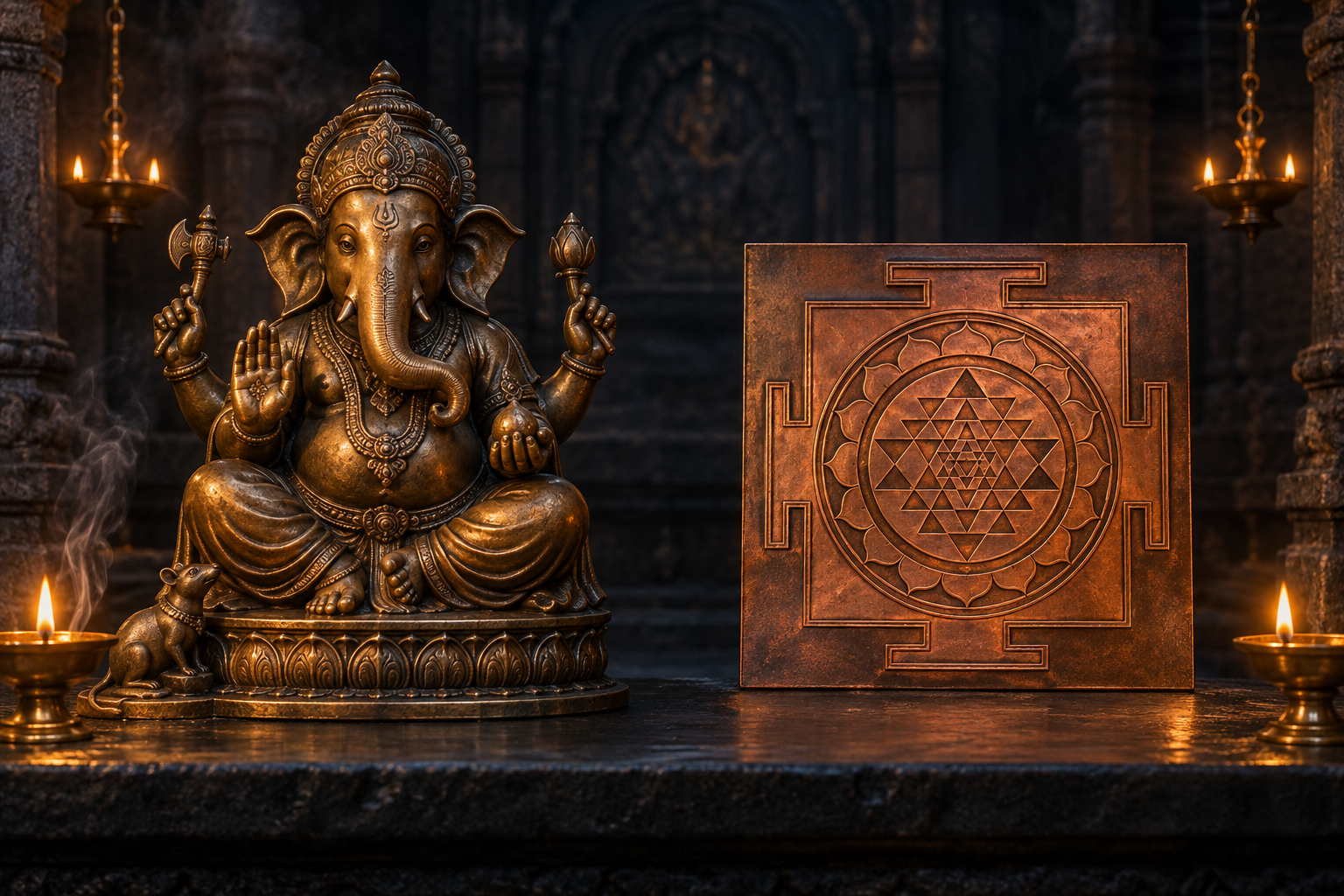
You are looking at a temple sculpture or yantra. You can identify a bull-like face or two intersecting triangles, but the image still feels closed to you. Should you read it as mythology, philosophy, an aid to worship, or simply sacred art?
Begin with a better question: what relationship is the image asking you to notice? Hindu symbolism becomes more intelligible when you stop treating each feature as a code word and start reading the whole composition: identity, position, direction, enclosure, and relation.
Key takeaways
- Divine forms and sacred diagrams use different visual languages. A composite being communicates through identity and role; geometry communicates through direction and relationship.
- Context comes before interpretation. Identify the tradition, setting, surrounding figures, and complete arrangement before assigning meanings to individual parts.
- Gomukha is a bull-faced figure associated with Shiva’s divine court. His name joins go, meaning cow or bull, with mukha, meaning face.
- An upward-pointing triangle joined to a downward-pointing triangle can express the relation of Purusha and Prakriti. Their conjunction matters more than either shape viewed alone.
- A symbol has done its work when it directs your attention toward a spiritual relationship, not when you have merely memorised a definition.
Start with context, not a universal symbol dictionary
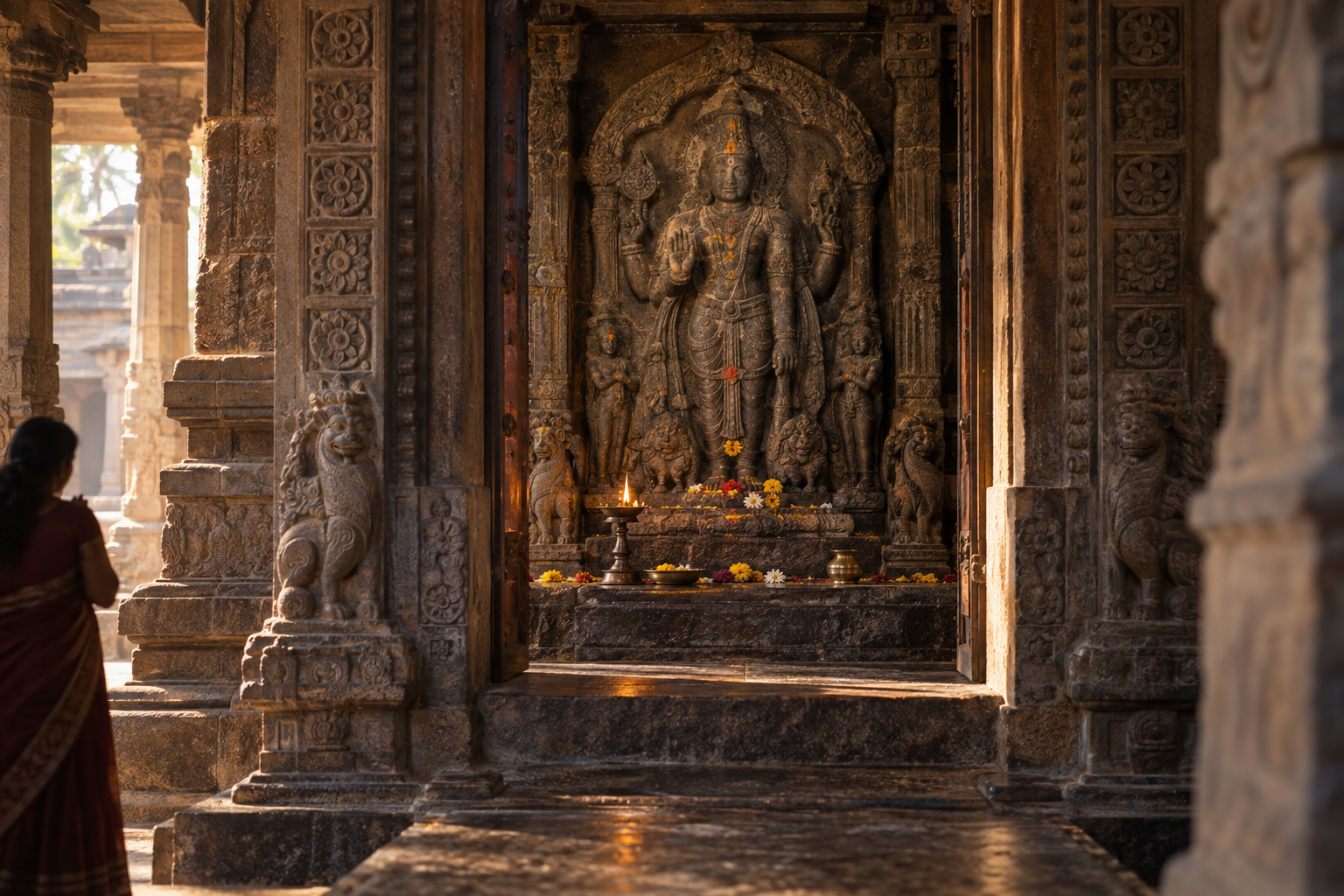
The quickest way to misread Hindu sacred art is to isolate one feature and attach a fixed definition to it. A triangle, animal face, circle, hand gesture, or position may acquire its meaning from the larger composition. The same basic shape can perform a different function when its orientation, companions, or ritual setting changes.
Use four questions before consulting any symbolic explanation:
- Which tradition frames the image? A Shaiva sculpture should first be read within a Shaiva setting, not through an interpretation borrowed indiscriminately from elsewhere.
- Where does the figure or shape appear? A central deity, guardian, attendant, boundary figure, and repeated decorative motif do not occupy equivalent positions.
- What is it connected to? Look for contact, overlap, opposition, enclosure, repetition, and direction. These relationships often carry more meaning than an isolated component.
- What remains uncertain? If the provenance, name, or ritual context is unknown, keep your conclusion provisional. Recognition is not the same as understanding.
This approach protects you from two opposite mistakes. One is reducing a sacred image to decoration. The other is forcing every visible detail into an elaborate interpretation that its context cannot support.
Divine form communicates identity through relationship
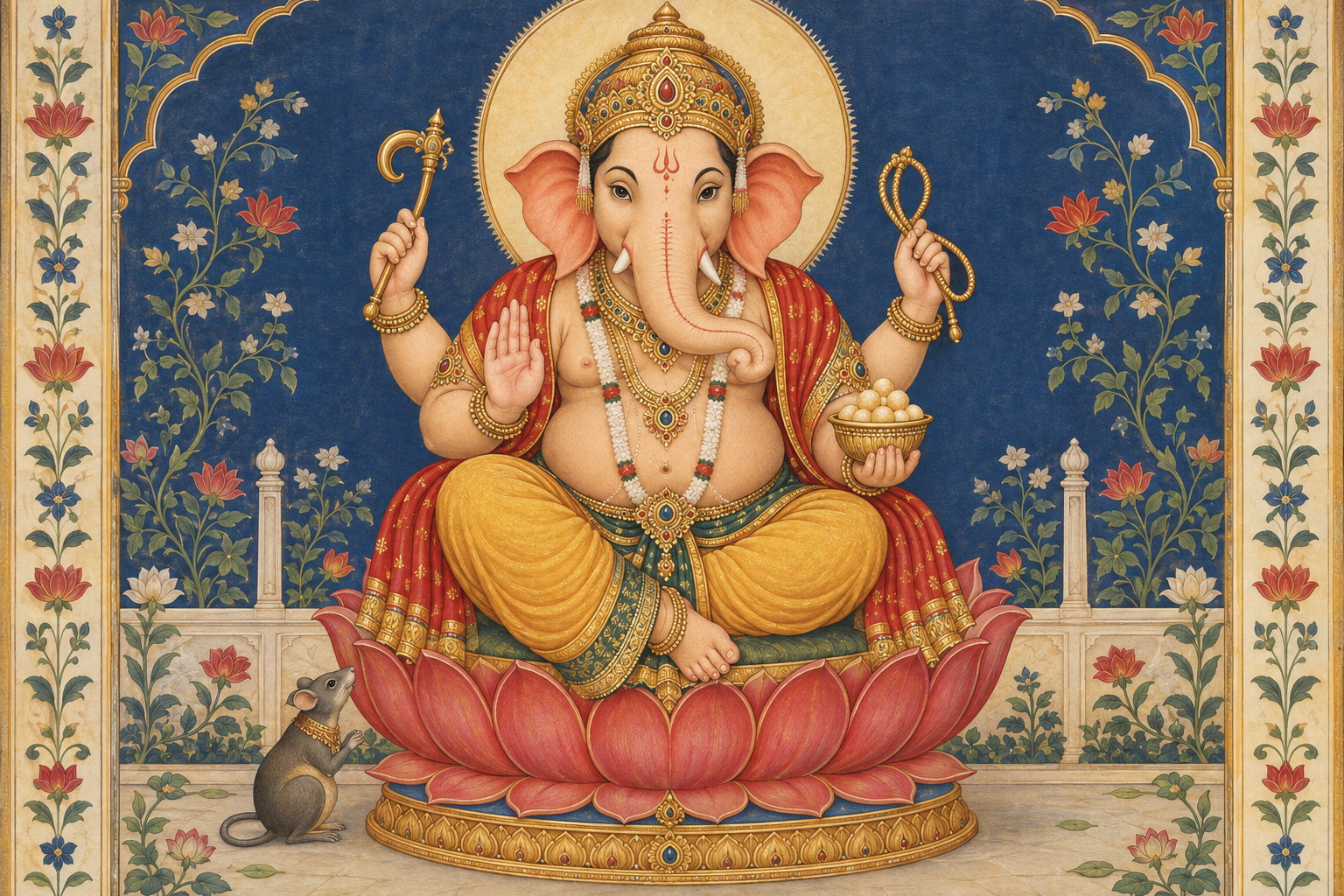
Hindu divine imagery is not limited to reproducing an ordinary human body. A non-human face or composite form tells you at once that you are encountering a sacred identity whose significance cannot be exhausted by physical realism. Yet the unusual feature should not be interpreted by itself.
Gomukha provides a useful example. The name combines go, meaning cow or bull, and mukha, meaning face. The resulting name, the Bull-Faced One, describes a divine figure associated with Shiva’s court and identified as a guardian.
If you focus only on the animal face, you miss part of the communication. His placement within Shiva’s divine order tells you how to begin reading him. The face establishes a distinctive identity; the court establishes affiliation; the guardian role establishes function. Form and position work together.
Read an unfamiliar composite figure in that same sequence:
- Name only what you can see. Say “a bull-like face” before jumping to qualities such as strength, fertility, ferocity, or patience.
- Establish the figure’s name if possible. A traditional name may clarify what the visual feature identifies, as Gomukha does.
- Locate the figure within the sacred company. Ask who occupies the centre, who faces whom, and whether the figure guards, accompanies, serves, teaches, or receives worship.
- Interpret the role before inventing a personality. A guardian’s placement gives you firmer ground than a list of generic animal associations.
This method also prevents a common category error. A sacred composite form is not a biological proposition. Nor is it merely fantasy ornament. It is an iconographic way of making identity and spiritual function visible.
Sacred geometry makes a relationship visible
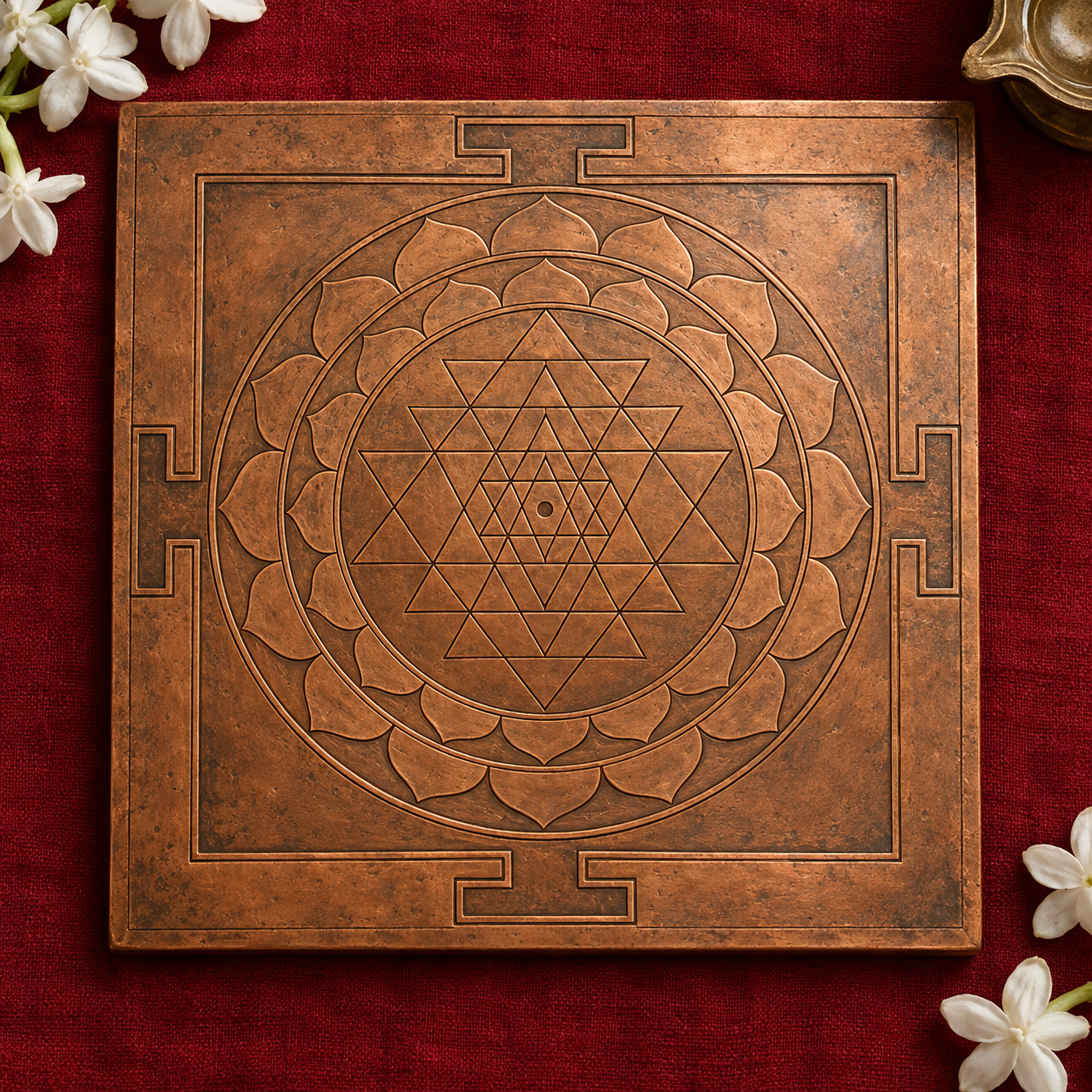
Geometry asks you to look differently. A divine figure can communicate through face, posture, identity, and place in a sacred court. A diagram reduces the visual field to lines, directions, intersections, and boundaries. That reduction is purposeful: it makes relation itself the object of attention.
Consider an upward-pointing triangle joined to a downward-pointing triangle. In a prominent Hindu interpretation, the paired forms communicate the union of Purusha and Prakriti and the balance of the cosmos. Purusha and Prakriti should not be flattened into an ordinary social contrast between male and female. In their philosophical pairing, they point toward consciousness and manifest nature, although particular traditions can develop that relationship in their own ways.
The most important visual fact is conjunction. One triangle rises; the other descends. Each preserves its direction, yet the two share a single figure. The symbol therefore does not ask you to choose one side and reject the other. It trains attention on distinction without disconnection.
The paired triangles are also often shown within a circle. Before assigning the circle a doctrinal definition, notice what it does visibly: it holds the opposed orientations within one field. That compositional observation is secure even when you do not yet know the diagram’s full ritual or sectarian context.
When you encounter a geometric symbol, inspect it in this order:
- Direction: Which forms rise, descend, radiate, turn, or converge?
- Relation: Are the elements separate, touching, intersecting, nested, or mirrored?
- Centre: Does the design direct your eye toward a point, an empty space, or an intersection?
- Boundary: Is the arrangement open, or does a circle or another form contain it?
- Whole: What becomes visible only after the parts are viewed together?
Do not automatically impose the Purusha-Prakriti interpretation on every pair of triangles you see. First verify that you are looking at the complete sacred arrangement rather than an extracted design, modern logo, or decorative fragment. Orientation is evidence, but provenance decides how confidently you can interpret it.
Divine form and geometry are complementary languages
A bull-faced guardian and a field of intersecting triangles may appear to belong to separate worlds. One is personal and embodied; the other is abstract and mathematical. Yet they solve a similar problem: both give visible form to realities that ordinary description struggles to hold.
Divine form invites relationship. You encounter a recognisable presence with a name, affiliation, and function. Geometry invites contemplation of structure. You encounter forces or principles through their orientation and mutual arrangement. The first lets a spiritual role become visible as a being; the second lets a philosophical relation become visible as order.
This distinction tells you what to do when an image remains difficult:
- With a divine figure, ask, “Who is this, where does this being stand, and what role is being made visible?”
- With sacred geometry, ask, “Which elements differ, how are they related, and what whole does their relationship create?”
- With a composition containing both, read each language separately before asking how they support one another.
Neither mode should be reduced to a rebus in which every feature translates into one word. Hindu sacred symbolism is relational. Meaning emerges through the ordered whole.
A practical way to contemplate a symbol without overreading it

You do not need to pretend expertise before looking carefully. Choose one image and give it three passes. This is disciplined observation, not a substitute for puja, initiation, textual study, or instruction within a living tradition.
First pass: describe
Write one sentence containing only visible facts. For Gomukha, you might note a bull-faced figure situated in a Shaiva sacred context. For the geometric design, note an upward and downward triangle joined within a circle. Avoid symbolic adjectives during this pass.
Second pass: relate
Write one sentence about arrangement. Who stands near the figure? What does the figure appear to guard? Which shapes intersect? What encloses them? This is where placement begins to disclose function.
Third pass: contemplate
Turn the established relationship into one restrained question. Gomukha may prompt you to consider what a guardian protects at the threshold of a sacred order. The triangles may prompt you to consider how apparently opposed principles can remain distinct while participating in one reality.
Keep the question close to the image. If your interpretation no longer depends on the figure’s placement or the diagram’s actual geometry, you have probably drifted from contemplation into projection.
The next time you meet an unfamiliar murti, temple figure, or yantra, pause before asking for a one-line meaning. Identify its tradition, describe what is present, and trace the relationships. Let the image teach you how it must be read.
References
- Hindu Blog — Gomukha: Sacred Symbolism, Sculpture, and Spiritual Significance in the Shaiva Tradition
- Hindu Blog — Combination Of Upward Pointing And Downward Pointing Triangles In Hinduism – Symbolism And Meaning

Leave a Reply
You must be logged in to post a comment.