
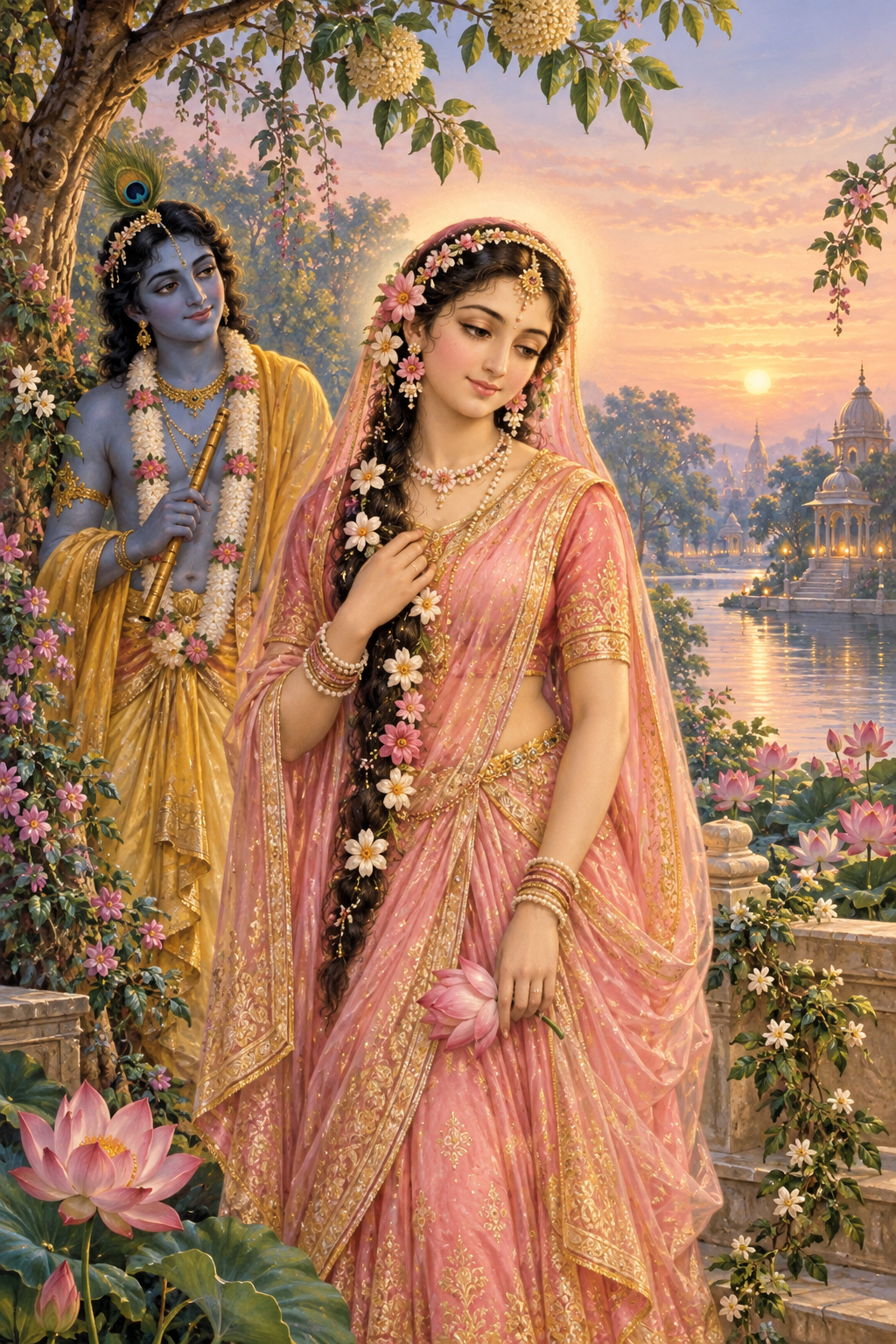
If Radhashtami is approaching and you are unsure whether the day calls for elaborate ritual, fasting, or simple remembrance, begin more quietly. Ask what your worship would look like if love for the Divine, rather than your own list of requests, stood at its centre.
That question can organize the whole observance. Understand whom the day honours, follow a tradition you trust, offer what you can with attention, and let the worship change one ordinary choice after the altar has been cleared.
Radhashtami centres Radharani’s divine appearance
Radhashtami honours the divine appearance of Srimati Radharani, the beloved of Sri Krishna and the embodiment of divine love and devotion. Calling this an appearance preserves the devotional meaning of the occasion: worshippers are not merely recalling an event in an ordinary biography. They are receiving a sacred manifestation as an invitation to remembrance and service.
This makes Radharani the devotional centre of the day, not a decorative figure added to a celebration of Krishna. If your preparations become so crowded that you have little time to remember her, hear about her, or examine the quality of your own bhakti, the arrangement has overtaken its purpose.
Her childhood pastimes and extraordinary transcendental qualities also belong within this remembrance. Do not hurry through such accounts simply to collect details. Listen for what they disclose about devotion. Ask which part of the narration exposes a habit in you that is demanding, distracted, or concerned with recognition.
Read the Radha-Krishna relationship on its own terms

The word beloved can be misunderstood when the Radha-Krishna relationship is forced into the categories of ordinary romance. Within bhakti, this is sacred language for divine love and devotion. Treating it as personality drama shrinks the very reality the festival asks you to contemplate.
A better approach is to let the remembrance question you. Keep these prompts beside you while hearing a discourse, reading a narration, or sitting before the altar:
- Where has my devotion become a bargain in which I expect a reward for worship?
- Do I seek Krishna’s attention, or am I learning to offer attention to Krishna?
- Which personal demand repeatedly pushes loving service to the side?
- What service could I perform even if nobody noticed or praised it?
- Which quality remembered today should become visible in my speech or conduct?
Different devotional traditions may explain the relationship of Radha and Krishna through distinct theological language and inherited practices. You do not need to force every teaching into one formula. If you belong to a particular tradition, use its prayers, vocabulary, teachers, and liturgy. If you are still learning, distinguish between a practice that is widely shared and one that belongs to a specific lineage.
A simple Radhashtami observance you can prepare at home
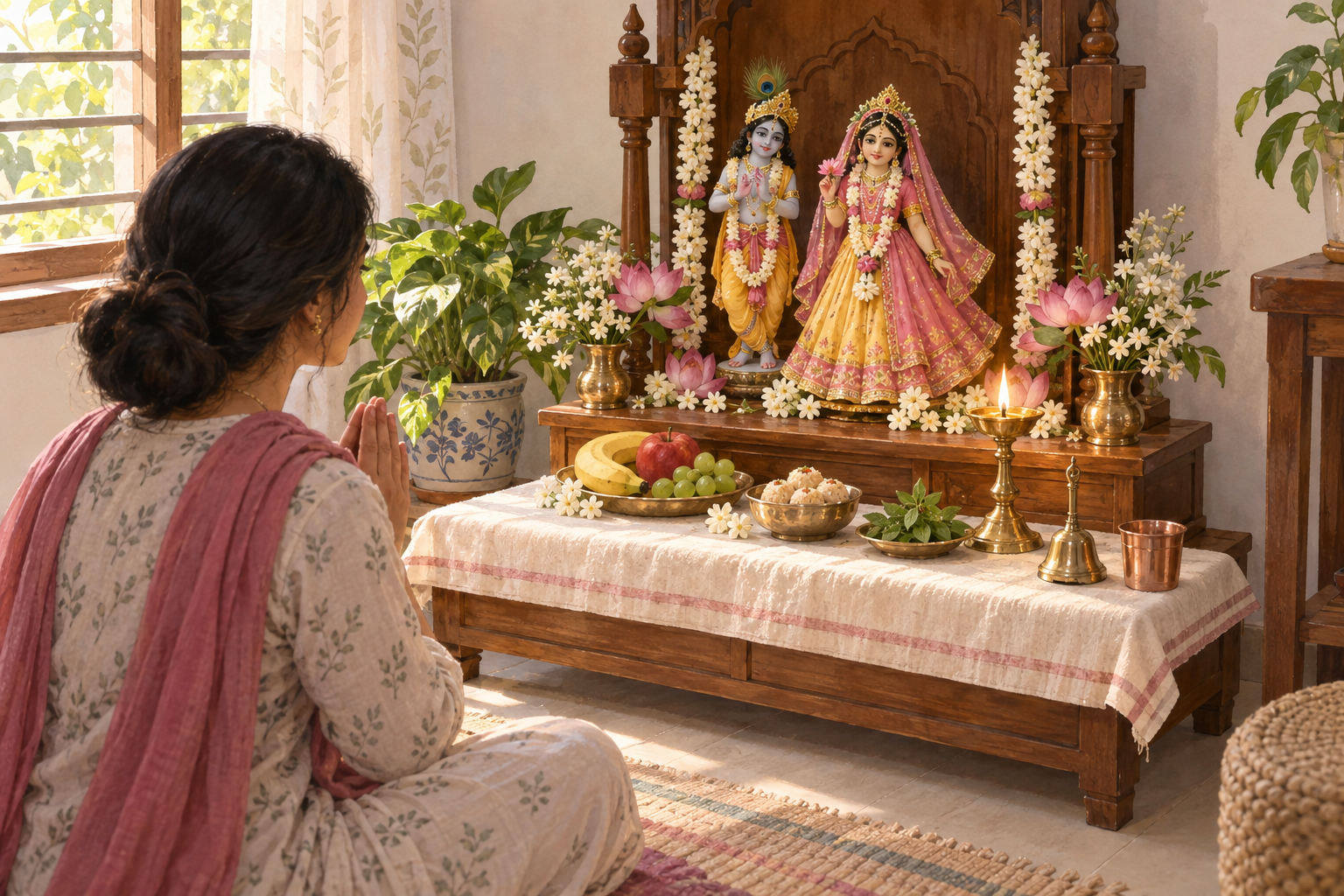
A sincere home observance does not require you to imitate a temple ceremony you have never learned. It does require preparation. Decide in advance what you will hear, chant, offer, and do as seva so that the day is not spent searching for instructions.
- Anchor the observance in a trusted tradition. If you have a mandir, teacher, or inherited family practice, ask about its worship sequence, food customs, prayers, and any vrata. Do not assemble a new ritual from unrelated online fragments.
- Prepare a clean, quiet place. Use the Radha-Krishna murti or image already honoured in your home. If you do not have one, centre the observance on hearing, chanting, and prayer rather than improvising a form of consecrated worship you do not understand.
- State your intention plainly. You might pray: May this worship help me remember Srimati Radharani and learn loving service to Sri Krishna. A clear intention prevents the external arrangements from becoming the entire event.
- Offer according to your household custom. Where your tradition permits it, you may offer a clean flower, water, fruit, or a vegetarian preparation before partaking. Do not present a local custom or a preferred item as a universal requirement.
- Make hearing the heart of the observance. Choose a trusted narration of Radharani’s divine appearance, childhood pastimes, and qualities before the day begins. Listen without multitasking, and pause when a teaching deserves reflection.
- Chant what your tradition has actually given you. Use established divine names, prayers, or kirtan rather than selecting an unfamiliar mantra because it looks impressive. Put the phone aside unless it is needed for the recitation or discourse.
- Conclude with a definite act of seva. Help with a household duty, serve at a mandir, support someone carrying a burden, share prasada where appropriate, or complete a neglected responsibility without seeking credit.
If your tradition includes fasting, first learn the form it observes. Do not turn austerity into a competition or assume that every person should follow the same restriction. Anyone whose food intake is affected by medication, pregnancy, age-related nutritional needs, illness, or a history of disordered eating should not improvise a fast; obtain qualified medical guidance and ask a trusted spiritual teacher about an appropriate alternative. Inability to undertake a particular fast need not become inability to remember, pray, hear, chant, or serve.
Let the puja alter something beyond the altar
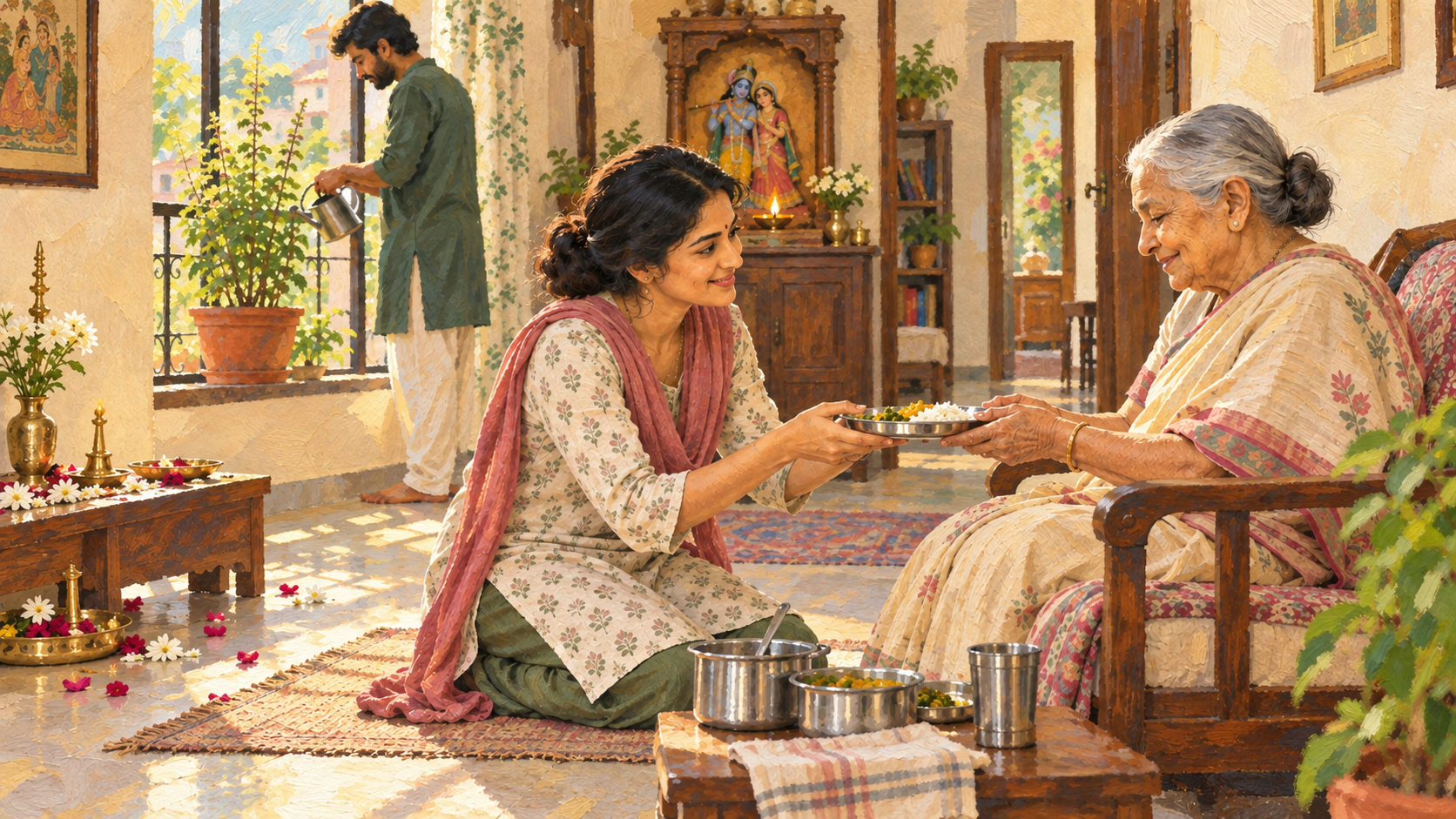
A ritual can be complete as a ceremony yet unfinished as spiritual formation. The practical test comes after the lamps, flowers, music, and festival greetings: has remembrance changed the way you treat another person or perform a duty?
Choose one translation from worship into daily life:
- If you contemplated devotion without demand, perform a necessary task without announcing that you did it.
- If your prayers revealed how often you approach Krishna only with requests, begin the next prayer with gratitude and the question, How can I serve?
- If kirtan softened your speech, pause before using words intended to embarrass or wound someone.
- If the festival showed that your seva appears only on special days, establish a small recurring responsibility you can fulfil reliably.
- If you noticed that display was competing with attention, simplify the next observance and reserve more of it for hearing and quiet remembrance.
Several habits can weaken the day. Do not reduce Radha-Krishna devotion to ordinary romance, collect unfamiliar rituals merely for novelty, measure bhakti by public display, or treat bodily strain as proof of spiritual worth. Each mistake moves attention from loving service back to the performing self.
The following morning, ask whether you can name one ordinary choice that the observance changed. If you cannot, do not respond by adding more ceremony next time. Give more space to attentive hearing, honest self-examination, and service.
Key takeaways for a sincere Radhashtami
- Radhashtami celebrates the divine appearance of Srimati Radharani, beloved of Sri Krishna and embodiment of divine love and devotion.
- The Radha-Krishna relationship should be approached through the sacred language of bhakti, not reduced to ordinary romantic categories.
- A workable home observance can centre on preparation, prayer, an appropriate offering, trusted narration, established chanting, and concrete seva.
- Lineage-specific prayers, vows, food customs, and fasting rules should be learned from the tradition that carries them.
- The festival bears fruit when remembrance changes your speech, motives, responsibilities, or service after the celebration ends.
Before Radhashtami, make four decisions: whom you will ask about the proper custom, what trusted narration you will hear, what simple offering you will prepare if it belongs to your practice, and what act of seva will follow. Then you can meet the day without chasing novelty and give Srimati Radharani what elaborate arrangements cannot replace: undivided devotional attention.
References

Leave a Reply
You must be logged in to post a comment.