
If you have opened the Vrindavan glorifications because you love Srimati Radharani but aren’t sure how to receive them, don’t reduce them to devotional background noise. Listen for the quality of bhakti being placed before you, and then carry one part of that teaching into your own conduct.
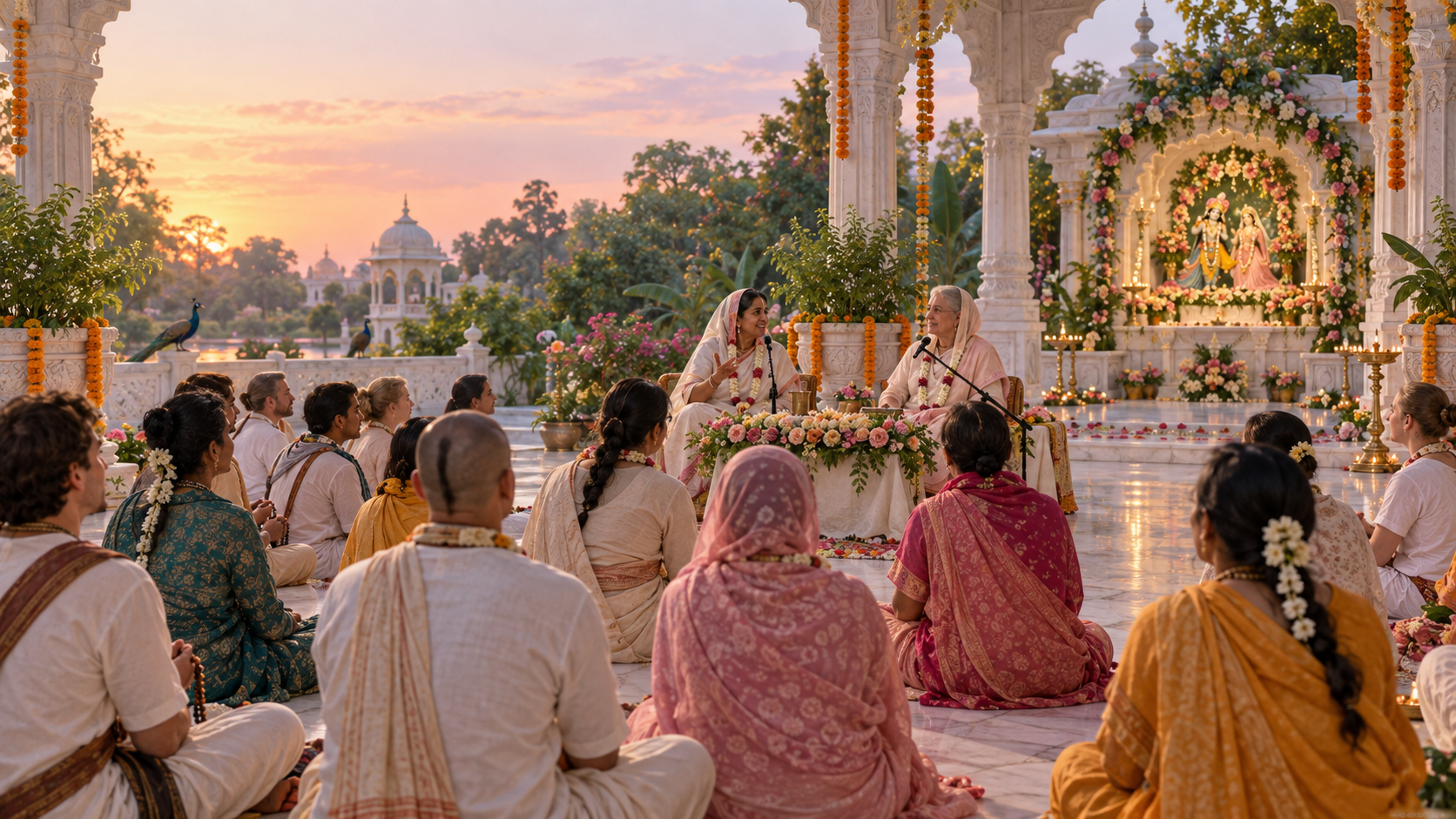
On 19 September 2026, Narayani Mataji and Daivi Shakti Mataji each offered glorification of Srimati Radharani during the Kirtan Utsav at Sri Sri Krishna Balaram Mandir, ISKCON Vrindavan. Two devotional voices, heard with one clear intention, can help you move from admiration of Radharani toward the service-mindedness her name calls forth.
Why glorification of Radharani is spiritual practice

Within Gaudiya Vaishnavism, Krishna is not approached as an isolated philosophical absolute. Divine life is relational, and Srimati Radharani is revered as the fullest embodiment of loving devotion to Krishna. Glorifying her therefore means contemplating what completely Krishna-centred love looks like.
This is more demanding than collecting beautiful descriptions. Praise becomes spiritually useful when it reveals the distance between pure devotion and our own mixed motives. We may serve while wanting recognition, chant while mentally negotiating with Krishna, or speak reverently while protecting our convenience. Radharani’s example turns the question around: not “What am I receiving?” but “How can Krishna be served?”
That question is the practical centre of the glorification. You don’t have to manufacture an elevated mood or imitate the expressions of advanced devotees. You can begin by noticing where self-importance enters an ordinary act of seva, prayer, japa or human relationship. The next step is to remove one demand for recognition from that act.
What the Vrindavan setting asks you to notice

The setting is Sri Sri Krishna Balaram Mandir in Vrindavan, and the occasion is a Kirtan Utsav. That places spoken glorification within a devotional gathering centred on sacred sound. Kirtan, remembrance and hearing are not competing activities here. Each turns attention away from the isolated self and toward the Divine Couple.
Vrindavan also changes the moral weight of listening. The holy place shouldn’t become scenery, branding or a substitute for attention. Its significance asks for greater care: hear without treating the discourse as entertainment, resist the urge to consume one devotional clip after another, and give the teaching time to expose something in your own character.
If you are listening far from Vrindavan, distance doesn’t prevent meaningful participation. What matters is the posture you bring to the hearing. Make the space orderly, silence avoidable interruptions and decide beforehand that you will remain with one complete glorification. This small discipline protects the devotional encounter from the habits of ordinary online consumption.
How to turn the two glorifications into sadhana

Approach the two presentations separately before comparing them. Each devotee may direct your attention differently, and jumping repeatedly between them makes it harder to follow either devotional movement. Use the following method with the first session, put its teaching into practice, and then return to the second.
- Begin with one intention. Ask to understand one quality of Radharani’s devotion that you can remember in service. A single honest question is more useful than trying to capture everything.
- Listen without multitasking. Don’t place the glorification behind messages, chores or scrolling. When attention wanders, return to the speaker’s present point rather than restarting repeatedly.
- Keep three short notes. Write down the quality being praised, the part of your conduct that resists it, and one action through which you can practise it. This keeps note-taking subordinate to transformation.
- Distinguish teaching from your inference. If you are unsure whether a statement is established Gaudiya siddhanta, devotional metaphor or a speaker’s personal emphasis, mark the uncertainty. Ask a trusted teacher or consult an authoritative text rather than building a conclusion on a phrase you may have misunderstood.
- Choose an ordinary act of application. Take an unglamorous service without announcing it, keep a promise that inconveniences you, give another devotee credit, or protect a chosen period of japa from your phone. The action should address a real habit, not merely sound devotional.
- Revisit the lesson after acting. Before hearing the second glorification, ask what changed when you tried to serve without claiming the centre. Then listen for a quality that confirms, deepens or corrects your first understanding.
A simple three-column page headed “Quality,” “My resistance” and “My next service” is enough. If the page fills with quotations but the third column remains empty, you are gathering material rather than allowing the glorification to guide you.
Three mistakes that weaken Radha-centred hearing
Mistaking strong emotion for completed transformation
Tears, tenderness and longing can belong naturally to devotional hearing, but an emotional response isn’t a certificate of spiritual attainment. Test the hearing where ego becomes visible: how you speak after disagreement, whether you resent unnoticed service, and whether remembrance continues when the atmosphere is no longer uplifting.
Imitating exalted devotion instead of following its direction
Radharani’s devotion is not a role to perform. Trying to reproduce elevated language or emotion can draw attention back to the very self that bhakti is meant to purify. Follow the direction of her devotion through humility, truthful conduct, attentive nama and dependable seva. Let genuine inner depth develop under proper guidance.
Treating glorification as personality-centred praise
A devotional speaker matters because she directs attention beyond herself. Receive Narayani Mataji and Daivi Shakti Mataji as two servants glorifying the same sacred personality, not as performers competing for your preference. Instead of asking which presentation was more impressive, ask what each helped you notice about service to Krishna.
Key takeaways
- In Gaudiya Vaishnavism, glorifying Srimati Radharani means contemplating the highest expression of Krishna-centred devotion.
- The Kirtan Utsav setting joins sacred sound, remembrance and hearing rather than treating the glorification as an isolated performance.
- Listen to each presentation completely and separately before looking for shared or contrasting emphases.
- Record one praised quality, one form of resistance in yourself and one concrete act of seva.
- Don’t mistake devotional emotion for attainment or imitate expressions that belong to an advanced spiritual state.
- Measure the value of your hearing by its effect on attention, humility and service after the recording ends.
Carry one instruction beyond the festival
Choose one of the two glorifications and give it your undivided attention. Name one quality of Radharani’s devotion, identify the self-centred habit that opposes it, and practise its opposite in your next genuine opportunity to serve. Then hear the second presentation with the same discipline. That is how a Vrindavan observance can continue beyond its date and location: not as content you finished, but as devotion you have begun to obey.
References
- Dandavats — Glorification of Srimati Radharani (Her Grace Narayani Mataji), 19 September 2026
- Dandavats — Glorification of Srimati Radharani (Her Grace Daivi Shakti Mataji), 19 September 2026

Leave a Reply
You must be logged in to post a comment.