
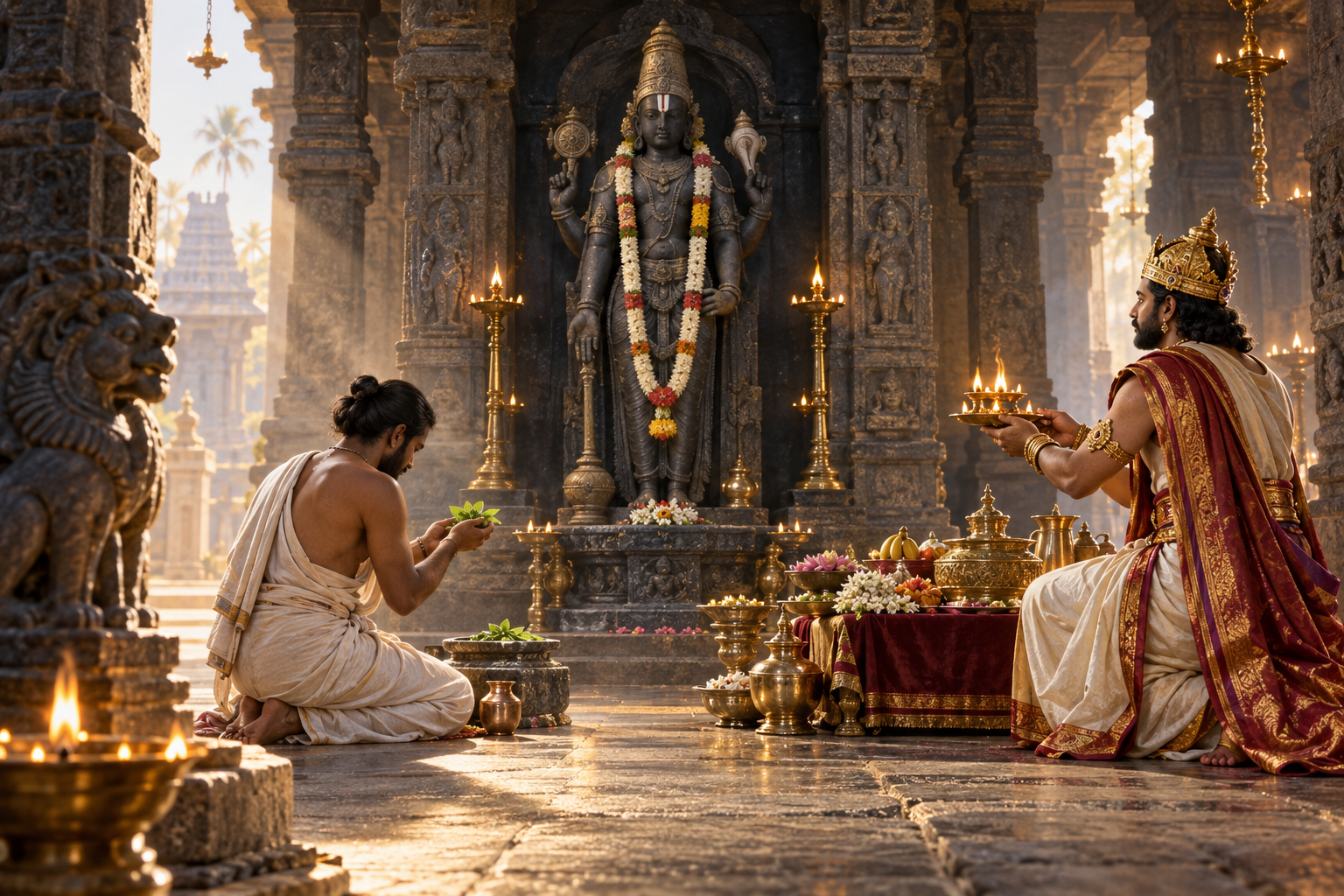
You may want to worship Bhagavan sincerely yet feel that what you can offer is too small. Perhaps you lack a dedicated shrine room, costly materials, enough time for an elaborate observance, or the confidence to perform every step perfectly. When devotion is measured against someone else’s display, an ordinary home practice can begin to feel inadequate.
The story of Vishnudas and King Chola corrects that measure. It does not ask you to despise wealth or abandon ritual. It asks a more searching question: does the outer form serve your devotion, or has the outer form become the thing you want others to admire?
The comparison the story asks you to make
The traditional account, preserved in the Padma Purana, places a poor Brahmin named Vishnudas beside the wealthy King Chola. Both are ardent devotees of Bhagavan Vishnu, but their material capacities are radically unequal. The king can express devotion through costly ceremony and visible magnificence. Vishnudas cannot compete on those terms.
That inequality is the point. If expense were the measure of bhakti, the contest would be settled before either devotee began. The king would always possess the advantage, while poverty would become a spiritual disability. The story rejects that arithmetic. Wealth can enlarge an offering, but it cannot purchase the inward act that makes an offering devotional.
This does not make King Chola a villain. Both men are presented as devotees, so the lesson is subtler than rich ritual versus good simplicity. A magnificent ceremony can be sincere. A modest act can be distracted, careless, or proud. Neither cost nor austerity proves purity by itself.
When you assess your own practice, stop asking whether it looks impressive beside another person’s worship. Ask three better questions:
- Am I offering what is honestly available to me, without neglecting my duties?
- Does this form help me remember Bhagavan, or am I mainly managing appearances?
- Does the worship make my conduct more truthful, restrained, grateful, and compassionate?
Those questions can be answered whether you stand in a great temple or before a small home altar. They move the standard from comparison to sincerity.
Devotional simplicity is not spiritual carelessness
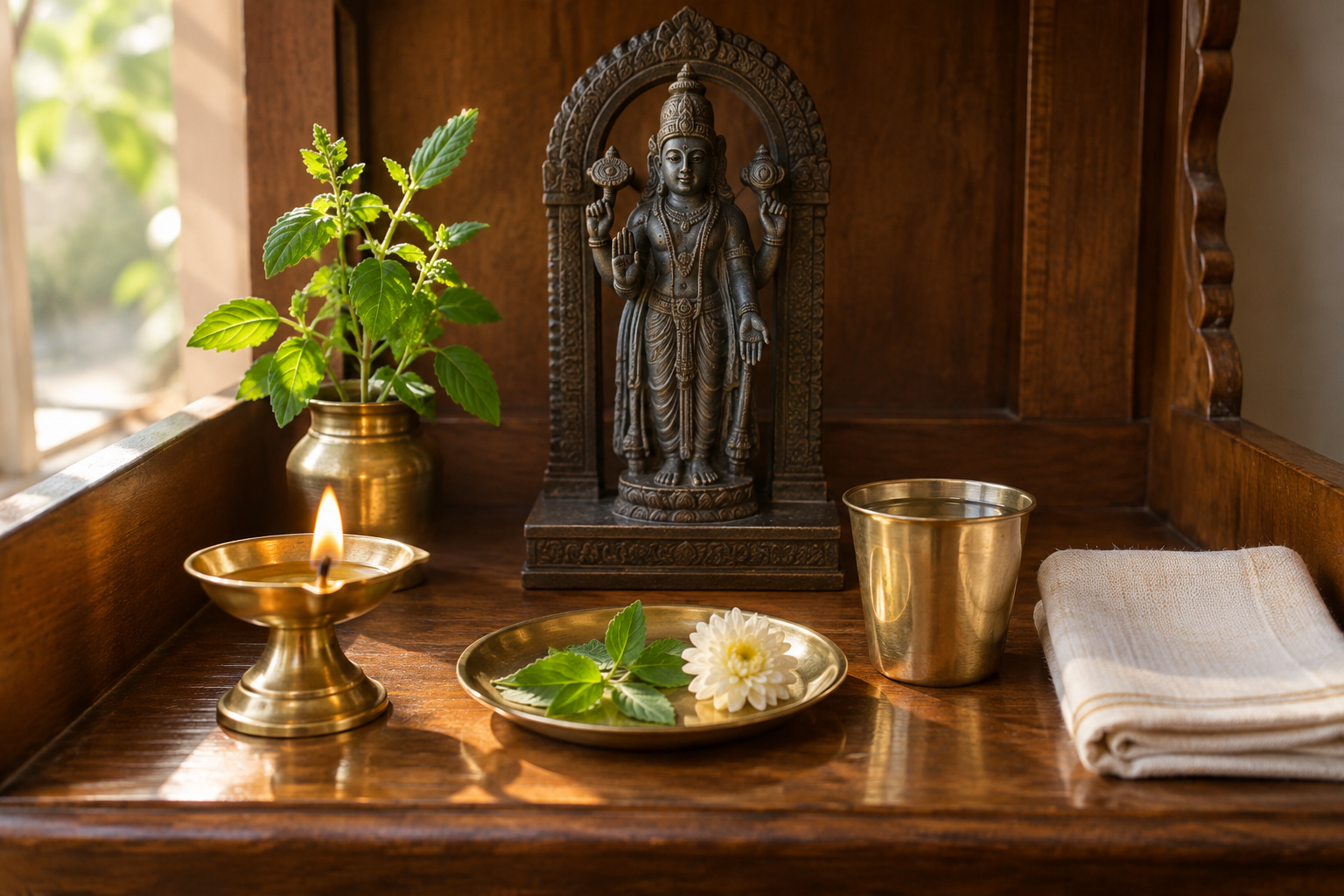
It is easy to misuse this teaching. If Bhagavan values the heart, someone may reason, then preparation, cleanliness, regularity, and inherited forms do not matter. That conclusion confuses simplicity with indifference.
Simplicity means removing what is unnecessary so that attention can become whole. Carelessness means withholding effort even when effort is available. The difference is visible in your attitude. Carelessness asks how little you can get away with. Simplicity asks what you can offer completely.
A simple practice still deserves reverence. You prepare the place as well as your circumstances allow. You handle sacred objects respectfully. You learn the prayers or procedures you have chosen instead of rushing through unfamiliar words. You return regularly rather than waiting for a perfectly arranged day. None of this requires luxury, but all of it requires attention.
Traditional ritual forms also have a purpose. They give the body something disciplined to do, gather a wandering mind, preserve memory across generations, and prevent devotion from becoming whatever is most convenient in the moment. If your family or sampradaya has given you a form of worship, simplicity need not mean discarding it. It may mean performing a manageable portion faithfully, seeking guidance where necessary, and refusing to imitate a scale you cannot responsibly sustain.
There is also a hidden form of pride to avoid: feeling spiritually superior because your worship is austere. A person can become attached to being seen as simple just as easily as another becomes attached to grandeur. Vishnudas should turn your attention toward Bhagavan, not give you a new identity with which to judge other devotees.
Build a practice that survives ordinary days
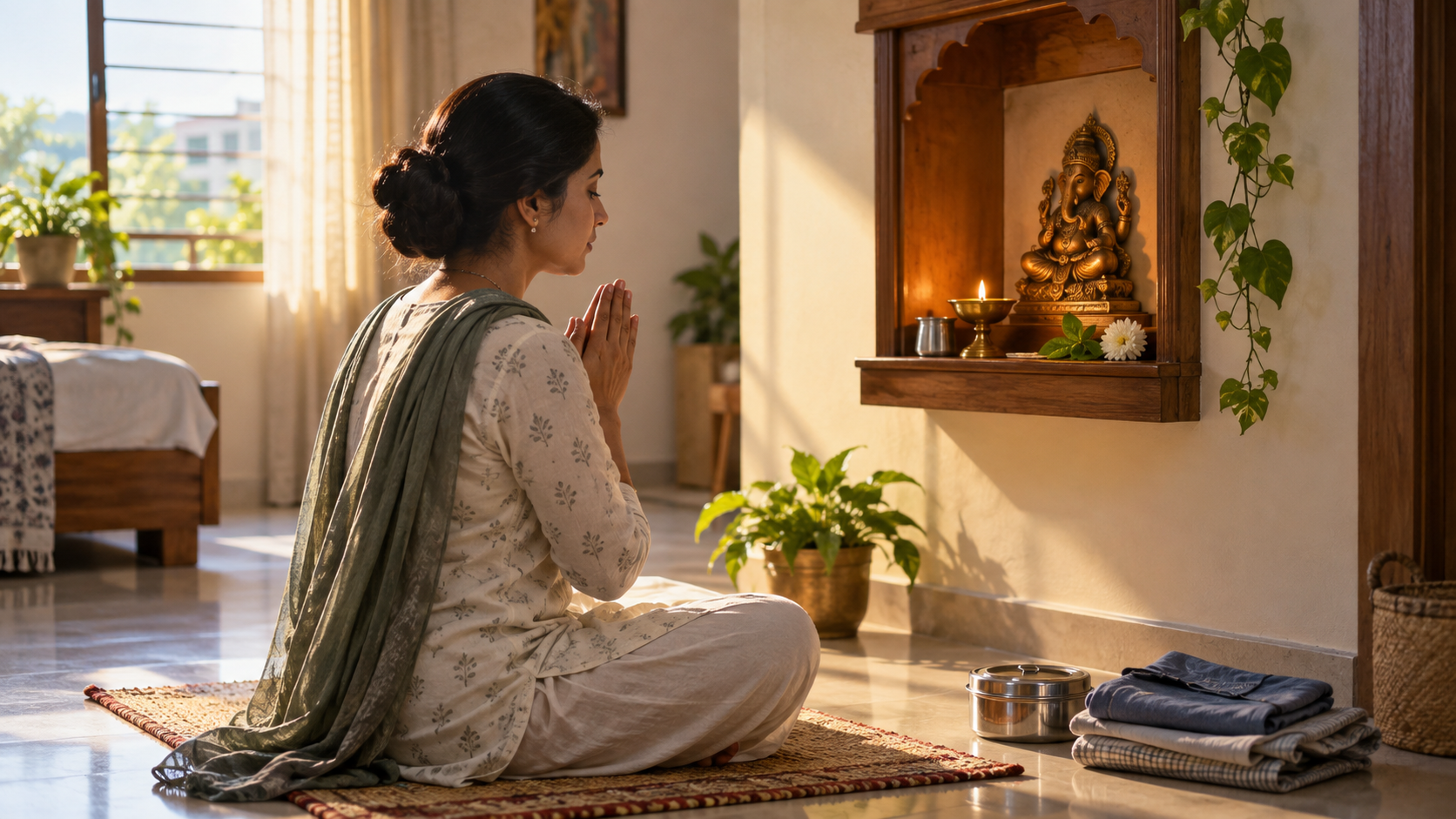
The practical test of devotional simplicity is not whether you can produce one emotionally intense moment. It is whether your worship remains possible on an ordinary day, within your real responsibilities and means. A small practice that you actually keep has more power to shape attention than an elaborate plan that repeatedly collapses.
You can build that practice in the following order:
- Choose a dependable anchor. Attach worship to an existing part of your day, such as the period after bathing or before the first meal. The anchor reduces the need to negotiate with yourself each time.
- Prepare a clean, limited space. Use the space you can maintain respectfully. A smaller altar kept with care is better than an ambitious arrangement that becomes a burden.
- Select one central devotional act. This might be pranama, remembrance of a familiar divine name, a prayer you understand, or a short passage from a sacred text. Give that act your attention instead of collecting more practices than you can hold.
- Offer what is reasonably available. A flower, water, food, time, or quiet attention can be offered without turning worship into a display of purchasing power. Follow the requirements of your own tradition where they apply.
- Carry the worship into one duty. After you rise, identify the conduct through which devotion will continue: patient speech, honest work, restraint in anger, care for family, service, or generosity within your means.
On a crowded day, shorten the practice without making it casual. On a festival or a day of greater capacity, expand it without making grandeur the new minimum. This protects continuity while allowing celebration.
If you miss the practice, resume at the next appropriate opportunity. Do not compensate by designing an even more demanding routine. Guilt often creates complexity, complexity produces another failure, and the cycle pushes worship farther away. The better correction is a sincere return.
When elaborate worship belongs in a Dharmic life
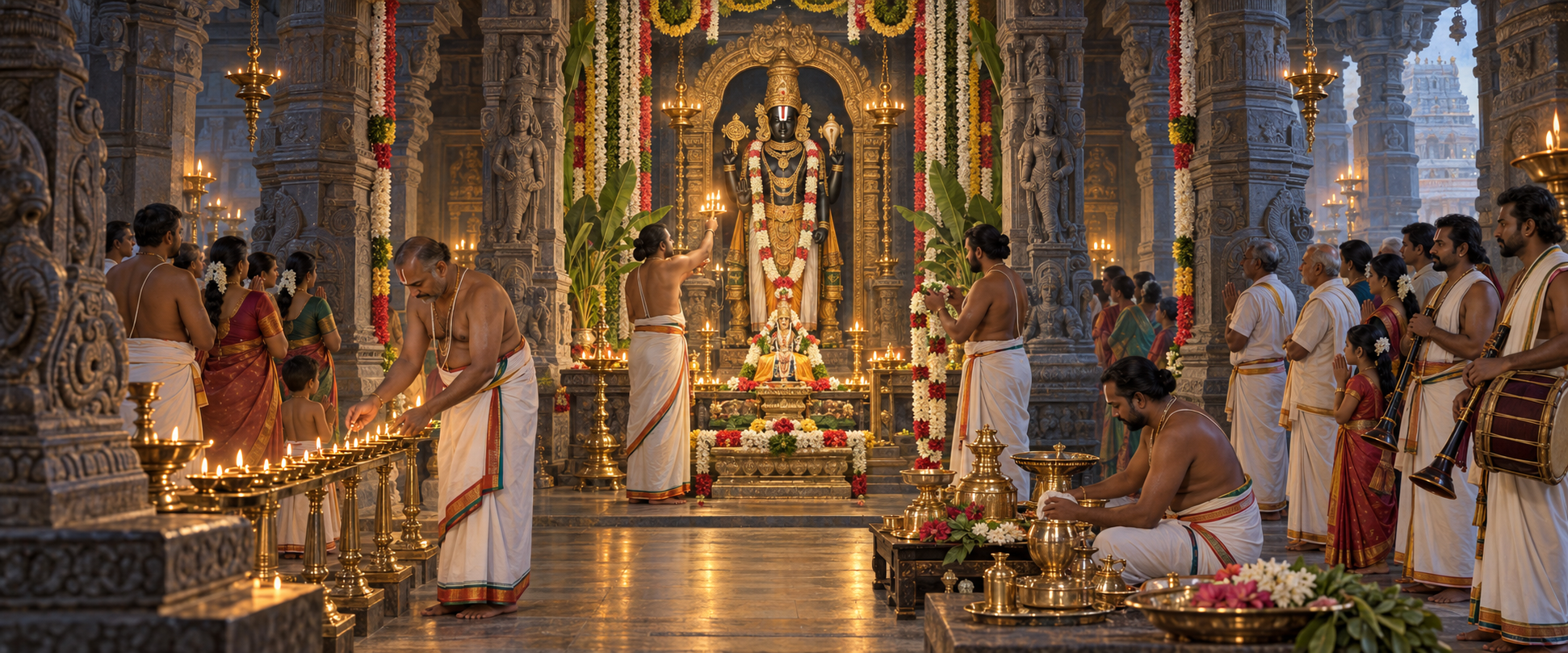
The lesson of Vishnudas is not an argument against temple splendor, festival processions, skilled ritual, beautiful music, generous hospitality, or substantial offerings. Shared ceremony can unite a community, transmit tradition, support temples and those who serve them, and give collective expression to gratitude. Beauty offered to Bhagavan need not be vanity.
The decisive issue is whether scale remains a servant of devotion. Trouble begins when ceremony becomes a contest for status, when a family spends beyond its means to satisfy social expectations, or when the treatment of people involved in the event contradicts the sanctity being displayed.
Before committing to an elaborate observance, use this practical check:
- Purpose: Can you explain the devotional purpose without mentioning prestige, comparison, or what guests will think?
- Means: Can you meet the expense without debt, neglected household duties, or pressure on relatives to contribute?
- Conduct: Will priests, artisans, workers, guests, and family members be treated with dignity throughout the preparation?
- Attention: Will the arrangements leave room for prayer and remembrance, or will logistics consume the entire occasion?
- Continuity: Will some private practice remain after the public event has ended?
- Witness: Would the offering still feel worthwhile if no photograph, praise, or public recognition followed?
If the expense would create financial strain or displace a genuine duty, reduce the scale. Bhagavan does not need you to injure your household in order to prove devotion. If the means are available and the answers remain sound, magnificence can be offered without contradicting the lesson of simplicity.
The same standard applies to modest worship. Do not compare the price of offerings; examine the direction of desire. Wealth is not spiritual guilt, and poverty is not automatic purity. Each devotee has to decide whether available resources are being offered as seva or used to manufacture religious importance.
Key takeaways
- Vishnudas and King Chola represent unequal material capacity, not a simple division between a good poor man and an evil rich man.
- Cost can change the scale of worship, but it cannot establish the sincerity of bhakti.
- Simple worship should still be clean, attentive, disciplined, and consistent with the requirements of your tradition.
- Elaborate ritual is appropriate when it serves devotion, community, and dharmic duty without creating debt, rivalry, or neglect.
- The clearest test comes after worship: sincere remembrance should begin to govern speech, work, restraint, generosity, and service.
At your next time of worship, remove one element that exists mainly for comparison and strengthen one element that directs your attention toward Bhagavan. Then offer what you can with care. You do not need to imitate King Chola’s resources to follow Vishnudas into the heart of bhakti.
References

Leave a Reply
You must be logged in to post a comment.