
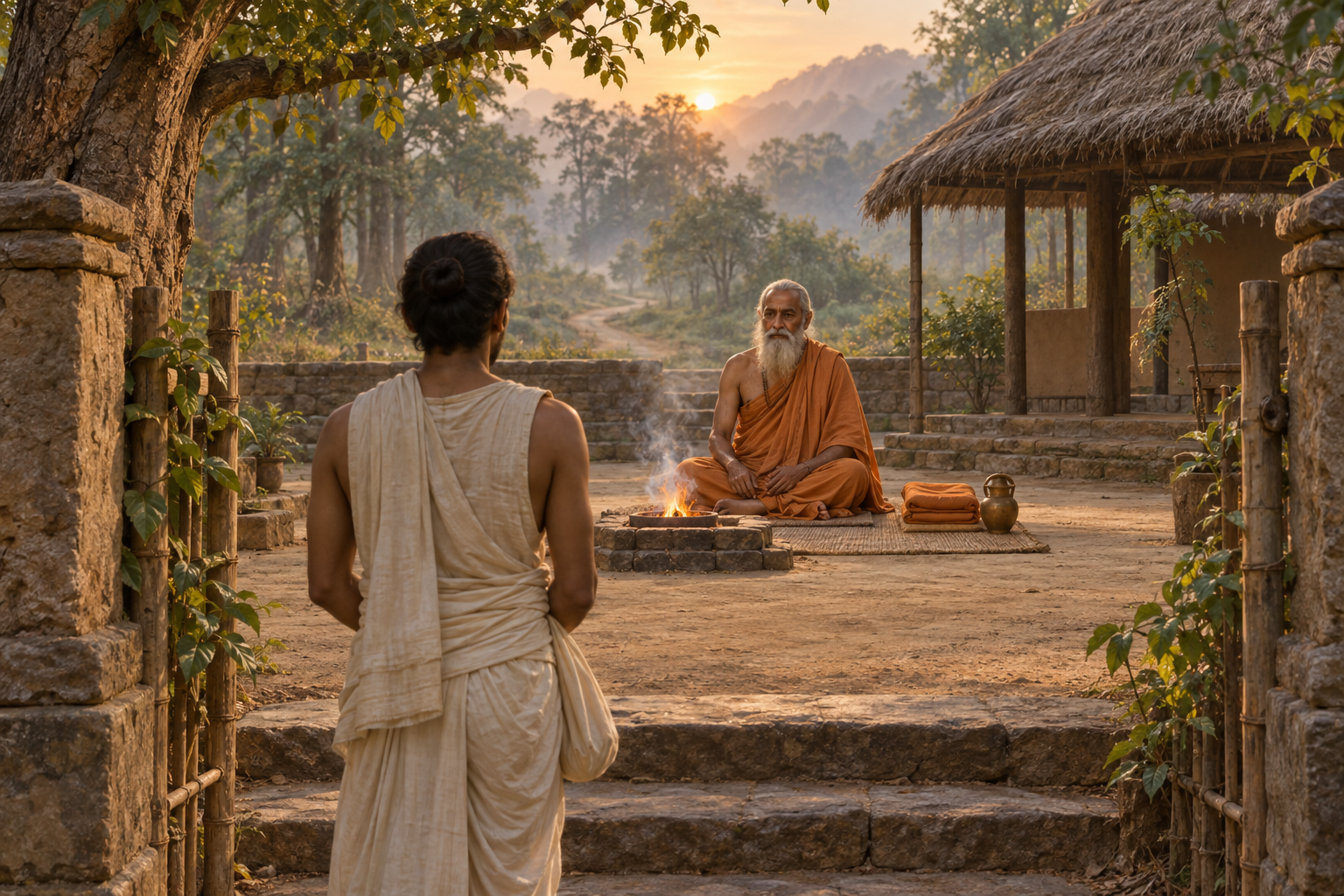
If you have encountered the word paryankashaucha while reading about sannyasa, the immediate difficulty is knowing how much the term covers. Is it an act of physical cleansing, a preparatory observance, or another name for the initiation itself?
The safest answer is precise: paryankashaucha is a sacred purification ceremony associated with initiation into sannyasa. It belongs to the passage from worldly life to formal renunciation, but it should not be treated as a complete description of sannyasa or as a stand-alone practice that can be reconstructed from its name.
Where paryankashaucha belongs in the renunciant journey
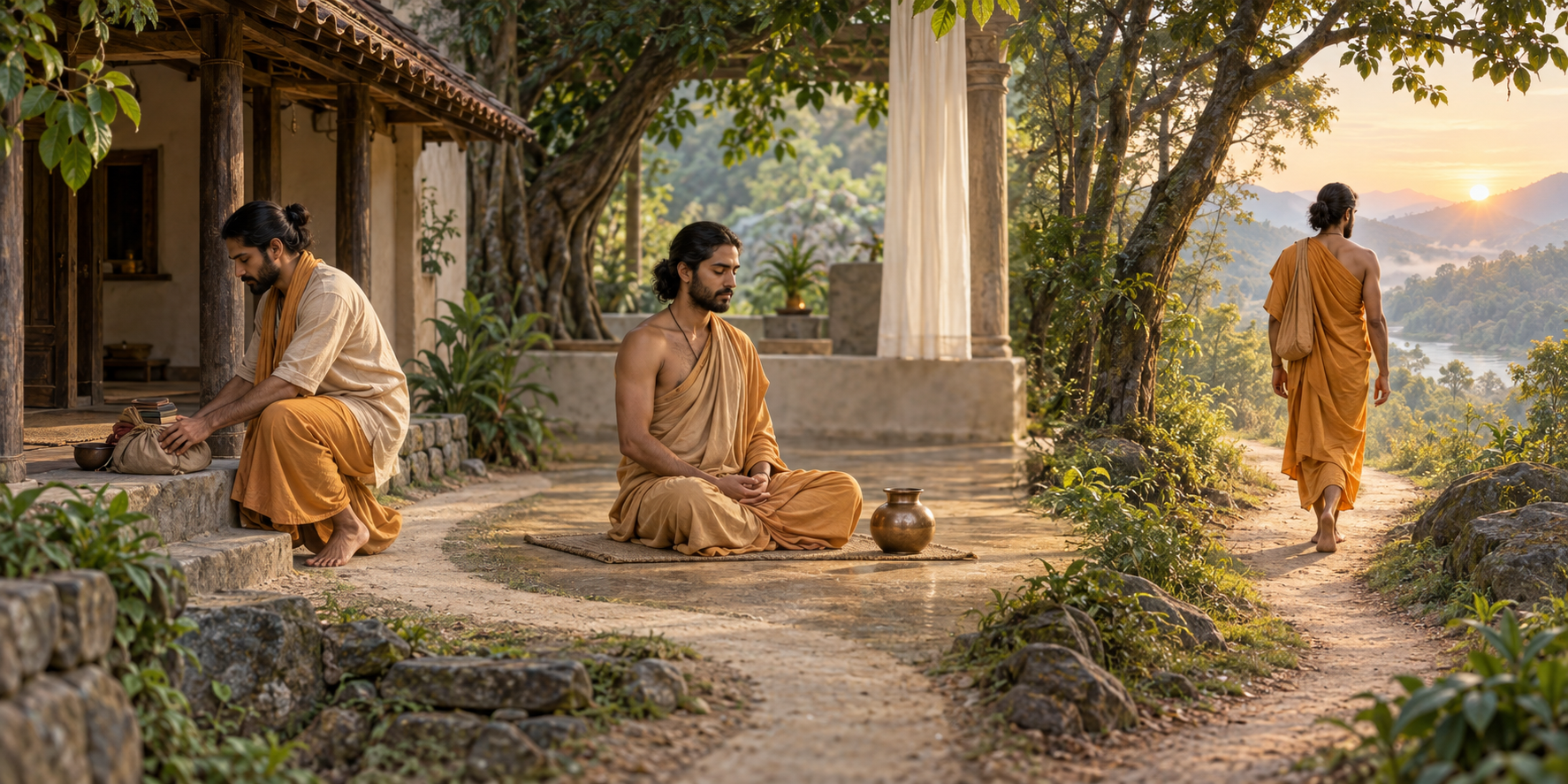
In the classical fourfold ashrama framework, human life is understood through brahmacharya, grihastha, vanaprastha, and sannyasa. Sannyasa occupies the fourth and final place. Its defining orientation is complete spiritual renunciation rather than the continuation of ordinary household aims under a new appearance.
Paryankashaucha belongs at this threshold. That placement matters because a threshold rite gets its meaning from the change it marks. Removing it from sannyasa initiation and treating it as an isolated purification exercise strips away the very context that makes it intelligible.
You should therefore distinguish three things when you meet the term:
- Sannyasa is the renunciant condition and way of life.
- Sannyasa initiation is the formal transition into that condition.
- Paryankashaucha is a particular purification ceremony situated within that initiatory transition.
This distinction prevents the most common conceptual error: mistaking one ritual component for the whole transformation. A ceremony can solemnize a decisive commitment, but the commitment must continue to govern the life that follows it.
Why “purification” means more than ordinary cleanliness
The Sanskrit idea of shaucha includes cleanliness and purity, but ritual purification cannot always be reduced to washing the body or cleaning an object. In an initiatory setting, purification helps articulate a change in religious condition. The candidate is approaching a life defined by renunciation, so the rite must be read in relation to that change.
This does not make the outward act unimportant. Hindu ritual does not require us to choose between a physical action and a spiritual meaning. A prescribed act can be concrete while also expressing a deeper reorientation. The mistake lies in keeping only one side: either treating the ceremony as mere hygiene or dissolving it into a vague metaphor.
When you interpret paryankashaucha, ask what is being purified for. The answer supplied by its setting is entry into sannyasa. That keeps your attention on the transition from worldly participation to renunciant discipline rather than on an isolated technique.
What the name does not tell you
A short definition establishes the place and purpose of paryankashaucha. It does not establish a universal sequence of gestures, mantras, materials, officiants, or timings. Those details require the instructions of the sampradaya in which the initiation is being conducted.
For that reason, do not turn a dictionary meaning or a brief online description into a ritual manual. Three conclusions are especially unsafe:
- Do not assume that every Hindu renunciant lineage uses the same terminology or performs every initiatory element identically.
- Do not assume that imitating an external action produces the religious transition signified by formal sannyasa initiation.
- Do not assume that learning the ceremonial sequence is equivalent to becoming qualified for renunciation.
The final point is crucial. Sannyasa concerns the direction of an entire life. Curiosity about its rites is legitimate, but ritual curiosity and readiness for renunciation are different questions. You can study the former without pretending to possess the latter.
How to approach the rite without flattening its tradition
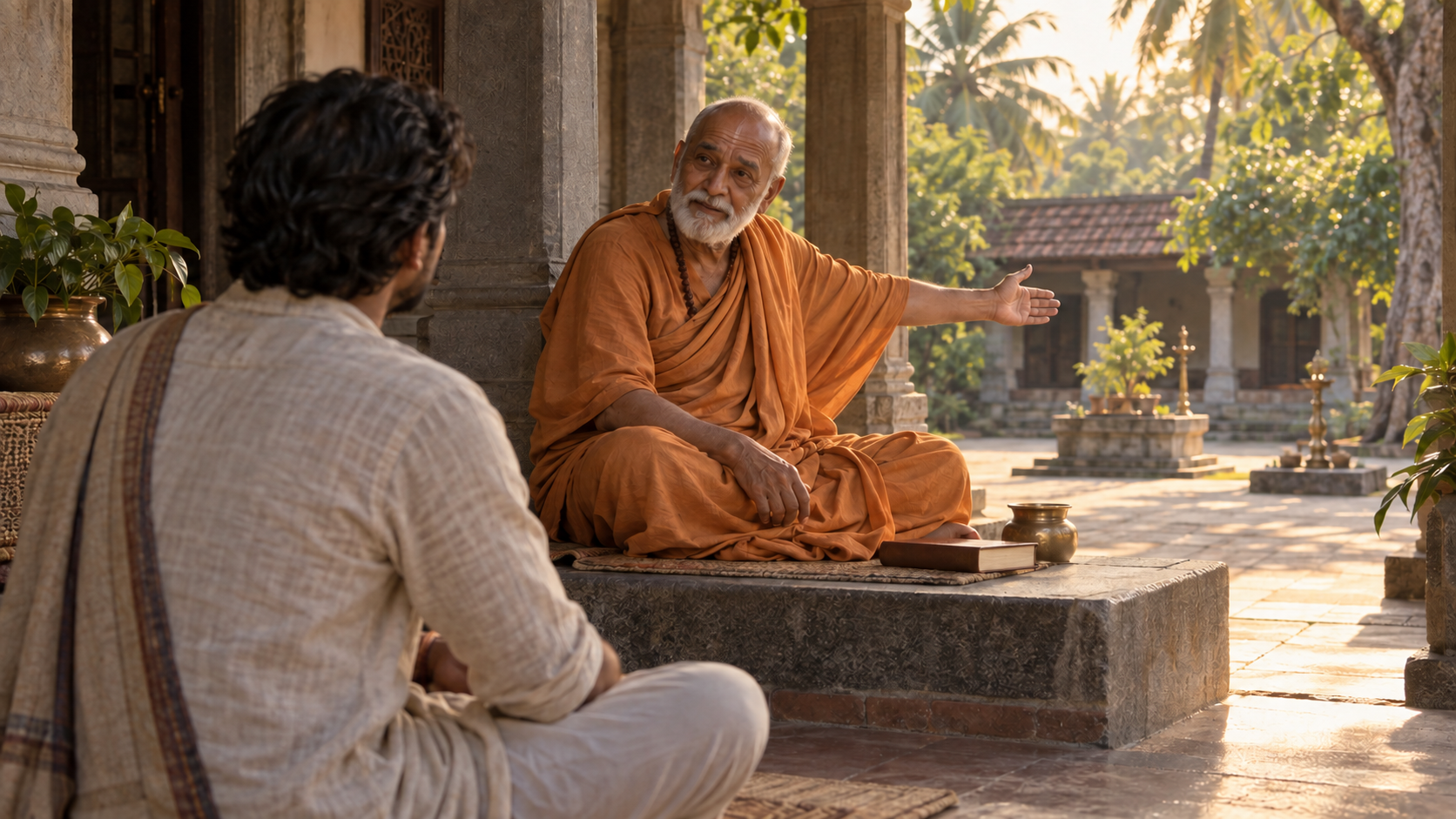
If you are preparing for an initiation, assisting at one, or documenting it, begin with lineage context. “What is paryankashaucha?” is only the first question. The practical questions below determine whether the answer applies to the ceremony before you.
- Identify the sampradaya. Record the tradition in which the term is being used. Do not silently combine instructions from unrelated lineages.
- Ask the initiating authority for the operative meaning. A guru, acharya, or authorized officiant can explain what the name denotes in that particular initiation and where it falls in the sequence.
- Clarify your role. A candidate, attendant, family member, observer, and researcher may each have different responsibilities and boundaries.
- Request practical instructions directly. If preparation is required, ask about dress, materials, timing, recitation, fasting, attendance, and who may handle ritual objects. Do not fill gaps by guesswork.
- Obtain permission before recording or publishing. A sacred initiation is not automatically a public demonstration. Photography, video, transcription, and circulation should follow the direction of those responsible for the rite.
- Preserve the distinction between description and prescription. A historical or explanatory account may help you understand the ceremony, but it does not authorize you to perform it.
If you are studying paryankashaucha academically or for general dharmic education, keep the original term in your notes. Add any English gloss after it rather than replacing it. Also record who used the term, in which lineage, and at what point in the initiation. Those details prevent a local usage from being presented as a rule for all Hindu traditions.
If you are contemplating sannyasa personally, the next step is not to assemble a ceremony from fragments. Speak with the spiritual authority under whom the renunciation would actually be undertaken. The rite derives its integrity from the initiatory tradition, while the life after the rite must bear out the renunciation it declares.
Key takeaways
- Paryankashaucha is a sacred purification ceremony connected with sannyasa initiation.
- It marks part of the passage from worldly life to formal spiritual renunciation; it is not a synonym for the whole of sannyasa.
- Purification in this setting should not be reduced either to ordinary hygiene or to an abstract symbol with no ritual form.
- The term alone does not provide a universal procedure. Lineage-specific instructions must come from the competent initiating authority.
- Study can clarify the rite, but reading about it does not confer initiation or authorize private imitation.
Your most useful next step is simple: identify the living tradition in which you encountered paryankashaucha, then ask its authorized teacher how the ceremony functions there. That one move will take you from a floating term to its proper dharmic setting.
References

Leave a Reply
You must be logged in to post a comment.