

If someone in your family, temple, or community invokes varna to decide who deserves respect, you do not have to choose between denying every social difference and defending a hierarchy fixed by birth. Begin with a more precise question: what is this label being used to decide?
The central distinction is simple. Duties and qualifications can differ; human dignity does not. Varna may help describe forms of responsibility, but it becomes spiritually corrupt when it is used as a verdict on a person’s inner worth, capacity for growth, or relationship with the Divine.
First, stop using varna, jati, and caste as synonyms

Many arguments become confused before they begin because three different ideas are collapsed into one word.
- Varna is the fourfold social classification found in classical Hindu thought: Brahmana, Kshatriya, Vaishya, and Shudra.
- Jati refers to the numerous inherited communities through which marriage, kinship, occupation, custom, and local identity have often been organized.
- Caste is a broad English term commonly used for varna, jati, hereditary status, or the entire social system. Its meaning changes with the speaker.
When someone says, “varna is necessary,” ask whether they mean that society needs different kinds of work, that a particular community should preserve its customs, or that ancestry should determine status. Those are separate claims. Agreement with the first does not automatically prove the second or third.
Then separate three levels that are often mixed together:
- Role: What work or responsibility is being performed?
- Rule: How should a community choose, train, and regulate the person performing it?
- Reality: What does the person’s identity or occupation say about spiritual worth?
A community may need rules for a role. It does not follow that the rule reveals the ultimate reality of the person. If a debate jumps from occupation to ancestry and then from ancestry to spiritual rank, stop the discussion at each jump. Ask for the missing reason.
Varna can describe function; it cannot measure the Self

The four varnas can be read as broad modes of contribution. Brahmana points toward learning, teaching, counsel, and sacred responsibility. Kshatriya points toward protection, governance, and the disciplined exercise of power. Vaishya points toward cultivation, production, exchange, and stewardship of resources. Shudra points toward skilled service, practical work, and implementation.
These are not modern job descriptions, personality tests, or complete biographies. One person may teach in one setting, protect others in another, manage resources elsewhere, and perform indispensable practical work every day. A framework that helps you notice duties can be useful. A framework that pretends to exhaust a human being has ceased to serve truth.
Hindu communities have not all interpreted the relationship between varna and birth in the same way. Readings based on qualities, conduct, and work exist alongside hereditary interpretations. That disagreement should be acknowledged rather than hidden. But even a hereditary account of social organization does not logically prove hereditary superiority of the soul. That is a different claim, and it requires a different argument.
Advaita Vedanta gives non-division its most uncompromising metaphysical expression. Other Hindu schools describe the relation among the individual self, the world, and the Divine differently, so spiritual unity should not be reduced to the vocabulary of one school. Yet the practical warning travels widely across Hindu thought: truth is obscured when division is treated as ultimate.
Unity does not mean sameness. A student and teacher have different responsibilities. A novice and an experienced ritual practitioner do not possess the same training. A judge, farmer, soldier, artisan, monk, and parent answer to different forms of duty. The mistake begins when a relevant difference in responsibility is converted into an irrelevant difference in human value.
Krishna exposes the weakness of birth-only logic
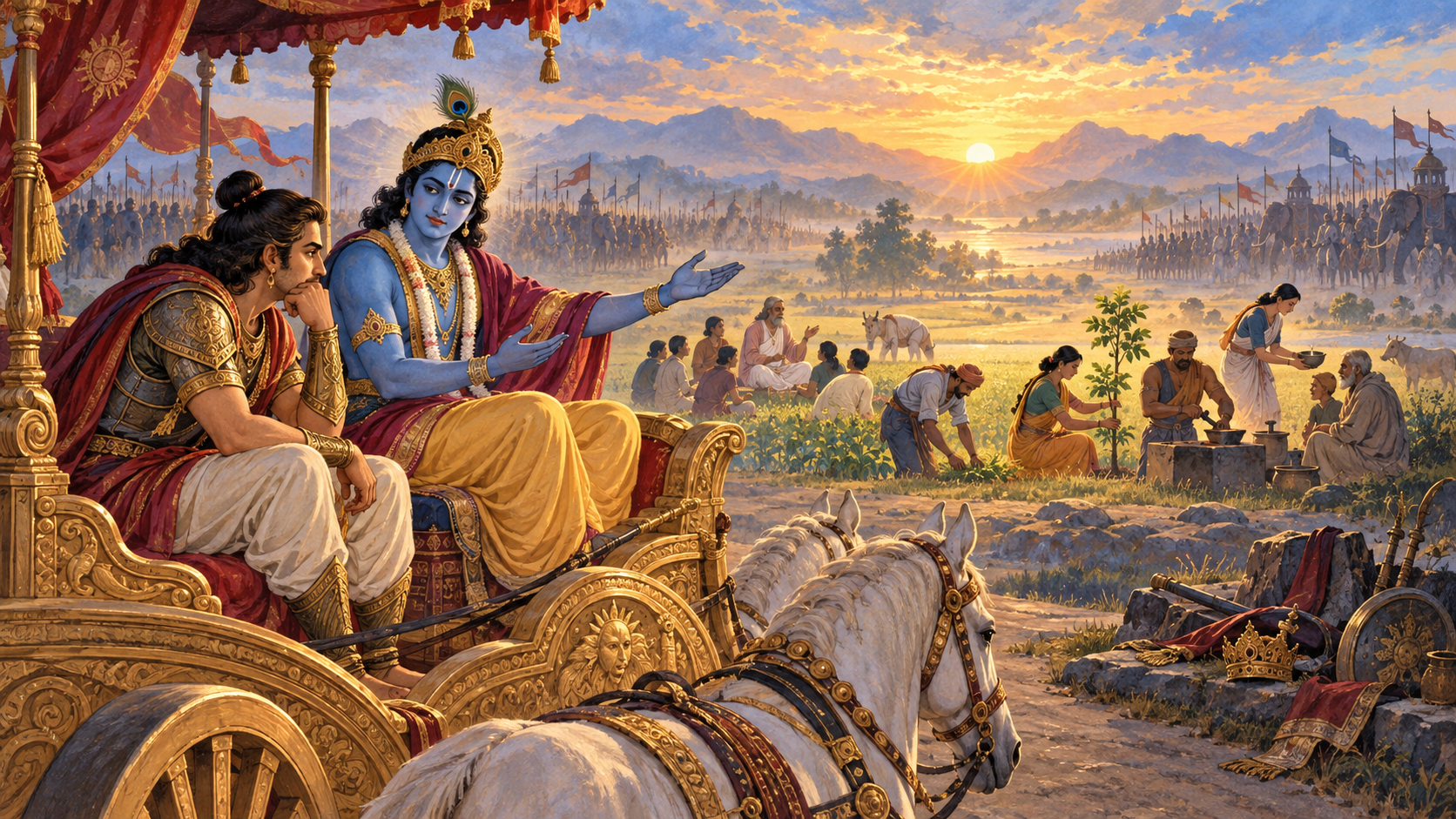
Krishna’s life resists a closed social box. He was born to Devaki and Vasudeva in the Yadava lineage, described in Kshatriya terms, yet he was raised in Nanda’s pastoral household among cowherds. The significance is not that one label must defeat another. It is that ancestry alone does not explain a life, a vocation, or a person’s capacity to serve Dharma.
This example does not settle every historical dispute about caste, nor does it prove that social identity never mattered. It does expose the weakness of a theory that treats inherited classification as a complete spiritual biography. If Krishna can be encountered through kinship, pastoral life, protection, counsel, friendship, leadership, and divine teaching, then a single inherited label plainly cannot tell us everything that matters.
Use that insight carefully. Do not turn Krishna into a convenient slogan for your preferred politics. Instead, let the example discipline the question you ask of any social rule: does this rule help people perform a real duty, or does it merely protect someone’s inherited prestige?
Put every social distinction through six tests

You do not need to resolve the whole history of varna before judging a particular claim. Write down the concrete consequence being proposed, then apply these tests.
- The function test: What necessary task does the distinction help perform? “This is our custom” describes continuity, but it does not yet explain the function.
- The relevance test: Is the stated qualification actually relevant to the task? Knowledge, discipline, training, vows, trust, and experience may be relevant. Social prestige by itself is not evidence of competence.
- The conduct test: Is the person being judged by demonstrated character and action, or is ancestry being used as a substitute for evidence?
- The accountability test: Are people of higher status held to stricter duties, or does rank merely provide privilege? A Dharmic office without corresponding restraint and responsibility is difficult to defend as Dharma.
- The development test: Where competence can be learned, is there a real path to instruction and responsible service? If no path exists, ask whether the barrier protects the integrity of the role or only the position of its present holders.
- The dignity test: Does the rule authorize humiliation, contempt, exploitation, or assumptions of spiritual inferiority? If it does, the rule has moved beyond division of responsibility into domination.
Some ritual traditions will answer the development test differently because they understand lineage, initiation, and transmission differently. That internal diversity is real. The stricter and more exclusionary a rule is, however, the greater the obligation to explain its specific Dharmic purpose. Birth should not be treated as a self-explanatory argument.
The same tests work in ordinary settings. In a family, describe a child’s qualities and responsibilities without making inherited status the ceiling of possibility. In a temple or community body, distinguish ritual qualification from basic welcome and respect. In professional life, do not dress nepotism or social exclusion in sacred language. In debate, ask what actual consequence the other person wants. People often agree about the need for duty while disagreeing sharply about inherited privilege.
Apply the tests inward as well. Varna becomes spiritually dangerous not only when it is used to push someone down, but also when it gives you an identity that seems to place you above examination. Ask whether the label makes you more responsible, disciplined, and useful. If it mainly makes you proud, defensive, or contemptuous, it is feeding ahamkara rather than Dharma.
Key takeaways
- Ask what decision a varna label is being used to make; never let the label stand in for an argument.
- Keep varna, jati, occupation, ritual qualification, and spiritual worth conceptually separate.
- Accept differences that are relevant to a real duty, supported by competence, and joined to accountability.
- Reject the leap from inherited identity to inherited moral or spiritual superiority.
- Judge a social arrangement by what it produces: responsible service and mutual dignity, or privilege and humiliation.
The next time varna enters a conversation, do not begin with a slogan for or against it. Name the proposed consequence, test its relationship to the duty, and examine what it does to the dignity of the person affected. Keep the discipline of differentiated service. Refuse the contempt of inherited superiority. That is where social responsibility and spiritual unity can meet in practice.
References
- Hindu Blog — One Life, Four Varnas: How Krishna Dismantled the Caste Illusion
- Hindu Blog — The Man Who Accepts Division, Will Never Find Truth — Hinduism Teaching

Leave a Reply
You must be logged in to post a comment.