

If you have stopped before an image of Vishwakarma and wondered why one divine craftsman needs five faces and ten hands, counting the features will not answer the real question. You need to know what the form asks you to notice about vision, skill, tools, and responsibility.
Read the image as a discipline of making. Its many faces widen perception; its many hands enlarge the field of action; and its implements place technical work inside a sacred and moral order. That reading can change how you approach a workshop, a design desk, a building site, a studio, or even a computer.
Begin with the whole form, not a catalogue of attributes
Viewers often begin by isolating details: count the faces, identify the objects, and search for a fixed meaning beside each one. Details matter, but starting there can reduce a cosmic form to an illustrated glossary.
Vishwakarma is Devashilpi, the master architect and craftsman of the devas. His significance therefore exceeds the care of tools or the protection of a particular occupation. He embodies creative intelligence acting through order, knowledge, material, and skilled work.
The word cosmic is important. It does not merely make Vishwakarma larger or more powerful than a human artisan. It places craftsmanship within the intelligible order of existence. A craftsperson does not create from nothing. The maker must understand purposes, relationships, materials, limits, and consequences, then bring them into a fitting arrangement. Sacred craft begins when that ordering work is treated as a responsibility rather than as mere production.
You can read the form in three passes:
- Look at the complete figure before naming individual attributes. Notice the impression of awareness and coordinated power.
- Turn to the repeated faculties: faces see, while hands act. Ask why ordinary human proportions are insufficient for what the image communicates.
- Only then consider the implements. Treat each one as a sign of trained action, not as an ornamental accessory.
This order of attention prevents a common mistake. Vishwakarma is not an ordinary worker supplied with supernatural equipment. The whole form expresses a creative principle; the individual features reveal dimensions of that principle.
The five faces call for a wider field of vision

A single human face looks in one direction at a time. A five-faced form breaks that limitation. It invites you to contemplate awareness that cannot be confined to one angle, one task, or one immediate result. For a maker, this is a demanding idea: excellent work requires more than concentrating on the object directly in front of you.
The scriptural horizon associated with the five-faced form includes the Taittiriya Shruti and the Pancha Brahma Upanishad. That context warns against treating the faces as decorative multiplication. They belong to a theological vision in which creative power, divine order, and the structure of reality are connected.
At the same time, you should be cautious with neat charts that assign an exact colour, direction, element, tool, or occupation to every face. Such correspondences may belong to a particular text, temple, region, or lineage. Do not present a lineage-specific interpretation as though it were the sole universal key. If you are learning within a sampradaya or hereditary craft community, follow its attested teaching and vocabulary.
You do not need an invented face-by-face code to apply the central lesson. Before beginning a substantial piece of work, examine it from five practical angles:
- Purpose: What should this work actually accomplish, and for whom?
- Relationship: What people, spaces, systems, or traditions will it affect?
- Material: What does the chosen medium permit, resist, or require?
- Consequence: What will happen after the object is delivered, installed, published, or used?
- Offering: What standard of care would make you willing to place your name, lineage, or devotion behind it?
These questions are a contemporary contemplative exercise, not a claim that tradition equates the five faces with this checklist. The distinction matters. A sacred image can guide present conduct without being forced to certify every modern framework we devise.
The ten hands join power to disciplined action
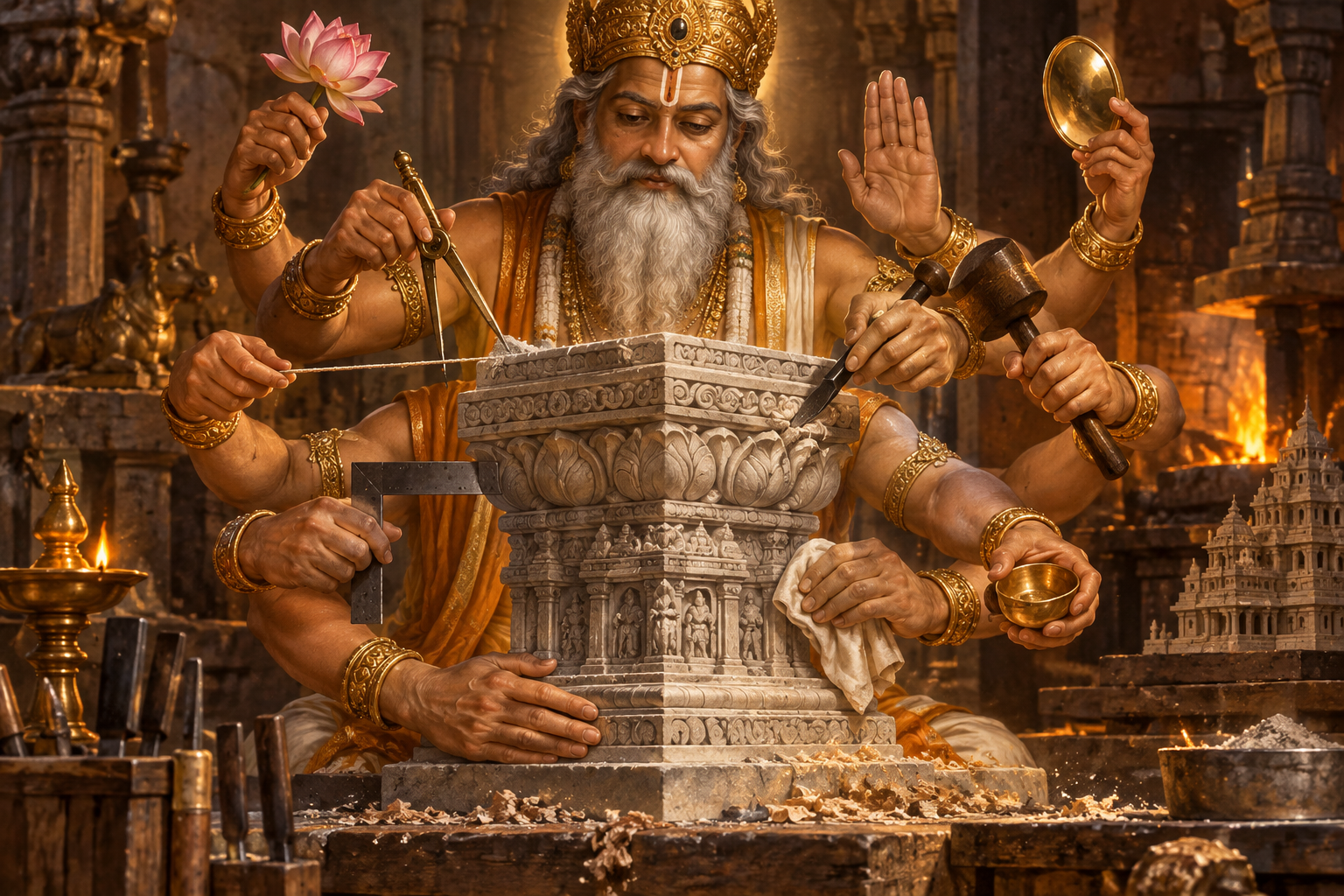
If the faces expand vision, the hands expand agency. The ten-handed form of Vishwakarma portrays a capacity for action beyond ordinary human limitation. Yet more hands do not mean frantic activity. In a coherent divine form, many actions remain coordinated by one intelligence.
That distinction is immediately useful. Busyness is not craftsmanship. A maker may perform many operations and still produce disorder. Sacred craftsmanship requires the right action, in the right sequence, with the right instrument, directed toward a fitting result.
Tools therefore deserve more than sentimental reverence. Every instrument extends your power while imposing its own discipline. It has a proper use, a range of capability, a condition that must be maintained, and a danger when handled carelessly. The principle applies to physical implements as well as digital ones. A drawing application, measuring device, machine, chisel, or compiler can amplify skill, but it can also amplify error.
Build a three-part tool discipline around your next task:
- Before the work: Inspect the instrument, confirm that you understand its use, and prepare the working area. Do not let devotion become an excuse for exceeding your competence, especially where electricity, structural loads, heat, machinery, or other hazards are involved.
- During the work: Let the material and the tool correct you. If either behaves differently from what you expected, pause and examine the cause instead of forcing the result.
- After the work: Verify the outcome, clean and store the instrument, record what another person will need to maintain the work, and leave the workspace in order.
This is one practical way to honour a deity associated with tools and workshops. Respect appears not only in a ritual gesture toward an implement, but also in refusing to misuse, neglect, or conceal defects in it.
Sacred craftsmanship joins technical skill to dharma
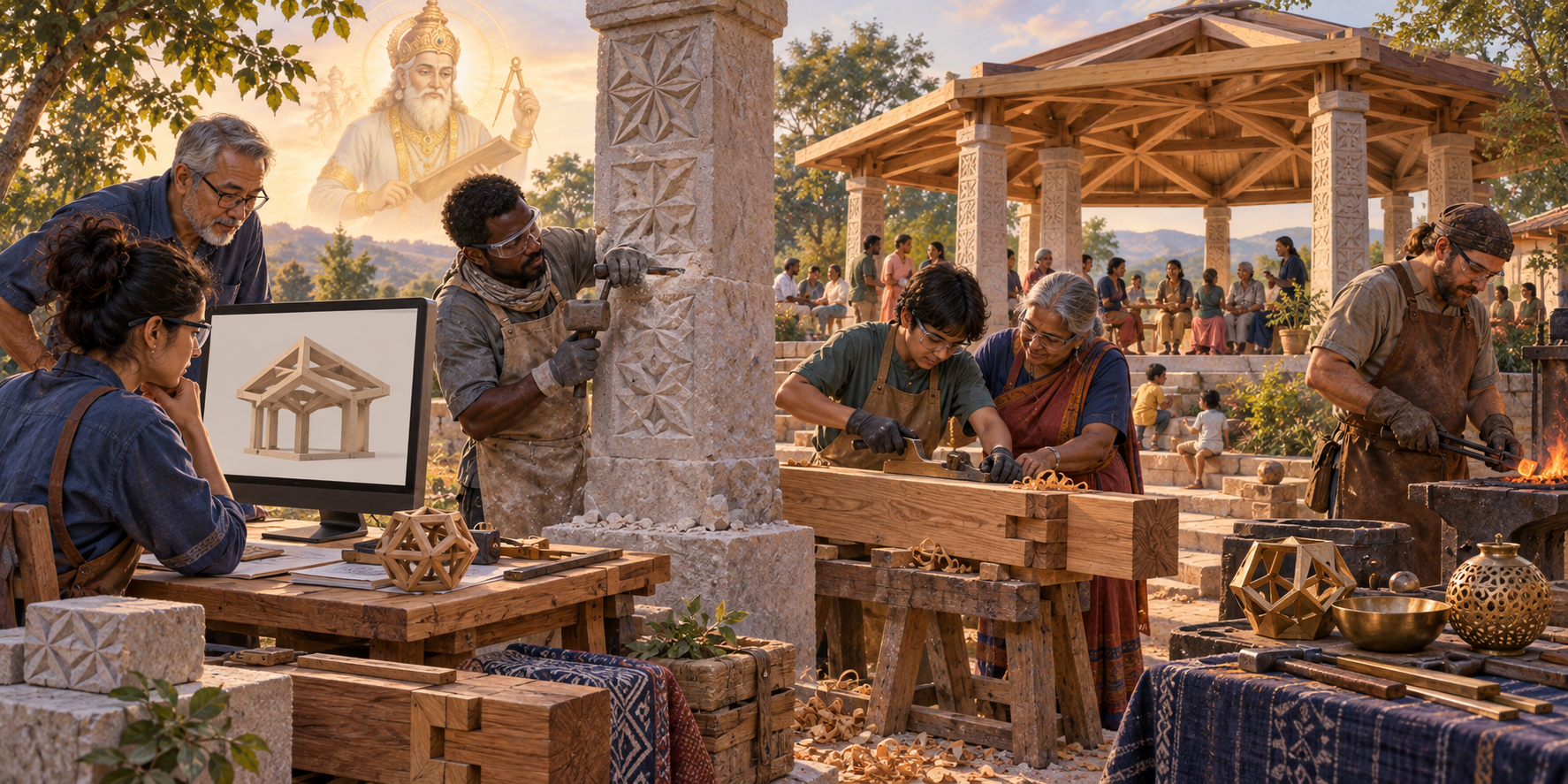
Calling craft sacred does not mean that every manufactured object becomes a ritual object. It means that making cannot be separated from the order it serves. Vishwakarma’s cosmic form resists the modern habit of treating technical competence and moral responsibility as unrelated concerns.
An object can be ingenious but harmful, attractive but unfit for use, efficient but dishonest, or traditional in appearance but careless in execution. None of those contradictions disappears merely because the maker invokes a sacred name. Devotion raises the standard of workmanship; it does not replace workmanship.
Test a project with four questions before you call it complete:
- Does it work? Verify function rather than relying on appearance or intention.
- Does it fit? Check whether the result suits its user, setting, material, and actual purpose.
- Was it made responsibly? Look for avoidable waste, concealed weakness, careless imitation, or harm transferred to someone else.
- Can it be cared for? A finished work should not leave its user unable to understand, maintain, repair, or safely retire it.
The last question is easy to neglect because delivery feels like the end of the maker’s task. In practice, the life of a crafted thing continues after it leaves the maker’s hands. Maintenance, repair, adaptation, and eventual replacement belong to the same chain of responsibility. A cosmic view notices that longer chain.
This also clarifies what it means to preserve a craft lineage. Preservation is not limited to copying an inherited surface pattern. It includes transmitting the discipline that made the pattern possible: patient observation, knowledge of materials, correct use of instruments, honest correction of mistakes, and accountability for the finished work. Without those habits, resemblance can survive while the craft itself weakens.
When you encounter a Vishwakarma image in a temple, home, workplace, or festival setting, resist two reductions. Do not treat him only as a professional mascot for certain occupations, and do not dissolve him into a vague metaphor for creativity. The first makes the cosmic form too small; the second removes its Dharmic and devotional depth. Approach him as Devashilpi: divine craftsmanship expressed through knowledge, order, instruments, and responsible action.
Key takeaways for your next act of making
- The five faces and ten hands should first be read as one cosmic form, not as disconnected pieces of iconographic trivia.
- The faces invite wider perception. Examine purpose, relationships, material limits, consequences, and the standard to which you will answer.
- The hands represent coordinated agency, not mere activity. Good craft depends on sequence, restraint, and command of instruments.
- A tool is worthy of reverence when it is understood, maintained, used competently, and never allowed to conceal careless work.
- Sacred craftsmanship unites function, fitness, responsibility, and care. Ritual respect cannot compensate for unsafe or dishonest execution.
Before your next act of making, pause before touching the tool. Name the purpose, inspect the instrument, consider who will live with the result, and decide what honest completion requires. Then work with full attention and leave both the object and the workspace in better order.
That is how the cosmic form becomes practical without being reduced to a productivity slogan. You allow Vishwakarma’s image to enlarge your vision, discipline your hands, and restore responsibility to the act of creation.
References

Leave a Reply
You must be logged in to post a comment.