
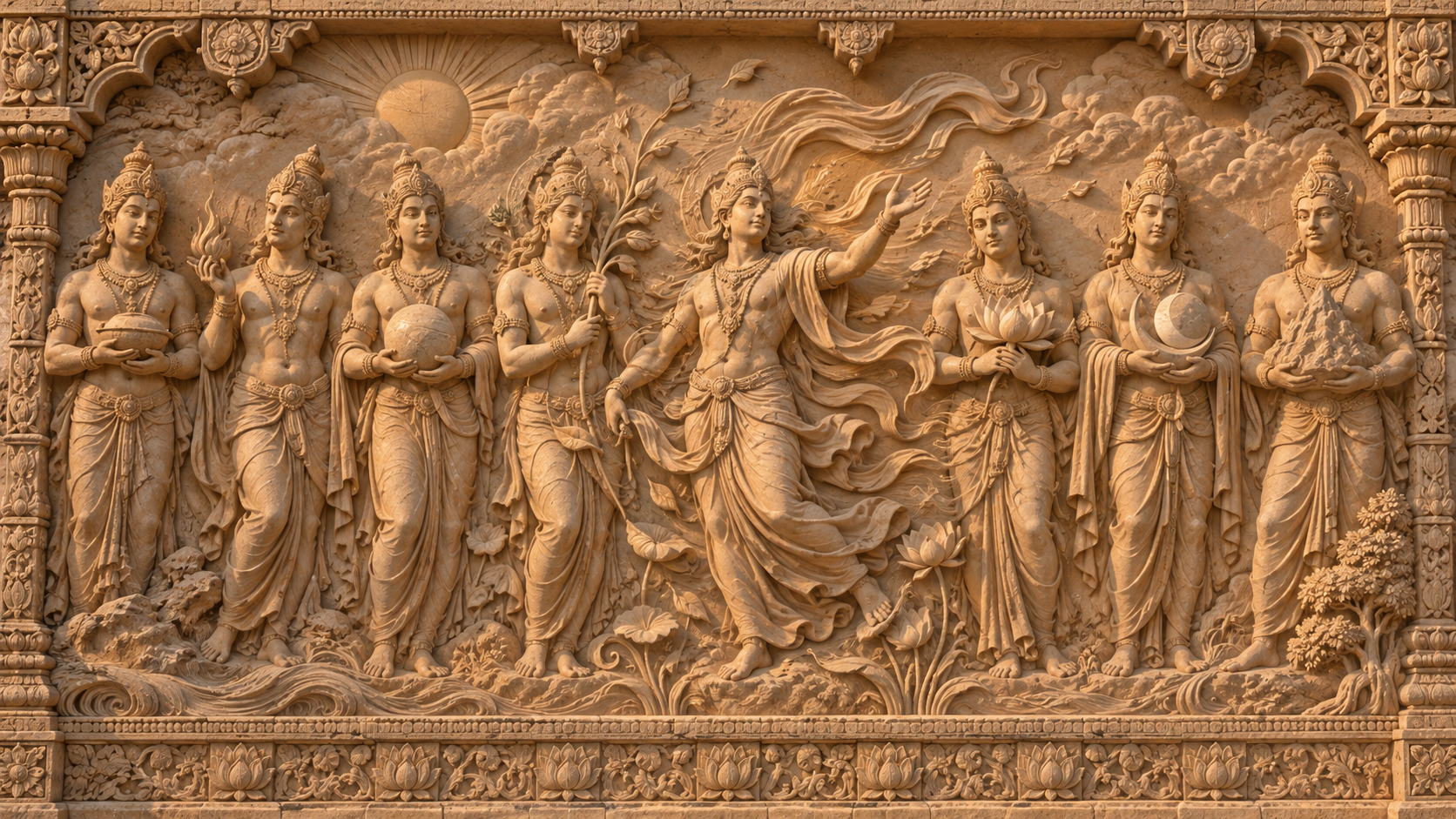
You are looking at a temple carving or museum image, and the figure is identified as Anila. The name tells you that wind is present, but it does not tell you how an invisible force can have a sacred form—or what you should actually look for.
The most reliable answer begins outside the figure itself. Read Anila through his place among the Ashtavasus, through the visual language of movement, and through the larger sculptural program. That approach helps you interpret the image without turning every flowing garment or dynamic pose into an unsupported identification.
Begin with Anila’s place among the Ashtavasus
Anila belongs to the Ashtavasus, the Eight Vasus associated with fundamental forces of the natural world. The group is named in the Rigveda and developed more fully within the wider Hindu cosmological tradition. This family identity is essential: Anila is not merely a poetic personification of a windy day. He gives divine intelligibility to an elemental power on which embodied life depends.
The word “elemental” can be misleading if you hear it as “simple” or “primitive.” Within a sacred cosmology, a natural force is not an isolated piece of matter. It participates in an ordered whole. Wind moves across boundaries, touches living beings without being grasped, and becomes perceptible through its effects. Anila therefore invites you to see motion, relation and dependence as parts of cosmic order.
This changes how you examine a sculpture. Before studying the face, pose or ornament, ask whether the figure belongs to an ensemble. Look at adjacent figures, repeated niches, matching proportions and the sequence of the larger panel. If several related beings share a common sculptural format, the group may carry more identifying weight than any single visual detail.
Do not treat the presence of eight figures as automatic proof that you have found the Ashtavasus. A count is a clue, not a conclusion. A label, inscription, documented temple program or reliable catalogue entry should take priority over visual resemblance alone.
How sacred art makes an invisible force visible
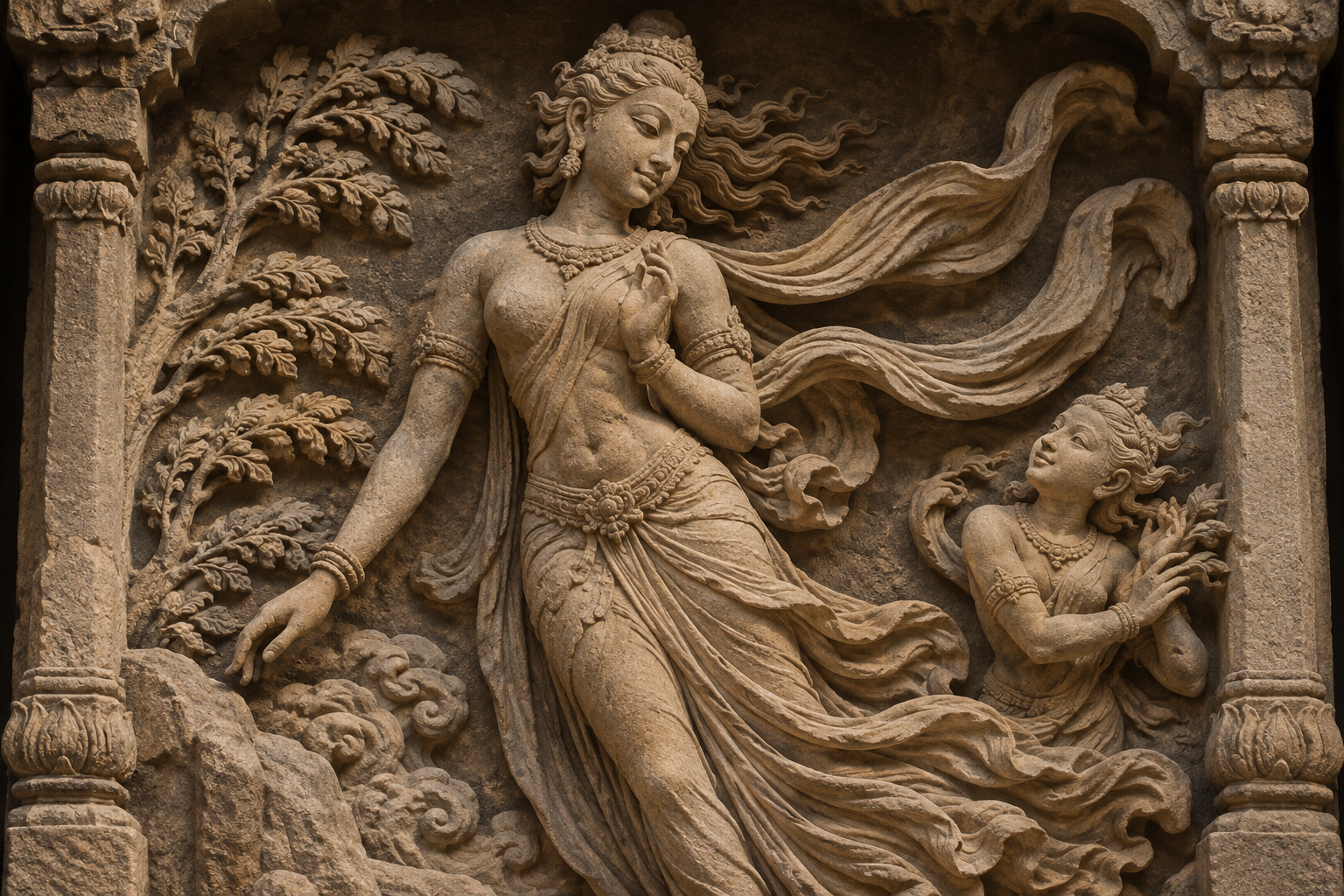
Stone cannot blow, and a painted surface cannot produce a current of air. Sacred art must therefore reveal wind indirectly. You know that wind is present because something responds to it: cloth lifts, hair streams, foliage bends, clouds gather or bodies adopt a sense of motion. These are ways an artist can make invisible movement legible.
When viewing an image associated with Anila, follow the direction of its lines. Notice whether the composition feels still, circular, rising or forcefully lateral. Examine the edges of garments and ornaments. Look at the space around the body rather than only at the body. Empty space may function as active space when the composition encourages your eye to move through it.
These features help you interpret a representation of wind, but they do not identify Anila by themselves. Flowing fabric may communicate dance, speed, divine energy or dramatic action in many sacred images. The sound method is to separate two questions: “What makes this figure Anila?” and “How does this image communicate the nature of wind?” Context answers the first; formal details help answer the second.
That distinction protects you from a common mistake in reading sacred art: searching for one supposedly universal attribute and ignoring the complete setting. Regional practice, period, material and the purpose of a sculptural program can all affect how a divine being is presented. An unfamiliar figure should be read patiently, not forced into the first category that seems plausible.
A practical method for examining an image of Anila
Establish the physical and ritual context
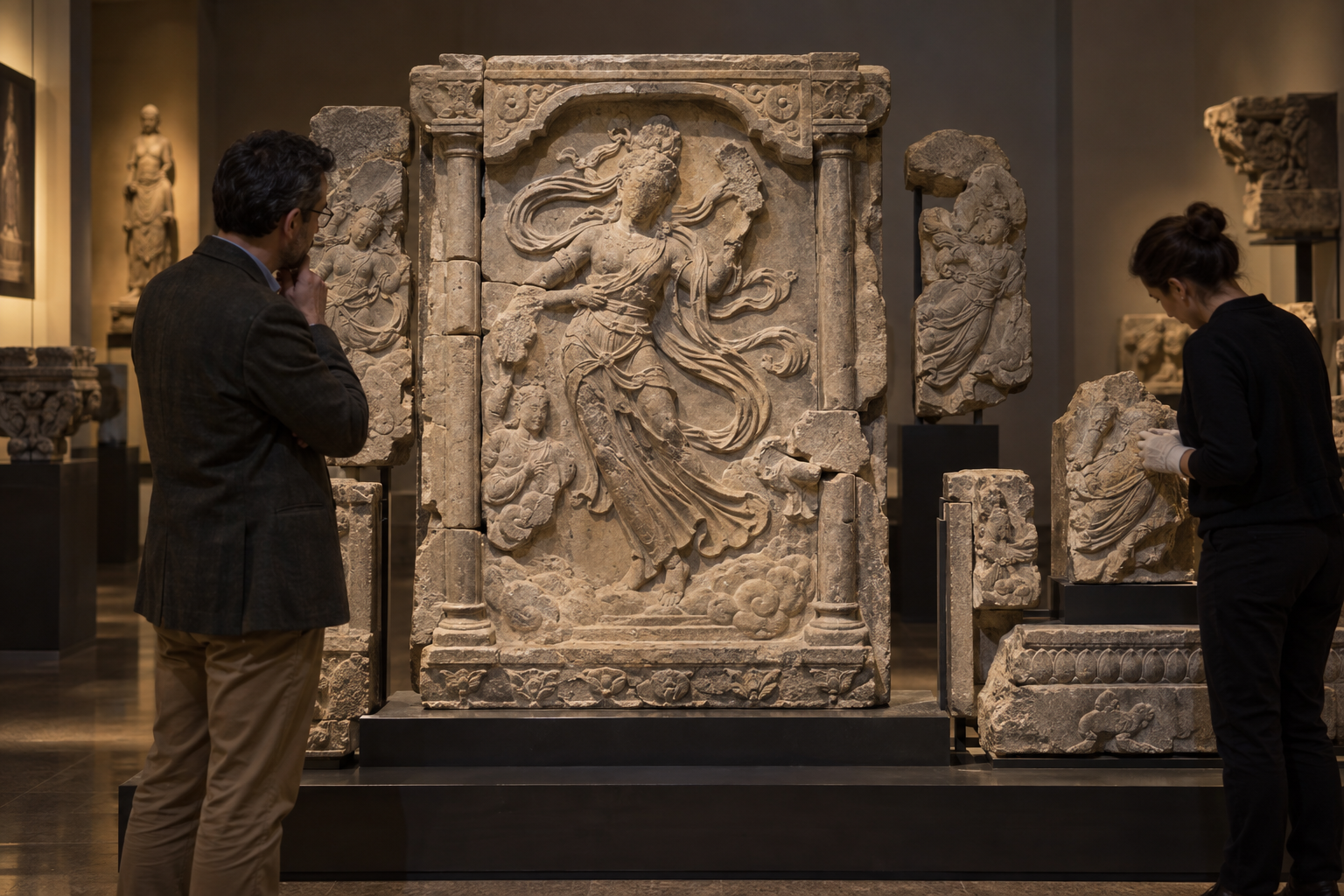
Start with location. Is the figure part of a freestanding image, a wall niche, a ceiling arrangement, a doorway, a narrative panel or a sequence of related deities? Its placement may tell you whether it is being presented for focused devotion, as a guardian presence or as one member of a cosmological order.
If photography is permitted, preserve the context before taking a close-up. Record the whole architectural surface, the complete panel, neighboring figures and any label or inscription. A tightly cropped photograph may preserve facial detail while removing the evidence needed for identification.
Separate observation from interpretation
Write down what is physically visible before deciding what it means. “The garment extends toward the right” is an observation. “The garment proves that the figure is the wind deity” is an interpretation—and probably an overconfident one without supporting context. This discipline is especially valuable when looking at weathered sculpture, where damaged attributes can tempt the eye to complete forms that are no longer present.
Then ask what the observed features accomplish. Does the carving make a solid body appear light? Does the composition connect Anila with surrounding figures? Does implied movement pass through the whole panel? Such questions uncover the artist’s visual reasoning without requiring you to invent a missing iconographic rule.
Confirm the identification before teaching or publishing it
If you plan to caption an image, teach from it or share it online, preserve the difference between a confirmed identity and a proposed reading. A temple record, inscription or well-documented catalogue can support a firm identification. A resemblance to wind-like motion supports interpretation, not certainty.
When confirmation is unavailable, use careful language: “a figure identified locally as Anila,” “possibly part of an Ashtavasu group,” or “a composition that evokes wind.” Honest qualification does not weaken the reading. It tells your reader exactly where evidence ends and interpretation begins.
What Anila adds to Hindu cosmological thought
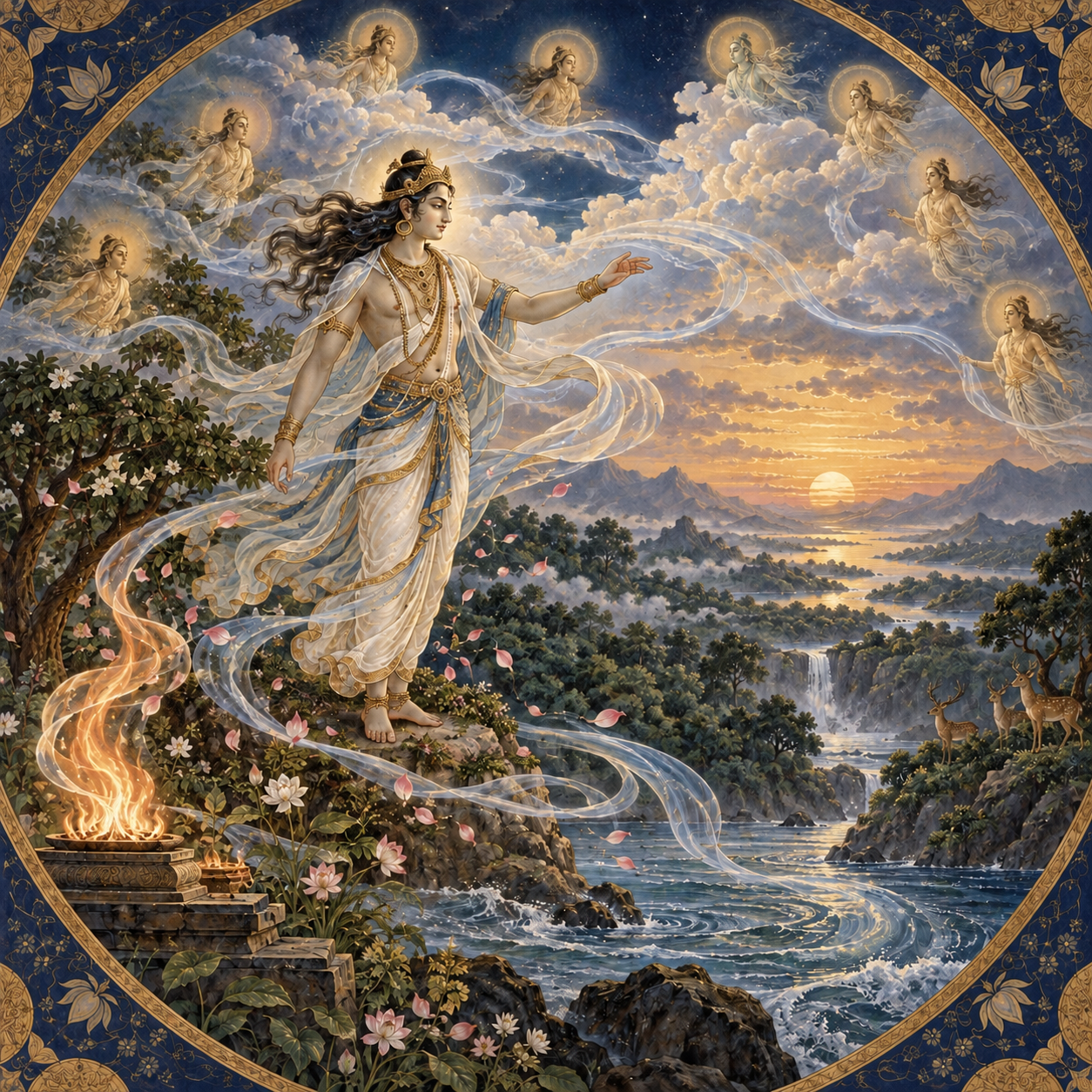
Anila presents a useful spiritual paradox: wind cannot be held, yet its effects are undeniable. You encounter it through contact and change. Leaves move. Skin cools. Breath enters and leaves the body. The invisible becomes knowable through relationship.
That is why a divine embodiment of wind can carry more meaning than a literal representation of weather. Anila directs attention toward the powers that sustain life without becoming possessions. You can receive air and respond to it, but you cannot keep it permanently. A sculpture gives this insight a form on which the mind can rest.
The Ashtavasu setting widens the lesson. If Anila is viewed only as an isolated personality, you may miss the cosmological claim made by the group: the natural world is structured through related forces. Wind does not act in a private universe. Its movement is known through what it touches, just as each element acquires meaning within a larger order.
You can turn that idea into a simple contemplative practice when standing before an image. First, let your eyes follow the movement of the composition. Then notice the movement of air around you and the unforced rhythm of your breathing. Finally, consider how many conditions support that single breath. The point is not to reduce Anila to a breathing exercise. It is to let the visible form direct attention toward an ordinarily unnoticed dependence.
Key takeaways for viewing Anila responsibly
- Begin with the ensemble. Anila’s identity as one of the Ashtavasus is more informative than an isolated pose or decorative feature.
- Treat movement in cloth, hair, vegetation or surrounding space as symbolic evidence of wind, not automatic proof of identity.
- Use inscriptions, labels, architectural placement and documented groupings to confirm what a figure represents.
- Keep observation separate from interpretation, especially when the sculpture is damaged or removed from its original setting.
- Read Anila as a sacred embodiment of an elemental force: invisible in itself, perceptible through movement, contact and dependence.
The next time you encounter Anila, resist the urge to begin and end with a name on a label. Step back, recover the surrounding order, trace how the artist has made movement visible, and then return to the figure. You will see more than a deity assigned to wind. You will see an attempt to give sacred form to one of life’s most intimate and least possessable conditions.
References

Leave a Reply
You must be logged in to post a comment.