

If you are trying to decide whether the Mahabharata supports hereditary kingship or rule by the most capable person, the honest answer is: neither principle is sufficient by itself. Birth can establish a legitimate claim, but it cannot turn an unfit heir into a righteous ruler. Ability can establish fitness, but it does not automatically create an accepted right of succession.
The epic asks you to keep four questions separate: Who belongs to the royal line? Who is eligible to inherit? Who possesses the qualities needed to govern? And who continues to act according to dharma after receiving power? Its answer to the conflict between seniority and fitness emerges from the tension among all four.
A claim to the throne is not the same as fitness to rule
Modern discussions often reduce the Kuru succession to a contest between primogeniture and meritocracy. That makes the story look simpler than it is. The Mahabharata does not present a constitutional rule saying that the eldest son must always reign. Nor does it imagine a modern competition in which anyone with sufficient talent may apply for kingship.
Lineage matters because it provides continuity, limits the field of claimants, and makes succession intelligible to the kingdom. Seniority matters within that lineage. Yet neither is absolute. Eligibility, recognition by the elders, personal vows, political circumstances, and the ability to discharge rajadharma can alter the outcome.
This distinction is essential: birth may give a person an initial title to consideration, but kingship is an office with duties. The kingdom is not merely an inherited possession. A prince receives authority so that he can protect the people, uphold order, administer justice, restrain destructive interests, and preserve the realm. If he treats the throne as private property, he misunderstands what he has inherited.
Merit also requires a precise meaning. It is not popularity, physical strength, skill with weapons, clever speech, or success in defeating rivals. Those qualities may help a ruler, but the epic repeatedly tests whether a powerful person can govern himself. Someone who can command an army but cannot restrain anger, greed, jealousy, or attachment remains dangerous to the kingdom.
The Kuru succession shows why no single rule works
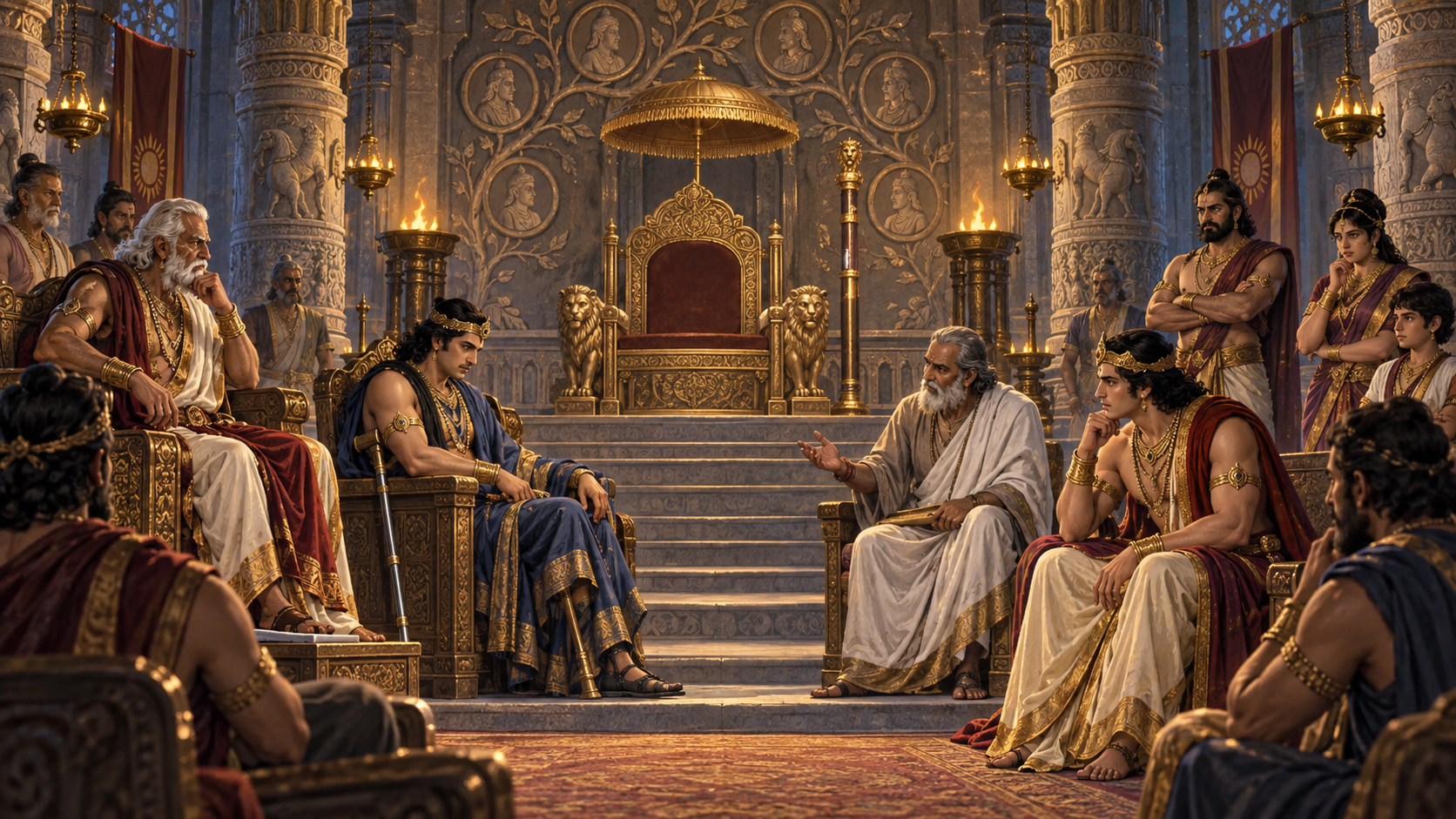
Dhritarashtra and Pandu: seniority can be overridden
Dhritarashtra is the elder brother, yet his blindness counts against his installation and Pandu receives the crown. At the most immediate level, this is evidence against an unconditional rule of birth order. The elder prince’s claim does not disappear, but an eligibility judgment prevents seniority from deciding the succession by itself.
Dhritarashtra later governs after Pandu withdraws and dies. That development reveals another layer: being passed over once does not remove his dynastic standing or political importance. The Kuru arrangement remains unsettled because the family has addressed the immediate vacancy without establishing a durable agreement about the next generation.
You should not turn Dhritarashtra’s treatment into a timeless judgment about disability. The more important moral test is what he does while exercising authority. He often recognizes the danger created by Duryodhana, hears warnings from prudent counsellors, and understands that injustice is unfolding. His failure lies in allowing attachment to his son to defeat the judgment demanded by his office. The body becomes less decisive than the will.
Yudhishthira and Duryodhana: rival claims need moral adjudication
The next dispute cannot be solved by saying only that a king’s son succeeds him. Duryodhana is the eldest son of the ruler occupying the throne, but Yudhishthira is the eldest prince of their generation and belongs to the line of the previously crowned Pandu. Both sides can therefore frame a genealogical argument. The family tree supplies competing claims rather than an automatic answer.
Conduct then becomes decisive. Yudhishthira’s association with dharma strengthens his legitimacy, but the epic does not flatter him into perfection. His catastrophic gambling exposes a failure of judgment and self-command. He has a rightful claim and many kingly qualities, yet he still has to suffer the consequences of grave decisions. Birth and reputation do not exempt him from accountability.
Duryodhana, meanwhile, cannot convert determination, courage, political support, or command into dharmic fitness. His central defect is not a shortage of talent. It is his refusal to accept limits on his desire for exclusive power, even when compromise could preserve the family and the realm. The Mahabharata thus distinguishes competence from character: a capable claimant can still be unfit because he directs his abilities toward injustice.
Karna and Vidura: merit alone does not create succession
Karna complicates any claim that the epic simply endorses hereditary privilege. His martial ability forces the court to notice him. When his apparent social status becomes an obstacle, Duryodhana makes him king of Anga. The episode shows that office can be conferred and that conspicuous ability can disrupt an inherited hierarchy.
Yet Karna’s ability does not make him a contender for the Kuru throne. Recognition, relationship to the dynasty, political sponsorship, and perceived birth continue to matter. His story demonstrates both the power and the limits of merit: excellence can expose the inadequacy of social judgment, but excellence by itself does not establish a lawful line of succession.
Vidura makes the point even more sharply. He is one of the Kuru court’s clearest voices of prudence and moral discernment, but his birth places him outside the royal succession. If the Mahabharata were teaching pure meritocracy, Vidura would be an obvious candidate for supreme authority. Instead, he advises those who possess dynastic claims. The arrangement values wisdom without allowing wisdom alone to manufacture hereditary legitimacy.
Bhishma: qualification does not compel a person to reign
Bhishma possesses royal descent, formidable ability, experience, and the confidence of the dynasty. Nevertheless, his vow removes him and his descendants from succession. His case introduces a factor that the birth-versus-merit debate usually misses: renunciation and binding obligation.
A person may have a strong claim and excellent qualifications yet relinquish the office. That choice can preserve an immediate promise while producing consequences far beyond the moment in which it was made. Bhishma’s renunciation helps secure one succession but leaves him responsible for protecting a throne he cannot occupy. The lesson is not that vows are wrong. It is that a political vow must be judged partly by the institutional future it creates.
Merit in rajadharma begins with rule over oneself
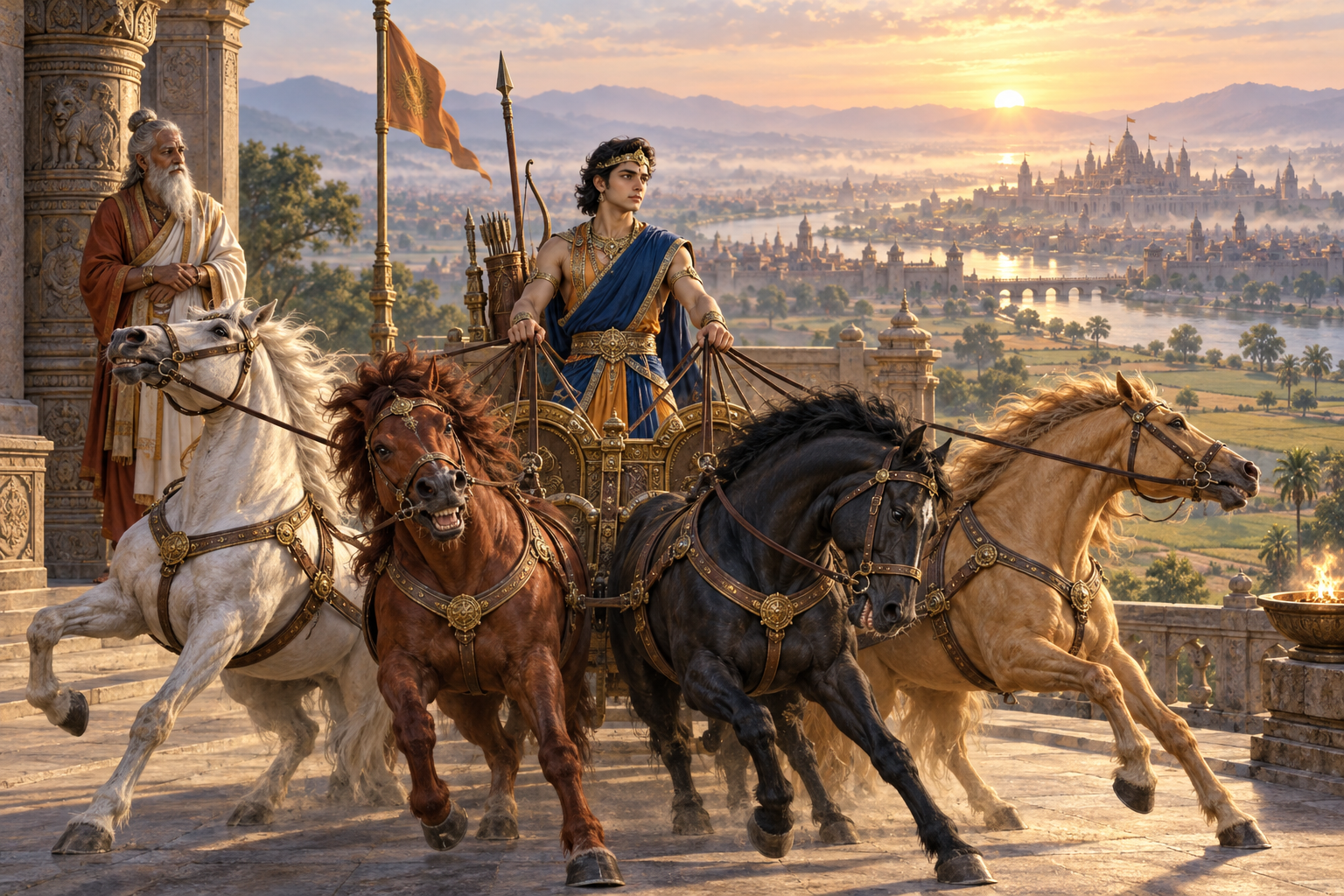
When you evaluate a Mahabharata ruler, do not ask only whether he is virtuous in private or impressive in battle. Rajadharma concerns the use of entrusted power. Merit must therefore be matched to the office.
- Self-command: Can the claimant restrain anger, envy, appetite, pride, and partiality when they conflict with public duty?
- Impartial judgment: Can he rule against the interests of his own relatives when justice requires it?
- Respect for counsel: Does he listen to uncomfortable warnings, or retain counsellors merely to approve decisions already made?
- Protection of the vulnerable: Does his authority shield people from humiliation and predation, including misconduct within his own court?
- Fidelity to agreements: Can allies, subjects, and rivals rely on his promises, settlements, and accepted rules?
- Responsibility for consequences: When he makes a grave mistake, does he acknowledge its cost and change his conduct, or transfer blame to others?
These tests explain why neither heredity nor talent settles the issue. Lineage cannot guarantee self-command. Martial excellence cannot guarantee justice. Intelligence cannot guarantee the courage to act on good advice. Even a reputation for righteousness cannot substitute for sound judgment in a specific crisis.
The kingly quality most easily overlooked is impartiality. Dhritarashtra’s tragedy is not that he loves his son; a father is expected to do so. The failure comes when paternal attachment governs decisions that affect the entire realm. Once private loyalty controls public authority, the ruler stops holding the scales and becomes a participant in the quarrel.
This is also why the epic’s answer is more demanding than rule by the supposedly best person. Who declares someone the best? A court impressed by physical prowess may choose differently from counsellors concerned with restraint. Supporters reward loyalty. Relatives defend inheritance. Merit becomes politically useful only when its qualities are named, tested, and tied to the duties of the office.
A practical way to read any Mahabharata succession dispute
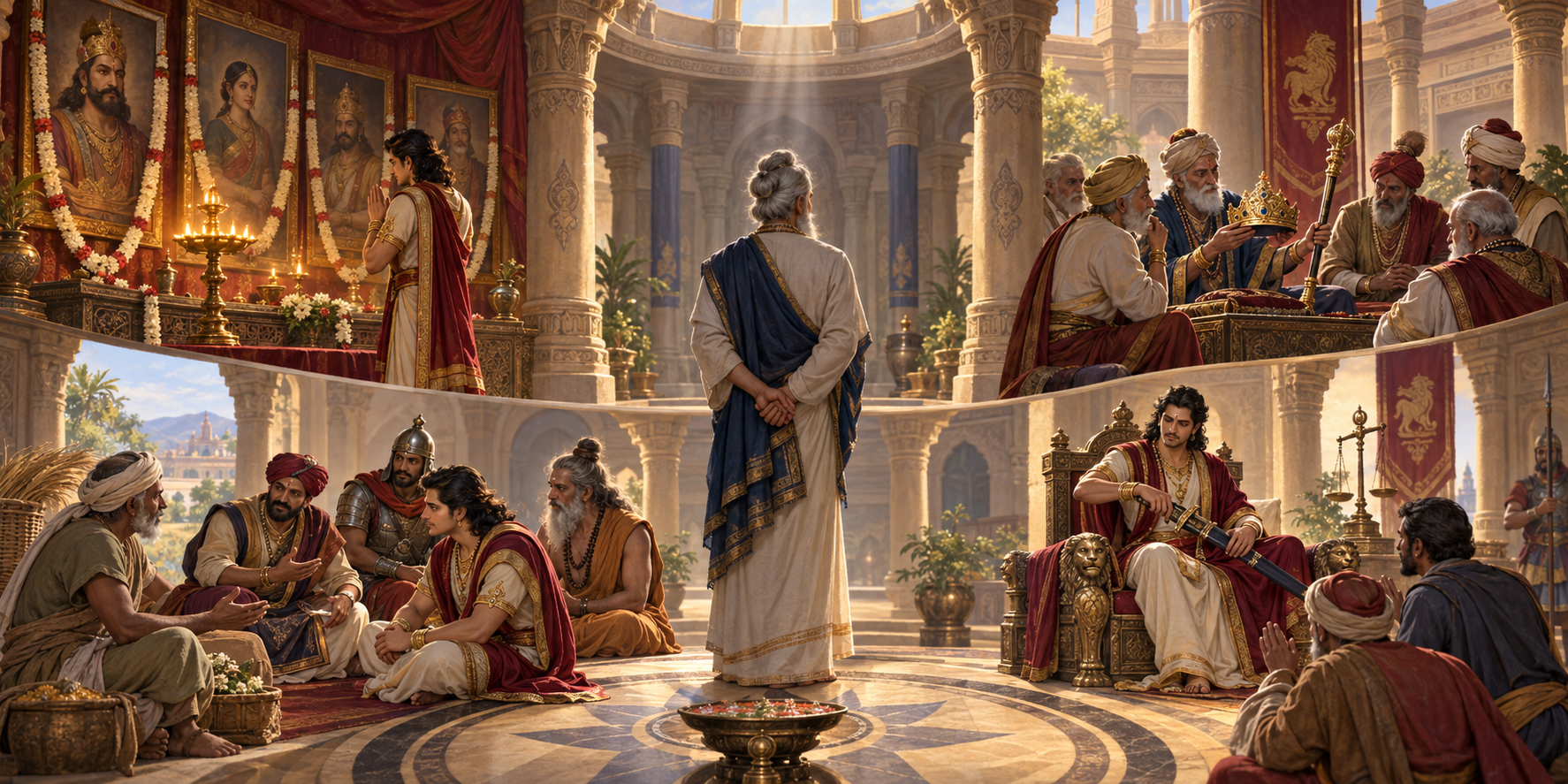
You can apply the following method whenever the epic presents a contested throne, command, inheritance, or appointment. It prevents one attractive quality from swallowing the whole question.
- Identify the basis of the claim. Is it seniority, descent from a previously crowned ruler, formal appointment, recognition by elders, marriage, alliance, or possession of the capital? Do not use the vague word “right” until you know which right is being asserted.
- Separate claim from eligibility. A claimant may belong to the proper lineage but face an impediment created by a vow, an earlier settlement, perceived incapacity, or another accepted rule. Ask whether that impediment is permanent, conditional, or politically contested.
- Define merit for the actual office. A superb warrior may be a poor judge. A wise counsellor may lack an accepted route to succession. List the duties of the position before ranking the candidates.
- Watch conduct under pressure. Ceremonial virtue proves little. Notice what the claimant does when required to surrender advantage, discipline an ally, protect an opponent, hear an unwelcome truth, or bear the result of his own mistake.
- Examine the institutions around the ruler. Elders, counsellors, family settlements, assemblies, and shared customs can contain personal ambition only if they are willing and able to enforce their judgments. Advice without consequences is not an effective limit on power.
This method also keeps you from forcing modern categories onto the epic. The Mahabharata’s world accepts dynasty as a basic political institution; it is not proposing open elections or career advancement based on examination scores. At the same time, it subjects hereditary authority to moral scrutiny so severe that no prince can point to ancestry as a complete defence.
If you are applying the lesson to a family enterprise, temple trust, community body, or political organisation, preserve that distinction. Continuity and inherited responsibility can have value, but they should not silently confer unchecked executive power. Define the qualifications of the working office, establish who can correct the leader, record the terms of succession, and decide in advance what happens when family loyalty conflicts with institutional duty.
The practical translation is not “reject every heir” or “always choose an outsider.” It is to separate symbolic continuity from operational authority when the two require different qualities. An heir may preserve lineage while a qualified council administers affairs; a successor may undergo preparation before assuming full powers; or a recognised claimant may remain accountable to enforceable rules. The structure should make service to the institution harder to confuse with ownership of it.
Key takeaways
- The Mahabharata does not make birth order an unconditional law of succession.
- Lineage creates a serious claim, but eligibility, recognition, vows, circumstances, and conduct can qualify that claim.
- Merit means fitness for rajadharma, especially self-command, impartiality, protection, sound judgment, and willingness to hear counsel.
- Talent without a recognised claim may earn honour or office without establishing a right to the dynastic throne.
- A rightful heir can lose moral legitimacy through misconduct, while a wise person does not automatically acquire hereditary legitimacy.
- The strongest claim joins lawful continuity, demonstrated capacity, dharmic character, institutional recognition, and accountable performance.
So when someone asks you whether the Mahabharata chooses birth or merit, resist the forced choice. Ask which claimant can unite a legitimate route to authority with the discipline required to use it for others. Then ask what will restrain that ruler when affection, ambition, or fear pulls in the opposite direction. That is where the epic’s political wisdom becomes usable rather than merely admirable.
References

Leave a Reply
You must be logged in to post a comment.