

You have found the Nigarbha Yoginis in a diagram, a name list, or a description of Mahameru, but the list alone does not tell you how to understand them. Your immediate question is more basic: where do these Yoginis belong, and what does their position mean?
Begin with their address in the Sri Chakra. Once you can identify the sixth avarana as the Antardashara and connect its ten inner triangles with its ten Shaktis, the group stops looking like an isolated collection of goddesses. It becomes an intelligible part of the yantra’s inward architecture.
Start with the address, not the names
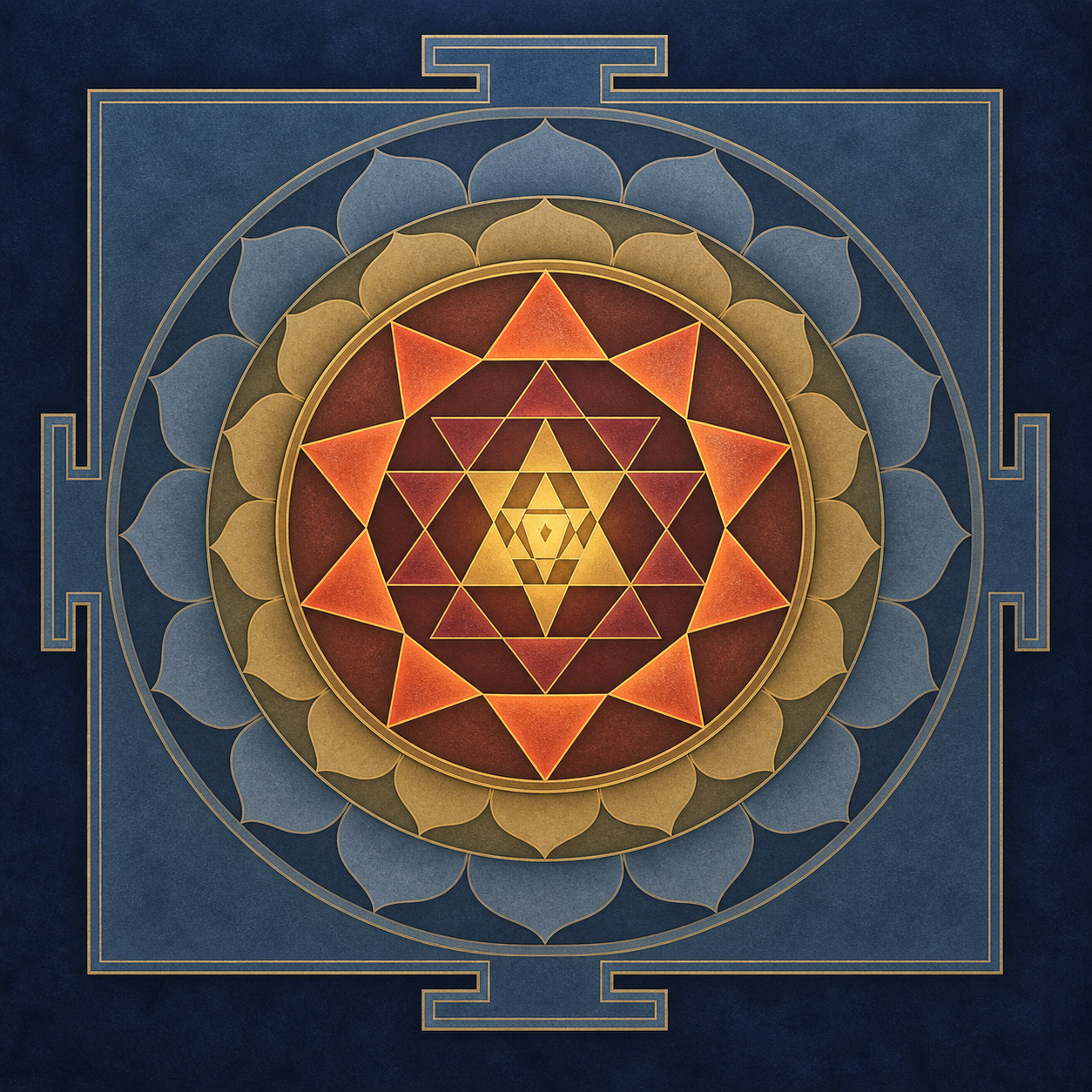
An avarana is an enclosure or distinct layer of the Sri Chakra. The Nigarbha Yoginis belong to the sixth avarana, the Antardashara formed by ten inner triangles. Ten Shaktis preside within this enclosure.
That short description gives you the four anchors needed to recognize the group:
- Position: the sixth avarana.
- Traditional geometric designation: Antardashara.
- Visible structure: ten inner triangles.
- Presiding group: ten Nigarbha Yogini Shaktis.
Keep those four facts together. If you memorize the Yoginis without their enclosure, you know a list but not the Sri Chakra. If you see the triangles without recognizing their presiding Shaktis, you have geometry but not the sacred architecture the geometry carries.
Do not identify the enclosure by guessing which lines look sixth from the outside. Interlocking triangles produce many visible shapes, and a single visual fragment is not automatically an avarana. Use a properly labelled Sri Chakra, find the Antardashara, and then confirm that you are looking at the group of ten inner triangles. The same discipline applies when studying a three-dimensional Mahameru: follow its enclosures rather than counting whichever surfaces are easiest to see.
Why the ten Nigarbha Yoginis belong together

The Sri Chakra is a map of differentiated powers held within one ordered whole. Its triangles are not decorative compartments, and its divine presences are not entries in an unrelated catalogue. Location, number, enclosure, and presiding Shakti must be read together.
For the sixth avarana, this means treating the Nigarbha Yoginis first as a coordinated mandala. Each Shakti has her own identity within the transmitted sequence, but all ten share the Antardashara as their ritual and contemplative context. Their collective placement tells you something that a name-by-name glossary cannot: differentiation remains present as attention moves inward, yet those differentiated powers participate in a single architecture.
This corrects two easy misreadings. First, “inner” does not mean that the earlier enclosures are disposable or spiritually inferior. Every avarana belongs to the complete Sri Chakra. Second, the presence of ten Yoginis does not turn the enclosure into ten separate systems. Multiplicity is organized here; it is not fragmentation.
You may also encounter language describing these Shaktis as guardians. Read that description within the mandala rather than imagining ten external sentries. A useful contemplative understanding of guardianship is the preservation of order as consciousness moves toward greater inwardness. The triangles define a sacred boundary, while the Yoginis disclose that the boundary is alive with Shakti.
Use a study method that preserves the map

A reliable study routine begins with orientation and only then turns to individual names or meanings. Use the following sequence whenever you open a diagram, commentary, or lineage manual:
- Locate the centre of the Sri Chakra so that you know the direction of inward movement.
- Identify the avaranas using the labels supplied with the diagram. Do not count miscellaneous visible triangles.
- Find the sixth avarana and confirm the term Antardashara.
- Verify that the enclosure consists of ten inner triangles and is associated with ten Nigarbha Yoginis.
- Only then add the individual names, meanings, directions, or ritual details transmitted by the tradition you are actually studying.
The final step matters. Sanskrit names can appear in different transliteration styles, while practice manuals may organize instructions according to a particular lineage. Preserve the wording used by your teacher or chosen text instead of silently combining several lists. Apparent disagreement may be no more than spelling, but a genuine difference in order or ritual placement should not be normalized without guidance.
A compact study sheet will keep your notes from drifting away from the yantra:
| Field | What to record | What it prevents |
|---|---|---|
| Address | Sixth avarana; Antardashara | Confusing the group with another enclosure |
| Geometry | Ten inner triangles | Treating every visible triangle as a separate layer |
| Presiding group | Ten Nigarbha Yoginis | Detaching the Shaktis from their mandala |
| Individual entry | Name and meaning exactly as transmitted | Mixing spellings, sequences, or interpretations |
| Practice instruction | Teacher, text, or lineage manual used | Mistaking general study for ritual authorization |
You can also use the enclosure for non-ritual contemplation. Look at the ten triangles as one ordered field and ask: what changes when distinct powers cooperate without losing their distinctness? Write a short response, then return to the diagram and test whether your reflection respects the geometry. This is contemplative study, not a substitute for a lineage practice.
If your purpose is formal Sri Vidya sadhana, do not invent a mantra, bija, nyasa, mudra, invocation order, or offering sequence from a public description. Those elements belong to transmitted practice. Use the appropriate paddhati and the direction of a qualified guru. A diagram can orient you, but orientation and initiation are not the same thing.
Correct the mistakes that distort the sixth avarana
Most confusion around the Nigarbha Yoginis comes from separating something that the Sri Chakra presents as a relationship. Watch for these errors in your own notes:
- Beginning with an unlabelled picture. A beautiful image may be suitable for darshana yet poor for technical study. Keep a clearly labelled diagram beside it until you can locate the Antardashara reliably.
- Remembering “ten” but forgetting “inner ten.” Record the complete phrase “ten inner triangles” so that the number remains attached to the correct geometric group.
- Reducing Yoginis to independent personalities. Study each identity, but repeatedly return it to the shared enclosure. The mandala supplies the relationship that an alphabetical list removes.
- Assuming every use of the word Yogini names the same group. Here it designates the ten Shaktis of a particular Sri Chakra avarana. Do not merge them automatically with another Yogini classification encountered elsewhere.
- Treating Mahameru as an unrelated map. Its three-dimensional presentation changes how the structure is viewed, not the need to identify the sixth avarana through its proper geometric address.
- Making “inner” into a ranking of devotion. The movement inward gives the sixth enclosure its context, but the full Sri Chakra depends upon all its enclosures. Do not dismiss the outer architecture after reaching the Antardashara.
- Mixing study systems without recording provenance. If two manuals differ, keep separate notes until a competent teacher explains the relationship. Combining them immediately can produce a sequence that belongs to neither tradition.
One further restraint will save you considerable confusion: do not improvise a translation of “Nigarbha” and then build an entire theology on that guess. Retain the Sanskrit designation until you have a trustworthy explanation within the tradition being studied. A speculative etymology can sound convincing while pulling your attention away from the one fact the yantra makes unmistakable: these Yoginis belong to the Antardashara.
Key takeaways for your next reading
- The Nigarbha Yoginis are the ten Shaktis associated with the ten inner triangles of the Sri Chakra’s sixth avarana.
- The enclosure’s traditional geometric name is Antardashara.
- Learn position, geometry, number, and presiding group as one unit before memorizing individual entries.
- Read the ten Yoginis collectively as an ordered mandala, not merely as a list of separate goddesses.
- Keep the flat Sri Chakra and the three-dimensional Mahameru aligned through their avaranas.
- Use public explanations for orientation and reserve formal ritual details for the paddhati and guru of your lineage.
The next time you encounter the Nigarbha Yoginis, point to their enclosure before opening a name list. Say the complete address to yourself: sixth avarana, Antardashara, ten inner triangles, ten Nigarbha Yogini Shaktis. Then study each individual presence without allowing her to become detached from the sacred whole in which she appears.
References

Leave a Reply
You must be logged in to post a comment.