

You may have encountered Swami Govinddev Giri’s name alongside the Ram Mandir Trust and wondered what, exactly, his appointment establishes. The useful answer begins with a precise distinction: an institutional office, a public felicitation and a formal decision are three different things.
Swami Govinddev Giri was appointed General Secretary of the Shri Ram Janmabhoomi Teerth Kshetra Trust. Representatives of the Hindu Janajagruti Samiti subsequently visited him in Pune to felicitate him and seek his blessings. Those facts identify his office and one public response to it; they should not be stretched into claims about powers, policies or institutional alliances that have not been specified.
The appointment and the felicitation are separate events

The appointment is the institutional event. It placed Swami Govinddev Giri in the named office of General Secretary within the Shri Ram Janmabhoomi Teerth Kshetra Trust. The later Pune meeting was a response to that appointment: Hindu Janajagruti Samiti representatives offered their congratulations and sought his blessings.
This distinction matters because public coverage often compresses several actions into a single impression. A reader can easily mistake the organisation offering a felicitation for the organisation making the appointment. Here, the two should remain separate in your mind. The Trust appointment concerns Swami Govinddev Giri’s institutional role; the Samiti’s visit concerns its recognition of that development.
When you share the news, retain both the actor and the verb: Swami Govinddev Giri was appointed to the Trust office; Hindu Janajagruti Samiti representatives felicitated him afterward. That formulation is short, accurate and resistant to exaggeration.
What the title General Secretary does and does not prove

General Secretary is a specific office, not a synonym for sole controller, universal spokesperson or final decision-maker. The title establishes that Swami Govinddev Giri holds an organisational position. By itself, it does not disclose the Trust’s internal division of responsibilities, voting arrangements, financial authority or the matters on which an office-bearer may act independently.
That boundary gives you a practical way to assess later claims. Ask whether the claim concerns a personal statement by Swami Govinddev Giri, an action taken through his office, a collective decision of the Trust or an interpretation supplied by someone outside the Trust. These categories can overlap, but they are not interchangeable.
In particular, do not attribute a policy to the entire Trust merely because one office-bearer’s name appears beside it. Look for an identified decision, resolution, announcement or authorised statement. If none is provided, describe only the narrower action that can actually be verified.
How to read the Pune courtesy visit
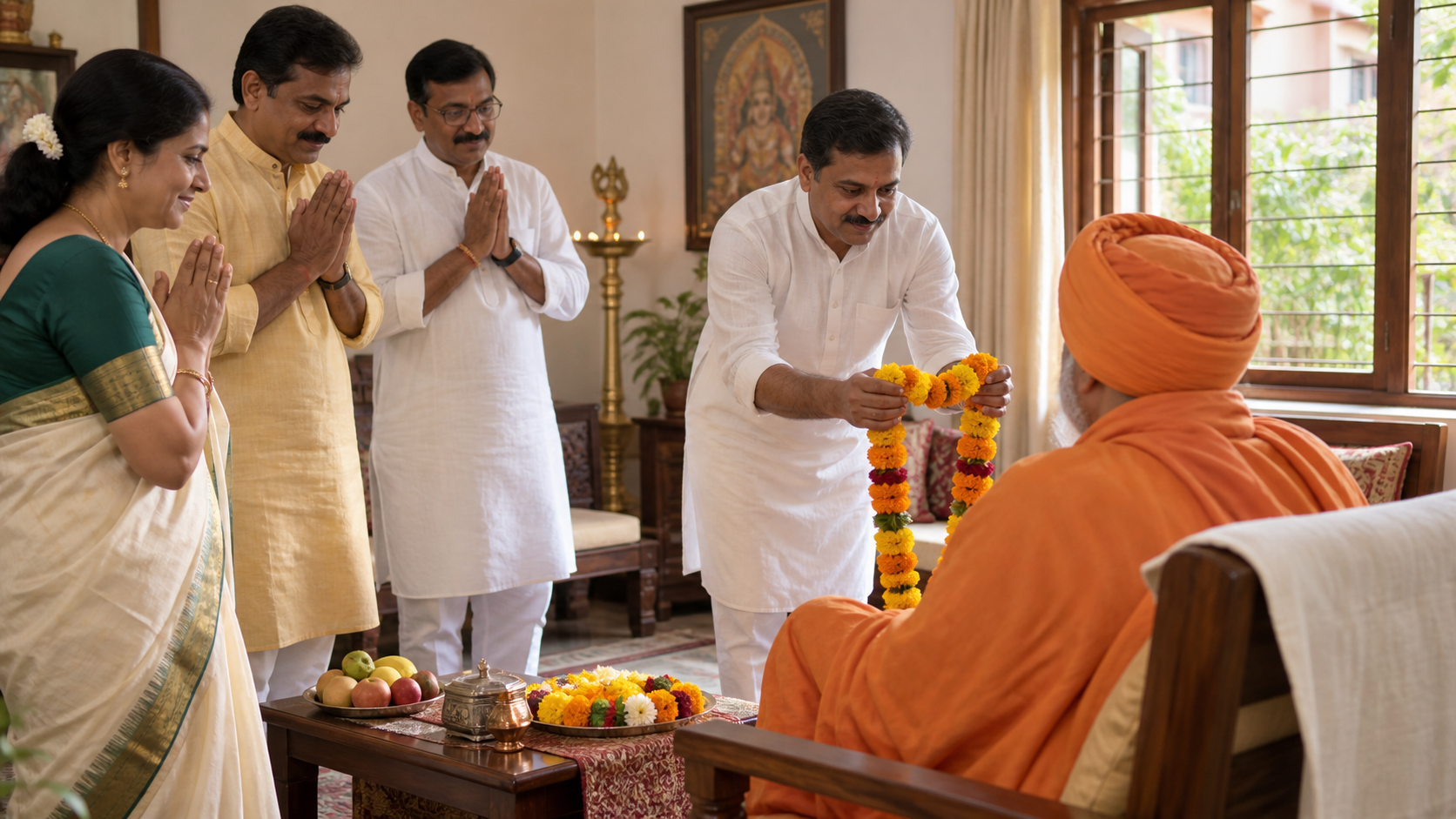
The language of the meeting carries useful information. It was described as a courtesy visit. The representatives felicitated Swami Govinddev Giri and sought his blessings. That combination presents the encounter as congratulatory and reverential rather than as a stated policy meeting or administrative session.
Within Dharmic public life, felicitation and the seeking of blessings can express respect for spiritual standing as well as recognition of a new responsibility. You can acknowledge that cultural meaning without assigning the meeting a function it was not said to have. Nothing in the stated facts establishes a formal partnership, delegated authority or joint programme between the Samiti and the Trust.
The safest reading is therefore also the clearest: a Hindu organisation marked the appointment through an in-person expression of respect. The location, Pune, tells you where that interaction occurred. It does not by itself identify a Trust headquarters or establish where Swami Govinddev Giri performs every part of his institutional work.
A four-part test for future claims about the Trust

Use the complete institutional name
“Ram Mandir Trust” is convenient shorthand, but Shri Ram Janmabhoomi Teerth Kshetra Trust is the name attached to the appointment. Using the full name at least once prevents confusion with committees, campaign groups or other organisations discussing the Mandir.
Match every action to its actor
Ask who appointed, who visited, who spoke and who decided. In this case, Hindu Janajagruti Samiti representatives were the visitors; Swami Govinddev Giri was the person felicitated following his Trust appointment. Keeping those roles distinct stops a courtesy interaction from being recast as governance.
Pay attention to the operative verb
“Appointed,” “felicitated,” “blessed,” “announced” and “resolved” describe different kinds of events. A felicitation communicates honour. A resolution would indicate an institutional decision. If a claim quietly substitutes one verb for another, its meaning has probably been enlarged beyond the known facts.
Require specifics before repeating consequential claims
Claims about money, construction, ritual arrangements, appointments or Trust policy require more than an office title or a photograph of a meeting. Before repeating such a claim, look for the exact action, the responsible body and a statement that clearly connects the two. If those elements are missing, say that the claim remains unverified rather than filling the gap with inference.
Brief questions readers commonly ask
What position was Swami Govinddev Giri appointed to?
He was appointed General Secretary of the Shri Ram Janmabhoomi Teerth Kshetra Trust.
Did Hindu Janajagruti Samiti make the appointment?
That is not what the recorded sequence establishes. Its representatives visited Swami Govinddev Giri after the appointment to felicitate him and seek his blessings.
Does the Pune meeting prove a formal alliance with the Trust?
No such alliance is established by the stated facts. A courtesy visit and felicitation demonstrate recognition and respect; they do not, without further confirmation, create an administrative or policy relationship.
As more public statements appear, keep this baseline intact. Name the office accurately, attach each action to the right organisation and distinguish reverential recognition from institutional decision-making. That discipline will let you follow developments around Swami Govinddev Giri and the Trust without either understating their significance or amplifying claims beyond the facts.
References

Leave a Reply
You must be logged in to post a comment.