
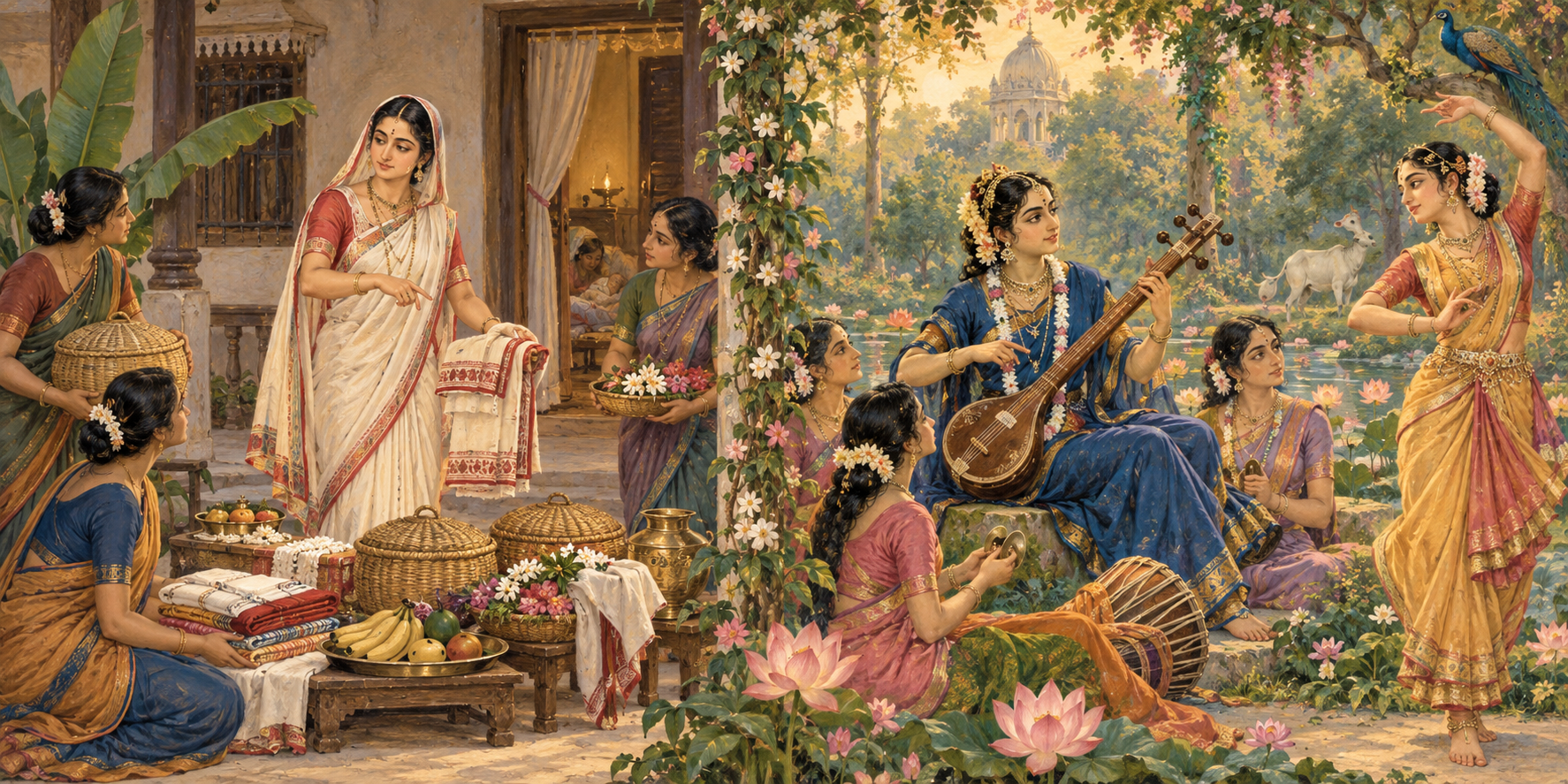
You may have arrived with a simple question: are women central to Gaudiya Vaishnava sacred history, or do they appear mainly beside better-known men? A list of female names will not settle that question. You have to notice what each woman does, what kind of knowledge she carries, and how the tradition understands her identity.
Sita Thakurani and Tungavidya Sakhi offer a disciplined starting point. One exercises maternal and theological authority within Gaura-lila. The other is remembered through artistic mastery in Krishna-lila. Reading them carefully helps you recognize forms of authority that disappear when sacred history is measured only by modern offices and public titles.
Begin with function, not proximity to a famous man
Introductions such as wife of, mother of, or sakhi of establish real relationships, but they do not exhaust a woman’s identity. In a bhakti tradition, a relationship can be the setting in which knowledge, devotion, protection, instruction, and service become visible. The practical mistake is to record the relationship and stop reading before reaching the action.
Use five questions whenever you encounter a woman in Gaudiya sacred history:
- What action is she shown performing?
- What knowledge or competence does that action require?
- Which devotional relationship, or bhava, gives the action its meaning?
- Does the tradition give her a title or identify her across different lilas?
- What can you conclude without adding details that have not been established?
This method guards against two opposite errors. One is erasure: treating women as scenery around male saints. The other is inflation: forcing every sacred relationship into a modern political category or claiming more than the tradition preserves. Careful reading does neither. It recognizes authority in the form in which it actually appears.
Sita Thakurani turns maternal care into directive seva
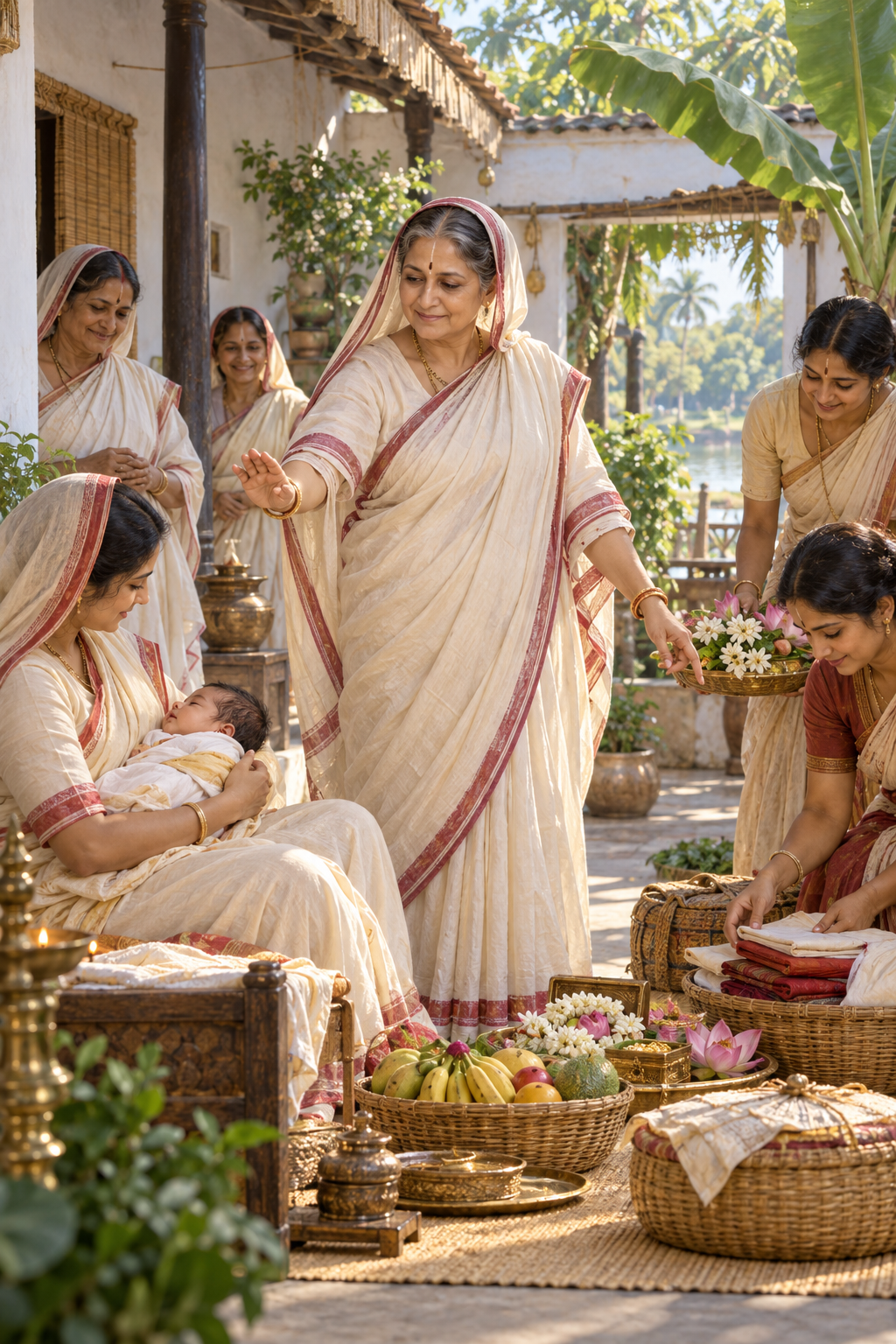
Sita Thakurani was the daughter of Shri Nrishinga Baduri and married Shri Advaita Acharya in Phuliya Nagara. Following their marriage, Advaita Acharya went to Nadiya and lived in Shantipura. These details establish family and place, but they are only the outer frame of her sacred role.
Her distinctive action appears in relation to the young Gaurasundara. Sita Thakurani was absorbed in vatsalya-prema and, out of parental concern, instructed Jagannatha Mishra about caring for the boy. The verb that deserves your attention is instructed. She is not merely present in a household scene, admiring the child from a respectful distance. Her maternal knowledge takes a directive form.
Vatsalya-prema is more precise than ordinary affection. It names devotion expressed through parental care. That distinction matters because the object of Sita Thakurani’s concern is Gaurasundara. Feeding, protecting, advising, and attending to a child become modes of seva when they arise from this devotional relationship. The apparently domestic setting does not make the act spiritually marginal.
This does not mean that every domestic action automatically becomes religious authority. The force of this episode comes from three elements appearing together: her vatsalya-bhava, her recognition of Gaurasundara, and her willingness to guide the person responsible for his care. Remove any one of those elements and the meaning becomes less exact.
Gaudiya remembrance accordingly gives her maternal status unusual weight. She is revered alongside Sachi Devi and honored as a mother of the universe. You should therefore resist reducing her to the phrase Advaita Acharya’s wife. That relationship is true, but it is not an adequate account of her place in Gaura-lila.
Her theological identity adds another layer. Sita Thakurani is identified as Yogamaya in Gaura-Ganodesha-Dipika. In Gaura-Parshada-Charitvali, her identity in Krishna-lila is Purnamasi, the mother of Sandipani Muni, grandmother of Madhumangal and Nandimukhi, and a disciple of Narada Muni. These identifications tell a devotee how her maternal service is situated within the continuity of divine lila. They intensify her sacred status rather than replacing the concrete act of care through which that status becomes visible.
Tungavidya Sakhi makes artistic mastery a form of authority
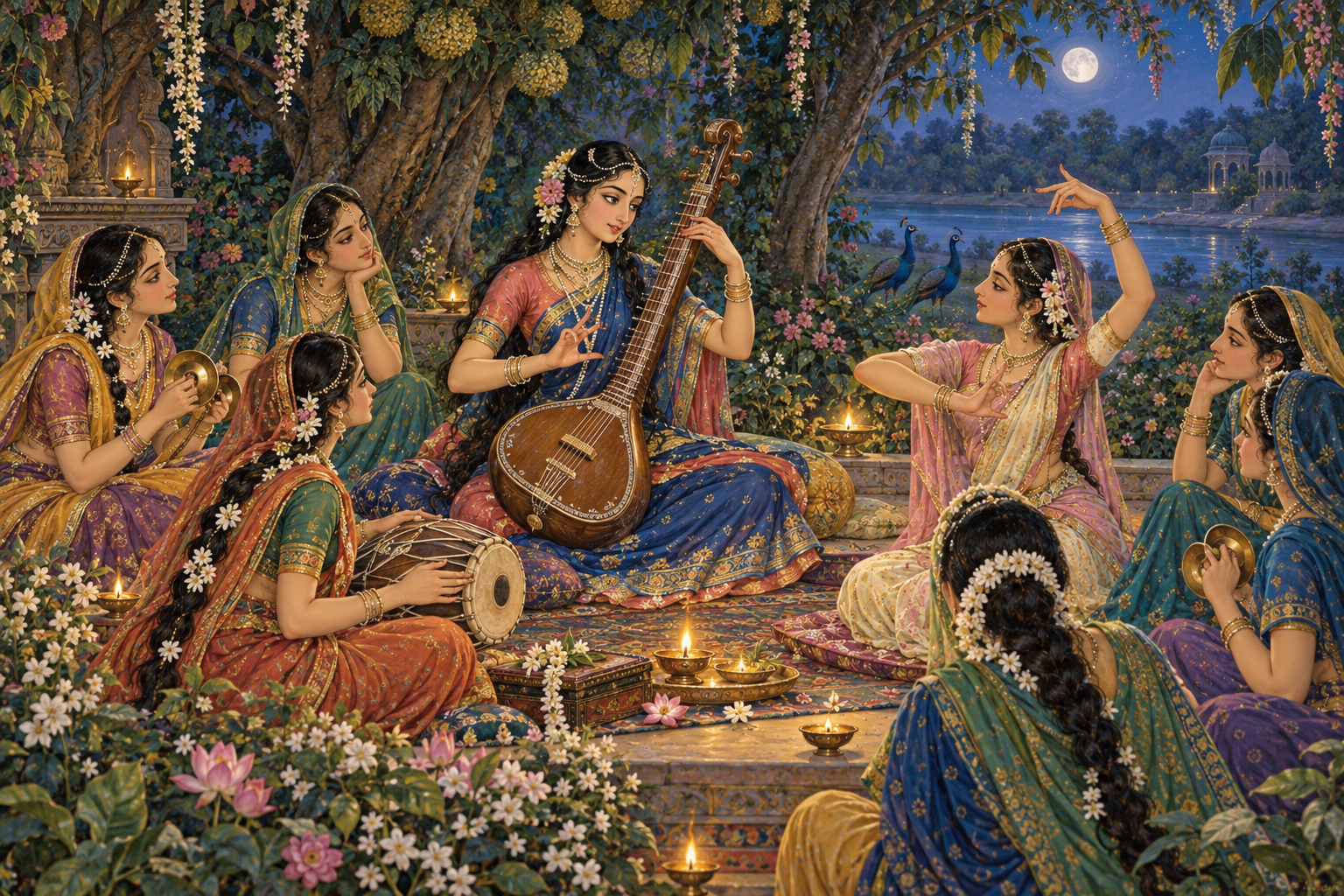
Tungavidya Sakhi is remembered as the musical acharya of Vrindavan. Each part of that designation matters. Sakhi locates her within an intimate devotional relationship. Musical names a field of cultivated ability. Acharya marks authoritative mastery and the transmission or embodiment of knowledge.
If you retain only sakhi, Tungavidya can dissolve into the indistinct category of companion. If you retain only musical, she can be mistaken for an entertainer adding atmosphere to the lila. Musical acharya preserves the stronger meaning: artistic knowledge itself can be disciplined devotional authority.
This also gives you a useful rule for reading names and honorifics. Do not paraphrase them too quickly. First preserve the complete designation, then ask what each word contributes. Relationship and expertise are not rival descriptions here. Tungavidya’s relational identity as a sakhi is the setting in which her musical excellence belongs to sacred service.
Precision also requires restraint. Unless a dependable basis establishes a particular instrument, composition, teaching episode, or method, leave it unstated. You do not need an embellished biography to recognize the significance of a woman being remembered as an acharya in a learned art. The established designation already corrects the assumption that feminine participation in the lila is merely decorative.
This insight can shape how you observe devotional culture now. When music is offered in worship, do not notice only the visible performer. Ask who preserves the melodic knowledge, who teaches disciplined listening, and whose judgment shapes the offering. Tungavidya’s designation gives you a Gaudiya category for recognizing that work: aesthetic competence can be seva, and mastery within seva can carry authority.
Keep biography, bhava, and theological identity distinct

Sacred history becomes confusing when different kinds of claims are forced into a single category. A family relationship, an action within a lila, a devotional emotion, and an identity across lilas do not answer the same question. You can honor all four without pretending that they function like entries in a modern civil biography.
- Record the relationship: daughter, wife, mother, grandmother, disciple, or sakhi.
- Find the action: instructing, caring, teaching, protecting, performing, or another specific verb.
- Name the devotional category actually present, such as vatsalya-prema, without replacing it with a vague word like kindness.
- Place theological identifications on their proper level. An identity such as Yogamaya or Purnamasi explains who a figure is within sacred ontology; it is not the same kind of claim as a marriage or change of residence.
- State the significance one degree more cautiously than your first impulse. Preserve what is powerful without manufacturing a missing detail.
The difference becomes clear when the method is applied side by side:
| Figure | Established detail | Responsible reading | Overreach to avoid |
|---|---|---|---|
| Sita Thakurani | She guides Jagannatha Mishra in caring for Gaurasundara out of vatsalya-prema and is identified as Yogamaya and Purnamasi. | Maternal knowledge operates as directive seva, while theological identity places that service within continuity across lilas. | Turning one episode into an unsupported claim that she exercised every possible kind of social or institutional authority. |
| Tungavidya Sakhi | She is designated the musical acharya of Vrindavan. | Learned artistry is treated as a domain of devotional mastery rather than ornamental performance. | Assigning her an instrument, repertoire, or documented teaching method without a dependable basis. |
This distinction is especially useful when conversations about women in tradition become polarized. Counting only modern offices will miss authority carried through bhava, seva, learning, and sacred identity. Treating every relationship as proof of unlimited authority will also misread the material. Gaudiya categories are specific; let them remain specific.
Key takeaways for your next reading
- Look for the verb attached to a woman’s name. Action reveals more than proximity to a famous man.
- Do not treat wife, mother, disciple, or sakhi as a complete description. Ask what knowledge and service occur within that relationship.
- Read bhava precisely. Sita Thakurani’s vatsalya-prema explains why parental guidance is a form of devotion rather than a background detail.
- Preserve honorifics. Calling Tungavidya a musical acharya conveys more authority than calling her a talented companion.
- Distinguish narrative facts from theological identities across lilas. Both matter, but they answer different questions.
- Stop where established detail stops. Restraint protects sacred history from both erasure and embellishment.
The next time you meet a woman in a Gaudiya narrative, take one minute before moving on. Underline her action, circle the term for her devotional relationship, preserve any title she receives, and write one sentence beginning with: Her authority appears here as… That small practice will help you see women in sacred history as the tradition presents them – through concrete seva, cultivated knowledge, and spiritually meaningful relationship.
References
- Dandavats – Tungavidya Sakhi – The Musical Acharya of Vrindavan | Mayapur TV English
- Dandavats – Sita Thakurani Appearance | Ramai Swami

Leave a Reply
You must be logged in to post a comment.