
If you are trying to decide whether an election, arrest, court order or change of government means Pakistan is returning to democracy, do not start with the winning politician. Start with a harder question: which institution can permit, constrain or reverse the political outcome?
That question makes Pakistan’s recurring crises easier to read and helps you separate a dramatic headline from a genuine transfer of power. This is a structural guide, not a live update: its factual timeline ends in 2023.
Key takeaways for reading Pakistan’s crisis
- A constitutional procedure can be valid while the wider political environment remains distorted. Imran Khan lost office through a parliamentary no-confidence process in 2022, but that fact alone cannot establish that every institution surrounding the process acted neutrally.
- Popular support and governing power are different assets. Khan won six of seven National Assembly by-elections after leaving office, yet electoral popularity did not give him command over the Army, courts, accountability bodies or governing coalition.
- Selective accountability is an institutional warning sign. When legal and anti-corruption machinery repeatedly changes targets as political alignments change, you should examine consistency rather than assume that every prosecution proves either guilt or persecution.
- Economic distress, extremist violence and political disorder reinforce one another. Each reduces the state’s room to resolve the others.
- For Bharat, the desirable outcome is not simply a strong government in Islamabad. It is an accountable civilian order capable of restraining cross-border extremism, meeting economic obligations and respecting constitutional limits.
The real power map is larger than parliament
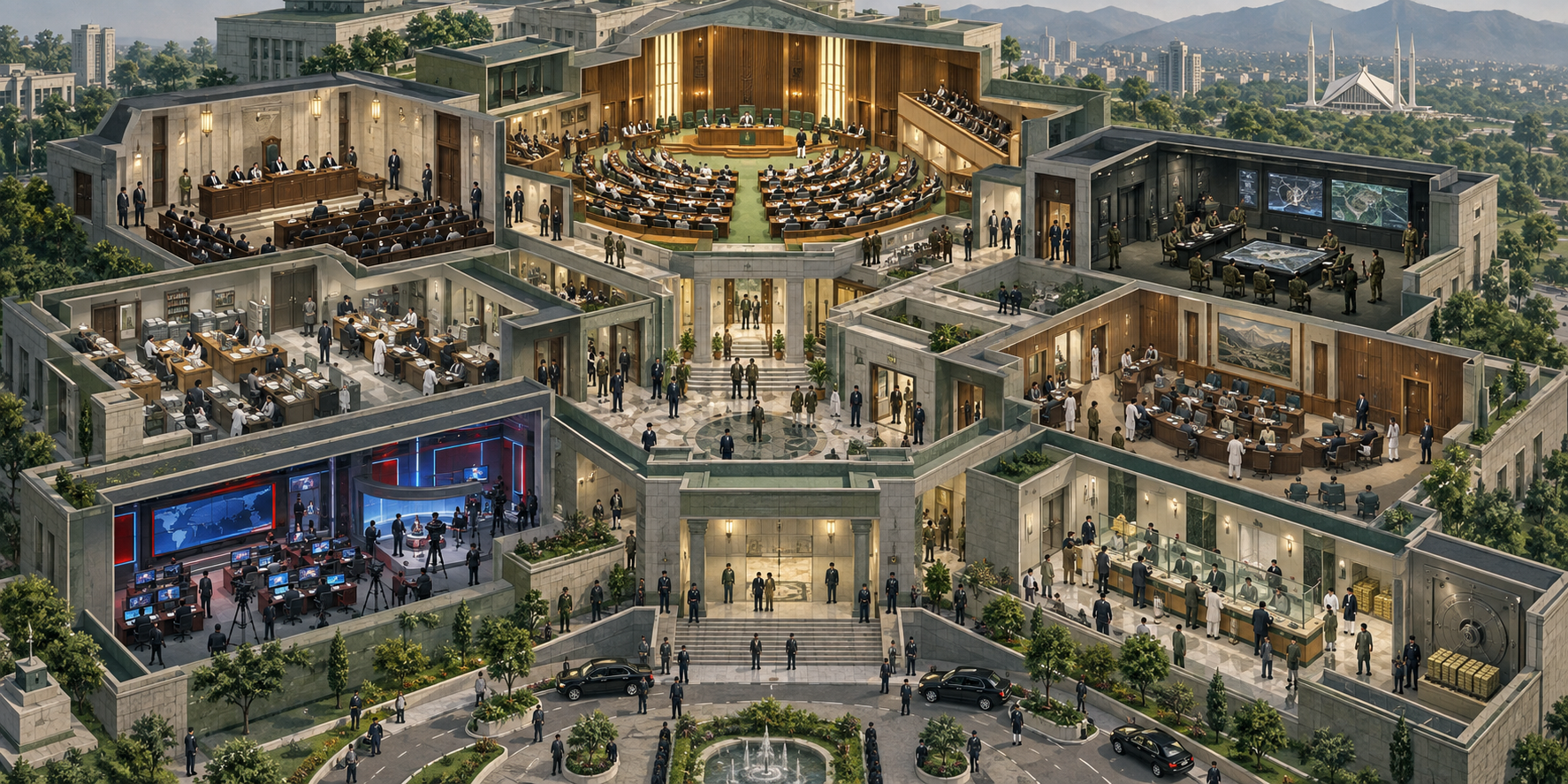
Pakistan has elections, parties, courts and a parliamentary constitution. It also has a military establishment with far greater organizational continuity than most civilian institutions. If you look only at seats in the National Assembly, you see the formal government but miss the institution with the strongest capacity to shape the boundaries within which that government operates.
The constitutional shell
The 1973 Constitution is Pakistan’s third constitutional framework. It has survived shifts between presidential and parliamentary arrangements, repeated military interventions and intense conflict among political parties, judges and generals. Parliament remains important, but it has not acquired an uncontested monopoly over political authority.
That creates a recurring pattern. A civilian leader benefits from establishment support, gains office and later tries to acquire greater autonomy. The relationship breaks down. Courts, accountability institutions, party defections and coalition arithmetic then become arenas in a struggle that is not confined to parliament.
Imran Khan’s trajectory illustrates the pattern. The Sharif camp alleged that a hidden military hand influenced the 2018 election that brought Khan to office. Khan’s early relationship with the Army was cooperative, but it deteriorated as he attempted to act more independently and became involved in disputes surrounding the senior military hierarchy. Whether or not you accept every allegation about the 2018 contest, the later confrontation revealed the structural point: an elected prime minister could not treat military support as incidental.
The same caution applies to the judiciary and the National Accountability Bureau. Nawaz Sharif was judicially disqualified before the 2018 election, while NAB pursued his political camp. After the balance of power changed, Khan faced NAB action and numerous criminal cases. Critics also accused senior judges of partisan treatment. None of this proves that every case lacked merit. It does mean that the correct test is consistent procedure: Were comparable standards applied to rival leaders? Were hearings independent? Did legal action follow evidence, or political rupture? Did an adverse ruling settle a case, or merely begin another institutional confrontation?
Use those questions whenever accountability is announced. Counting cases is not a substitute for evaluating them. Reports placed the number involving Khan above 140 in 2023, covering widely different allegations. A large total can indicate serious legal exposure, an effort to incapacitate a political opponent, or a mixture of both. Only charge-by-charge scrutiny can distinguish among those possibilities.
The 2022-23 stress test
The immediate crisis began when opposition parties brought a no-confidence motion against Khan’s government in 2022. He left office that April. The disruption then spread beyond Islamabad: Punjab’s chief minister resigned amid an attempted political rearrangement, Khyber Pakhtunkhwa’s chief minister faced a no-confidence motion, and PTI moved against its own prime minister in Pakistan-administered Kashmir.
That provincial spread matters. A crisis limited to the federal cabinet can sometimes be resolved by replacing a ministry. Simultaneous conflict across federal and provincial institutions indicates a struggle over the rules of political control themselves. When you see several assemblies, governors, courts and party alliances pulled into the same confrontation, treat it as an institutional crisis rather than routine parliamentary competition.
The confrontation escalated on May 9, 2023, when NAB officials arrested Khan at the Islamabad High Court in the Al-Qadir Trust case. Supporters protested across Pakistan, and some crowds attacked military-associated sites, including the Lahore corps commander’s residence. Authorities restricted Twitter, Facebook and Instagram. The combination was revealing: popular mobilization challenged symbols of military supremacy, while the state curtailed the communication channels enabling that mobilization.
Do not overread the images. Attacks on military property demonstrated an extraordinary loss of public deference and a serious internal-security failure. They did not, by themselves, prove that Pakistan’s command structure had collapsed or that its nuclear arsenal had been compromised. Claims involving particular military assets were reported rather than independently established. The responsible conclusion is narrower: political conflict had breached spaces previously treated as untouchable, creating risks that required verification rather than sensationalism.
Political, economic and security failures form one loop
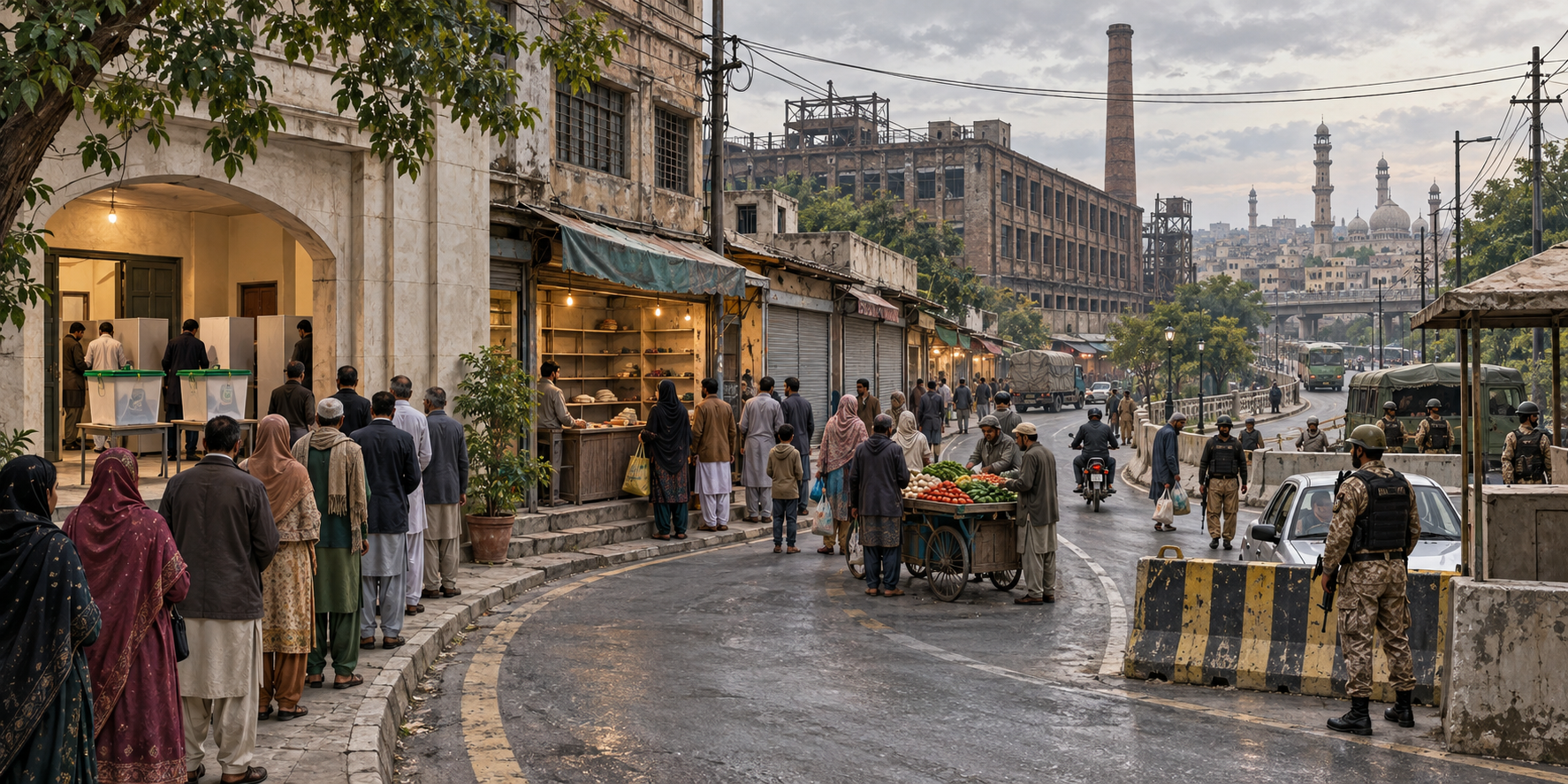
Pakistan’s institutional crisis cannot be isolated from its economic distress. Financial mismanagement, cronyism, corrupt practices, political instability and the severe floods of 2022 placed the state under acute pressure. Dependence on IMF assistance and support from China, Saudi Arabia and the UAE provided relief but could not substitute for domestic political stability and durable economic management.
The mechanism is straightforward. Political uncertainty delays difficult fiscal decisions and weakens confidence. Economic hardship intensifies public anger and reduces the government’s capacity to deliver basic services. That anger makes mass mobilization easier, while disorder further raises the cost of economic recovery. A bailout can address an immediate financing problem; it cannot decide who legitimately governs or make competing institutions obey common rules.
Internal security adds another layer. Alienation in Balochistan and Khyber Pakhtunkhwa has fed separatist and extremist currents. A state preoccupied with elite conflict has fewer political and administrative resources for addressing regional grievances. Heavy coercion may suppress visible disorder temporarily, but it does not create civic trust or procedural legitimacy.
Extremist organizations also cannot safely be treated as instruments that can be activated for one political or strategic purpose and contained afterward. Once street coercion, theological mobilization or proxy violence becomes an accepted tool, other actors can adopt it. The method eventually turns inward. Pakistan’s experience with mobilized religious groups and the violence surrounding May 2023 shows why apparent short-term leverage can produce long-term loss of control.
When you assess whether conditions are improving, therefore, do not treat a new loan, a quieter week of protests or the detention of one leader as a turning point. Look for simultaneous movement in four areas: predictable constitutional procedure, even-handed legal treatment, reduced political interference by the military and enough economic capacity to govern without permanent emergency measures. Improvement in only one area is fragile.
How to interpret the next dramatic headline

Pakistan’s politics generates confident claims after every election, court ruling and military statement. A disciplined reader should replace the first inference with a more useful question.
| Headline event | Tempting conclusion | Better question |
|---|---|---|
| A party wins an election or by-election | The democratic struggle is settled | Can the winner form and operate a government without an extra-constitutional veto? |
| A court grants bail or disqualifies a leader | The judiciary has defeated political interference | Are comparable rules being applied to rival leaders, and will the ruling be implemented consistently? |
| The Army promises political neutrality | Military influence has ended | Do subsequent appointments, coalitions, defections and arrests provide operational evidence of withdrawal? |
| Protesters attack a military facility | The Army or nuclear command is collapsing | What has been independently verified about command cohesion, access and the specific asset involved? |
| External financing is secured | The economic crisis is over | Has the financing bought time for reform and stable governance, or merely postponed the next payment emergency? |
Three distinctions will keep your analysis grounded. First, legality is not the same as legitimacy: an action may use a constitutional mechanism yet occur inside a coercive or selectively enforced system. Second, popularity is not institutional control: crowds and votes matter, but they do not automatically command courts, security forces or administrative machinery. Third, order is not democracy: an institution may suppress unrest while preserving the imbalance that caused the crisis.
Also separate facts from claims about motive. Khan blamed foreign pressure, including the United States, for his removal. His opponents blamed his ambitions, record in office and confrontation with the generals. The institutional diagnosis does not require you to accept either side’s complete story. Ask what can be observed: which formal procedure occurred, which actors possessed enforcement power, whether standards changed across political camps and what happened to dissent afterward.
What Bharat should want from Pakistan
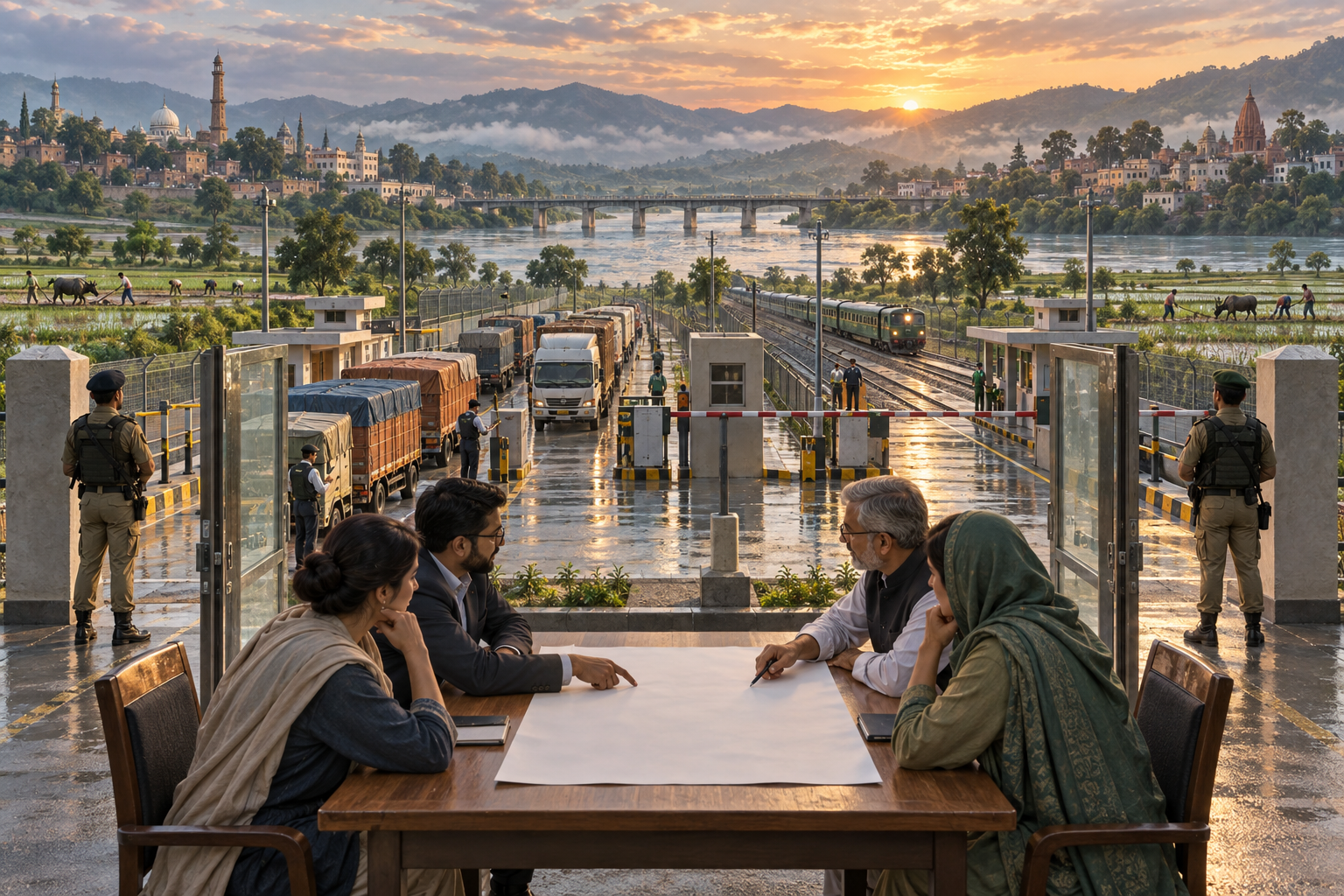
For an Indian reader, it is easy to turn Pakistan’s crisis into a contest between personalities: Khan versus the Sharifs, PTI versus PML-N, civilian politicians versus generals. That framing is too narrow for Bharat’s security interests. The decisive issues are whether Pakistan can restrain cross-border extremism, reduce its use of Kashmir as a source of domestic legitimacy, keep military assets secure and conduct state policy through accountable institutions.
A weak and chaotic Pakistan is not automatically advantageous to Bharat. Fiscal breakdown, radical mobilization, separatist violence and conflict within the security establishment can spill across borders or create dangerous miscalculation. Nuclear capability makes institutional disorder more consequential, even when alarmist claims about immediate loss of control are unsupported.
Nor is stability alone sufficient. A durable but unaccountable military order may control the streets while continuing hostile proxy policies. The more valuable form of stability combines civilian legitimacy, predictable law, economic functionality, human dignity and effective control over extremist networks.
This distinction should shape how you read developments. Do not ask only whether Islamabad looks calmer. Ask who produced the calm, which rules now constrain that actor, whether political opponents retain lawful recourse and whether policy toward Bharat is becoming less dependent on confrontation. Those indicators tell you more than the latest rally size or ministerial appointment.
The next time Pakistan appears to reach a decisive political moment, wait before declaring either democratic renewal or state collapse. Trace the decision from the public vote to the institution that can enforce it. If the same constitutional rule binds parties, judges, generals and accountability bodies, a democratic recovery may be taking shape. If power still depends on selective permission, the personalities have changed but the crisis has not.
References
- DharmaRenaissance Blog – Peaceful Pakistan: An Utopian Vision?
- DharmaRenaissance Blog – Pakistan – Withering State
