

You may have seen claims of substantial progress in the Bhutan-China boundary talks and wondered whether India is about to lose a vital layer of protection near the Siliguri Corridor. The answer depends less on the announcement of a settlement than on the line eventually drawn through Bhutan’s western sector.
Progress after 24 rounds of talks is not, by itself, an Indian security setback. The decisive questions are whether Bhutan retains control around Doklam, whether a northern-for-western territorial exchange is accepted, and what physical access China gains after any agreement. Read the map and the implementation terms before reacting to the diplomatic headline.
The western sector matters more than the headline acreage

The Siliguri Corridor is the narrow land connection between much of India’s Northeast and the rest of the country. To its north lies the Chumbi Valley, the narrow Tibetan salient between Sikkim and Bhutan. This geometry gives Doklam an importance that cannot be understood by counting square kilometres alone.
Sikkim flanks the Chumbi Valley from the west, while Bhutanese territory constrains it from the east. As long as Bhutan controls the disputed western ground, China cannot treat the lower end of the valley as unrestricted operating space. A boundary alignment favourable to China around Doklam could weaken that constraint and make the valley more useful for military movement, surveillance and logistical support.
That would not place the Siliguri Corridor in instant danger. A legal transfer of territory is not the same thing as an operational military advantage. The actual risk would still depend on roads, posts, force posture, surveillance, logistics and India’s own preparedness. But geography determines which military options can later become practical, so waiting for construction or deployment before taking the boundary question seriously would be a strategic mistake.
India’s mobilisation during the 2017 Doklam standoff shows that this is already treated as an operational concern, not an abstract cartographic disagreement. The confrontation was contained through political and diplomatic engagement, but it established an important threshold: a change on the ground near Doklam can require an Indian response even when the disputed land is not Indian territory.
Three territorial files carry very different consequences

Bhutan’s boundary problem should not be discussed as though every disputed area were interchangeable. The negotiations involve northern and western claims with sharply different strategic effects, while the claim introduced in eastern Bhutan in 2020 adds another pressure point.
| Area | Sector | What an Indian reader should notice |
|---|---|---|
| Pasamlung and Jakarlung | Northern Bhutan | These are established areas of dispute and may be used in a package settlement. Chinese flexibility here could be offered in return for a Bhutanese concession elsewhere. |
| Doklam | Western Bhutan | This is the area with the most direct connection to the Chumbi Valley and the approaches toward the Siliguri Corridor. A seemingly small change here may carry greater military value than a larger adjustment in the north. |
| Sakteng Wildlife Sanctuary | Eastern Bhutan | China raised this claim in 2020 even though it had not formed part of the earlier dispute. From an Indian security perspective, its location also matters because of the possible pressure it could create around the Tawang sector. |
One reported bargaining structure would give Bhutan more favourable terms in the northern sector while moving the western boundary in China’s favour. Bhutan could therefore receive more territory in gross terms and still accept an arrangement that creates a more serious security problem for India. Mountain territory is valued by the approaches, observation, movement and logistical options it controls, not merely by its area.
Sakteng requires separate attention. Its addition in 2020 suggests that the set of Chinese claims need not remain fixed while negotiations continue. It also prevents India and Bhutan from assuming that resolving the older northern and western disputes would necessarily remove every future point of pressure. The practical question is whether Sakteng is settled, excluded, deferred or left available for a later round of bargaining.
How to read claims of substantial progress

Bhutanese Foreign Minister Tandi Dorji indicated substantial progress after 24 rounds of boundary talks and deliberations by an expert group. That tells you the process is mature enough to deserve close attention. It does not tell you that a final boundary has been accepted, that every sector has been resolved, or that control on the ground is about to change.
A political understanding, a boundary drawn on maps and a line marked on the ground are distinct stages. Implementation arrangements can matter as much as the broad bargain. When the next announcement appears, test it against these questions:
- Where exactly does the western line run? General language about a comprehensive settlement is inadequate. The position of the line around Doklam is the first detail to inspect.
- Are the sectors being settled independently or traded against one another? A northern-for-western exchange may look balanced diplomatically while producing an unbalanced security result.
- What changes on the ground? Look for provisions governing posts, patrols, roads, civilian access, construction and the timetable for transferring administrative control.
- What happens to Sakteng? Silence may mean exclusion from the settlement, but it may also leave the eastern claim unresolved. The text or an authoritative explanation must distinguish the two.
- How were Indian security concerns handled? Bhutan owns its boundary decision, but any western change has consequences beyond Bhutan. Evidence of serious India-Bhutan consultation matters more than ceremonial assurances.
- Are boundary settlement and diplomatic relations being treated as the same decision? They are not. Formal Bhutan-China relations would alter the political environment, but they would not automatically transfer Doklam or create a military threat. The territorial and access provisions remain decisive.
This test also guards against two opposite errors. One is complacency: assuming that a friendly Bhutan could never accept terms harmful to India. The other is alarmism: treating every Bhutanese contact with China as a strategic betrayal. Neither approach helps you identify the point at which diplomatic movement becomes a material security change.
India must combine defence planning with respect for Bhutan
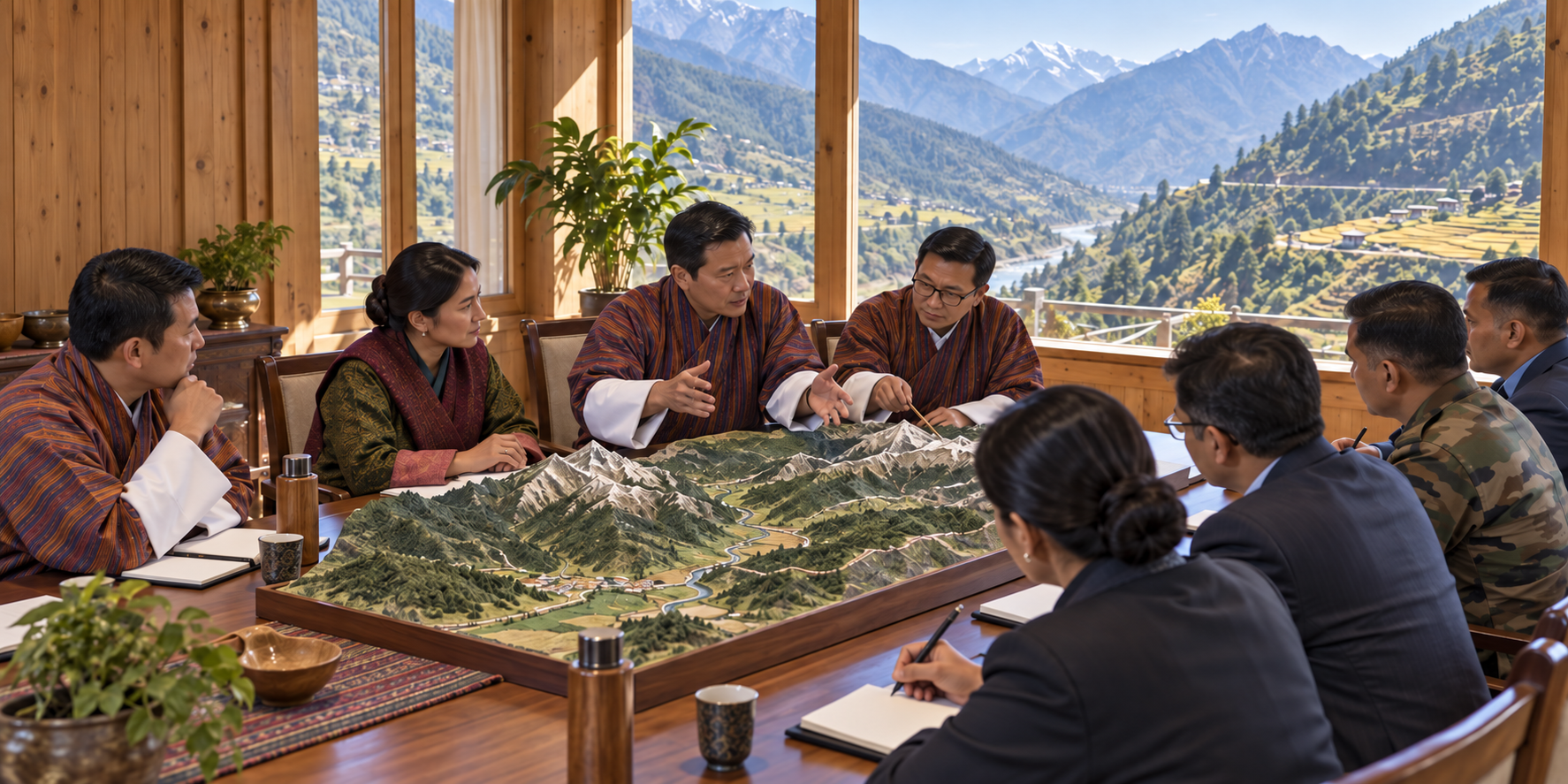
Bhutan is a sovereign state negotiating its own boundary. It is not merely a buffer on an Indian military map. At the same time, sovereignty does not erase geography: a change in Bhutanese control near Doklam can legitimately concern India because the resulting military possibilities extend toward Indian territory.
India has trained and equipped Bhutanese forces, provided substantial economic support and maintained close people-to-people relations. Those ties create the basis for candid coordination, but they do not purchase a veto over Bhutanese policy. If New Delhi treats assistance as an entitlement to obedience, it will weaken the trust on which effective security cooperation depends.
A workable Indian response should proceed on two tracks at once:
<!– wp:list {