
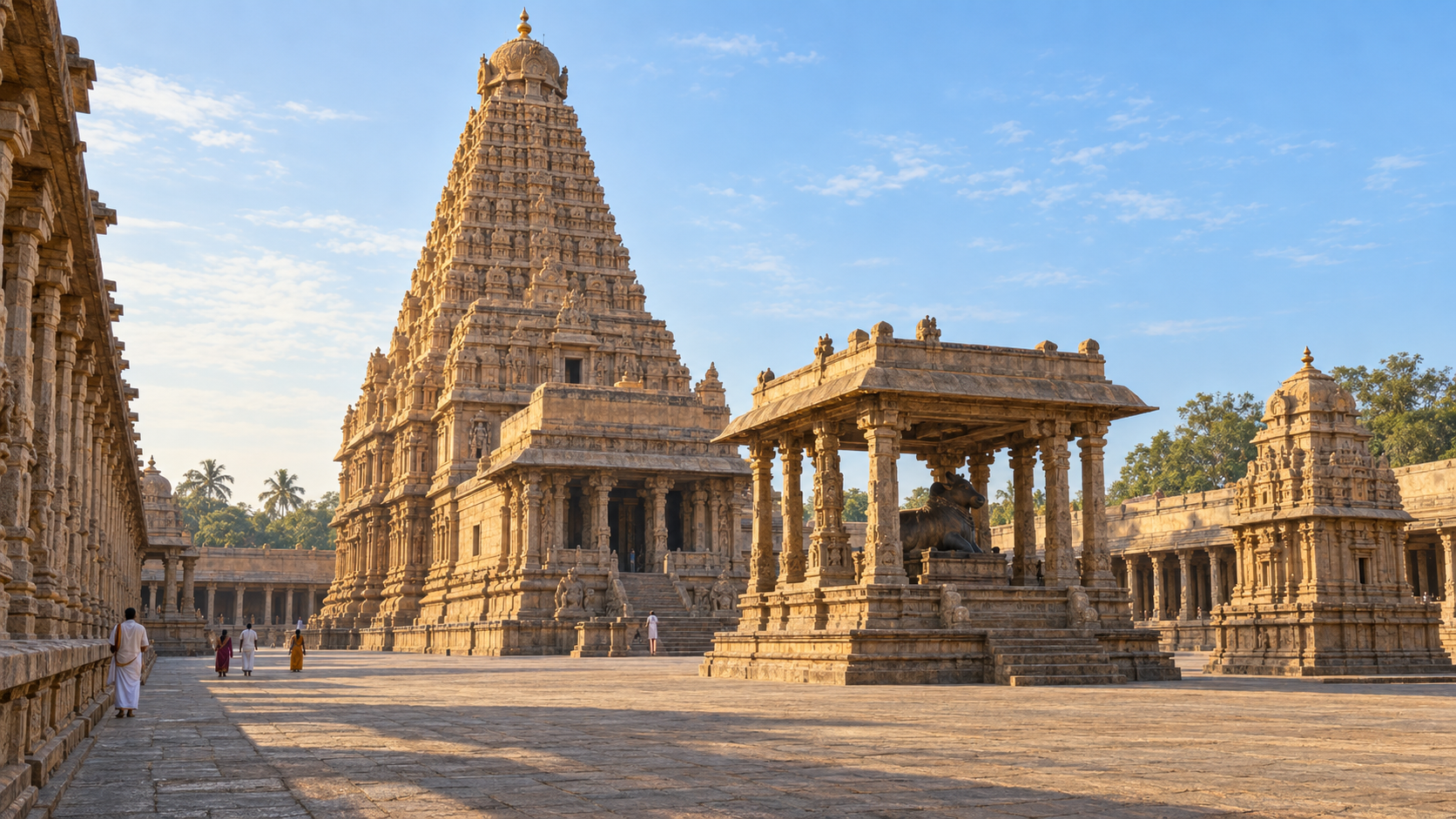
If you are trying to understand why the Brihadeeshwara Temple matters, don’t stop at its height, granite, or age. Those features explain why the monument is astonishing. They do not explain why Rajaraja Chola regarded it as the crowning work of his life.
The more useful answer lies in three connected achievements: a king placed imperial power at the service of Shiva, a carefully organised workforce turned distant stone into sacred architecture, and a patron thought beyond construction to the traditions that would have to continue after his death. Read the temple through those three lenses and it becomes more than a surviving wonder. It becomes a lesson in how a civilisation builds for permanence.
Begin with Rajaraja’s question: what should power serve?
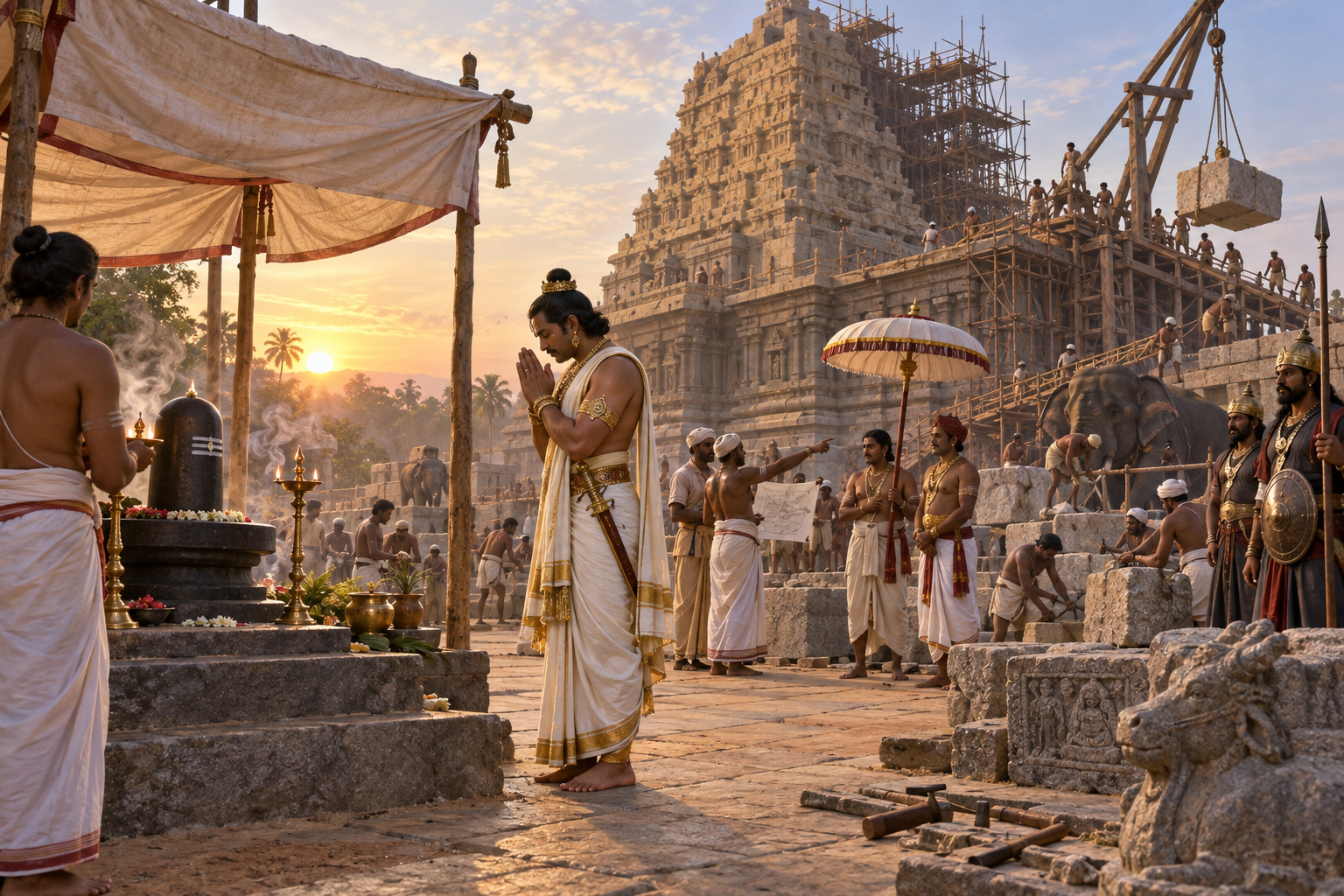
By the final year of his reign, Rajaraja Chola had ample reason to measure his life through political success. Roughly three decades of rule had transformed the fortunes of the Cholas. His empire extended along India’s eastern coast from Kanyakumari to Kalinga. Chola forces had overwhelmed Anuradhapura and brought the northern half of Sri Lanka under his control. Thanjavur had become an imperial capital drawing traders, artisans, artists, and business communities.
Yet the sixty-seven-year-old king’s anxiety was not centred on the next conquest. It was centred on whether the Brihadeeshwara Temple would preserve its discipline, traditions, celebrations, and institutions after he was gone. That concern tells you how he ranked his achievements. Territory belonged to the changing realm of kings. Shiva was anadi-ananta, without beginning or end. The temple was Rajaraja’s attempt to place the temporary resources of kingship in the service of that enduring sacred order.
His title Shivapada Shekhara marked this Shaiva devotion. His relationship to the temple therefore cannot be reduced to the familiar idea of a ruler using religion merely to advertise political authority. Royal power was certainly present, but it was deliberately subordinated to bhakti. The presiding deity was named Rajarajeshwara, yet Shiva remained the temple’s centre and the king remained the mortal devotee responsible for serving him.
This is the Brahma-Kshatra ideal in concrete form: spiritual and cultural authority giving direction to political and military power. Rajaraja’s Kshatra secured resources and stability; his bhakti determined their highest use. If you look only for imperial propaganda, you miss the hierarchy he intended. The king’s victories supplied the capacity to build, but devotion supplied the purpose.
Thanjavur makes that achievement even more significant. It did not possess an ancient Shiva shrine counted among the celebrated Tamil Shiva kshetras of the Tevaram. Rajaraja did not merely enlarge a sacred centre whose prestige had already been established for centuries. He helped make his capital into one. His patronage of Nambiyandar Nambi also helped the Tirumurai take the form by which it would be transmitted. Temple-building, literary preservation, worship, and political patronage consequently belonged to the same civilisational project.
That distinction should change how you read the site. Ask not only, “What did Rajaraja build?” Ask, “What sacred life was he trying to establish here?” The first question points to stone. The second brings the deity, canon, ritual community, and future generations into view.
The building problem began long before the stones reached Thanjavur
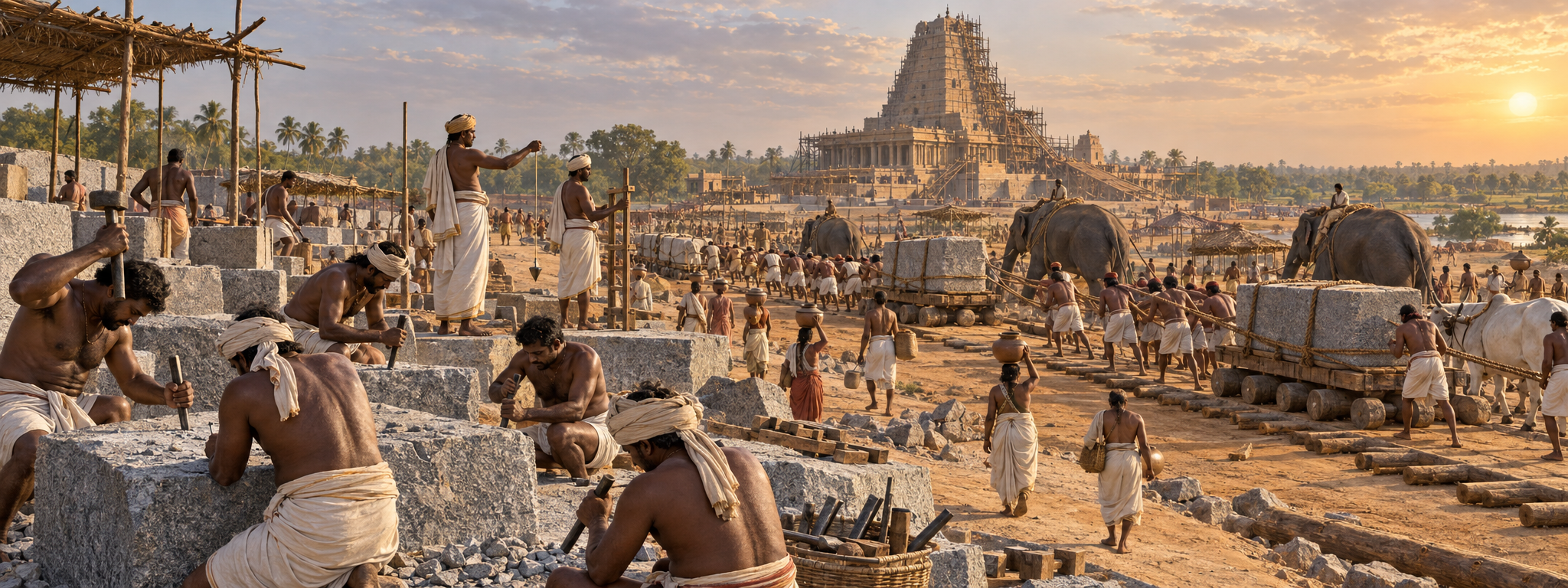
Monumental architecture can make difficult work look inevitable after it has been completed. Brihadeeshwara was anything but inevitable. Thanjavur had no suitable quarry of good building stone nearby. The granite had to be brought by road from Maramali near Tiruchinapalli, approximately thirty miles away. Before carving could begin at scale, planners had to solve procurement, transport, route, sequencing, and supervision.
| Construction marker | Recorded detail | What you should notice |
|---|---|---|
| Granite supply | Maramali near Tiruchinapalli, about thirty miles from Thanjavur | Moving the raw material was a major part of the building problem. |
| Final lifting operation | A great incline associated with Sharapallam, four miles from Thanjavur | The builders converted horizontal distance into a workable ascent. |
| Granite block | Approximately eighty tons | The crowning stage required controlled movement of an exceptional load. |
| Building period | Seven years | The temple required sustained organisation, not a single burst of royal expenditure. |
| Crowning milestone | The 275th day of 1010 CE, in Rajaraja’s twenty-fifth regnal year | The physical and sacred completion was tied to an exact ceremonial moment. |
| Kalasha | A 235-pound copper vessel overlaid with about 35 pounds of gold plate | The summit joined demanding engineering with ritual sanctification. |
Sharapallam literally carries the sense of a scaffold hollow. There, a massive incline or ramp was erected for the culminating lift. An eighty-ton granite block was placed upon it and raised with care toward the summit of the vimana. The important point is not to turn the ramp into an isolated feat of ancient ingenuity. A ramp of that scale represented the last visible stage of a much larger system: quarrying the right stone, moving it across thirty miles, preparing an extended approach, controlling the ascent, and ensuring that earlier work could bear the final load.
The numbers become meaningful when you read them as dependencies. The eighty-ton lift could not succeed unless the route existed. The route meant little unless the material had arrived intact. The crowning could not occur unless seven years of design, tooling, placement, and coordination had already converged. Brihadeeshwara’s engineering achievement therefore lies as much in organised continuity as in any single spectacular operation.
On the 275th day of 1010 CE, Rajaraja handed over the sanctified kalasha. The copper vessel weighed 235 pounds and its gold overlay about 35 pounds. This was not an ornamental afterthought attached to an otherwise finished secular structure. The temple was being ritually crowned. Material completion prepared the sacred space for formal consecration.
When someone reduces Brihadeeshwara to an ancient engineering mystery, you can now correct the frame. Its builders deserve attention not because the project is inexplicable, but because they solved a linked series of explainable and formidable problems with discipline over seven years. Wonder does not require you to abandon reason. Here, careful reasoning makes the achievement more impressive.
Its design prevents immensity from crushing devotion
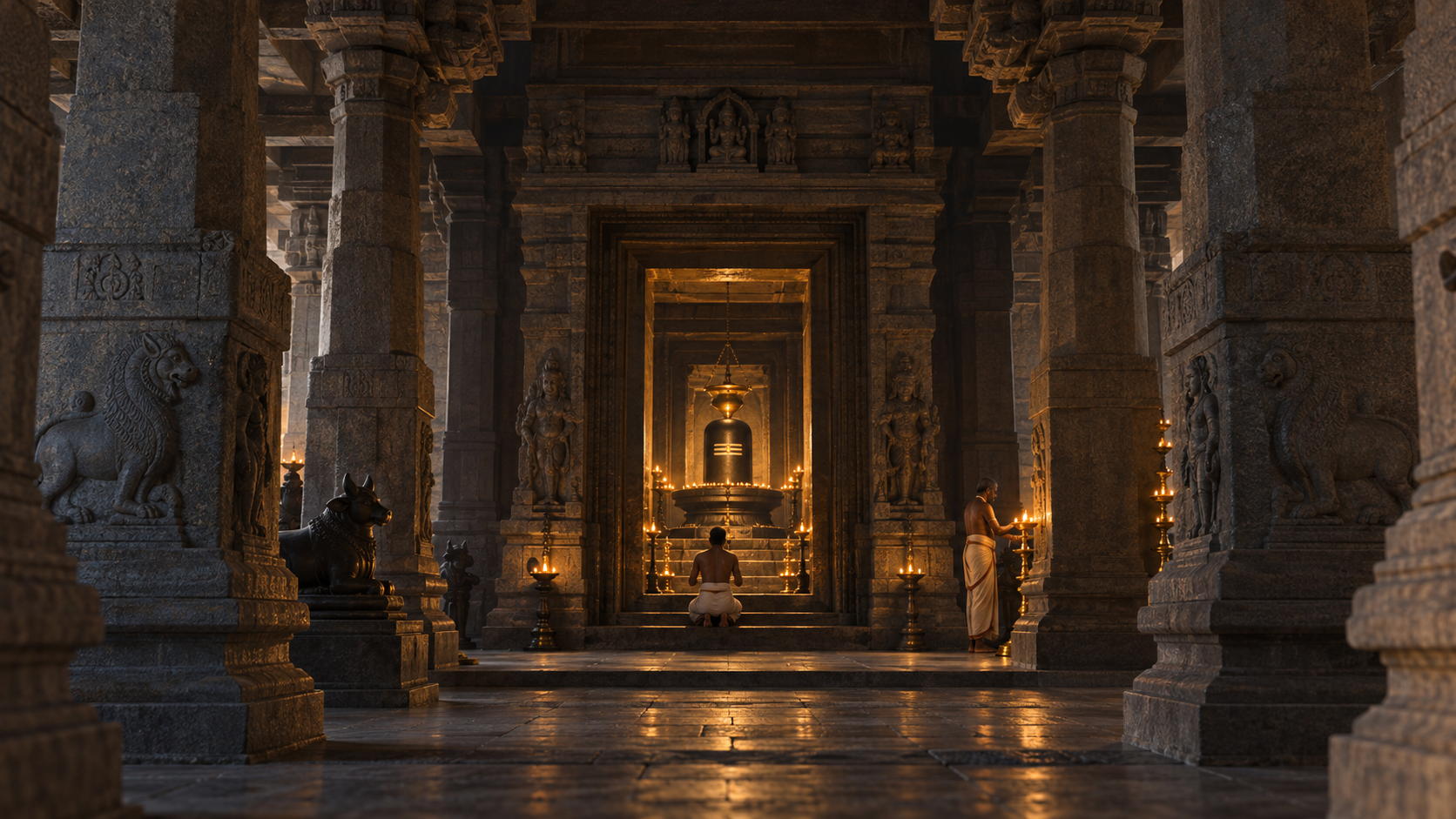
A colossal structure can overwhelm without uplifting. It can make the visitor conscious of weight, expense, and domination while leaving no room for inward attention. Brihadeeshwara’s architects faced precisely that artistic danger: the temple’s size could not be allowed to extinguish its beauty or its devotional purpose.
“The grandeur and simplicity of the design, and the perfect style of its execution.”
K. A. N. Sastry
Grandeur and simplicity are not opposites here. The vast proportions establish majesty, while the controlled design keeps the mass intelligible. Elegant sculpture and ornament remain subordinate to the whole instead of dissolving it into visual noise. Even the stone tooling and inscriptional lettering were executed with exceptional sharpness and delicacy.
If you visit the temple, or study a serious set of images, use this four-step sequence rather than rushing to collect isolated marvels:
- Begin far enough away to take in the building as a complete composition. Notice whether your eye can understand the ascending mass instead of being lost in it.
- Move closer and examine how sculptural and ornamental details relate to the larger surfaces. Look for restraint as well as abundance.
- Give the inscriptions the attention you would give the sculptures. Their crisp lettering belongs to the same standard of workmanship.
- Return your attention to the whole. Ask whether the scale now feels merely heavy, or whether proportion and detail have turned immensity into an experience of order.
This way of looking helps you notice the architects’ hardest success. They did not simply decorate a very large mass of granite. They created a visual hierarchy in which scale evokes awe, craftsmanship sustains attention, and both lead the mind toward the presiding deity. The temple’s artistic discipline is therefore inseparable from its religious function.
A temple survives only when its living order survives
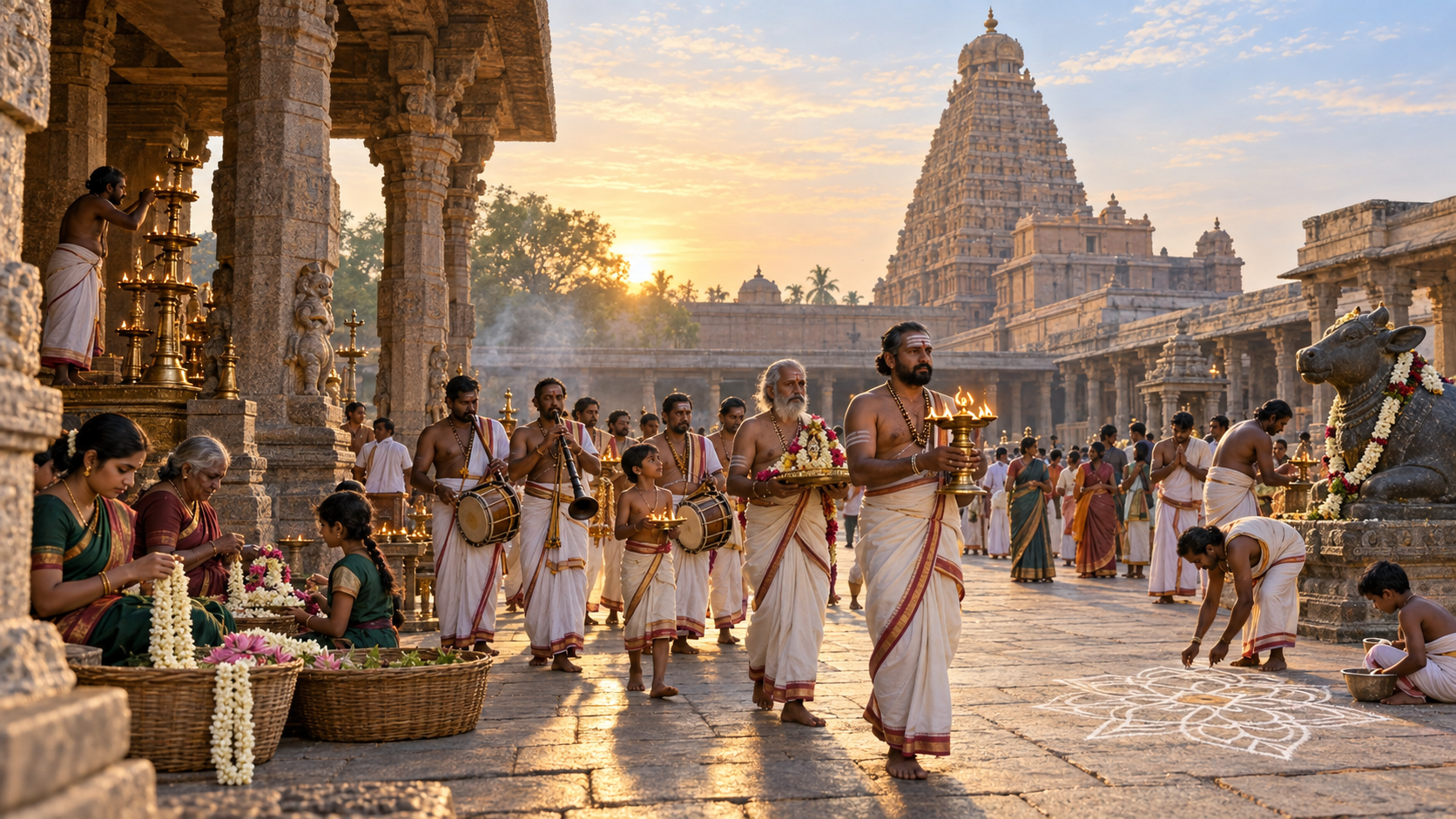
Rajaraja understood a distinction that is often lost in conversations about heritage. Finishing a building is not the same as securing the life for which it was built. Granite can remain standing while ritual knowledge, festival practice, institutional responsibility, and disciplined service disappear around it.
That was the danger occupying him near the end of his life. His concern extended beyond whether the walls and vimana would endure. He wanted the temple to retain four forms of continuity: disciplined worship, inherited traditions, recurring celebrations, and the institutions capable of carrying them. The temple’s permanence depended on people and practices as surely as its vimana depended on stone.
This is why calling Brihadeeshwara a monument is accurate but incomplete. A monument can be admired by spectators. A temple requires participants. It creates recurring duties, shared time, artistic work, sacred memory, and relationships of responsibility around the deity. In that sense, Rajaraja was establishing a concentrated civilisational world rather than commissioning a single magnificent object.
The distinction also gives present-day Hindu communities a practical test for preservation. When a temple is described as protected, ask what exactly is being protected. Is attention confined to masonry and tourism, or does it also reach the knowledge, discipline, celebrations, and human institutions that make the shrine a temple? Conserving stone while neglecting sacred continuity preserves the shell and weakens the purpose.
That does not make physical conservation secondary. Brihadeeshwara’s exquisite stonework is itself a civilisational inheritance. It means that tangible and intangible preservation must not be separated into competing causes. Sound masonry allows worship and memory to continue in place; living traditions explain why the masonry deserves more than the treatment given to a beautiful ruin.
Rajaraja’s final anxiety consequently reveals more than personal attachment. He knew that a founder’s energy cannot be inherited automatically. A durable sacred institution must carry purpose across the death of its patron. His own mortality made that task urgent: Shiva was eternal, the king was not, and the arrangements surrounding Shiva could not be allowed to depend indefinitely on one king’s supervision.
Key takeaways for reading Brihadeeshwara clearly
- Read power through purpose. Rajaraja’s conquests supplied imperial capacity, but his Shaiva bhakti directed that capacity toward a sacred institution.
- See Thanjavur as a created sacred centre. The city had no ancient Shiva shrine celebrated among the Tevaram kshetras; royal patronage helped establish a new centre while supporting the transmission of the Tirumurai.
- Treat logistics as part of the achievement. Granite came roughly thirty miles by road, and the final lifting operation used an incline extending toward Sharapallam, four miles away.
- Look for restraint inside grandeur. The temple’s proportions, elegant ornament, fine tooling, and crisp lettering show how its architects kept scale from overwhelming beauty.
- Do not separate the structure from its sacred life. Rajaraja wanted traditions, celebrations, discipline, and institutions to outlast him, not merely the stones.
The next time you encounter Brihadeeshwara, give yourself three questions to carry through the experience: What does the architecture direct you to revere? What chain of human skill made that direction possible? What living practices must endure for the temple’s purpose to remain whole? Those questions will take you closer to Rajaraja Chola’s achievement than any isolated superlative.
References
- DharmaRenaissance Blog — How “Shivapada Shekhara” Rajaraja Chola Built the Brihadeeshwara Temple
