
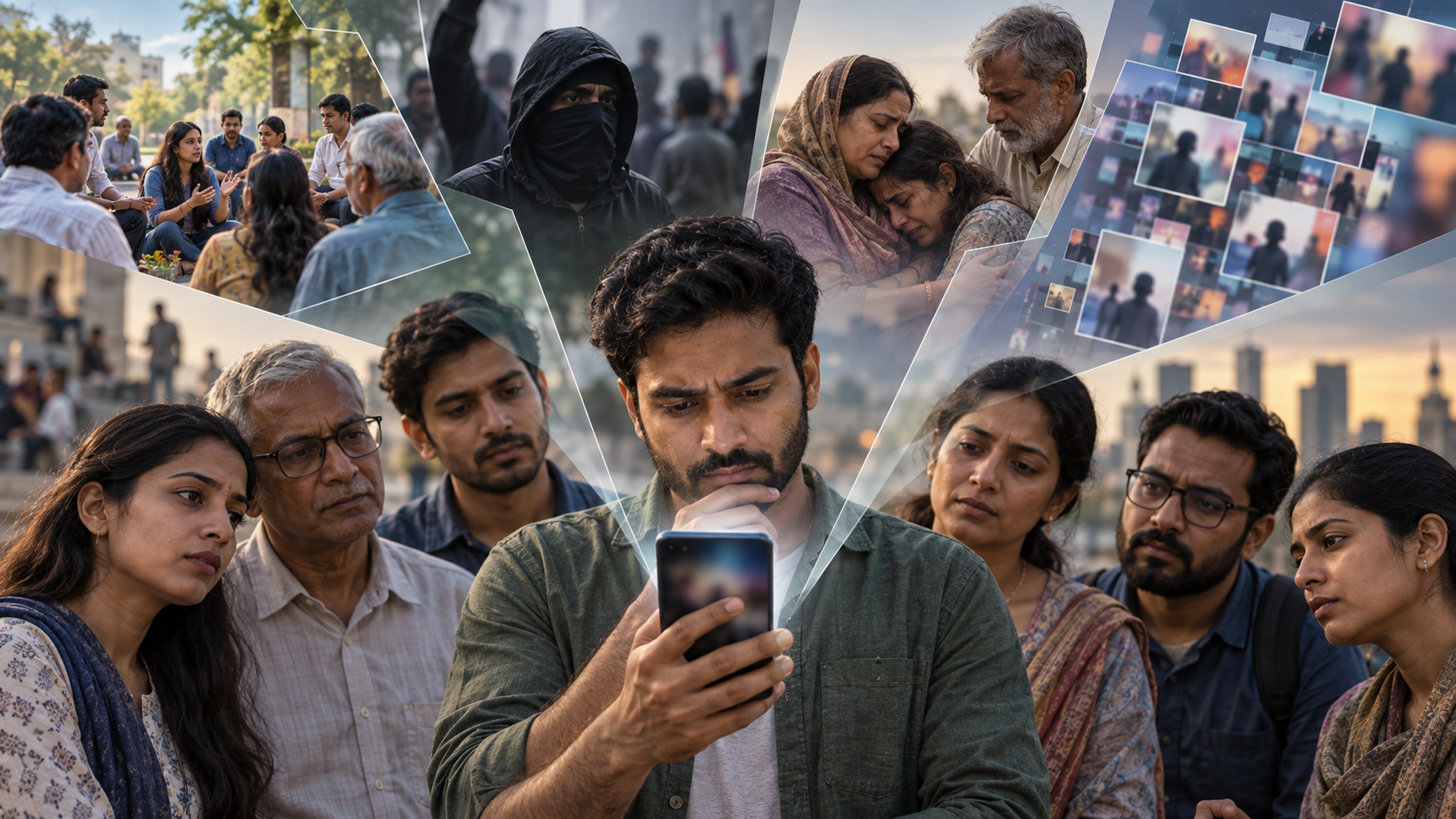
A disturbing clip reaches your family group. A campus event calls a terrorist a freedom fighter. A civilian death is blamed on India before anyone establishes who caused it. You have to decide whether you are looking at democratic dissent, separatist advocacy, incitement, terrorist propaganda, a genuine grievance, or some mixture of them.
That distinction matters. A careless share can carry hostile messaging farther than its originators could. A careless accusation can turn an innocent Sikh, Kashmiri, Muslim, student, journalist, or overseas Indian into a suspect because of identity alone. You defend Bharat more effectively when you identify conduct precisely, preserve the full sequence of events, and refuse both manipulation and collective blame.
Begin by separating five different things

Narrative warfare depends on category confusion. Political criticism is presented as sedition, peaceful separatist advocacy is treated as identical to terrorism, or terrorism is repackaged as ordinary political resistance. Once those categories collapse, evidence stops deciding the argument. Allegiance decides it.
| Category | What you need to establish | Proportionate response |
|---|---|---|
| Democratic dissent | A person criticizes a government, security operation, law, election, or public institution without advocating secession or violence. | Answer the criticism on its merits. Do not infer disloyalty from disagreement. |
| Peaceful separatist advocacy | A person seeks secession or a new state but has not been shown to incite, fund, plan, or glorify violence. | Oppose the political demand with constitutional, historical, social, and strategic arguments. Do not use the terrorist label without evidence. |
| Incitement or material assistance | Words, money, logistics, recruitment, targeting information, or other conduct may be advancing violence. | Preserve the evidence and refer it to competent authorities. Legal thresholds differ by jurisdiction, so do not make confident legal claims from a social-media clip. |
| Terrorism | Violence or a threat of violence is being used to coerce a political outcome. | Name the act and responsible organization as specifically as the evidence permits. Centre the victims and avoid transferring culpability to a whole community. |
| Narrative warfare | Content is being selected, stripped of context, relabelled, coordinated, or fabricated to change perception and behaviour. | Reconstruct the event, identify the distributors, expose the missing context, and avoid needlessly republishing the manipulative asset. |
Jammu and Kashmir and Khalistani militancy show why this discipline is essential. In J&K, organizations including the United Jihad Council, Lashkar-e-Taiba, Jaish-e-Mohammed and Jamaat ul Dawa openly supported or conducted jihadist violence. Over the long conflict, Hindus and Muslims were killed or displaced when they would not submit to the armed radical line. Violent Khalistani actors, meanwhile, have used bombings, assassinations and targeted killings in pursuit of an independent Sikh state; their victims have included civilians, law-enforcement personnel and politicians.
Those facts justify firm opposition to violent networks. They do not justify treating every Kashmiri grievance as separatism, every Sikh activist as a Khalistani, or every overseas critic as a foreign agent. If your label describes a person’s community more clearly than it describes that person’s conduct, stop and revise it.
The same precision must work in the other direction. Calling an assassination political expression does not make it peaceful. Calling recruitment activism does not remove its operational purpose. Calling a gunman a freedom fighter does not answer who was threatened, who was killed, who supplied the weapon, or what political result the violence was intended to coerce.
Recognize how one incident becomes a narrative weapon

Narrative warfare is not simply the circulation of false information. A campaign can use a real photograph, a real death, a real statement, or a real grievance. The manipulation lies in the causal story built around it: what happened first, who acted, which fact disappears, which identity is enlarged, and what the audience is urged to do next.
- Select the most emotionally powerful fragment. A grieving relative, an injured child, a funeral, a damaged home, or a clipped official remark can command attention before the event has been reconstructed.
- Remove the preceding cause. The explosion, armed attack, threat, infiltration attempt, or coercion that produced the response may vanish from the caption and the edit.
- Replace actors with identities. A specific militant becomes the people. A decision by an identifiable official becomes India, Hindus, Sikhs, Muslims, Kashmiris, or the diaspora as a whole.
- Repeat one moral frame through many channels. Political accounts, anonymous handles, sympathetic activists, public events and diaspora networks can repeat the same phrase. Repetition can create familiarity, but it is not independent corroboration.
- Use reaction as apparent confirmation. Outrage, bans, arrests, denunciations and counter-protests are folded into the campaign as further proof that the original narrative must have been true.
- Convert attention into political utility. The final demand may be recruitment, fundraising, diplomatic pressure, social segregation, public disorder, legitimacy for an armed group, or silence from people who fear being targeted.
The chronology surrounding the proposed G20 events in Srinagar illustrates what should catch your attention without encouraging an unsupported leap. On 6 May 2023, Pakistan’s foreign minister warned that India would receive a response it would remember. On the same day, LeT/PAFF messaging threatened to strike the G20 meetings in Srinagar. The alignment in date, target and political message is relevant evidence of a common narrative direction. Chronology alone, however, does not prove that the minister ordered the threat or establish a specific operational command link. Say exactly what the evidence shows, then mark the remaining inference as an inference.
A second pattern appears when the original perpetrator is pushed out of the story. After a civilian died during an LeT attack in Sopore in June 2020, Pakistani state messaging reportedly repurposed the death as anti-India material, including a song circulated by the DG ISPR and a postage stamp. The victim remained visible while the reported cause of the death became less visible. That inversion is a standard warning sign: the image is real, but the political caption redirects culpability.
Watch for five practical tells: a caption that is more certain than the available evidence; a clip that begins after the apparent trigger; a demand to share before verification; a slogan repeated by accounts that do not supply independent evidence; and blame assigned to an entire nation or religious community instead of an identifiable actor. None proves a coordinated operation by itself. Several appearing together should slow you down.
The objective may not be to make you endorse secession. It may be enough to persuade you that no Indian institution can ever tell the truth, that every militant is merely a dissident, or that every critic is an enemy. Each extreme destroys the common factual ground on which a plural country must settle disagreement.
Run a verification drill before you share or answer

You do not need an intelligence agency to avoid becoming an unpaid distributor. You need a repeatable drill. Use it before replying in a family group, publishing a community statement, confronting a campus claim, or forwarding material to a journalist.
- Freeze the original. Record the account, link, visible time, caption and version you received. Do not improve its reach by reuploading it. Screenshots can preserve a claim but can also hide edits, replies and account history, so retain the original location when it is safe to do so.
- Write the claim in one sentence. Identify the alleged event, actor, place, time and consequence. If you cannot do that, you are probably reacting to mood rather than a testable claim.
- Separate observation from allegation. A video may show smoke, a body or police activity. It may not show who started the event, when it was filmed, why force was used, or whether the captioned location is correct. List only what the asset itself establishes.
- Rebuild the sequence. Ask what happened immediately before and after the circulating fragment. Look for the earliest available upload, the full statement, the complete video, named witnesses and official records. A later commentary account is not a substitute for the original evidence.
- Map the actors. Keep the victim, perpetrator, narrator, distributor and beneficiary in separate boxes. The person harmed is not necessarily the person whose political narrative benefits from the harm.
- Test the strongest alternative explanation. Ask what evidence would disprove your preferred conclusion. If no imaginable evidence could change your view, you are defending an identity position rather than verifying an event.
- Choose the least amplifying effective response. Ignore low-reach bait, correct a falsehood where its audience has already seen it, and publish a fuller reconstruction only when the harm of silence exceeds the extra reach you will give the material.
A compact evidence ledger keeps your public language honest:
- Verified: facts established by the original material or mutually independent evidence.
- Alleged: a claim attached to the person or organization making it.
- Inferred: a conclusion that fits the evidence but has not been directly proved.
- Unknown: the missing fact that would materially change your conclusion.
- Misleading element: the omitted event, false label, cropped sequence, recycled image, or collective generalization.
- Safe action: do not share, publish a correction, seek more evidence, or report a credible threat.
Your correction can then be short: At present, this event is verified; the claimed perpetrator remains unverified; the clip does not show what happened before the confrontation; do not circulate the threat footage while that remains unresolved. This form is more credible than a sweeping counter-slogan because readers can see where certainty ends.
If material contains an actionable threat, targeting information, instructions, recruitment, or apparent operational details, do not debate the account or try to identify suspects yourself. Preserve what you received and report it through the platform and appropriate local authorities. Republishing such content can enlarge its audience, expose a target, interfere with an investigation, or create legal risk. The applicable reporting and speech laws depend on your jurisdiction; obtain qualified legal advice if you are responsible for an organization or publication facing a serious case.
Counter separatism without manufacturing new grievances

Security action and narrative defence solve different parts of the same problem. Removing armed operatives can interrupt an attack. It cannot by itself remove the story that recruits the next operative, excuses the financier, intimidates a moderate, or persuades a distant audience to romanticize violence. Conversely, good messaging cannot substitute for protection when weapons, infiltration, narcotics, funding and recruitment networks remain active.
The strategic shift in J&K from targeting individual terrorists to targeting the wider conditions that sustain terrorism captures this point. Intelligence-led operations, infiltration control, disruption of weapon and narcotics links, prevention of recruitment, action against facilitators, functioning local government, reduced corruption, economic opportunity, and space for art, culture and sport each affect a different part of the system. They should not be collapsed into a publicity campaign. Residents judge governance through daily experience, not a slogan.
Indian forces and the J&K Police restored substantial state authority after civil institutions had been badly weakened or subverted during the insurgency. The Indian strategic position also emphasizes restrictions on heavy weaponry during counterterrorism operations to limit civilian harm, in contrast with Pakistan’s use of artillery, attack helicopters, drones and fighter aircraft in operations such as Zarb-e-Azb. That comparison is relevant, but it is not permission to dismiss every allegation against Indian personnel. A credible complaint should be examined on evidence. Automatic denial supplies separatist propagandists with material just as surely as an invented allegation does.
A durable response should follow five disciplines:
- Target conduct, not ancestry. Investigate financing, threats, weapons, recruitment, coordination and glorification of violence. Do not substitute surnames, gurdwara attendance, Kashmiri identity, Muslim identity, student politics or residence abroad for evidence.
- Protect peaceful disagreement. Citizens who can criticize policy without being branded enemies are harder for violent separatists to recruit. The line should turn on conduct and applicable law, not on whether a viewpoint embarrasses the government.
- Give peaceful local voices room to speak. Separatist networks gain power when moderates fear both militants and collective suspicion from the state or wider society. Security includes protecting the person who rejects violence inside the affected community.
- Correct honestly. If an image is genuine but its caption is false, acknowledge the image. If a grievance is real but the separatist conclusion does not follow, acknowledge the grievance and challenge the conclusion. A correction that denies visible reality will fail.
- Keep victory claims modest. Falling violence, disrupted networks or successful public events are valuable. They do not prove that recruitment narratives have disappeared. Radical networks can wait for a state error, communal provocation or emotionally powerful death to reopen an old grievance.
The diaspora requires the same precision. A Sikh who opposes the Indian government is not thereby a Khalistani, and a person who favours Khalistan is not thereby proved to support terrorism. The decisive questions concern advocacy, intimidation, financing, glorification, recruitment and violence. This distinction allows democratic societies to protect open political debate while confronting the actors who exploit that openness to advance coercion.
It also prevents violent movements from claiming ownership of an entire tradition. Sikh identity is not reducible to Khalistan. Kashmiri identity is not reducible to Islamist separatism. Indian Muslims are not represented by Pakistan-backed jihadist organizations. Hindus do not become more secure when innocent neighbours are treated as proxies for militants. Collective suspicion grants separatists the communal division they need.
A Dharmic response has to hold truth and protection together. Satya rules out the convenient falsehood, even when it appears to help our side. Ahimsa rules out transferring the guilt of a violent actor to uninvolved people. The duty to protect society rules out passivity toward terrorism, assassination and intimidation. These are not competing commitments. Together, they produce a response that is firm without becoming indiscriminate.
Key takeaways
- Separate democratic dissent, peaceful separatist advocacy, incitement, terrorism and narrative warfare before choosing your response.
- Reconstruct the full sequence of an incident. A real image can carry a false causal story when the preceding attack or responsible actor is omitted.
- Treat synchronized timing and messaging as evidence worth examining, not automatic proof of operational command or conspiracy.
- Name organizations and conduct precisely. Do not turn Sikh, Kashmiri, Muslim, Hindu, student or diaspora identity into a substitute for evidence.
- Acknowledge genuine grievances while challenging false captions, political inversions and attempts to legitimize violence.
- Preserve and report credible threats without republishing them. Correct public falsehoods where their audience encountered them, and deny low-reach bait unnecessary attention.
The next time separatist content reaches you, open a blank note before opening the share menu. Write down the event, actor, evidence, missing context and safest response. If you cannot fill those fields, wait. If you can, answer with one verified fact, one clearly labelled uncertainty and one proportionate action. That small discipline denies narrative warfare what it needs most: your certainty before the facts.
References
- DharmaRenaissance Blog — J&K Battle Of Narratives
- DharmaRenaissance Blog — Origins of Khalistani Terrorism in Canada
