
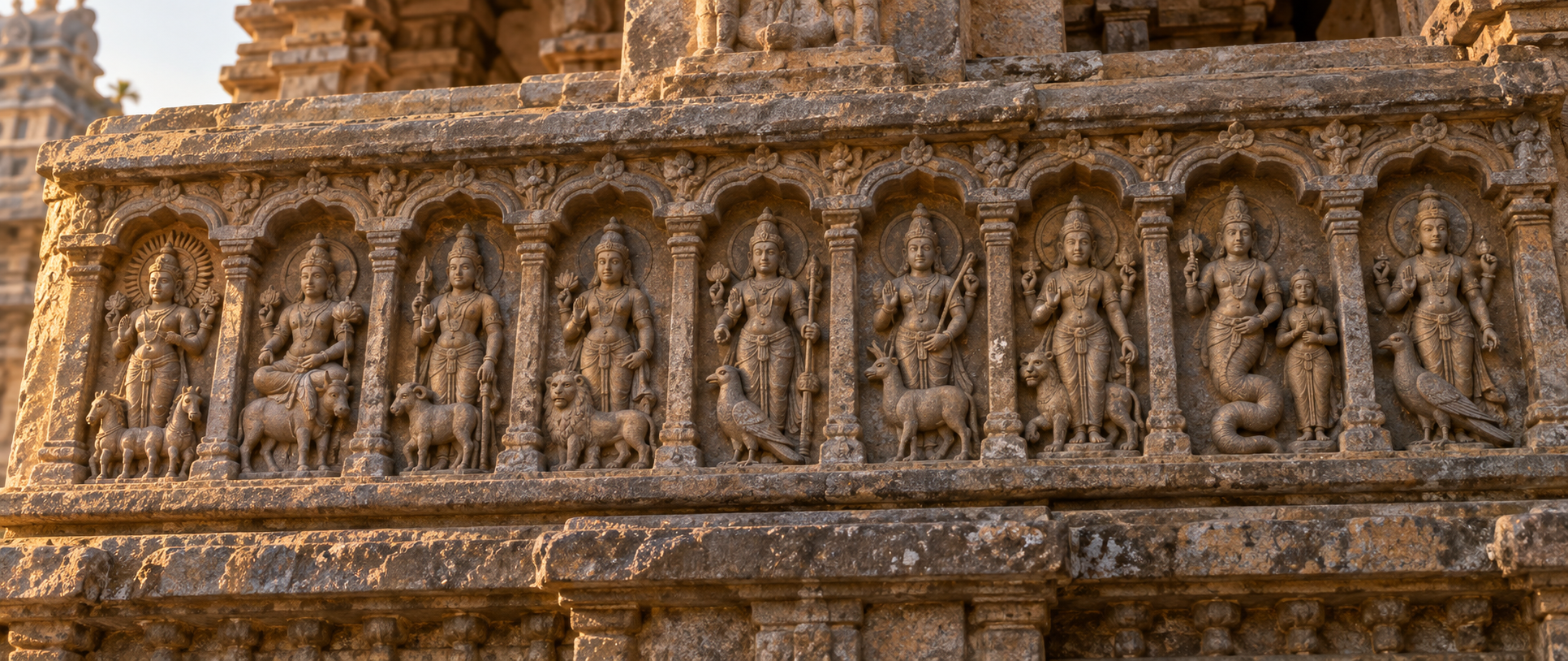
You are looking at a Navagraha panel, a weathered temple relief, or a museum photograph. One figure appears serpentine or physically unusual, and a smaller female figure stands beside it. Is this Ketu with Chitralekha, or are you reading too much into damaged stone?
The safest answer comes from the whole composition, not from one dramatic feature. Establish the Navagraha setting, identify Ketu from a cluster of clues, and only then ask whether the accompanying figure is Chitralekha. That order will protect you from the most common iconographic mistakes.
First establish the Navagraha setting
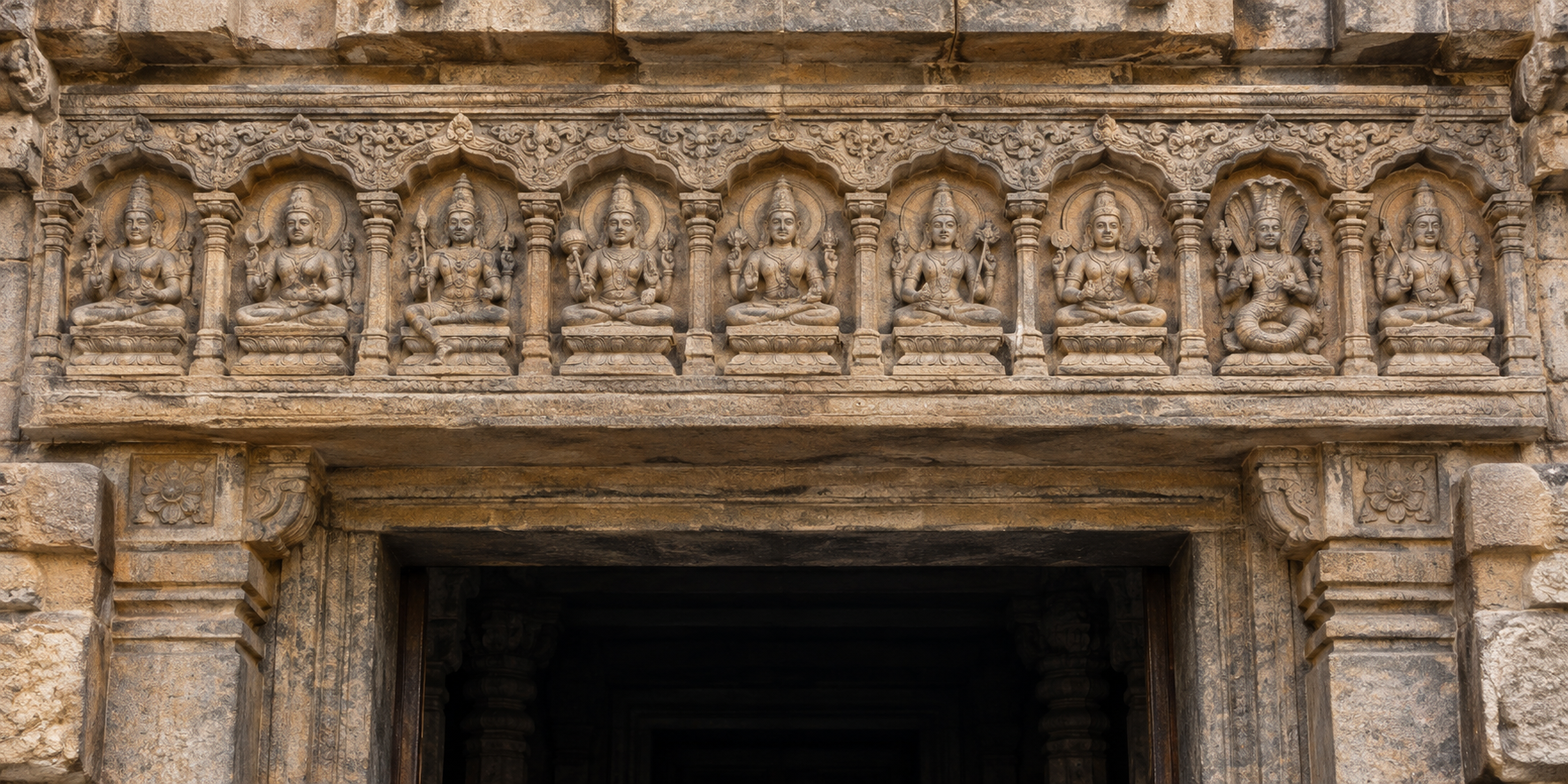
The Navagrahas are nine celestial influencers represented in Hindu worship and temple architecture. The word graha belongs to a sacred cosmological category broader than the modern astronomical category of “planet.” This matters because Ketu is associated with the descending lunar node rather than with a visible planetary body.
Before naming any individual figure, look for evidence that the sculpture belongs to this ninefold ensemble. Count the surviving principal figures, but also count empty niches, broken pedestals, severed feet, halos, and repeated framing elements. A damaged nine-figure arrangement can easily look like a group of seven or eight.
Next, compare the figures rather than inspecting the unusual one in isolation. Navagraha images within a single ensemble normally share a visual grammar: similar pedestals, comparable scale, repeated halos, aligned seats, or a common architectural register. These formal repetitions tell you which figures are primary members of the group and which are companions, attendants, donors, or decorative additions.
Do not make sequence alone decisive. The placement and orientation of a Navagraha group can change with region, period, architectural setting, and local convention. A figure standing at one end may be Ketu, but “last in the row” is not an adequate identification. Use position as supporting evidence only after the ensemble itself is secure.
If the sculpture has been removed from its original temple setting, keep the identification provisional. A museum label, collection record, old photograph, inscription, or documented find-spot can restore context that the detached image no longer supplies.
Recognize Ketu through a cluster of clues
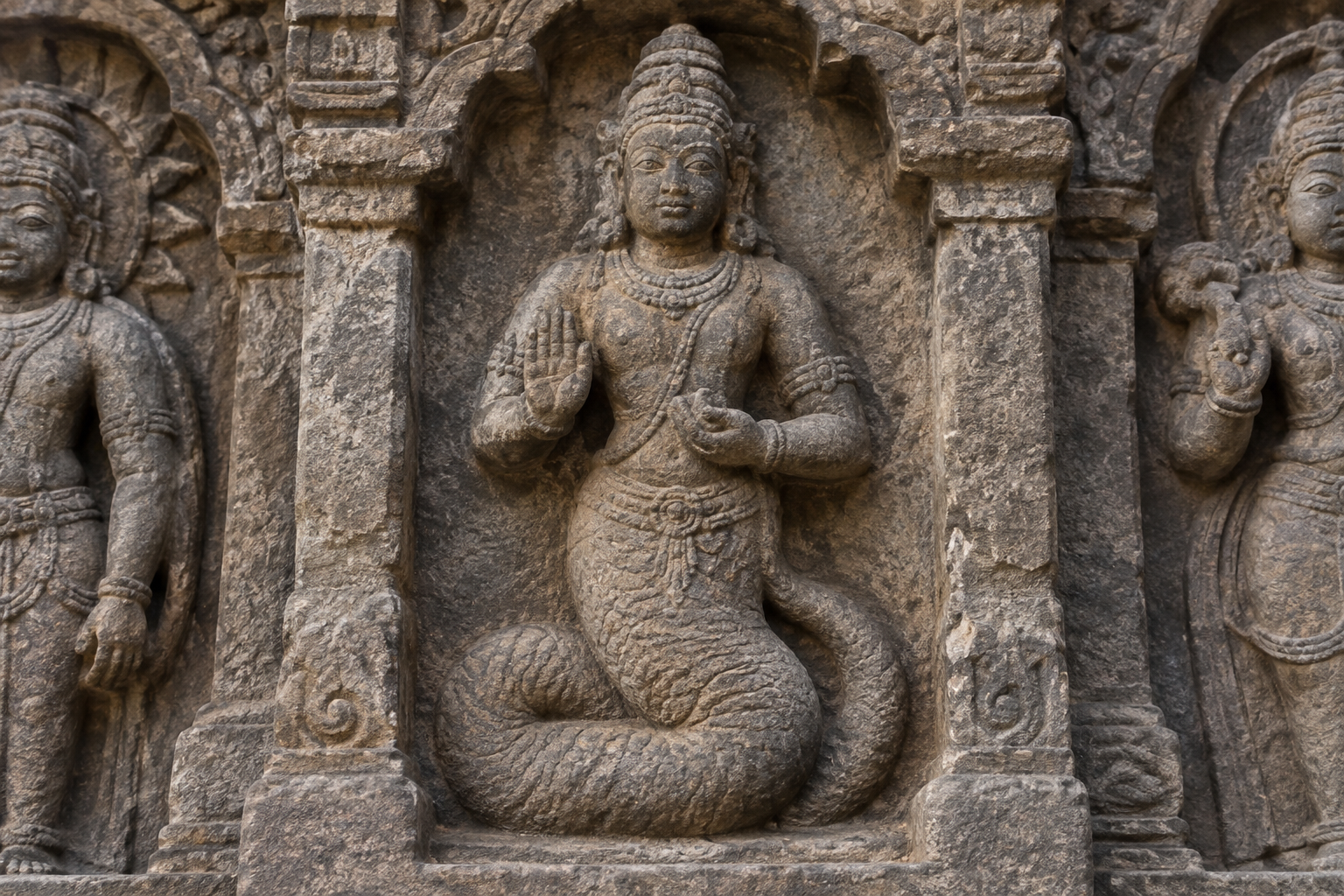
Ketu’s iconography translates an invisible nodal influence into a form suitable for worship and contemplation. That translation is not mechanically uniform. One sculptor may stress a serpentine or tail-like aspect; another may use a non-ordinary head or body; another may preserve a more human-looking figure while distinguishing Ketu through the surrounding program.
The mythic relationship between Rahu and Ketu helps explain this instability. Rahu carries the logic of the severed head, while Ketu carries that of the remaining body or tail. Temple artists can express that relationship literally, symbolically, or through a combination of human and serpentine features. You should therefore look for correspondence between Rahu and Ketu, not demand one universal silhouette from Ketu alone.
Use four kinds of evidence together
- Ensemble evidence: the figure occupies a principal place within a demonstrable Navagraha group.
- Bodily evidence: some deliberate discontinuity, serpentine association, tail-like form, or non-ordinary anatomy distinguishes it from the more conventionally human figures.
- Relational evidence: its form makes sense when compared with the ensemble’s Rahu image.
- Local evidence: an inscription, temple tradition, catalogue, site record, or repeated regional convention supports the identification.
No single clue is infallible. A missing head may be damage rather than iconography. A serpent may belong to another deity’s symbolism. A companion figure may be an attendant rather than a consort. Even a modern label can repeat an old misidentification.
Examine the stone where an unusual bodily feature begins. A deliberately carved transition normally belongs to the finished design; a rough, irregular break suggests later damage. Weathering can blur that distinction, so compare the surface with known breaks elsewhere on the same sculpture. If the neck, lower body, or emblem is missing, state what survives before stating what you think it means.
Lists of colors, vehicles, weapons, and gestures can help when a sculpture preserves them clearly, but they should not overrule the monument in front of you. Attributes vary, small objects are easily eroded, and later repairs may alter a figure’s appearance. Context and internal comparison are usually stronger than one indistinct object held in a damaged hand.
Identify Chitralekha by relationship, not gender alone
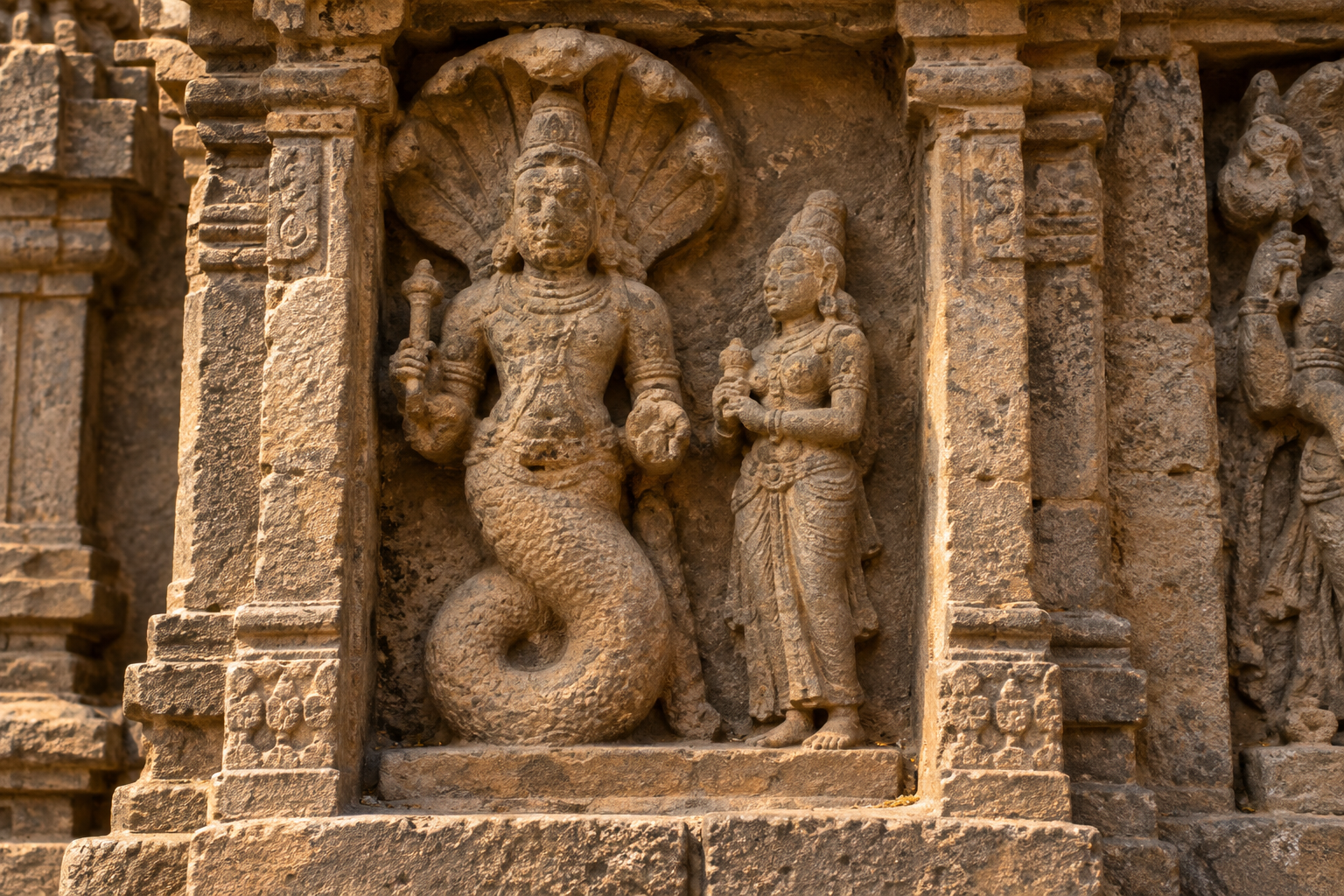
Chitralekha is identified as Ketu’s consort in Hindu sculpture. She is not a tenth graha. When she appears, she belongs to the iconographic world organized around Ketu, so you must first establish which principal figure is Ketu.
A female figure beside a possible Ketu is not automatically Chitralekha. Temple sculpture includes devis, consorts, attendants, guardians, donors, and narrative figures. Jewelry, dress, or bodily outline may indicate a feminine figure, but none of those features establishes her individual identity. Relationship does the decisive work unless an inscription or firmly documented local tradition supplies an independent name.
| Clue | What strengthens the identification | What limits it |
|---|---|---|
| Placement | The companion is physically integrated with the Ketu image, pedestal, niche, or shared composition. | Simple proximity may result from crowding, reuse, or later rearrangement. |
| Scale | Ketu remains the principal figure while the companion occupies a clearly subordinate scale or position. | Scale can express hierarchy without proving a marital or consort relationship. |
| Orientation | The figure turns toward Ketu or participates in the same compositional center. | A general inward-facing pose may simply balance the panel. |
| Sculptural treatment | Both figures share the same stone, carving depth, pedestal, and period of workmanship. | Matching workmanship establishes contemporaneity, not a name. |
| Repeated pattern | Other grahas in the same program also have similarly placed consort figures. | An isolated pair offers less comparative evidence. |
| Local identification | An inscription, established temple record, or documented tradition names Ketu and Chitralekha. | A recent unsourced caption should remain supporting rather than conclusive evidence. |
The repeated pattern is especially valuable. If several principal grahas have smaller companions carved in the same position, the sculptor has supplied a relational grammar. Once Ketu is securely located within that grammar, identifying his corresponding consort as Chitralekha becomes much stronger than a guess based on appearance alone.
Use confidence language that matches the evidence. Call the identification secure when a reliable inscription or established record agrees with the surviving composition. Call it probable when Ketu is securely identified and the female companion fits a repeated consort pattern. Call it possible when the work is isolated, damaged, or without provenance. “Unidentified female companion of probable Ketu” is more useful than a confident name unsupported by the object.
Read the pair spiritually without reducing Ketu to fear
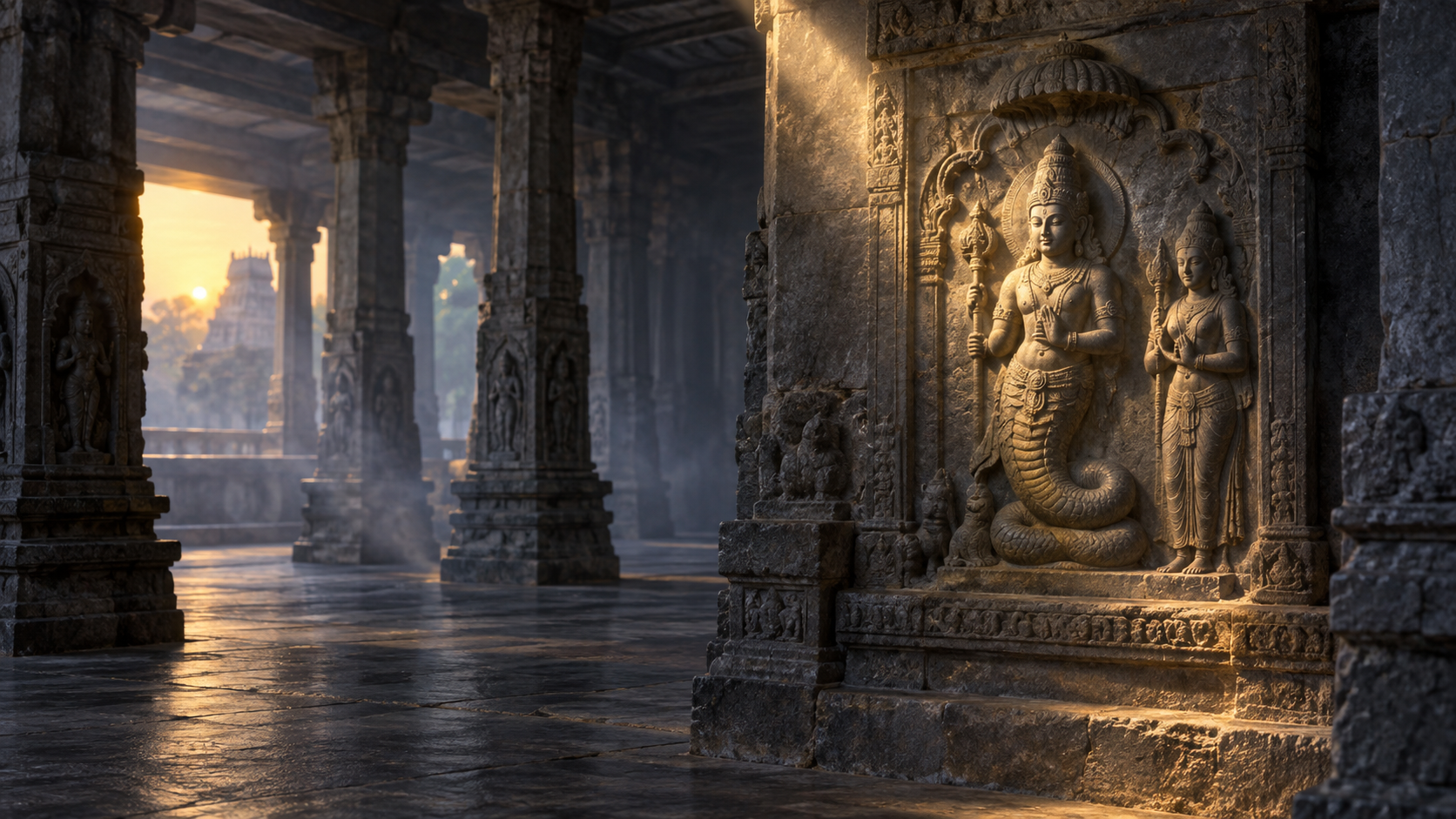
Iconographic identification and spiritual interpretation are related, but they are not the same task. The first asks, “Whom did the sculptor intend?” The second asks, “What does this sacred form disclose to the worshipper?” Keeping those questions distinct prevents symbolism from being used as evidence for a name.
Ketu occupies a mysterious and spiritually potent place among the Navagrahas. Common Jyotisha interpretation associates Ketu with severance, detachment, inwardness, and the loosening of worldly fixation. These associations explain why Ketu cannot be understood merely as a frightening or unfavorable force. Detachment can feel like loss when you cling to what is passing, but it can also expose what remains when borrowed identities and compulsions fall away.
Ketu’s nodal character deepens that reading. Unlike a luminous celestial body, a lunar node is known through relationship and effect. Temple art gives bodily presence to that subtle influence. The unusual anatomy is therefore not a failure to represent a normal body; it is a visual language for a graha whose meaning includes rupture, incompleteness, and movement beyond ordinary form.
Chitralekha’s presence adds another dimension. A consort image places Ketu within a relational sacred order rather than presenting him as an isolated mechanism of fate. It would go too far, however, to claim that the female figure simply “softens” Ketu, cancels his effects, or functions as an automatic remedy. The sculpture supports the relationship; any more detailed symbolic claim needs evidence from the temple’s own tradition.
When you stand before the pair, a better contemplative question is not, “What misfortune will Ketu cause?” Ask what you are being invited to see without attachment. Ask which identity, possession, habit, or certainty has become more important than truth. This approach respects Ketu’s spiritual force without turning temple iconography into fatalism.
It also keeps Chitralekha visible. Do not treat her as decorative punctuation beside a more important male figure. Once the temple presents a named consort relationship, both presence and placement contribute to the sacred composition. Careful seeing is itself part of respectful darshan.
A practical method for your next temple visit
If you want to identify and document Ketu with Chitralekha, work from the widest evidence to the smallest detail. This sequence is useful in a temple, an archaeological site, a museum, or a photographic archive.
- Record the original setting. Note whether the image is in a dedicated Navagraha shrine, an architectural panel, a detached slab, or a museum display.
- Map the full ensemble. Count principal figures, damaged positions, pedestals, halos, niches, and framing devices. Do not count every secondary companion as a graha.
- Compare the figures. Look for the shared visual grammar that marks the nine principal members and separates them from smaller companions.
- Locate Rahu and Ketu relationally. Search for the two figures that express complementary head-and-body or human-and-serpentine logic, allowing for regional variation.
- Separate design from damage. Inspect unusual necks, heads, lower bodies, and attributes for deliberate carving versus irregular breakage.
- Identify Ketu before Chitralekha. Only after the principal figure is reasonably secure should you interpret the associated female figure as a possible consort.
- Test the consort pattern. Compare her scale, orientation, pedestal, and placement with companions attached to other grahas in the same program.
- Check local evidence. Read inscriptions and site labels, consult temple records or informed custodians, and preserve the exact wording rather than silently upgrading “possibly” to “certainly.”
- Document three views where photography is permitted. Take one image of the whole setting, one of the complete Navagraha group, and one close view of Ketu and the companion. The wide view often preserves evidence that a dramatic close-up removes.
Do not touch, trace, wet, chalk, or move a sculpture to clarify a feature. Apart from the religious impropriety of handling a consecrated image without permission, physical intervention can damage old surfaces. Better light, a permitted photograph from another angle, or a return visit is the safer answer.
Key takeaways
- Confirm the Navagraha context before naming Ketu.
- Use several clues together; no single serpent, missing head, attribute, or position is conclusive.
- Identify Chitralekha through her structured relationship with an established Ketu image.
- Treat damage, regional variation, and lost provenance as reasons to grade confidence honestly.
- Read Ketu as a spiritually potent force of detachment and inward movement, not merely as an omen to fear.
On your next encounter, begin with the whole panel and let the temple teach you its visual grammar. Name Ketu only after the ensemble supports it; name Chitralekha only after the relationship becomes visible. That disciplined attention will give you a truer identification and a deeper encounter with the sacred image.
References
