
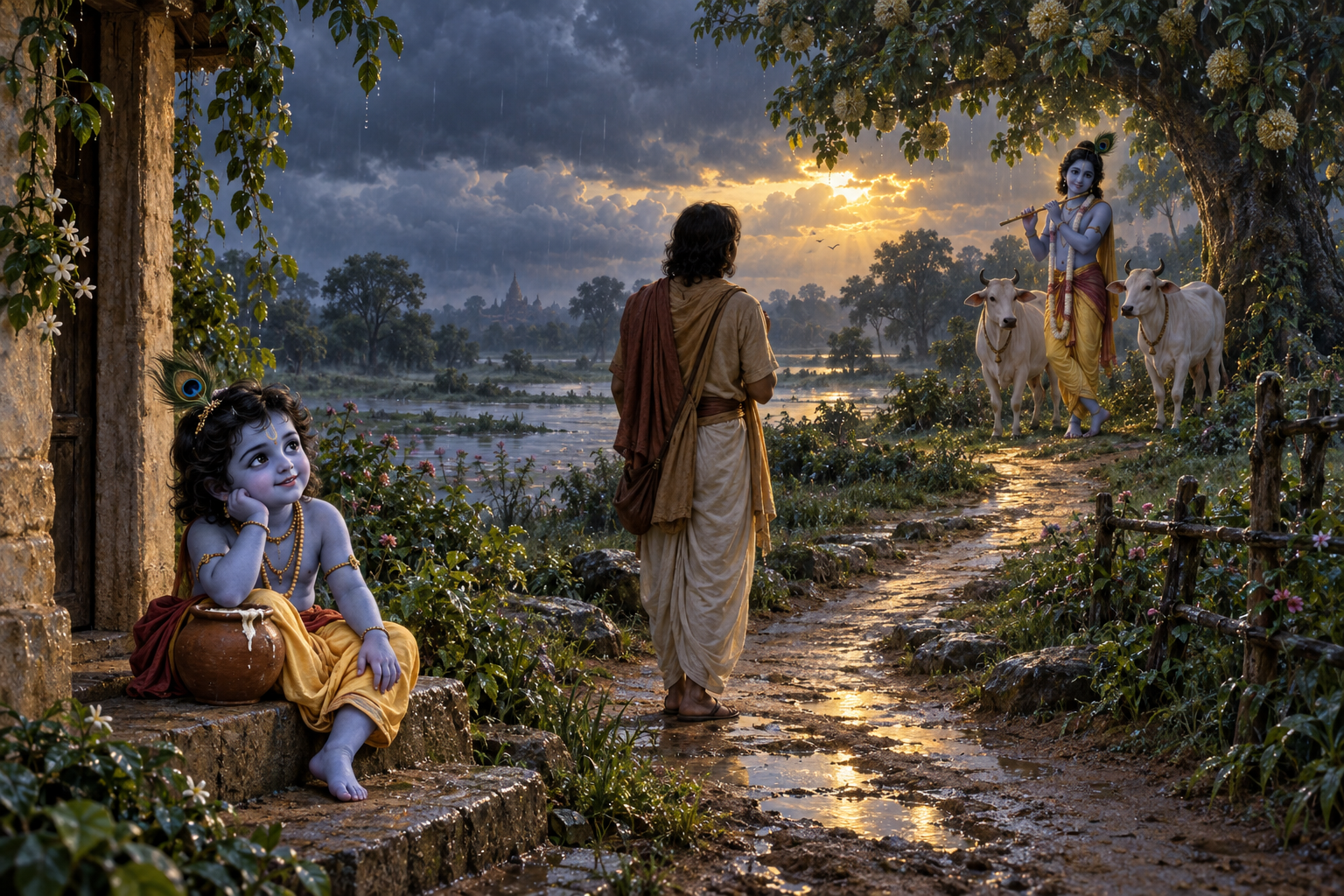
If you have prayed to Krishna in distress and then wondered whether silence meant absence, the two Gopalas offer a more exact way to understand what may happen next. Devotion does not always remove the rain, fear, or uncertainty first. It can steady your attention so that you recognize the help already moving toward you.
The useful question is not merely, “Did something extraordinary happen?” It is also, “What kind of person am I becoming able to notice, trust, and follow?” That question turns Krishna bhakti from a search for dramatic experiences into a discipline for meeting the next moment well.
A prayer learned before fear becomes usable within it

The first Gopala is ten years old, the son of the temple archaka Keshava Bhatta. His religious life is not separate from ordinary village work. He learns texts, assists with puja, sees Krishna in the temple, tends the family’s cows, and returns with them around Godhuli. His devotion has a place in the day and duties through which it is expressed.
Then the familiar order collapses. Heavy rain drives him into the forest. Darkness removes the landmarks by which he would normally find his way. Cold, isolation, and fear overwhelm what he knows. Only after weeping does he remember his father’s instruction: when you are in trouble, call Krishna. His plea is simple. He asks for help and asks to be taken home.
This is why a daily practice matters even when it feels uneventful. In a crisis, you seldom invent a stable inner language from nothing. You reach for what repeated worship, family instruction, and habit have already placed within reach. Gopala can call because someone taught him whom to call before he entered the forest.
You can prepare in the same way without making your practice elaborate. Choose a familiar name of Krishna, such as Gopala or Achyuta, and join it to one honest petition: “Show me the next right step,” or “Keep me with my dharma.” Use it at the same point in your regular puja or aarti. This is abhyasa in a practical form: repetition that becomes available when your composed words do not.
The two Gopalas reveal closeness through contrast

The boy’s call is not followed by a commanding voice from the sky. He first hears hoofbeats. Cattle emerge from the darkness, and among them is another boy of about his age. This cowherd carries a flute. He gives his name as Gopala and speaks as though the dangerous forest were entirely familiar.
| Point of contrast | The village Gopala | The cowherd Gopala |
|---|---|---|
| Place in the forest | Cannot find his direction | Moves through it without fear |
| Relationship with the cattle | Was trying to drive his cows home | Says he follows cattle that do not get lost |
| Emotional condition | Shivers, weeps, and asks for help | Smiles, jokes, and plays the flute |
| Sense of identity | Knows himself as a boy named after Krishna | Bears Krishna’s name and the familiar signs of the divine cowherd |
| Knowledge of home | Can describe its landmarks but cannot reach it alone | Recognizes the description and takes his hand |
In a devotional reading, the force of the encounter lies in this mixture of likeness and difference. Krishna does not meet the frightened child as something alien to his world. He comes as another Gopala: a boy among cattle, carrying a flute, speaking with playfulness rather than ceremony. The divine presence is close enough to be mistaken for an ordinary companion.
That closeness gives you a useful test for discernment. Do not assume that every coincidence or pleasant feeling is darshana. Ask instead what the encounter does to your relationship with dharma. Does it help you see your duty more clearly? Does it reduce panic without dulling conscience? Does it guide you toward rightful responsibilities rather than offering a flattering escape from them? Krishna’s nearness should make you more truthful and responsible, not less.
Darshana may begin before you recognize the face

Recognition unfolds gradually. Gopala hears the hoofbeats before he sees the animals. He makes out their large forms and painted horns. He catches sight of light before he can identify its source. Only then does the cowherd become distinct. Voice follows sight, conversation follows voice, and finally the other Gopala takes his hand.
The order matters. Help does not become real only at the instant when the frightened boy can explain who has appeared. His rescue has already begun while he is still uncertain. He sees the companion clearly but interprets him through the most ordinary available category: another boy who happens to share his Krishna-derived name.
There is a tender irony here. The first Gopala grieves because he has missed seeing Krishna in the temple, even as a Krishna-shaped presence stands before him outside it. His attachment to temple darshana is sincere and valuable. Yet the form in which he expects to find Krishna initially prevents him from recognizing how Krishna may be finding him.
You do not need to label an event miraculous in order to become more attentive. When fear narrows your awareness, separate three things: what is physically happening, what duty remains yours, and what trustworthy help is actually present. Gopala still has to listen, observe the cattle, describe his village, and accept guidance. Grace works with those faculties rather than requiring him to abandon them.
This also protects devotion from credulity. A sound may simply be a sound, and a stranger may simply be a stranger. Stay alert to consequences. A sound form of spiritual discernment does not ask you to deny observable danger, neglect responsibility, or surrender judgment. It helps you notice the next dharmic possibility without demanding that you first possess a complete explanation.
The flute gives peace without offering an escape

The cowherd’s flute does not instantly stop the rain or carry the frightened child home. After one tune, played for about two minutes, the boy continues to sob, yet he feels an unexpected peace amid his tears. His emotion has not vanished. What changes is his capacity to speak and choose.
That distinction is central to mature bhakti. Peace is not always the disappearance of grief. Sometimes it is the recovery of direction while grief remains. The first Gopala can still say what he needs: he wants to return home. When invited to another village with the promise of delicious food and butter, he refuses. His parents will be worried, Mahamangalarati has passed, and he does not want comfort purchased by abandoning his relationships.
The second Gopala’s presence therefore consoles without distracting. The flute settles the child enough for his dharma to become audible again. Home means more than shelter from rain. It means parents, temple, duty, cattle, and the life to which he belongs. The pleasure of another destination cannot replace it.
When your own prayer seems unanswered, you can use the same pattern:
- Say what is true. Name the fear or confusion without making it grander or smaller than it is.
- Call Krishna directly. Use the name already rooted in your practice instead of searching for impressive words.
- Let emotion remain. Do not treat tears, bodily fear, or uncertainty as proof that your prayer has failed.
- Recover your dharma. Ask who depends on you, what promise still binds you, and which “home” you are actually trying to reach.
- Describe the terrain. State the facts, landmarks, resources, and trustworthy people available to you. Practical observation is part of the response.
- Take the next offered step. You may be able to accept sound guidance before you understand its full meaning.
This is not a formula for producing a vision. It is a discipline for responding faithfully when certainty is unavailable. If you are in actual danger, seek available human help and emergency assistance immediately. Calling Krishna is not a reason to delay practical rescue; receiving such help may itself be part of the path home.
Key takeaways for your own Krishna practice
- Daily devotion gives you a language to use when fear takes away your more elaborate thoughts.
- The two Gopalas show divine closeness through familiar forms: another child, cattle, a flute, a hand, and knowledge of the way home.
- Recognition can lag behind grace. Help may already be present before you can interpret it spiritually.
- Peace is not merely a pleasant sensation. Trustworthy peace restores truthful speech, discernment, and responsibility.
- Prayer and practical action belong together. You still listen, observe, describe the terrain, evaluate help, and walk.
At your next puja or aarti, choose one name of Krishna and one plain petition you can remember under pressure. When the difficult moment comes, do not wait for spectacle. Call Krishna, recover the duty that points toward home, notice the next trustworthy sign, and take the offered hand.
References
- DharmaRenaissance Blog — The Heart of Sri Krishna: The Story of Two Gopalas
