
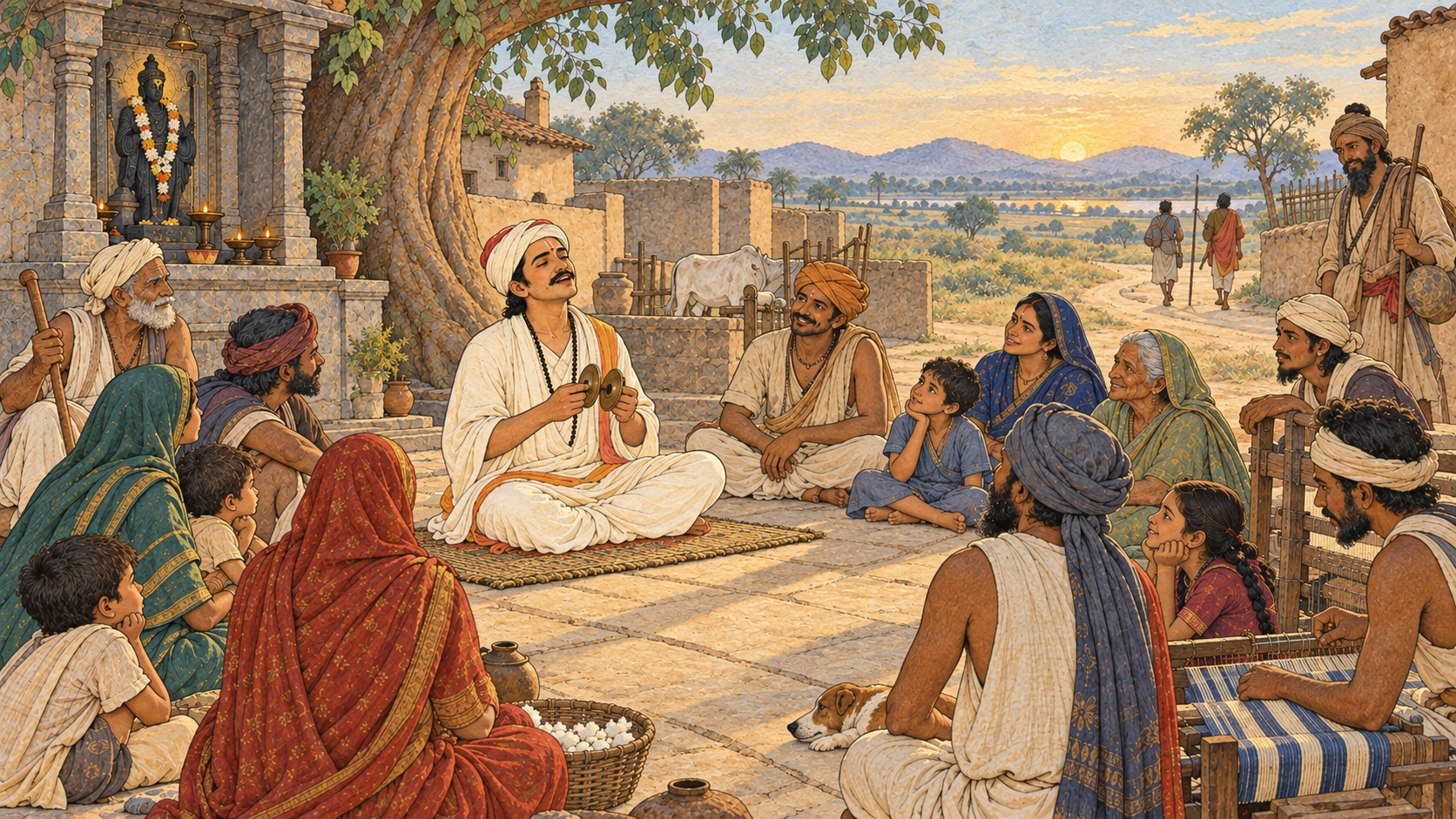
If you have heard Namdev Ji honoured in a Hindu bhajan and then encountered him as Bhagat Namdev in Guru Granth Sahib Ji, you may wonder which tradition has the stronger claim on him. The possessive question is understandable, but it is too small for the life and bani before us.
Namdev Ji does not ask you to erase temples, sacred names or disciplined paths. He asks whether you have mistaken any one of them for a wall around the Divine. His example offers a demanding balance: remain rooted enough to practise faithfully, yet never use those roots to deny another person spiritual dignity.
Key takeaways
- Namdev Ji can be understood through both his Maharashtrian devotion to Vithal and the place of his bani in Guru Granth Sahib Ji; one fact does not cancel the other.
- Crossing a religious boundary is not the same as declaring all traditions interchangeable. Namdev Ji remains devoted even as he refuses to confine the Divine to one institution or vocabulary.
- His challenge to caste is practical: birth, occupation and social permission cannot determine a person’s capacity for devotion or spiritual insight.
- You honour his legacy by removing needless barriers in your own community while preserving the discipline and integrity of its sacred practices.
The question is not which community gets to own Namdev Ji
The life traditionally associated with Namdev Ji is unmistakably rooted. It places his birth in 1270 at Narsi Bahamni in Maharashtra, connects his family with the tailor community, and describes his early devotion to Sri Vithal, a form of Krishna revered in Maharashtra. Rootedness matters because a universal message does not appear from nowhere. It is learned through a name, a place, a community and a practice.
Yet the path does not remain geographically enclosed. Namdev Ji is remembered as travelling through Bharat and later settling in Ghuman in Punjab, where a gurdwara preserves his memory. His compositions were subsequently incorporated by Guru Arjan into the scriptural body received by Sikhs as Guru Granth Sahib Ji. Namdev Ji therefore stands within a living Hindu devotional inheritance and within the daily scriptural life of Sikhs.
Neither tradition needs to be diminished to make room for the other. Calling him only a generic interfaith poet strips away his Vithal-centred formation. Treating his presence in Guru Granth Sahib Ji as incidental storage fails to recognise the theological seriousness of scriptural inclusion. Guru Arjan did not preserve diversity merely for display; the included bani had to speak truth consonant with the Guru’s vision.
This gives you a useful rule for approaching shared Dharmic inheritance: distinguish origin from reception. Ask where a teaching arose, and then ask how another tradition received, interpreted and lived it. You do not have to collapse those answers into a single label.
Three boundaries his devotion refused to make absolute

Caste could not decide who possessed spiritual authority
Namdev Ji’s association with an artisan community is not a decorative biographical detail. It exposes the difference between social rank and spiritual attainment. A society may depend upon a person’s labour while refusing to hear that person as a teacher. His bani overturns that arrangement: the voice that hierarchy might place at the edge enters the centre of sacred hearing.
Do not respond by hiding caste behind a vague claim that everyone is equal. Look at the mechanisms that distribute honour in your own mandir, gurdwara or study group. Who is invited to explain a text? Whose pronunciation is mocked? Who performs visible worship, and who is expected to remain in the kitchen, car park or cleaning rota? Seva is sacred, but it becomes a social boundary when the same families are always permitted to lead and the same families are only permitted to serve.
The repair need not begin with a dramatic declaration. Begin by noticing whether responsibility, instruction and public respect are genuinely open to qualified devotees across inherited social lines. Where liturgical roles are governed by a tradition’s maryada, honour that maryada; where exclusion is merely habit dressed as religion, stop protecting the habit.
A sacred building could not contain the whole Divine
One of Namdev Ji’s best-known lines observes that a Hindu turns toward the temple and a Muslim toward the mosque. He then directs attention beyond the rivalry of locations:
Nam Dev serves that Lord, who is not limited to either the temple or the mosque.
Bhagat Namdev Ji, Guru Granth Sahib Ji, Ang 874
This is not a command to abandon sacred places. A mandir or gurdwara can discipline the body, gather the sangat and turn distracted attention toward worship. The error begins when reverence for a place becomes a claim that the Divine is absent everywhere else, or that those kept outside its door must also be outside divine regard.
Namdev Ji’s insight therefore changes what you should notice when you leave worship. If you bow before the Divine within a sanctum but humiliate the worker, stranger or dissenter outside it, the bow has not yet educated your sight. Sacred space should train recognition beyond its own boundary.
Geography could carry devotion without owning it
The remembered movement from Maharashtra to Punjab is more than a travel itinerary. It shows how devotion moves through pilgrimage, song, memory and hospitality. A teaching can cross a region without becoming rootless, and a receiving community can make it integral to its life without pretending to have originated it.
That is the standard to use when presenting Namdev Ji outside the community most familiar to you. Retain the names Vithal, Maharashtra and Ghuman. Identify whether you are reading an Abhanga tradition or bani preserved in Guru Granth Sahib Ji. Give the scriptural Ang when you have it. Shared heritage becomes more trustworthy, not less shared, when its routes and contexts remain visible.
Read Ang 874 without flattening Hindu or Sikh tradition
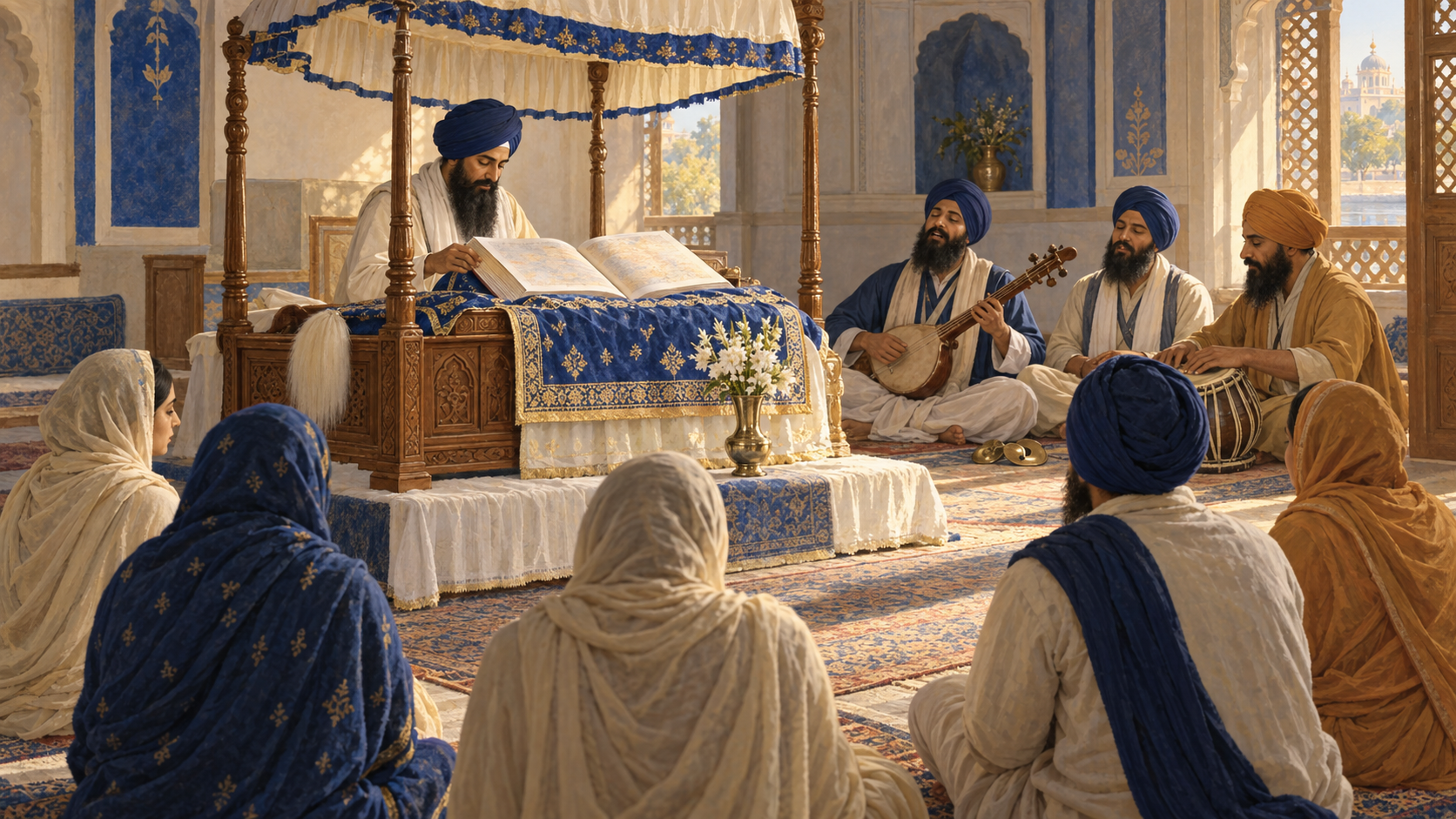
The temple-and-mosque verse is easy to turn into a slogan: institutions are bad, doctrines are irrelevant, or every form of worship means exactly the same thing. None of those conclusions is required. The verse names distinct practices plainly. What it denies is their power to restrict the One they seek.
Namdev Ji’s openness is also not spiritual pliability. In the devotional account associated with Ang 1165, he is pressured to abandon Ram for Khuda under threat. He refuses to exchange the Name he loves merely to satisfy political power. The same devotee who recognises the Divine beyond temple and mosque will not accept coerced sameness. That distinction remains vital: voluntary reverence across traditions is not forced conformity.
Use the following sequence when you study this or another boundary-crossing shabad:
- Locate the voice. Identify the bhagat, the scriptural setting and the sacred vocabulary actually being used.
- Name what remains distinct. In Ang 874, temple and mosque are not relabelled as identical institutions.
- Name what is made universal. The Divine cannot be monopolised by either institution.
- Identify the false inference. Refusing divine confinement does not make disciplined practice, doctrine or sacred community meaningless.
- Turn the line inward. Ask where you assume that only your language, lineage or ritual form can carry genuine devotion.
- Test the interpretation through conduct. If your reading produces contempt for another community, it has reproduced the very boundary the verse unsettles.
This method protects you from two opposite mistakes. Sectarian possession reduces Namdev Ji to a badge for one group. Vague universalism removes every feature that made his devotion concrete. His example offers rooted universality instead: a chosen Name loved deeply, and a Divine presence encountered everywhere.
Put the teaching to work in your own community

You do not need to manufacture a hybrid ritual to practise what Namdev Ji teaches. Try this seven-day exercise within your existing discipline. It is a contemporary application, not a claim about his historical routine.
- Keep one devotional anchor. Set aside ten minutes each day for the mantra, Naam, shabad or prayer proper to your path. If your sampradaya or maryada gives instructions for the practice, follow them.
- Read the Ang 874 line at the beginning and end of the week. On the first reading, write what you think it says. On the final reading, note whether your interpretation has moved from an argument about religions to an examination of your own conduct.
- Find one human boundary near your worship. Look for a language barrier, a caste-coded assumption, an inaccessible invitation, a newcomer who receives no guidance, or a service role that has become hereditary by habit.
- Make one proportionate repair. Provide a translation, explain an unfamiliar protocol without condescension, invite a capable person into responsibility, or ask the appropriate community leader to review an exclusionary custom. Do not improvise changes to liturgy on your own.
- Meet one neighbour without demanding sameness. Ask how a person from another Dharmic or religious tradition practises devotion. Listen for the form, discipline and moral demand of that practice rather than searching only for parallels with your own.
- Use conduct as the final measure. Each evening ask: Did remembrance make us less contemptuous, more truthful and more ready to serve? If not, the practice may be producing religious emotion without devotional transformation.
The point is not to become less Hindu, less Sikh or less committed to a particular path. It is to become less willing to confuse commitment with monopoly. Carry one line of Namdev Ji into your next act of worship, then let it follow you through the door: the Divine before whom you bow is already present in the person you are tempted to place outside.
References
