

You may be preparing a course, discussion group, or public programme for people who do not read Gurmukhi, know Punjab’s history, or regularly enter a gurdwara. The challenge is not simply to give them more information. It is to make Sikh thought intelligible without turning it into a handful of agreeable slogans.
Your best test is practical: after learning with you, can a person explain what is distinctively Sikh, why it matters beyond the Sikh community, and how it changes a real choice? If not, the teaching is either too enclosed to travel or too diluted to carry meaning.
Universal does not mean anonymous
Sikh universalism begins with an address to humanity, not with the erasure of Sikh particularity. The conviction that Sikh wisdom concerns every human being does not mean that every tradition is interchangeable, every interpretation is equally sound, or every Sikh concept can be detached from the Gurus, Gurbani, sangat, and lived discipline.
This distinction matters especially in global education. A teaching becomes accessible when outsiders can understand and engage it. It becomes generic when its own vocabulary, history, practices, and standards of interpretation disappear. Accessibility opens a door; dilution removes the house.
- Universal scope is not religious sameness. Traditions can address common human problems while giving different accounts of reality, freedom, authority, and practice.
- Equality is not the absence of identity. A Sikh can affirm the dignity of every person while remaining visibly and institutionally Sikh.
- Participation is not appropriation. A learner may receive ethical and philosophical insight without pretending to possess an identity or discipline that has not been undertaken.
- Dharmic kinship is not absorption. Sikh, Hindu, Buddhist, and Jain traditions may share civilizational settings and questions, but comparison must preserve the grammar and conclusions of each path.
When you hear a claim such as “Sikhism teaches equality,” ask what gives that statement its Sikh content. Does the explanation connect equality to oneness, the critique of haumai, remembrance, seva, sangat, or the shared discipline embodied in institutions such as langar? If it does not, the claim may be admirable but educationally incomplete.
Teach a connected philosophy, not a catalogue of beliefs
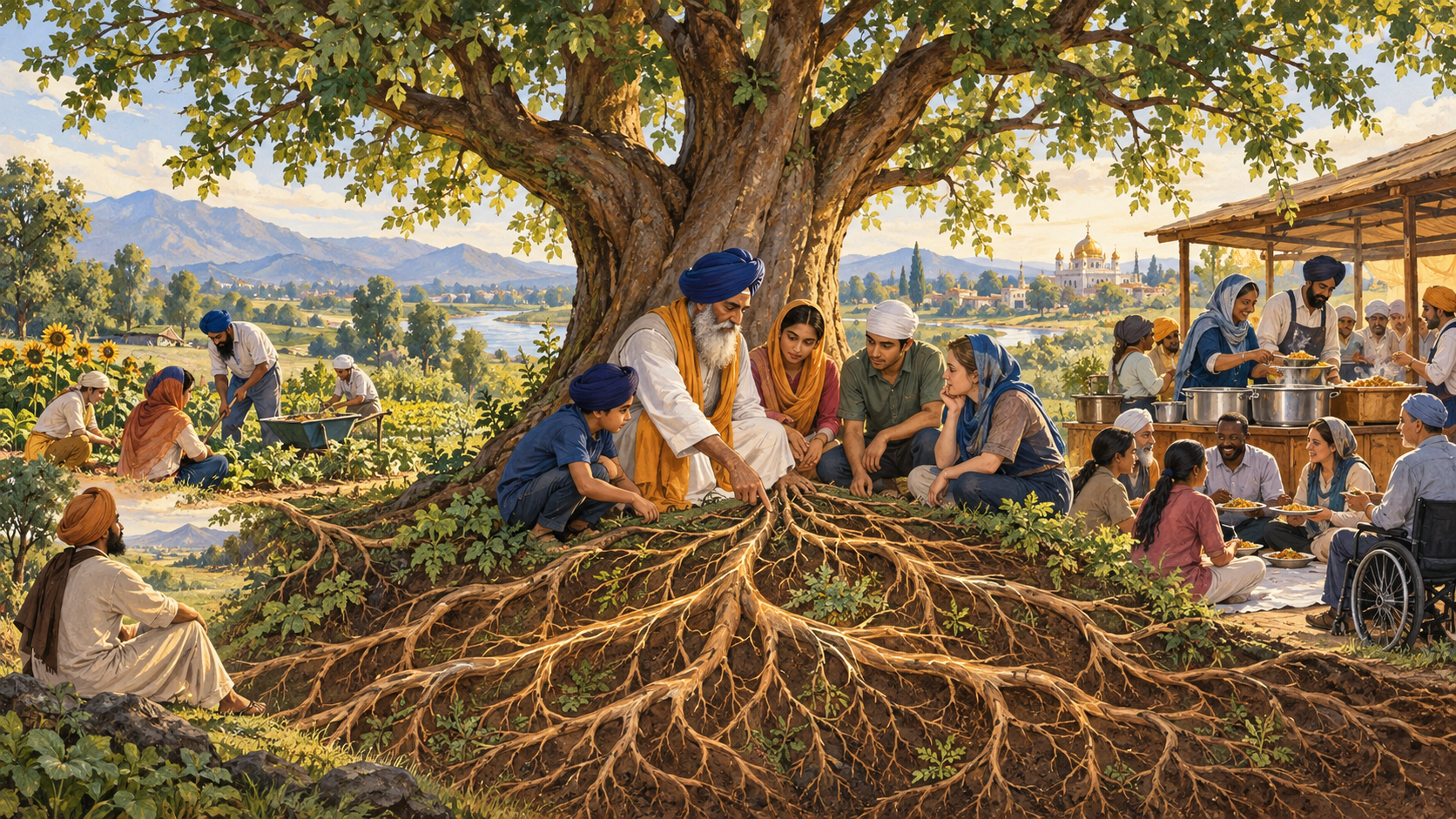
A strong introduction to Sikh philosophy follows a chain: an account of reality shapes an account of the human problem; that diagnosis calls for disciplines; those disciplines become social ethics and institutions. Students should see those connections rather than memorise isolated terms.
| Philosophical lens | Sikh anchor | Question for the learner |
|---|---|---|
| Reality | Ik Oankar and the unity underlying existence | If reality is fundamentally one, what kinds of hierarchy or exclusion become harder to justify? |
| Human condition | Haumai and life within hukam | How does self-centredness distort perception, conduct, and relationships? |
| Knowledge and formation | Guru, Gurbani, remembrance, and disciplined attention | Why is information alone insufficient for transformation? |
| Ethics | Truthful living, honest work, sharing, and seva | What would make a spiritual claim visible in ordinary conduct? |
| Community | Sangat, pangat, and langar | How can a principle of equality acquire a social form rather than remain an intention? |
This framework avoids two common failures. The first presents Sikh philosophy as abstract monotheism with some ethical values attached. The second presents Sikh life as a collection of festivals, foods, clothing, and heroic biographies without showing the thought that connects them. Culture and philosophy belong together: the idea explains the form, while the form tests whether the idea has become real.
Placing Guru Nanak in conversation with natural philosophers associated with ancient Greece and the Renaissance can widen the classroom’s intellectual map. Use that comparison as a doorway, not as a contest over who ranks highest. Ask what each thinker takes reality to be, how knowledge is acquired, what obstructs truthful perception, and what kind of life wisdom should produce. A shared question creates comparability; the different answers preserve integrity.
That last step is essential. Guru Nanak should not be made acceptable to a global audience by being recast as a European-style philosopher who happened to live in Punjab. Nor should philosophical analysis exclude revelation, poetry, devotion, music, or communal practice merely because a modern syllabus separates those fields. Let the Sikh material challenge the categories of the course as well as occupy them.
Translation is part of the philosophy

The existence of a graduate-level Sikhism course taught in French points to an important possibility: serious Sikh learning can cross linguistic boundaries without abandoning its intellectual centre. Translation, however, is never just the replacement of one word with another. A translated term can quietly import assumptions that the original does not carry.
For each central concept, give the learner four things in a consistent order:
- The original form. Show the Gurmukhi when your format permits it.
- A stable transliteration. Do not change spellings from one lesson to the next without explaining why.
- A provisional translation. Present the nearest useful expression in the teaching language.
- A boundary note. State what the translation fails to capture or what misleading association it might introduce.
Take hukam as a teaching example. Words such as “order” or “command” may help a reader begin, but neither should be presented as a complete substitute. The learner needs to know that an English or French gloss is an entry point, not the whole concept. Apply the same care to Ik Oankar, Naam, Guru, haumai, seva, and sangat.
Keep translated passages attached to their edition and translator. Two translations may make different interpretive choices even when both are responsible. If a class cannot consult Gurmukhi, place alternative renderings beside each other and ask what changes: agency, tone, metaphysical emphasis, or ethical consequence. That exercise teaches humility without leaving students unable to judge.
Do not solve unfamiliarity by removing Sikh terms after their first appearance. Repetition lets vocabulary become usable. By the end of a course, a learner should be able to use a term such as haumai in an explanation, distinguish it from a loose synonym such as selfishness, and connect it to practice.
Build every lesson around text, practice, and consequence

A global course becomes coherent when each lesson moves through the same sequence. The structure works in a university seminar, a gurdwara discussion, an interfaith programme, or a serious self-study group.
- Begin with a human question. Ask, for example, whether recognising equality is enough to overcome status in daily life. A real question gives the learner a reason to need the concept.
- Introduce the Sikh vocabulary. Define only the terms required for that question, and keep their transliterations visible.
- Read a short passage in context. Identify its place in the Guru Granth Sahib, the edition, and the translator. Do not use an isolated line as a decorative quotation.
- Examine an embodied practice. Connect the philosophical claim to remembrance, seva, sangat, langar, honest work, sharing, or another relevant discipline.
- Compare with one clear axis. If another tradition enters the lesson, compare accounts of the same question rather than assembling superficial similarities.
- End with a consequence. Ask what the idea changes in a workplace, family, classroom, public institution, or relationship with a stranger.
The consequence should not be a vague request to “be more equal” or “serve others.” Give the learner a decision. If a community meal is meant to embody human equality, what arrangements could quietly reintroduce rank? Who serves, who eats first, who performs the least visible work, and whose needs shape access? The philosophical principle now has something concrete to examine.
Visible Sikh identity also needs this connected treatment. When discussing Khalsa discipline, place the Five Ks within that specific context. Do not turn them into exotic objects or imply that observing appearance is the same as understanding formation. Ask how repeated, embodied commitments shape memory, responsibility, courage, and public accountability. The learner then sees discipline as philosophy lived through the body.
Site visits require the same care. Prepare learners for gurdwara etiquette, but do not let etiquette become the entire lesson. Give them a focused question to observe: how are authority, service, learning, food, music, and collective presence organised? Afterwards, separate what they directly observed from what they inferred. One visit can illuminate a community; it cannot stand in for every Sikh community.
Measure understanding by what the learner can distinguish
Recognition is a weak educational outcome. A student who can identify a turban, repeat that Sikhs value equality, or name Guru Nanak may still be unable to reason with Sikh ideas. Better assessment asks for distinctions, connections, and responsible application.
- Conceptual accuracy: Can the learner explain a Sikh term without collapsing it into the nearest English or French word?
- Internal connection: Can the learner link a claim about reality to an ethical discipline or communal institution?
- Context: Can the learner distinguish scripture, interpretation, historical development, community norm, and individual behaviour?
- Comparison: Can the learner identify a genuinely shared question and a genuine difference between traditions?
- Application: Can the learner use the philosophy to analyse a concrete choice without claiming that one example exhausts the tradition?
- Interpretive humility: Can the learner state what remains uncertain, translated, contested, or beyond the evidence available?
A useful assignment therefore asks for more than description. Give learners a situation involving status, labour, exclusion, or service. Require them to analyse it through one Sikh concept, one textual passage, and one practice. Then ask them to name a limitation in their own interpretation. This reveals whether they can think with the tradition while respecting its depth.
Key takeaways
- Present Sikh universalism as an invitation addressed to humanity, not as proof that all religions say the same thing.
- Connect reality, the human problem, spiritual discipline, ethics, and institutions so that students encounter a philosophy rather than a list.
- Keep original Sikh vocabulary visible beside transliteration, provisional translation, and a note about the translation’s limits.
- Use comparison to clarify a shared question and a real difference, never to absorb Guru Nanak into another civilization’s categories.
- Assess whether learners can distinguish, connect, apply, and qualify what they know.
For your next lesson, choose one central concept and revise the material around four elements: its Sikh vocabulary, a contextualised passage, an embodied practice, and a decision the learner must examine. Sikh universalism travels well when its roots remain visible. The aim is not to make the tradition thinner, but to help more people meet it with the attention it deserves.
References
- SikhNet – News — Sikhism graduate level course in French
- SikhNet – News — UNIVERSAL MESSAGE OF SIKHISM
- SikhNet – News — Nanak: Top Among the Natural Philosophers
